
Planning the Right Depth for Greenhouse Beds
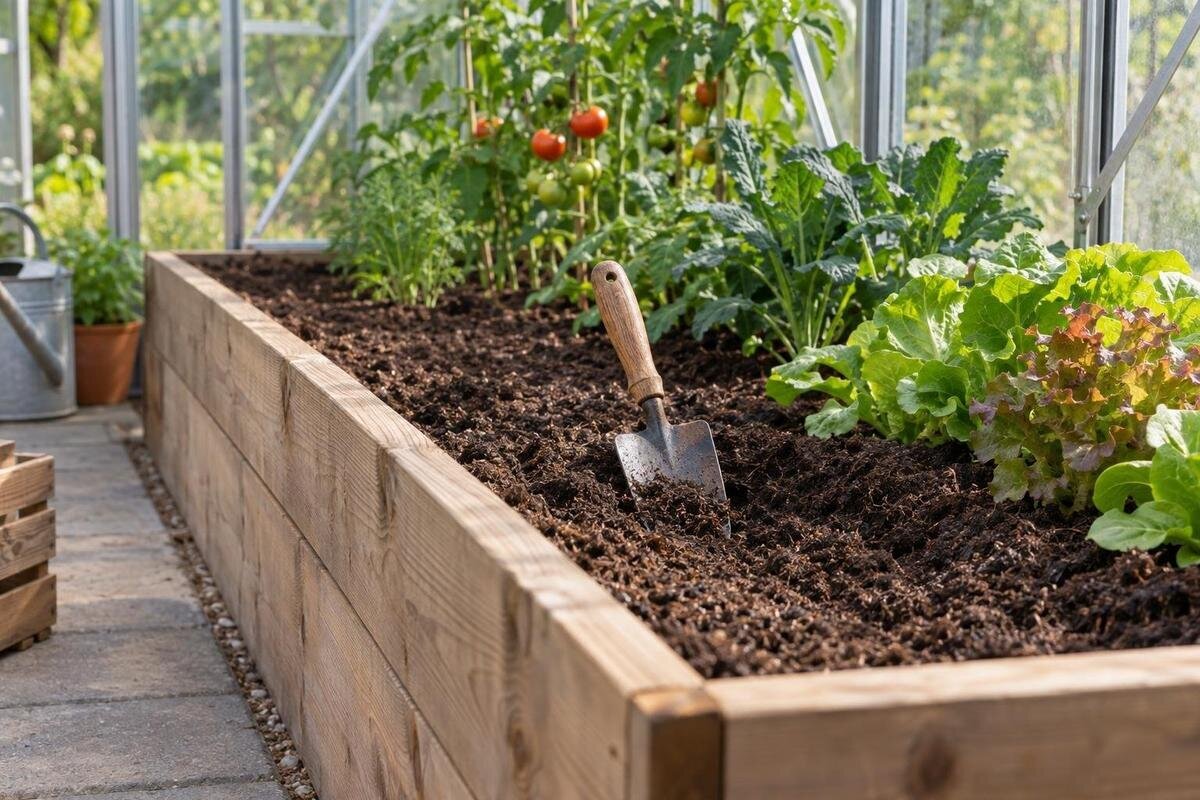
Greenhouse growing guide
Greenhouse bed depth should match the crops’ usable root space and what lies beneath the bed—not a standard frame height. For many mixed vegetables, 30–45 cm (about 12–18 in) of growing medium is a workable planning range, but shallow crops may need less and long-rooted varieties need an uninterrupted deeper profile. A raised bed over garden soil is different from a sealed planter. These figures are starting points, not crop guarantees: variety, bed base and drainage affect what roots can use. Measure the inside of the bed before ordering medium: a 1.2 m × 2.4 m bed filled to 30 cm holds 864 L by geometry alone, before settling or handling losses.

Measure usable root depth, not the bed frame
Bed-side height is not the same as root depth. Measure from the finished growing-medium surface to the first layer roots cannot pass: a bottom panel, compacted subsoil, a slab or another barrier. If the side is 40 cm high but you plan to fill it to 35 cm, the contained root zone is about 35 cm, not 40 cm. Leave some freeboard to reduce spillover, and use the bed’s internal dimensions for volume; the outside measurement includes the sides and can overstate the space that holds medium. Check for a liner or base before treating a bed as open-bottomed. If you will top it up later, define the intended final surface first.
An open-bottom bed can borrow root space from the soil below, provided that soil is workable and roots are not blocked by fabric, dense compaction or a hard surface. A bed over concrete or another closed base behaves more like a large planter: all usable root depth must be inside, and drainage needs to be addressed before filling. For mixed vegetables, compare candidate fills such as 30 and 45 cm rather than assuming taller sides are always better. The Limited Edition Aluminum Greenhouses listing spans 3.77–28.08 m²; use the exact selected footprint, not the product-family range, when allocating beds and paths.
Match the crop to a realistic root zone
Root-depth figures are planning ranges, not fixed limits. Many crops concentrate fine roots in the upper, fertile layer but may explore farther when moisture, air and soil structure allow. A 15–30 cm (6–12 in) layer of loose medium can suit lettuce, spinach, many salad greens and annual herbs, depending on the growing setup. That describes a useful growing layer, not the maximum length every root will reach. Crop age matters too: a transplant is small at planting, but the bed should meet the needs of the mature plant. Roots also spread sideways, so depth alone is not the whole space requirement.
Beans, peas, cucumbers, peppers and tomatoes generally need a deeper continuous profile than a shallow salad bed. In a contained mixed bed, 30–45 cm (12–18 in) is a useful starting range for many crops, with more room where a vigorous variety or closed base warrants it; an open bottom can extend the profile into suitable soil below. If the greenhouse will hold separate crop groups, reserve an uninterrupted bed for the crop with the greatest root demand. The T-Shaped Orangery Greenhouse listing spans 16.52–30 m²; compare the selected footprint, not total area alone, before assigning crop zones and aisles.
Give root crops a clear, uncompacted profile
Root crops need a clear path, not just a number on the side panel. Long carrots and parsnips can fork or become misshapen when stones, hard clods or a compacted layer obstruct the developing root. Choose the variety to fit the depth: short or round carrots are more forgiving in shallow beds than long-rooted types. A 30–45 cm layer of loose, stone-free medium is a useful target for many standard carrots, but long cultivars may need more. A loose top layer over a firm base still gives less effective root space than its depth suggests. Check the variety description and measure to the first obstruction, not just the bed wall.
Radishes and beets usually do not need the same vertical profile as a long parsnip, although firm soil can still limit their growth. Potatoes are different again: tubers form on underground stems, and growers often mound more medium around plants, so the initial side height alone does not describe the growing zone. In a shallow bed, choose short-rooted varieties rather than combining them with a crop that needs a deeper, uninterrupted profile. Count any planned mounding as additional medium. If a long-rooted crop will meet a hard base, grow it elsewhere or choose a variety suited to the depth available.
Plan drainage through the whole bed
Depth helps only when water can move through the root zone and excess can escape. Because the greenhouse roof intercepts rain, beds usually rely on irrigation and any water entering at the edges rather than direct rainfall. A deeper fill will not correct compacted subsoil, a blocked outlet or growing medium that stays saturated. Consider the whole profile, from the surface to its lowest drainage point: roots need air as well as water. Roof-edge runoff can also wet one side more than the rest, so do not assume that moisture will be distributed evenly across the bed.
An open bottom lets water enter the ground only if the soil beneath can accept it. A paved or sealed base needs a suitable drainage route for that bed and greenhouse; if the arrangement is unclear, ask a qualified builder or horticultural professional to review it before filling. A gravel layer beneath fine soil is not an automatic fix: the abrupt texture change can leave water sitting above the coarse material. After a normal watering, look for persistent pooling or a lower layer that stays saturated. Review the profile and drainage route before adding height.

Open-bottom beds and containers need different depths
In-ground rows draw on existing soil, so their usable root depth depends on how far down that soil can be worked and how restrictive it is. A low raised bed may define the planting area or lift the surface, while an open-bottom bed can connect added medium with the ground below. A frame placed over hard, compacted soil does not make that layer disappear; roots still meet it at the same depth. A bed with a solid base is different: roots cannot count on the native soil, and the filled depth becomes a firm limit. Identify the base arrangement before estimating medium from the visible wall height.
Containers and pots also have finite width and depth, but they can keep crops separate or leave a path clear. Match each to the crop’s mature size and make sure excess water has an appropriate way out; extra depth cannot compensate for cramped width or poor drainage. Storage and work areas count in the floor plan too. If a greenhouse includes a storage option, keep that space out of the bed calculation: the Limited-Edition Aluminum Greenhouses with Storage listing identifies a storage configuration, while the selected plan determines how much floor area remains for planting.
Calculate growing-medium volume from inside dimensions
Multiply the bed’s internal length by its internal width and finished fill depth. Keep the units consistent; convert centimetres to metres before calculating cubic metres. For an example close to a 4 × 8 ft bed, use measured inside dimensions of 1.2 × 2.4 m. A 30 cm fill is 1.2 × 2.4 × 0.30 = 0.864 m³, or 864 L. At 20 cm, the same footprint takes 576 L; at 45 cm, it takes 1,296 L. These are geometric fill volumes. The comparison shows how a 15 cm increase adds 432 L before allowing for settling or handling.
Measure at the inside faces, since boards and supports take up space without holding medium. For an L-shaped or irregular bed, divide the footprint into simpler shapes, calculate each volume and add the results; leave out any fixed section that will not be filled. For tapered sides, account for the changing internal dimensions through the filled depth rather than treating the bed as a rectangular box. One cubic metre is 1,000 L, so the result can be expressed in either unit. The Bloomcabin Prestige Greenhouse listing covers 3.77–28.08 m²; that greenhouse area is a floor-plan reference, not a substitute for measuring the bed itself.
Account for settling when you order
Treat the calculation as the volume needed at the finished fill level, not automatically the exact amount to order. Loose growing medium can settle after watering, and different blends settle by different amounts; some may also be left in a pile or spilled while filling. Ask the supplier whether the stated volume is loose or settled and whether the product is sold by volume or weight. Avoid applying one fixed percentage allowance to every medium. Add it in layers and water gently as you fill, so voids become visible without pressing the root zone hard.
For bagged medium, divide the required litres by the labelled litres per bag and round up to whole bags; check the stated volume of the product you are buying. For bulk material, convert the bed total to cubic metres and keep any allowance for later top-ups separate from the base calculation. When planning beds for a model in the Spacious Greenhouse range, which spans 47–70 m², total the individual bed volumes before arranging the order. Keeping those calculations separate makes it easier to revise the quantity if one bed’s footprint or finished depth changes.
Reserve paths and working space before fixing bed widths
Map the working floor area before choosing bed width. Mark the door opening, paths, vents, staging, water access, supports and any storage, then fit beds around them. Do not count a doorway or its swing as planting space. Leave a route to carry medium in and harvested crops out; a layout that consumes every strip of floor can become awkward when tools or a full bag are in hand. Try the proposed outline with tape or cardboard before buying materials, and check that you can reach the whole planting surface from the paths you have drawn.
Choose width with a reach test from the path: if you cannot comfortably work the middle without leaning over plants, make the bed narrower or provide access from both sides. Depth and width are separate choices; a narrow, deep bed may preserve a path but still require substantial volume along its length. The Lean-To Greenhouses listing spans 3.69–14.34 m², but a range of total areas does not show how much continuous bed space a selected size leaves. Use the exact footprint and access points for your layout.

Fit the bed plan to the selected greenhouse footprint
A single floor-area number does not tell you whether the interior is one usable rectangle. A footprint may include corners, returns or narrow sections that still count in the total area but may not fit a standard bed or practical aisle. Sketch the selected outline to scale, then add each bed and path separately. Keep bed runs distinct if they turn a corner, and include access around fixed features. Calculate volume from each bed’s own dimensions rather than multiplying the greenhouse’s total floor area by one average depth.
The Pyramid Greenhouse listing spans 5.53–18.9 m². For the selected size, use an available drawing to mark where a continuous planting row, access path and work area can fit. Give each proposed bed its own dimensions on the sketch, including any shorter runs or separate sections. This keeps the greenhouse outline distinct from the areas you intend to fill with medium. If the drawing leaves an installation or support detail unclear, confirm that detail with the seller or a qualified installer rather than inferring it from the model name.
Set the final depth from the crop plan
Set depth to the most demanding crop you will actually grow in that bed. A 15–30 cm loose layer can suit shallow greens and annual herbs, especially when roots can continue into workable soil below. For many mixed crops in a contained bed, 30–45 cm is a practical starting range; provide a deeper profile for long-rooted varieties or where a closed base removes access to soil underneath. These are planning bands, not universal limits. If different crops need noticeably different depths, separate them into zones rather than filling the entire bed to the deepest requirement.
Before filling, record each bed’s crop list, open or closed base, internal length and width, finished medium depth, path access and drainage route. Keep the measurements and calculated volume together so that a change in crop choice or bed dimensions can be carried through to the order estimate. If you are considering a model from the Aluminum Greenhouses range, use the selected floor plan for this record. Note which beds share a depth and which require a separate calculation, then add their volumes to establish the total amount of growing medium needed.
Frequently asked questions
How deep should a greenhouse bed be for tomatoes?
For a contained bed, 30–45 cm of growing medium is a practical starting range, but some varieties benefit from more root space. If the bed is open underneath, roots may extend into suitable soil below. Check the variety and the condition beneath the bed; added depth will not fix poor drainage.
Can I grow vegetables in a 20 cm-deep bed?
Yes, a 20 cm layer can suit many leafy greens and short-rooted varieties, especially over workable garden soil that roots can enter. In a bed with a closed base, it limits the available root zone, so it is not a good default for every crop. Choose crops to fit the depth.
Does an open-bottom raised bed need the same depth as a planter?
No. An open-bottom bed can draw on the soil below if it is workable and roots are not blocked. A planter or bed with a solid base must provide the usable root depth inside its sides, as well as a suitable way for excess water to drain.
How much growing medium fits a 1.2 m × 2.4 m bed?
At 30 cm deep, its geometric volume is 0.864 m³, or 864 L. The same footprint holds 576 L at 20 cm and 1,296 L at 45 cm. Measure the inside dimensions and intended final depth; allow for settling or handling separately.
Should I put gravel beneath the growing medium?
Not as a default drainage fix. A sharp change from fine growing medium to coarse gravel can leave water sitting above the gravel. Consider the bed’s base, the soil below and the route excess water can take. Get a sealed-base drainage detail reviewed if you are unsure.
The useful depth is the part of the root zone that stays accessible below the finished growing surface. Decide whether roots can use the ground beneath, choose a depth for the crops you plan to grow, and account for drainage before filling. Once the bed’s internal footprint and final depth are clear, its growing-medium volume is straightforward to calculate—without mistaking taller sides for usable soil.
