
Drip Lines or Soaker Hoses for Greenhouse Beds?
Greenhouse watering guide
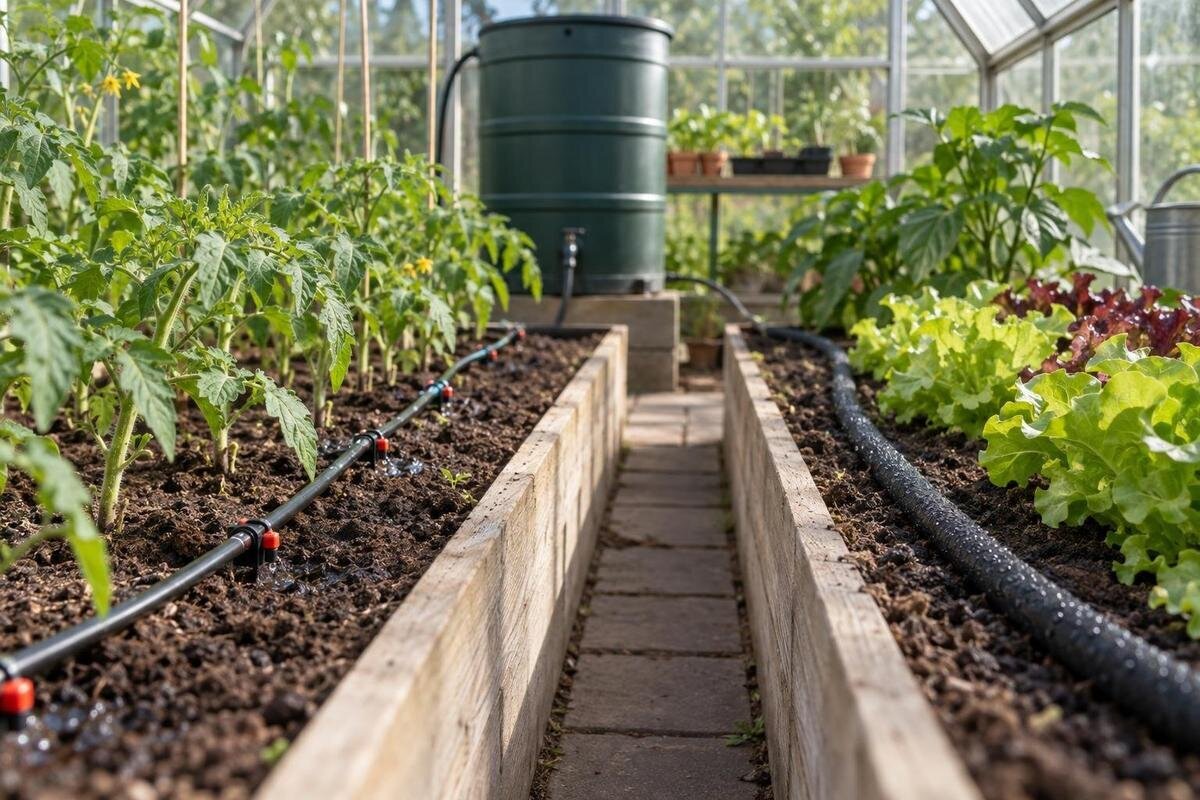
Most covered greenhouse beds receive little or no rainfall, so a missed strip can stay dry. Drip lines release water at spaced emitters; soaker hoses seep through a permeable length or openings, depending on design. Neither is automatically more uniform, easier to maintain or better suited to every bed. Results depend on the exact product, operating pressure and flow, line length, soil, filtration and layout. The useful comparison is not just the hose type: it is whether the system reaches the root zone consistently and can be inspected without disturbing plants. Here is what to check before choosing.

How drip lines and soaker hoses deliver water
A drip line is tubing with outlets at intervals, either integrated emitters or fittings added at selected points. That creates distinct delivery locations that can follow a crop row. The amount each outlet releases depends on the product’s specified flow, run time and operating pressure; a blocked outlet or a run outside the stated conditions can disrupt delivery. Match emitter spacing to plant spacing and the way water spreads through the bed. Some drip products use pressure-compensating emitters and others do not, so confirm that feature in the exact specifications. Note the recommended maximum run length as well.
A soaker hose releases water through a permeable wall or openings along the hose, depending on its construction. That may suit a continuous planted band, but seepage can vary with the model, pressure, total length, age, kinks and how the hose rests against soil. It does not necessarily deliver the same amount at every point. Both formats apply water near the bed instead of spraying overhead, but neither controls greenhouse humidity or condensation. Inspect below the surface: dry foliage does not prove that roots have received an even amount.
Measure bed runs, not just greenhouse area
Measure each planted bed and intended line route, including turns from the water source, branches and connection points. Do not count aisles, shelves or storage as irrigated area unless crops actually grow there. The Limited-Edition Aluminum Greenhouses with Storage listing gives size options from 5.52 to 28.08 m², but a listed greenhouse area does not tell you planted bed length. If the built-in storage area is not planted, exclude it from your line plan. A sketch with measured beds is more useful than a floor-area total.
Record bed width, number of rows, crop spacing and where outlets should sit relative to roots. A narrow row of evenly spaced plants may suit a drip line only when the outlet spacing and flow match. A broad bed or mixed planting may call for more than one water path, depending on soil spread and plant placement. A soaker hose distributes along its route, but avoid unnecessary overlap that could wet one strip twice. Check the exact product’s run-length, bend and fitting guidance; generic diagrams cannot settle those details. Mark seasonal changes to the beds, too.
What affects even water delivery
Uniformity means the intended root zone receives water, not simply that the surface looks equally damp. A drip line can deliver consistently when its emitter design, pressure and run length stay within the product limits. On a long run, pressure may differ between inlet and far end; elevation changes, partly closed valves and clogged outlets can also alter delivery. Some emitters compensate for pressure variation and some do not. Check the exact model, and remember that even pressure-compensating designs still need suitable installation and clean water. Assess the system in the configuration in which you plan to use it.
Soaker hoses do not necessarily seep at an identical rate along their length. Pressure, hose length, wear, kinks and partial blockage can make one area wetter than another, while soil texture changes how far moisture spreads sideways. A damp surface may hide dry roots, or a wet strip close to the hose may leave the bed edge dry. When planning beds for a Bloomcabin Prestige Greenhouse, listed in sizes from 3.77 to 28.08 m², mark moisture-check points near the hose and at the planted edges. Compare those locations rather than judging the whole bed from a single wet patch.
Check pressure and flow while the system runs
Before connecting a system, check its required operating pressure and flow, permitted length per run, and any filter or regulator specifications. Pressure measured with the tap closed is not a reliable picture of pressure while water is flowing. A long supply hose, filter or another outlet drawing from the same source can affect delivery. A suitable irrigation gauge can help check pressure under normal running conditions; compare the reading with the product instructions, not a generic number. Do not assume that a garden tap or rainwater setup automatically meets the requirements. If the supply changes as a storage tank empties, confirm the expected operating conditions for the product.
For a larger bed layout, check whether the planned circuits stay within the irrigation product’s run limits. If you are considering the Spacious Greenhouse, listed in sizes from 47 to 70 m², measure the actual routes before deciding how many lines to connect. Test each circuit with valves and filters in their normal positions. A line that works on its own may behave differently when other branches run at the same time, so assess the complete setup rather than extrapolating from a short sample. If delivery varies, investigate the cause before changing pressure or extending the run beyond the product’s guidance.

Filtration depends on the water and the emitters
Drip emitters may have narrow passages, so suspended grit and organic particles can obstruct them. Use the filter type or filtration level specified for the particular line; there is no single mesh size that suits every emitter and water source. A filter, if required, must be compatible with the tubing and installed according to its instructions. Check it before planting and during use. A dirty filter can restrict flow and look like a blocked line, so inspect it before replacing emitters or increasing run time. The right maintenance interval depends on the equipment and what is in the water.
Stored rainwater can carry sediment, leaves or other material, depending on the collection and storage setup. Soaker hoses can also lose output when their pores or openings clog; their distributed surface does not make them clog-proof. A filter only captures particles within its design range and does not remove dissolved minerals or correct pressure. Check the path from source to filter, hose and end fittings. Clean or flush components only as the maker permits, and avoid unapproved chemicals or forcing water through a hose. If a problem returns, inspect the full system rather than assuming the filter alone is responsible.
Plan the route and connections before planting
Route tubing beside planted rows and leave access to any valve, filter, connector or flush point specified for the system. When comparing the Classic Aluminum Greenhouse size options, which span 3.77 to 28.08 m², include the water-supply route in each proposed bed layout. Trace the path from source to bed, accounting for doorways, aisle crossings, bench legs and places where a line could be crushed or pulled loose. Keep joints visible enough to inspect rather than hiding them beneath soil or pots. Plan access for routine checks before foliage fills the beds.
Use fittings intended for the selected tubing, and verify diameter, thread and pressure compatibility in the product documentation; similar-looking connectors are not always interchangeable. Avoid tight bends or overlapping soaker hose unless its instructions allow them. Arrange lines so plants remain reachable and you can check bed edges without lifting or disturbing the system. Consider where the water can be shut off for maintenance and whether the layout lets you remove a section if it needs attention. Keep tubing away from sharp edges and places where trays or tools are regularly moved.
Test distribution before crops fill the bed
Before planting, run a complete circuit for a repeatable period with the source, filter and valves arranged as they will be in regular use. With a drip line, collect output from emitters near the inlet, middle and far end using identical vessels and equal run times, then compare what was delivered. Include more points on a long or branched route. The aim is to spot a clear difference, not to hit an arbitrary universal volume. For a planned Lean-To Greenhouse, listed in sizes from 3.69 to 14.34 m², mark these test locations on the bed plan so you can repeat the comparison after planting.
For a soaker hose, follow setup guidance, wet the bare bed, then inspect soil near the start, middle and end, including at typical root depth. Check beside the hose and toward the bed edge: surface wetness alone may miss a dry band below or farther away. If the pattern differs, inspect for kinks, loose connections, blockage and pressure changes before extending the timer. A longer watering time can overwater plants near the inlet while leaving an underlying fault unresolved. Repeat the check after adjusting the hose, since its position and contact with soil can change the wetting pattern.
Seasonal maintenance and winter storage
During the season, inspect lines after moving them or changing the crop layout, and check periodically for leaks, compressed sections, loose fittings and reduced output. Compare the same points under the same supply conditions so you can tell whether a change is in the line or at the source. Check and clean the filter in the manner specified by its maker; flush tubing only if the instructions allow it. Compare output before and after maintenance to see whether the problem remains. A simple note of which line serves each bed can help you locate a problem without disturbing the whole planting.
Before cold weather, follow the product’s seasonal instructions for draining, removing or storing hoses and fittings. Water trapped in exposed tubing can freeze and damage it, and not every hose is intended to remain in an unheated greenhouse over winter. When planning irrigation for a Limited Edition Aluminum Greenhouse, make sure you can reach connectors to remove sections without shifting plants or equipment. Avoid scrubbing porous hoses with tools or using cleaners the manufacturer has not approved. Keep your bed-to-line notes with the stored parts so you can restore the tested arrangement when watering resumes.

Match the system to the bed layout
A drip line may fit when distinct outlet positions make sense for the crop and the exact product can meet its pressure, filtration and length requirements. It can work well for measured rows where emitter spacing aligns with plants, but it is not automatically ideal for a wide bed or widely spaced crops. Consider how easily you can check individual outlets and replace a damaged section. A soaker hose may suit continuous seepage along a row when the planting and soil support that pattern, and when you can inspect its full length. Its simpler route is useful only if moisture reaches the intended area.
Where the bed plan branches into separate areas, map each run instead of assuming one hose will cover them all. For a planned T-Shaped Orangery Greenhouse, listed in sizes from 16.52 to 30 m², record which planted areas each branch will serve and where the connections will sit. Measure those routes and confirm them against the selected line’s limits. Separate runs can make a blocked section easier to locate, but extra branches and fittings affect the setup, so test the complete arrangement. If crops have different watering needs, do not assume one line layout and schedule will suit every bed.
Adjust watering to soil moisture
A watering line delivers water; it does not decide how often a bed needs it. Frequency depends on crop and growth stage, root depth, soil and greenhouse conditions, which change over the season. Check below the surface at more than one point, including near the start and end of a run, rather than relying on surface shine, leaf appearance or a fixed calendar alone. Warmer, brighter periods may dry beds faster; cool or cloudy periods may not. Use a consistent inspection method so you can compare one check with the next and adjust based on observed moisture.
Record run time, output differences and moisture observations, then make adjustments gradually and recheck the bed. For beds planned in a Pyramid Greenhouse, listed in sizes from 5.53 to 18.9 m², keep observations specific to each planted area so you can distinguish a local dry spot from a change across the beds. If some spots remain dry despite adequate run time, correct the distribution problem before adding more water to the whole line. Reassess the layout whenever you change crops, bed depth or line position, since a setup that suited one planting may miss another.
Frequently asked questions
Is a drip line always more uniform than a soaker hose?
No. A drip line can deliver consistently when its emitters, pressure and run length suit the setup, but outlets can clog or receive uneven pressure. A soaker hose can seep unevenly along its length. Test the exact product across the actual bed.
Should I filter water before it reaches a soaker hose?
Check the hose manufacturer’s instructions. Sediment can clog openings in a soaker hose, but the required filtration varies by product and water source. Use a compatible filter if specified; filtration does not correct unsuitable pressure or remove dissolved minerals.
How can I tell whether my water pressure is suitable?
Compare the product’s pressure requirements with a reading taken while water is flowing through the usual setup. A suitable irrigation gauge can help. A tap’s pressure when closed does not show how the system performs during watering.
How do I compare output along a drip line?
Run the line as it will normally be used, then collect water from emitters near the inlet, middle and far end for the same length of time. Compare the amounts and investigate clear differences rather than aiming for a universal target.
Why might the far end of a bed stay dry?
Possible causes include a kink, blockage, unsuitable run length, changing pressure or a wetting pattern that does not reach the bed edge. Check the line and soil before extending the timer; extra run time may overwater the near end without fixing the cause.
Neither drip lines nor soaker hoses guarantee even root-zone moisture on their own. Choose according to measured bed routes, the product’s pressure and filtration requirements, and the way water reaches the soil. A pre-plant test can reveal differences along the line, while accessible fittings and regular checks make it easier to maintain. Let moisture in the bed guide adjustments, rather than relying on the hose name or greenhouse area.
