
Greenhouse Bed Root Barriers Beside Trees and Shrubs
Greenhouse bed planning
Roots from nearby trees and shrubs can enter greenhouse beds through open soil at the sides or underneath. Their presence does not automatically explain weak crops: dry soil, uneven irrigation, nutrient problems and compacted media can look similar. Before placing a barrier or digging a trench, confirm what is in the bed, record its route and consider whether excavation could affect important roots. This guide covers careful diagnosis, barrier limits, bed boundaries and layout options when disturbance may not be appropriate.

01
Signs of root intrusion in greenhouse beds
Roots from nearby trees and shrubs can enter a greenhouse bed wherever its growing soil connects to surrounding ground. They may cross an open side, enter through a gap in the bed edge or grow up from below an open-bottom bed. Once in the same soil as crops, a dense root network can compete for moisture and nutrients. A few fine roots at the margin do not automatically explain poor growth, however, and visible roots do not identify which plant they came from. Look for a clear crossing point and treat it as evidence of entry, not proof that roots are the only cause of a crop problem. Roots from a hedge or shrub may also be involved.
Weak growth, wilting, uneven fruiting and a patch that dries quickly have several possible causes. A blocked or poorly placed emitter, inconsistent watering, compacted growing media, nutrient imbalance, disease, pests or greenhouse heat can produce similar patterns. Roots become a more plausible factor when the affected strip is near the tree-facing edge and roots are visible in the same area, but position alone is not a diagnosis. If no roots can be seen, keep investigating watering and growing conditions before deciding. Note whether the problem affects one plant or a continuous section. Installing a barrier without confirming intrusion can add digging and expense without correcting the actual cause.
Check the bed edge before buying a barrier
Begin with places you can inspect without disturbing the tree: the inside edge of the bed, existing gaps and any exposed underside. Gently move loose mulch or media aside and see whether a root can be followed from the outer ground into the bed. Avoid pulling it out, cutting it or digging a trench to chase its source. Crop roots can be interwoven with invading roots, and a root seen inside the bed may have arrived from below rather than from the nearest tree. A small inspection of an accessible area may be enough to document entry; avoid clearing the whole bed. If a woody root is already exposed, photograph its position and leave it in place until its significance is assessed.
Record which beds and crops are affected, where watering outlets sit, how often the soil dries and when symptoms began. Compare similar plants in different parts of the greenhouse rather than comparing a shaded crop with one in full light. Check soil moisture at several points using the same method and note any differences. This does not identify a cause on its own, but it can show whether the pattern follows the tree-side edge or the irrigation layout. A dated sketch and a few photographs make it easier to discuss the issue with an arborist or horticultural adviser without relying on memory. Keep the observations separate from your guesses about the cause.
02
Map the greenhouse, beds and nearby planting
Draw the greenhouse outline, each bed, paths, doors, water lines and the trunks or main stems of nearby trees and shrubs. Mark where roots were actually seen and whether the bed is open underneath. Do not use the canopy edge as a guaranteed root boundary, and do not assume that a particular distance from a trunk is root-free; root spread varies with the plant and site. A sketch helps expose practical conflicts, such as a proposed barrier running across the only access route or a bed planned directly over observed roots. Note where surface water drains as well, since a proposed boundary may change how water moves between soil areas. The sketch is a planning record, not a root survey.
If a greenhouse is not yet chosen, use the catalogue area to shortlist sizes. Limited Edition Aluminum Greenhouses lists sizes from 3.77 to 28.08 m², but that range cannot tell you the exact footprint of the version you want or how much space remains for beds. Add the selected unit’s dimensions and ground plan to your site sketch, then mark the proposed beds and barrier line. This brings the building and growing layout into the same plan before you commit to either. It also reveals whether the proposed arrangement leaves room for excavation and access to nearby planting. Do not treat the listed area as a measure of usable growing space.
Protect significant tree roots before excavation
Digging to install a barrier can be more consequential than seeing a root in the bed. Some roots contribute to a tree’s anchorage and health; their importance cannot be judged from a photo or a simple diameter rule. Do not cut a substantial woody root, remove a root that lies across the planned trench or excavate close to the trunk just to make a greenhouse bed fit. Stop if roots are clustered, large or of uncertain importance, and have a qualified arborist assess the proposed work. The same caution applies to mature or valuable shrubs. If you know the plant species or have records of past construction or root pruning, share that information during the assessment.
Before site work, share a measured sketch showing the greenhouse, beds, observed roots and the route you hope to excavate. Ask the arborist whether that route is acceptable and whether the roots present make a barrier practical at all. If the greenhouse is still being selected, the T-Shaped Orangery Greenhouse listing shows an area range from 16.52 to 30 m². Include the actual outline of the selected size in the discussion so the arborist can see where the structure and trench would sit in relation to the planting. Mark observed roots separately from the proposed work: a product plan shows the building layout, but it is not a root survey.

03
When a root barrier may help
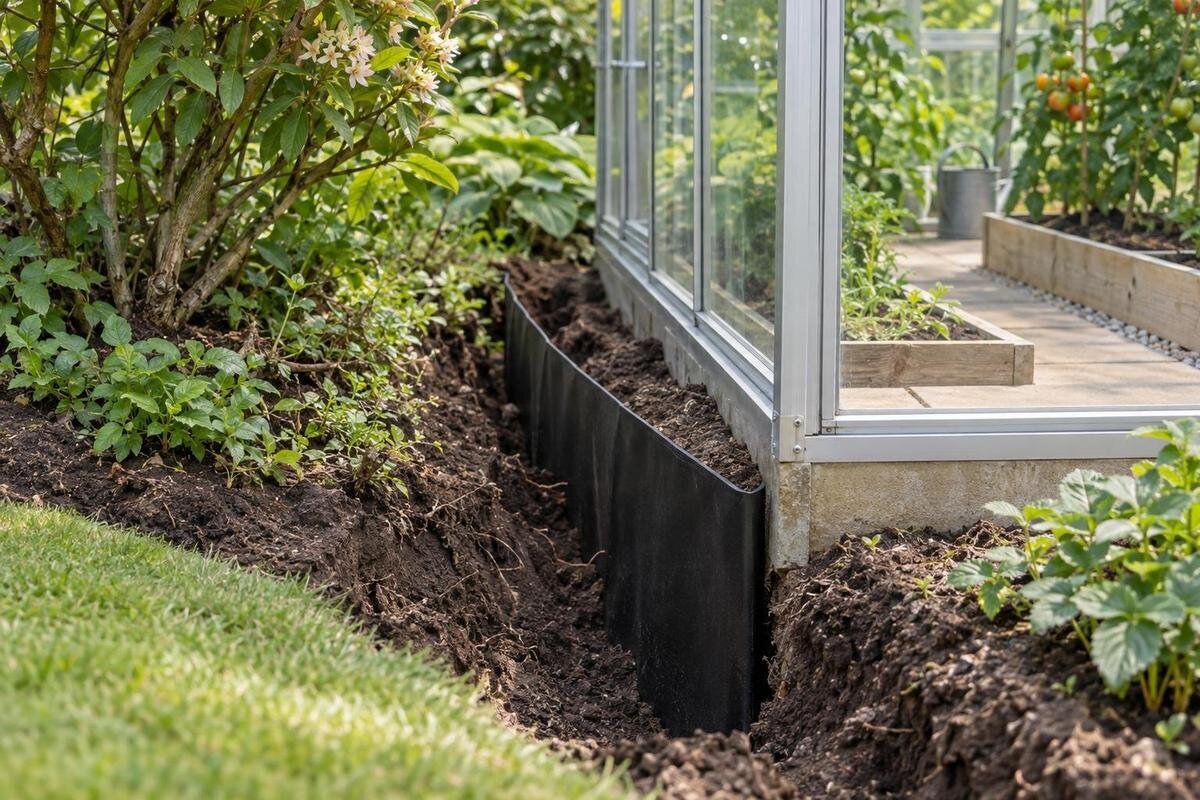
A barrier is most worth investigating when roots have been confirmed at a particular bed edge, the direction of entry is reasonably clear, and the proposed route meets the product’s installation requirements without damaging important roots. A continuous barrier may separate bed soil from adjacent ground along that route, but the result depends on its placement, depth, joints, ends and the roots present. Roots can go around or beneath an incomplete barrier, and roots already inside the bed remain there. After identifying the roots, ask whether a continuous line can be installed without unacceptable root damage. A barrier is not a way to remove existing roots or an automatic cure for poor crop growth; it addresses a specific connection between soils.
If entry is suspected only because crops are weak, keep investigating watering, media and crop health rather than installing a barrier by guesswork. Where a new greenhouse is part of the project, consider the barrier as part of the bed layout rather than as a separate addition. The Pyramid Greenhouse listing gives sizes from 5.53 to 18.9 m²; its area range is useful for initial comparison, but it does not establish a suitable trench route. Compare the proposed barrier with the outline of the selected greenhouse and the observed entry points. Soil replacement on its own will not prevent roots from entering again if the bed remains connected to surrounding ground.
Check what the barrier is designed to do
Choose a product whose documentation explicitly supports the intended root-exclusion use in soil. Bed edging, landscape fabric, weed-control fabric, liners and general-purpose sheets are made for different jobs; do not assume that any of them will resist roots simply because it forms a boundary. Verify the manufacturer’s application, how the material is joined at seams and corners, how its top and ends must be treated, and whether it is suitable for long-term contact with soil at your site. Ask for the product’s installation and depth requirements rather than choosing a panel by its advertised height alone. If the information does not cover these details, ask the supplier or a qualified installer instead of improvising with a material of unknown suitability.
Settle the barrier details only after the growing area is clear. Include every bed, aisle and storage zone, because a greenhouse’s listed total area is not the same as the area available for crops. For example, Limited-Edition Aluminum Greenhouses with Storage is listed in sizes from 5.52 to 28.08 m². On the plan for the selected version, separate storage and access from the bed footprint. Then measure the proposed barrier line, identifying its corners, joints and ends so you can match them to the product’s installation details. This gives you a basis for estimating the material needed without assuming that the barrier should follow the entire building perimeter.
04
A bed edge and a root barrier do different jobs
A raised bed’s sides contain its growing media, but an open bottom still connects the bed to the ground beneath it. Roots may enter underneath even when the sides are solid and the bed looks self-contained. A closed-bottom container may separate roots only if its base and drainage openings are designed for that purpose; check the system details rather than assuming a solid-looking wall is enough. Keep the bed boundary, root barrier and any liner distinct in the plan. Each has a different job, and placing a material around a bed does not prove it can exclude nearby tree roots. If you change the bed design, check that its boundary still suits access and the way you intend to grow.
Measure the growing space from inside the bed: multiply its internal length by internal width and planned fill depth, using consistent units, then account for tapered sides or unfilled space where needed. For an irregular bed, measure simple sections separately and add their volumes. Record each bed and compare the result with guidance for the crops you intend to grow; a greenhouse area figure cannot replace this calculation. Bloomcabin Prestige Greenhouse listings range from 3.77 to 28.08 m², so base your soil-volume calculation on the beds planned for the selected size. Check the volume again if accommodating a root barrier makes a bed narrower or shallower, rather than assuming the revised bed still provides the growing space your crops need.
Reposition beds before planning a trench
Where roots are important or a proposed trench crosses them, moving a bed can be safer than trying to isolate it in place. Depending on the site, it may be possible to shift the bed, alter the greenhouse position or leave a planting strip undisturbed. There is no universal setback from a trunk or canopy that guarantees root-free soil, so do not solve the sketch by moving the barrier a guessed number of metres. Keep access to the tree and surrounding ground in mind, and ask for an assessment when you cannot tell whether a new position avoids significant roots. Include young trees and shrubs you intend to keep; their roots may extend into the planned growing area as they establish.
A larger greenhouse footprint does not remove the need for that assessment. The Spacious Greenhouse listing gives sizes from 47 to 70 m², but a large total area does not establish that every bed location is safe or that roots stop at the structure’s edge. Use the confirmed footprint to compare alternative bed arrangements, including one that leaves known rooted ground undisturbed. Keep the observed roots visible on each version of the sketch so you can see which changes actually avoid them. If no arrangement works without risky excavation, consider relocating the greenhouse as well as the beds rather than forcing a barrier through established planting.

05
Use the chosen greenhouse dimensions, not its area alone
Before ordering materials, check that the measurements on your plan describe the same layout you intend to build. Record the selected greenhouse outline, the internal dimensions of each bed, aisle widths, entry clearance and the proposed barrier line. Distinguish finished dimensions from the space needed to build or inspect the boundary; a bed that fits on paper may leave no working access along its edge. Use the dimensioned plan for the exact greenhouse option, and ask the supplier to clarify any missing dimensions. Check the barrier manufacturer’s installation requirements against the available working space, particularly where a doorway, bed edge or tree trunk is close to the proposed trench.
Size ranges describe multiple options, not one standard footprint. The Aluminum Greenhouses listing ranges from 3.77 to 28.08 m², so do not extrapolate the dimensions of your chosen model from the smallest or largest area figure. Keep the selected size and its confirmed dimensions with your layout record. If you later change the number, width or depth of the beds, update the affected measurements and soil volumes rather than relying on the earlier plan. Compare the revised boundaries with the marked roots and barrier line as well. Extra greenhouse area does not by itself provide a root-safe route for future alterations, and a change to one bed can affect the access beside it.
Choose a non-excavation option when roots are uncertain
If a safe trench cannot be identified, choose an option that limits ground disturbance. You may be able to move the bed, keep crops in a container system with a root-separating base and suitable drainage, or grow in another part of the greenhouse. Confirm that containers provide the root volume and water management required for the chosen crops; a gap or opening in the base can still leave a route for roots. Compare the complete container system with the existing bed, including its base and drainage details, rather than treating any closed-looking container as equivalent. Where roots cannot be assessed confidently, defer excavation. An arborist can help distinguish a manageable bed issue from a tree-root conflict.
Changing greenhouse form can also be part of the comparison, but a different shape is not proof of a root-safe site. The Lean-To Greenhouses listing covers sizes from 3.69 to 14.34 m²; check the exact dimensions and how that outline would sit relative to existing planting before revising beds. Compare alternatives on the same sketch, including access, intended growing area and any ground that would need digging. A workable plan keeps crops contained, leaves the chosen beds large enough for their purpose and avoids unnecessary disturbance to established trees and shrubs.
Frequently asked questions
How can I confirm that roots are entering a greenhouse bed?
Look for a root crossing the bed edge or emerging through its open base, and record its position before moving it. Crop symptoms alone are not enough; check soil moisture and irrigation patterns too. If the root’s origin or importance is unclear, do not cut it or dig a trench to follow it.
Will a raised bed keep tree roots out?
Not if it has an open bottom: the soil still connects with the ground beneath it. A closed-bottom container may separate roots only if its base and drainage openings are designed for that purpose. Check the system details rather than assuming the sides or liner exclude roots.
How deep should a root barrier go?
There is no single depth that suits every tree, shrub, soil and bed. The required depth and layout depend on the roots present and the barrier product’s documented use. Have a qualified arborist assess the route and follow the product specifications before excavation.
Can I cut a root that is growing into a bed?
Do not cut it just to clear the bed. A root’s importance cannot be judged by appearance or size alone, and cutting it may affect the tree. Photograph its position and ask a qualified arborist to assess it, especially if it is woody, large or near the proposed trench.
What should I check before buying a root barrier?
Confirm that the product is specified for root exclusion in soil, and check its documented installation, joining and edge details. Do not assume that bed edging, landscape fabric or a liner has the same purpose. If suitability for your site is unclear, ask the supplier or a qualified installer.
A useful root-barrier plan begins with evidence of entry, not a guess based on crop symptoms or distance from a tree. Map the actual greenhouse and bed layout, confirm that a proposed barrier is specified for root exclusion, and get advice before disturbing roots whose importance is uncertain. If there is no safe route for excavation, adjust the bed or growing system instead. Keeping the planting and tree roots in view together helps protect established plants while making greenhouse beds more manageable.
