
Growing Cucamelons in a Greenhouse
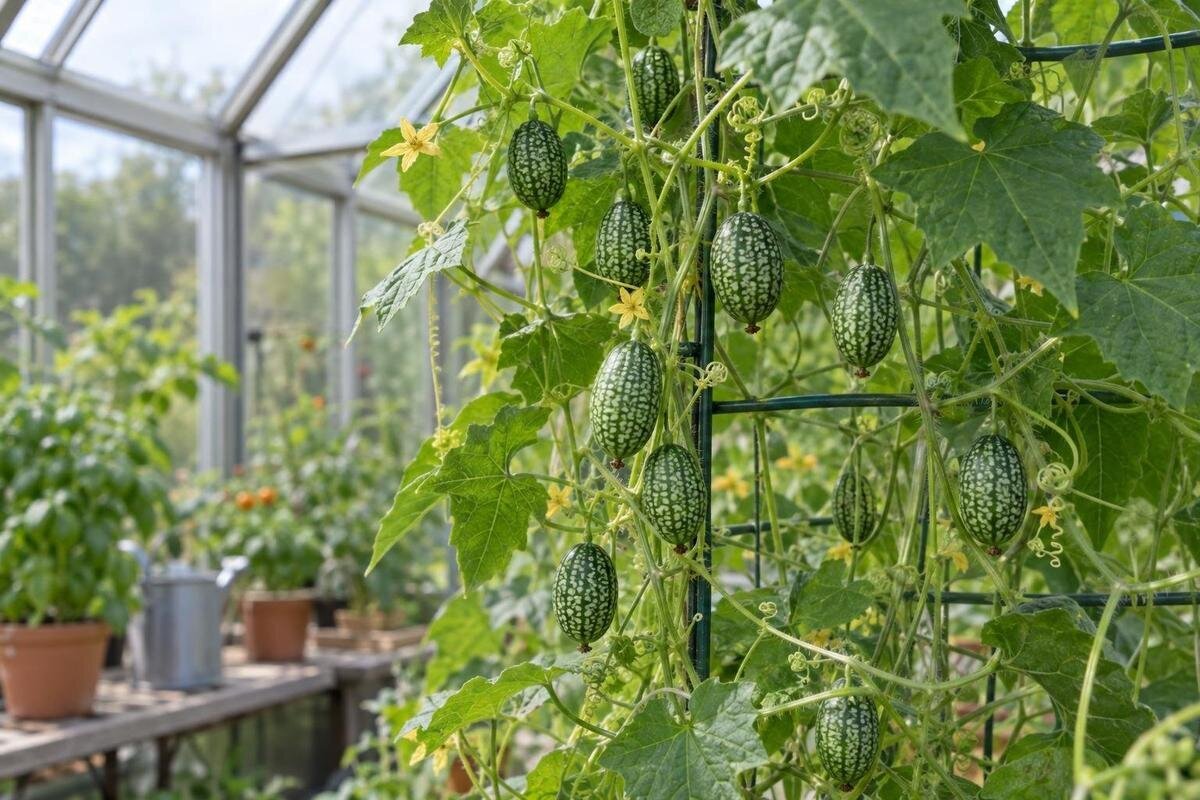
Greenhouse growing guide
Cucamelons are small, crisp fruits on vigorous climbing vines, so greenhouse success depends on warmth, a clear route upward and regular picking—not on filling a large bed. In Canada, use local frost guidance alongside actual greenhouse night readings: an unheated structure may warm quickly in sunshine yet cool sharply after dark. This guide covers sowing, transplanting, trellis placement, watering, pollination and harvest cues, with particular attention to the space and season limits of a small protected growing area.

What cucamelons need from a greenhouse
Despite their tiny, striped fruits, cucamelons (Melothria scabra, also called Mexican sour gherkins) grow on vigorous, warm-season vines in the cucumber family. In most Canadian gardens they are treated as annuals: frost can damage them, and cold soil slows establishment. A greenhouse may shelter plants from wind and help the bed warm earlier, but an unheated structure is not reliably frost-proof; temperatures can fall sharply overnight. Put a min–max thermometer near the plants and use actual night readings alongside local frost guidance. Bed-level readings matter more than the temperature in a sunny aisle, and a closed greenhouse can also overheat on bright days, so monitor daytime highs as well as overnight lows.
Think in terms of a suitable warm growing window from transplant through harvest, not winter protection. Check the seed packet for the chosen variety’s days to maturity and compare that with your local season. If the greenhouse will also hold several crops or a work area, the Spacious Greenhouse range is listed from 47 to 70 m². That range is not the space cucamelons require; it simply illustrates why you need the footprint of the exact model you are considering. For a compact plan, reserve room for one vine and a clear path before adding more plants. A larger unheated room still cannot replace warmth.
Place the vine where it will not crowd the greenhouse
Choose the brightest practical position and leave enough headroom for a climbing vine. Light through glazing can be reduced by framing, nearby buildings, a wall or foliage, so look at the site at different times rather than judging it from a sunny moment. Place the trellis where leaves will not shade shorter crops for much of the day, and keep the main path clear for harvesting and inspection. The plant needs more than a hole for its stem: allow room for leaves to spread, for a container if you are using one, and for you to reach the bed without pushing through vines.
Sketch the bed, pot, support and working route before planting, including access to doors and vents; add space for mature growth, not just the seedling. If space is tight, one carefully trained vine is a useful first trial. The Classic Aluminum Greenhouse range is listed from 3.77 to 28.08 m², so its range spans multiple sizes; use the plan for the specific model rather than treating the endpoints as one layout or assuming all floor area is planting area. Check whether shelving or permanent beds take up space, too. A clear route makes routine watering, hand pollination and picking easier.
When to sow cucamelons for greenhouse growing
Set the sowing date by working back from the time you expect to plant, not from the first mild afternoon. Consult local frost guidance, then check overnight readings in the greenhouse; a sunny day does not show whether the root zone will stay warm. A practical indoor-starting window is about four to six weeks before your intended transplant date. In a short season this gives seedlings a head start without asking an unheated greenhouse to carry them through cold spring nights. Starting much earlier can leave fast-growing vines crowded or leggy before their final space is ready.
You can direct-sow later once the bed or potting mix has warmed and the forecast is settled, but this leaves less time to mature in a short summer. If you start indoors, keep seedlings in a warm place rather than on a cold greenhouse bench, and move them gradually when conditions allow. A soil thermometer is more useful than judging warmth at midday. For gardeners comparing an attached protected area for trays and crops, the Lean-To Greenhouses range is listed from 3.69 to 14.34 m²; check the selected model’s plan to see how propagation space and a mature vine would share it. The listing itself does not indicate heating.
Germinate seeds and move seedlings carefully
Use a clean seed-starting mix that drains freely and sow roughly 1 cm deep, or follow the packet if it gives different directions. Moisten the mix before sowing, then keep it evenly damp rather than saturated; waterlogged mix and cold conditions make establishment unreliable. Warmth helps germination, and cucamelon seed can emerge unevenly, so do not discard a pot after only a few days. Keep each label with its seed tray, and resist repeatedly uncovering or digging up seeds to check them. If seedlings fail to appear within the packet’s stated window, review moisture and warmth before sowing again.
After emergence, give seedlings strong light and steady moisture so stems stay sturdy instead of stretching. Pot them on if roots fill the cell before conditions in the greenhouse are suitable, but avoid letting them become tangled or root-bound. Acclimatize indoor-grown plants gradually over several days to brighter light and moving air. Transplant only when frost risk has passed for your site and greenhouse nights are consistently mild; handle the root ball gently and water it in. The Limited Edition Aluminum Greenhouses range is listed from 3.77 to 28.08 m²; consult the exact plan when deciding how a planting bed, pots and access route will fit.

Give the climbing vine a dependable trellis
Install the support before the vine starts running. A stable trellis around 1.5 to 2 m tall is a practical target where headroom permits; use mesh, a strong net or another climbing surface that lets tendrils catch. In a lower greenhouse, plan how you will redirect the growing tip along the support rather than letting it spill across the path. Secure the trellis independently or only at points approved for that purpose by the greenhouse maker. Do not assume glazing or the greenhouse frame can take added loads. A support that shifts under foliage is harder to manage once the plant is large.
Guide young stems gently as they reach the trellis, using loose soft ties only where tendrils need help; tight loops can constrict a growing stem. Fine mesh gives tendrils something to catch, while smooth posts may need ties. Check the plant regularly and spread crowded growth along the support to preserve light and airflow. Routine hard pruning is not necessary: remove damaged leaves and redirect healthy shoots before cutting them. If you are comparing different floor-plan shapes for a shared growing area, the T-Shaped Orangery Greenhouse range is listed from 16.52 to 30 m². Review the selected model’s plan before choosing where its bed, trellis and path will sit.
Soil and containers for cucamelons
Choose a fertile, well-drained bed or a generously sized container with drainage holes. Work in mature compost if the soil needs organic matter, but do not leave the roots in a cold, waterlogged mix. In a bed, allow roughly 30 to 45 cm between plants as a starting point, then give more room if your layout has poor airflow or the variety’s instructions call for it. A container needs enough root volume to hold moisture through warm days; a small pot can dry out quickly and become top-heavy beneath a tall vine. If space is limited, plan one plant per support rather than letting several vines overlap. Position the support before filling or planting.
Check moisture at root level rather than relying on the greenhouse air: the roof keeps rain off beds, and pots often dry faster in warmth. Aim for evenly moist soil, watering at the base of the plant and avoiding repeated cycles of drying out completely and soaking. A mulch layer can slow surface drying if it does not press against the stem. Check containers more often during hot spells. Feed conservatively; excess nitrogen can favour leafy growth over flowers, while added fertilizer cannot correct low light or poor pollination. Follow the product label for edible crops. The Pyramid Greenhouse range lists models from 5.53 to 18.9 m²; compare the chosen plan with the space needed for a pot, trellis and watering access.
Encourage pollination and keep air moving
Cucamelon plants bear separate male and female flowers, usually on the same plant. A female flower has a tiny fruit-shaped swelling behind its petals; a male flower does not. Early flowers may be male, so a short spell with blooms but no cucamelons is not automatically a problem. Insects transfer pollen, but a closed greenhouse may have few visitors. If female flowers appear and fruitlets fail to develop, check whether pollen is reaching them as well as considering temperature and watering stress. You can transfer pollen from an open male flower to the centre of an open female flower with a small clean brush. The flowers need to be open for pollen transfer.
Open available doors or vents when weather allows to refresh the air and let pollinating insects enter, while protecting plants from cold nights. Keep access to openings clear and avoid a dense wall of leaves that makes flowers difficult to reach. Do not assume every greenhouse in a product range has the same ventilation layout: the Bloomcabin Prestige Greenhouse range is listed from 3.77 to 28.08 m², but those figures describe footprint only. Check the selected model’s documentation for its actual openings and plan a route to reach flowers without tugging on stems. Clear access helps you inspect foliage, while ventilation helps manage warm, stagnant conditions.
Catch pests and growth problems early
Inspect the growing tips and the undersides of leaves at least weekly, especially once the canopy thickens. Aphids cluster on tender growth, while spider mites can leave fine stippling and, in heavier cases, webbing. Check for leaf discolouration or powdery patches, but do not diagnose every yellow leaf as a disease: ageing leaves, uneven moisture, heat and nutrient problems can look similar. Look along stems and behind leaves where small pests or fruit can be hidden. Remove dead or badly damaged material and keep the vine open enough to inspect. Regular checks catch small problems before leaves and fruit disappear behind the trellis.
Water at the soil line, clear plant debris and avoid crowding neighbouring crops; these habits improve access and reduce persistently damp, stagnant growth. If a pest treatment is needed, identify the pest first and use only a treatment whose label allows the edible crop and greenhouse setting; follow its directions and protect pollinators. Keep snips, ties and labels somewhere dry and separate from soil. The Limited-Edition Aluminum Greenhouses with Storage listing includes models from 5.52 to 28.08 m²; consult its individual plan to see how the storage area affects growing floor space and the route around your vine.

Pick cucamelons while they are small and firm
Pick fruits when they are still small, firm and green with clear lighter stripes, usually around 2.5 to 4 cm long. They should feel crisp, not soft or watery. Do not wait for them to become as large as a cucumber: oversized cucamelons can turn pale or yellow and develop tougher, more noticeable seeds. Because the fruits hide beneath leaves, lift the foliage gently and check along the vine rather than taking only the obvious ones. Snip the short stem with clean scissors or pruners instead of pulling, which can tear the vine or loosen its support. Warm conditions can change fruit size quickly, so check often.
Once fruiting starts, inspect the plant every few days; regular picking makes it easier to catch the preferred size and keeps older fruit from lingering unnoticed. Cucamelons usually have a crisp texture and a tart flavour, which is why they are often eaten fresh or used for pickling. If a fruit is larger than expected, cut it open and judge its texture before deciding whether to use it. A sudden pause in harvest may simply reflect fewer female flowers or cooler weather, so check the plant before increasing fertilizer or watering. Handle picked fruits gently so their small size does not make them easy to bruise.
Plan for the end of the season
Expect the crop to end when nights become too cold or frost threatens, even if the greenhouse still feels pleasant in the afternoon. An unheated structure may delay exposure to cold, but it cannot be counted on to protect a tender vine during a hard frost. Harvest usable fruit before a cold spell rather than waiting for every fruit to enlarge. If reliable heat is part of your plan, consider how long warmth would need to be maintained and get qualified advice on appropriate equipment instead of improvising. A greenhouse can extend the growing window, but it does not remove the crop’s need for a sufficiently warm season.
After the crop is finished, remove vines and fallen fruit, then clean reusable ties, pots and trellis before the next planting. Discard diseased material responsibly rather than leaving it on the greenhouse floor; refresh container mix as appropriate and avoid planting cucamelons repeatedly in the same problem area if related cucurbits have suffered disease. For next year, adjust the sowing date according to actual temperatures, move the trellis to reduce shade or grow one plant instead of two. A manageable vine with room for light, air and harvesting is more useful than a crowded bed of foliage.
Frequently asked questions
When should I sow cucamelon seeds in Canada?
Work back about four to six weeks from the date you expect to transplant, using local frost guidance and your greenhouse’s overnight readings. Starting too early can leave seedlings crowded before conditions are warm enough.
Can cucamelons grow in an unheated greenhouse?
Yes, during a sufficiently warm growing season. An unheated greenhouse can warm up by day but may cool sharply at night, so it does not guarantee frost protection. Check conditions where the plants will grow.
Do I need two cucamelon plants for pollination?
Usually not. A cucamelon plant bears separate male and female flowers on the same plant. Pollen still needs to reach the female flowers, so encourage insect access or transfer pollen with a small brush if needed.
How tall should a cucamelon trellis be?
A stable support around 1.5 to 2 m tall is a practical target where your greenhouse allows. Plan to redirect extra growth if the vine reaches the top, and only attach a trellis to points approved by the greenhouse manufacturer.
When are cucamelons ready to harvest?
Pick them while they are small, firm and green with clear lighter stripes, usually around 2.5 to 4 cm long. Oversized fruit may turn pale or yellow, soften and develop more noticeable seeds.
For cucamelons, a well-timed start, even moisture and a dependable trellis matter more than forcing an early planting date. Monitor the greenhouse at night as well as in daytime, guide the vine before it sprawls and pick fruit while it is still small and crisp. Those habits make the crop easier to manage in a compact growing space.
