
Greenhouse Eggplants Flowering but Not Fruiting
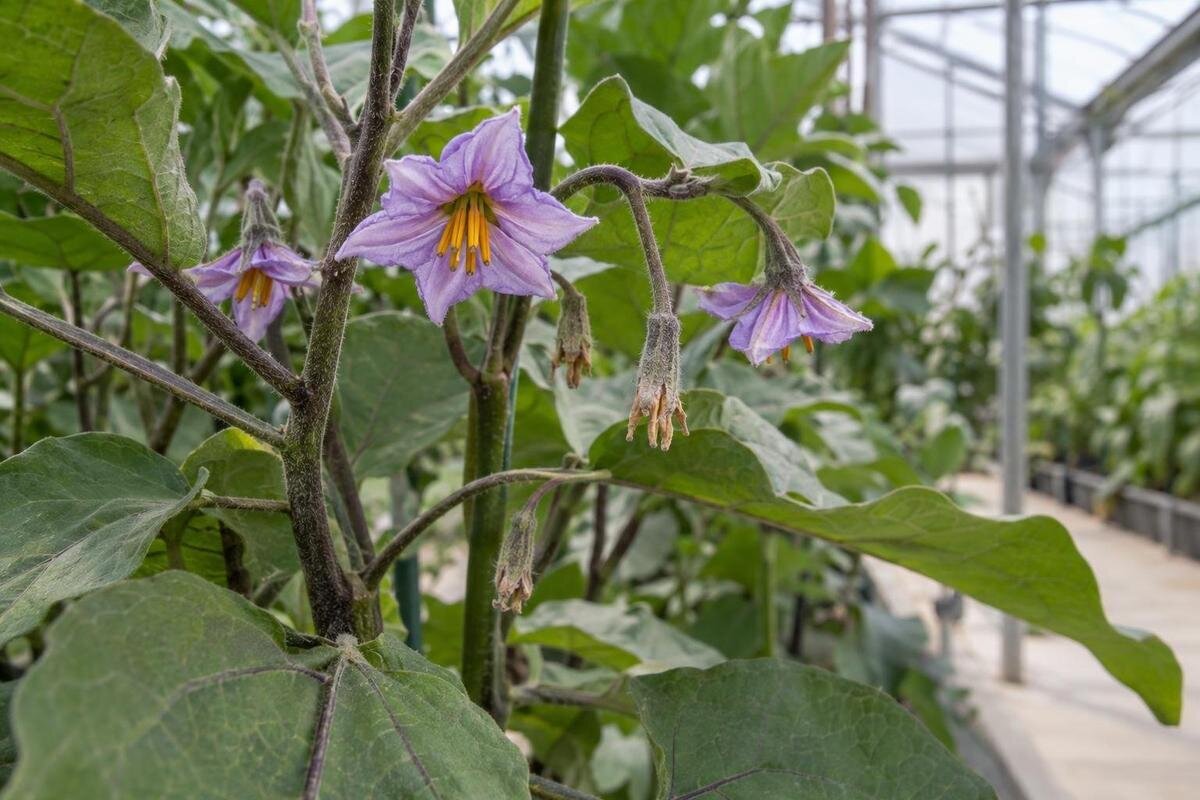
Greenhouse growing
An eggplant can carry plenty of open flowers and still produce little fruit if blossoms fall before an ovary grows, or if a tiny fruit starts and then stops. In a greenhouse, pollination is one possibility, not the only one: eggplants can self-pollinate, but pollen still has to move within the flower under suitable conditions. Cool nights, prolonged heat, humid or still air, uneven moisture and plant stress can produce similar symptoms. Start by checking what happens at the flower base, then compare temperatures around the flowers, root moisture and flower movement before changing several things at once.

01
Confirm whether a fruitlet ever formed
An open flower is only the first stage; petals normally close, wilt and fall. Look at the green base just behind the flower: that is the ovary. If it stays attached and begins to enlarge after the petals fall, a fruitlet has set. A whole flower that drops without swelling has failed to set; an ovary that swells and then turns yellow or stops growing indicates a later loss. A single fallen blossom is not enough to identify a cause. Eggplants can lose some flowers while conditions shift, even when other blooms are progressing. Note whether petals fall while the flower stem remains or the whole bloom detaches; that describes the stage of loss, though it does not identify its cause.
Choose several newly opened flowers on the same plant and note their dates and positions. Mark each bloom with a loose tag, then check it after the petals fall rather than relying on memory. Photograph the flower base when it opens and again later; record whether the ovary began to swell, whether the bloom moved or was visited, and recent temperature and watering conditions. Give each plant a simple identifier so you can match a fallen flower to the right pot or bed. If plants occupy separate zones, include those positions on your sketch. For anyone comparing growing spaces, Limited Edition Aluminum Greenhouses are listed in sizes from 3.77 to 28.08 m². Use the footprint to plan where beds and observation points would go, but keep your crop notes tied to individual plants rather than treating the whole greenhouse as one set of conditions.
Understand how eggplant pollen moves
Eggplant flowers usually contain both male and female parts, and most commonly grown varieties can set fruit with their own pollen. A second plant is not normally required, so adding one is not a dependable fix. Self-pollination does not mean pollen moves on its own, though: it is held in a cone of anthers, and vibration helps release it so it can reach the stigma. Outdoors, insect visits and ordinary plant movement can provide that vibration. In a protected greenhouse, visits or movement may be limited while the plant still looks healthy and flowers normally.
Watch an open flower during the day and note whether anything moves it, whether through an insect visit or gentle movement of the stem. A greenhouse that excludes insects can still produce fruit, but limited flower movement may make set less dependable; the absence of bees alone does not prove pollination failure. Record what you actually see rather than marking every unvisited flower as unpollinated. If you are comparing layouts, the T-Shaped Orangery Greenhouse listing includes options from 16.52 to 30 m². Sketch where eggplants would stand and how you would reach their flowers in each part of the space. Footprint and shape are planning information, not evidence of insect activity. For an existing crop, observe flowers in more than one position before deciding whether limited movement is a greenhouse-wide problem.
02
Look closely at the flowers that are dropping
Eggplant flowers do not all have the same pistil length. The pistil is the female centre, ending at the stigma, and the pollen-bearing anthers form a cone around it. In long- and medium-styled blooms, the stigma sits near or above that cone and these flowers are more likely to set. A very short-styled flower has its stigma lower in the cone and often drops without fruiting. Different flower forms can appear on one plant, so several dropped short-styled blooms do not by themselves show that the greenhouse lacks pollination.
Compare the centres of several flowers rather than judging only by petal size. Look for whether the stigma sits near the anthers, and note if later blooms have the same form. Also watch for browned or damaged petals, chewing, or fuzzy mould; a visibly injured or rotting flower needs a different investigation from an intact bloom that simply falls. A side-on close-up showing the flower centre, along with a wider picture of the plant, can make comparisons easier. Photos provide clues, not a definite diagnosis.
Record daytime highs and overnight lows
Eggplant is a warm-season crop, so a sunny afternoon reading can hide a night that was too cool. As a screening guide, repeated nights below roughly 15°C and prolonged daytime peaks in the low-to-mid 30s can interfere with pollen function and fruit set; these are clues, not universal cutoffs. Many plants set more reliably in steadier warmth, often around the mid-20s to 30°C by day and roughly 18–21°C at night. Cultivar, duration, humidity and plant stage all affect the response, so one brief excursion does not prove the cause.
Use a minimum/maximum thermometer or logger near flower height, shaded from direct sun while leaving air free to circulate around it. Record the pre-dawn minimum as well as the afternoon peak during a period when blooms are dropping; outdoor forecasts do not describe a sunlit greenhouse. Write down the measurement location and whether the reading is a daily extreme or a reading taken at one moment. Otherwise, two apparently different results may simply reflect different observation times. Check more than one crop position if plants sit at different ends or near an entrance. The Pyramid Greenhouse listing gives size options from 5.53 to 18.9 m². When considering a layout of that size, include accessible monitoring positions near the proposed plants. Neither the model name nor listed area is a temperature specification; your useful comparison is between readings where flowers are actually growing.

03
Check humidity and air movement around open blooms
Humidity and movement affect flower conditions, but they are easy to misread. In air that stays very humid, pollen may not release or move as freely; condensation or wet blossoms are useful clues, not proof that humidity alone caused the drop. Still air can also let heat and moisture build up in a dense canopy. A very forceful, drying draft is not the goal. Note whether the greenhouse feels damp at dawn, whether foliage stays wet, and whether flowers tremble slightly when air moves. If you have a humidity gauge, compare its readings with the tagged blooms.
When open, dry flowers are present, try a light vibration: tap the flower stalk or nearby stem so the bloom quivers, without pulling petals or shaking the plant hard. Repeat on several blossoms over a few days and label them, then watch whether their ovaries swell. Note whether the flowers were dry when treated, so you can distinguish that observation from a general impression that the greenhouse was damp. Ventilation may reduce heat and moisture build-up, but it does not guarantee pollen reaches every flower. If storage is part of a planned layout, the Limited-Edition Aluminum Greenhouses with Storage listing spans 5.52–28.08 m². Mark storage, beds and openings separately on your plan, and check the actual opening details. For a planted greenhouse, assess airflow and humidity at canopy level rather than beside stored tools or an empty aisle.
Keep root-zone moisture steady
Drought and waterlogged roots can both interrupt flowering and early fruit growth. A plant may wilt in strong afternoon heat even when its root zone is moist, so leaf posture at one moment is not a watering diagnosis. Check moisture a few centimetres below the surface in the bed or pot, and compare more than one plant. Containers can dry faster than in-ground beds, while compacted or poorly drained growing medium can remain wet below a dry-looking top. Check again after watering to see whether moisture reaches the roots.
Keep moisture reasonably even rather than alternating between a very dry root zone and a saturated one. Water near the roots and allow excess to drain; use guidance for your container or growing medium instead of copying another gardener's schedule. If the soil smells sour, stays wet, or roots look dark and damaged, investigate drainage or root health before feeding. Record which pots or bed sections were watered and what you found below the surface, not just that the greenhouse was watered. This lets you compare flower losses with conditions at the relevant roots. When planning beds within a Bloomcabin Prestige Greenhouse, whose listed sizes range from 3.77 to 28.08 m², distinguish the overall footprint from the space allocated to plants. Mark individual containers and bed sections so moisture checks remain specific to each eggplant.
04
Assess light and plant vigour before adding fertilizer
Light and plant vigour help explain why flowers form but fruit stays sparse. Eggplants need bright growing conditions; long periods of shade or a heavily crowded canopy can limit the energy available for flowers and developing fruit. Track shade at the plant, not just how bright the greenhouse looks at noon, because neighbouring plants, walls and overhead structures can affect different positions. If flowers appear mainly on weak growth or inner branches, note whether those areas also receive less light or have stale air.
Do not respond to every fruit-set problem with fertilizer. Too much nitrogen can push lush leaf and stem growth at the expense of balanced fruiting, but vigorous foliage alone does not prove excess; variety, plant age and light matter. Review what has already been applied, and use a soil or growing-medium test if a deficiency seems plausible. Include the feed used, application dates and which plants received it in your notes. Adding a high-phosphorus feed without evidence may not solve pollination or temperature stress. For a larger planting plan, the Spacious Greenhouse catalogue lists options from 47 to 70 m². Map the intended crop positions and compare their light through the day rather than assuming every part of a large footprint receives the same exposure. Keep feeding history and shade observations separate so lush growth is not automatically attributed to fertilizer.
Map microclimates across the greenhouse
A greenhouse can have local differences: a spot by the door, a sunny wall, a roof line or a dense group of leaves may not match the middle of the space. This matters when one plant sets and another does not. Take the same kind of reading at two or three crop positions and note which plant each bloom belongs to. Keep the sensor out of direct sun and away from a heated surface; otherwise it may measure solar warming of the instrument rather than the surrounding air.
Map vents, doors, beds, pots and eggplant positions on a simple sketch, then add temperature or humidity notes to the relevant area. Use the same position names in your flower records so a successful fruitlet and a dropped bloom can be traced back to their surroundings. Look for patterns instead of assuming the nearest opening explains everything: sun exposure, outside weather and canopy density interact. Record whether doors and vents were open when you took a reading; this makes comparisons between days easier to interpret. If you are comparing structures, the Aluminum Greenhouses listing includes sizes from 3.77 to 28.08 m². Check the opening details separately from the area range, and use your sketch to consider access to each growing zone. For the crop already in place, repeated observations at named positions are more useful than a single central reading.

05
Make flowers accessible to pollinators and to you
Think about access as well as insect presence. If open blooms are buried in dense foliage, insects may miss them and you may be unable to check or lightly vibrate a flower without bending a stem. Keep a practical route for inspecting plants, and avoid crowding eggplants so tightly that inner flowers stay dark and damp. Where mesh or a closed opening limits insect entry, visits may be rare, but that does not prove the plant cannot set fruit on its own. Look directly for visits over several calm periods.
If you use pest-control products, follow their label directions and pollinator precautions; avoid treating open blooms casually. For routine inspection, choose a route that lets you see flower centres and bases without repeatedly bending stems aside. Note any blooms you cannot reach, since an unchecked inner flower should not be recorded as having the same history as an accessible outer one. If insects rarely visit, use the gentle vibration trial described above rather than assuming a second plant is needed. When planning access in a wall-adjacent structure, the Lean-To Greenhouses listing spans 3.69–14.34 m². Consider the positions of the wall, openings, plants and inspection route together. The name and size do not establish light levels or flower access at your site; those depend on the actual arrangement you are assessing.
Test one likely cause at a time
Run a simple trial instead of changing temperature, feeding, watering and ventilation all at once. Tag several flowers that open at about the same time; gently vibrate some and leave others undisturbed, while keeping normal watering and feeding steady. Record the flower form if visible, the date, daily high and low, root moisture and any insect visit. This is not a laboratory test, and flower-to-flower differences matter, but repeated results are more informative than one blossom. Wait for each tagged ovary to show whether it is swelling before calling the trial a failure.
If both groups fail during cool nights or a heat spell, focus on that pattern; if short-styled blooms fall while other flowers set, flower type may explain some losses. If a few ovaries start and then shrivel, revisit water consistency, root health, light and later heat rather than repeating pollination alone. Compare your notes with close-up and whole-plant photos. Persistent failure across successive blooms, especially alongside damaged leaves or roots, is a good reason to seek input from a local horticultural adviser or an experienced grower.
Frequently asked questions
Do eggplant flowers need hand-pollination in a greenhouse?
Usually, pollen does not need to come from a second plant: most commonly grown eggplants can use their own pollen. Vibration helps release and move it within the flower, though. If open, dry blooms are not setting, gently tap the flower stalks so the blooms quiver, then watch whether their ovaries begin to swell.
Can one eggplant plant produce fruit on its own?
Yes. Most commonly grown eggplants have flowers with both male and female parts and can set fruit using their own pollen. A second plant is not normally required. Fruit set still depends on pollen movement, suitable temperatures and plant health, and cultivars can differ.
What temperature is too cold or too hot for eggplant fruit set?
There is no single cutoff for every cultivar or greenhouse. Repeated nights below roughly 15°C and prolonged daytime heat in the low-to-mid 30s are warning signs; steadier warm conditions are generally more favourable. Measure minimums and peaks beside the plants, since an outdoor forecast may not reflect conditions around the flowers.
Why do eggplant flowers drop before any fruit appears?
Some short-styled flowers naturally fail to set. Limited pollen movement, temperature extremes, humid or still air, uneven root moisture and other plant stress can also contribute. Check whether the ovary ever began to swell, then look for a pattern across several flowers rather than judging from one fallen bloom.
Should I add fertilizer when my eggplant flowers but does not fruit?
Not automatically. Extra nitrogen may encourage leaf and stem growth without addressing pollen movement, heat or water stress. Review recent feeding and the plant's overall condition; use a soil or growing-medium test if a nutrient issue seems plausible. Change what your observations point to rather than adding a general-purpose feed as a trial.
When eggplants flower without producing fruit, the stage at which growth stops helps narrow the problem. First look for ovary swelling and note which flowers fall; then match those dates to overnight lows, daytime peaks, flower movement and root moisture. Short-styled blooms may account for some losses, while repeated stress can prevent otherwise healthy flowers from setting or retaining fruit. A few labelled blossoms and readings taken near the plants can help you decide whether to focus on pollination, temperature or plant condition, without letting several simultaneous changes obscure the pattern.
