
Greenhouse Fans: Circulation or Exhaust?
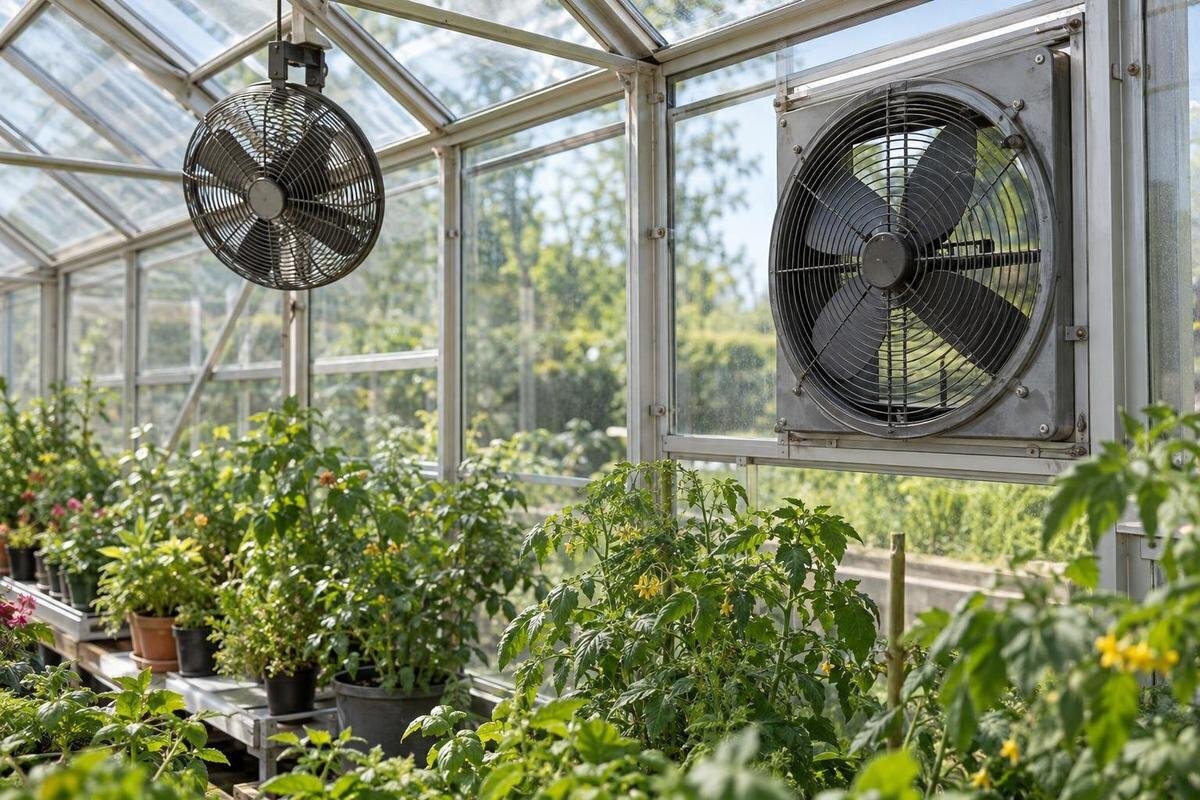
Greenhouse ventilation
Greenhouse fans are often grouped together, but their jobs are not interchangeable. A circulation fan moves air already inside the structure; an exhaust fan sends indoor air outside and depends on replacement air entering through a suitable opening. That difference determines whether equipment can address still pockets, broad heat build-up or neither. This guide explains how to identify the problem, sketch an inlet-to-outlet route, position circulation fans without confusing them with ventilation, and check the result with repeatable temperature and humidity records.

01
Circulation and exhaust fans have different jobs
A circulation fan takes air already inside the greenhouse and returns it to the same space. Its purpose is mixing: the moving stream can reduce still pockets and soften local differences in temperature or humidity by distributing existing air. It may carry air around foliage when the route is clear, but it cannot bring outdoor air in or send indoor air out. That means it does not, by itself, remove heat, water vapour or stale air from the structure. Leaves moving beside a fan do not prove the whole greenhouse is ventilated. Think of it as changing where indoor air travels, not how much indoor air is present; the unit’s reach depends on its design and unobstructed placement.
A greenhouse exhaust fan draws indoor air through an outlet to the outdoors. Air must enter elsewhere through an intended vent, louvre, door or other opening to replace the volume leaving. That exchange can carry heat and moisture out, but its effect depends on how much replacement air enters, its conditions, and whether the route crosses the growing area. An outlet beside the inlet can pull fresh air straight back out, leaving other sections poorly served. The key distinction is destination: circulation returns air indoors, while extraction sends it outside. The two fans may both move air, so classify them by where that air ends up, not by appearance or sound.
Match the fan to the symptom
Begin with the pattern, not the equipment label. If readings differ from one end to another, or a sheltered spot behind a bench feels unlike the open aisle, first ask whether air is mixing through the crop zone. A circulation fan may be relevant where the problem is local stagnation and a clear route exists. If readings across the greenhouse rise together during sunny periods, or humidity stays high at several points, check whether indoor air can leave and replacement air can enter. Sunlight, outdoor conditions, watering, crop density and vent positions also matter. Compare repeatable locations and times before choosing a fan; the way a fan blows is not, by itself, a diagnosis.
Record temperature and relative humidity at plant height, in a sheltered corner and near the likely inlet or exhaust. Use the same instruments and positions each time; note the time, sunlight, outdoor conditions, fan settings, recent watering and which doors or vents are open. A sensor beside the fan may report its local stream rather than conditions across the greenhouse. If readings vary sharply by location, inspect the route and obstructions. If they move together but remain outside the conditions you are trying to maintain for the crop, evaluate air exchange and solar gain. A short log makes the diagnosis easier to compare than a passing impression.
02
Draw the greenhouse airflow route
Draw a simple overhead plan before buying or mounting equipment. Mark the outline, doors, designed vents or windows, benches, shelves, crop rows and anything that could block air. Use one set of arrows for replacement air travelling from an inlet towards an exhaust, and a separate loop for air recirculated by circulation fans. Mark dead ends and places where incoming air could leave immediately without crossing the growing area. If you are comparing the Bloomcabin Spacious Greenhouse, its listed areas range from 47 to 70 m². Draw the exact configuration you are considering, with the growing areas and access aisles shown, rather than using the size range to estimate fan capacity.
Make the sketch reflect the greenhouse as it will be used, not simply an empty catalogue outline. Worktables, storage racks, mature crops and temporary equipment can split a route that appears clear on paper; a door or vent may also be closed for part of the day. Check the exact product plan and manuals for intended openings and mounting points rather than assuming a panel can be changed. If ventilation details are not shown, ask the supplier or manufacturer. The drawing need not be an engineering plan; it should show whether replacement air can cross the growing zone and whether recirculated air can reach sheltered sections.
Plan a clear inlet-to-outlet path for exhaust
An exhaust fan needs an outlet and a defined route for replacement air. In a straightforward example, air enters through an intended opening at one end or side, crosses the growing area and leaves through an outlet farther away. A higher outlet can help when the design permits it, since warm air often gathers above the canopy, but there is no universal mounting point: structure shape, wind exposure, vent arrangement and the fan manual all matter. The Classic aluminum greenhouse listing spans 3.77 to 28.08 m²; that range alone does not tell you where the selected configuration’s openings are or whether they form a clear path.
Make sure replacement air can actually enter. A closed or obstructed inlet, restrictive screen, or poorly positioned opening can reduce the air passing through the plants. Keep the intended route clear and avoid putting the inlet directly beside the exhaust. Do not count random gaps or leaks as a planned intake; they may not draw air from the direction you need. On your sketch, identify which opening will admit replacement air when the exhaust runs and note anything that could close or obstruct it during normal use. Check the fan and greenhouse documentation for compatible openings, permitted installation positions and operating conditions before treating that route as workable.

03
Place circulation fans along the growing area
Position a circulation fan so its stream can travel through the occupied growing zone, rather than striking a nearby wall, shelf or single plant and stopping. In a long greenhouse, a route along the crop rows with a return path on the opposite side can be sketched as a loop; that is a planning idea, not a universal rule. When comparing the lean-to greenhouse range, listed at 3.69 to 14.34 m², mark your proposed crop rows and shelving on the selected plan. The useful question is where air can travel around those obstacles. Use the fan’s stated airflow and placement instructions to assess that route, rather than choosing the number of units from floor area alone.
Check conditions beyond the fan outlet. Look at plant height in the aisle, behind shelving and near the far end; a strong stream at one point can coexist with still air elsewhere. A forceful jet aimed continuously at delicate foliage may not suit every crop, while a fan aimed into an empty aisle can miss the canopy. Follow crop-specific guidance when assessing the stream around plants. Compare the spots directly in its path with those sheltered by benches or foliage, and record where differences persist. This gives you a clearer basis for adjusting the direction: the aim is to reach the growing area, not simply to produce more noticeable movement near the fan.
Use circulation and exhaust as separate systems
Using both types can make sense when the greenhouse needs air exchange and more even distribution. The exhaust fan moves air outdoors; circulation fans can help carry incoming air beyond the easiest route between inlet and outlet. Sketch the two jobs separately: arrows showing outside air crossing the crop area to the exhaust, and an internal loop for mixing. Keep the circulation stream from directing new air straight into the outlet. If the Limited Edition aluminum greenhouse is on your shortlist, compare these two routes on the selected plan. Identify which crop zones lie along the exhaust route and which need circulation to reach beyond it, so each proposed fan has a clear purpose.
Evaluate the systems in stages. First check that the intended inlet-to-outlet path is open and the exhaust is being used as its manual specifies; then assess whether circulation reduces local differences. If both run at once, a poorly aimed stream may short-circuit the route or oppose another fan. Change one position or setting at a time and note it with the readings, so you can tell what helped. Do not use circulation as a substitute for inadequate replacement air or assume exhaust reaches behind a partition. Choose operating schedules and controls from the manuals and crop needs, rather than relying on one setting all year.
04
Account for branches, shelves and partitions
Air will not necessarily reach a side branch, a space behind a partition or the far end of a projecting bed. In a greenhouse with a branching floor plan, draw each leg as an area that needs a route in and a route through. For the T-shaped orangery greenhouse, inspect each arm of the selected plan rather than assuming a single central stream serves the entire interior. Mark the openings, crop rows and obstacles in each arm, then trace how air would reach its far end and return or leave. Add a measurement point near each branch end when diagnosing uneven conditions, so the central aisle is not your only reference.
Look for obstructions that appear after setup: trellises, mature foliage, trays, carts or seasonal storage can redirect flow. At the end of each side branch, compare temperature or humidity with a more open location and note whether the same pattern repeats. If a route is blocked, consider an approved change to fan position or additional circulation only after checking rated airflow, permitted use and placement limits. An exhaust opening cannot pull air through a sealed compartment. If sections are separated, confirm whether they communicate and whether each has an intended inlet and outlet; ask the greenhouse manufacturer when the plan does not make this clear.
Check airflow with temperature and humidity logs
Once fans are positioned, keep a simple log: temperature and relative humidity at the same points, time of day, outdoor conditions, fan setting, and vent or door state. Repeat readings in broadly comparable sunlight and weather; otherwise a difference may reflect the day rather than the layout. If conditions near the inlet shift while the far end stays unchanged, inspect the route and sheltered corners. If readings become more consistent but the whole greenhouse remains hot, circulation may have improved mixing without exporting heat. Logs let you test one adjustment at a time and see whether its effect lasts beyond a single observation.
Take diagnostic photographs from repeatable positions: a wide view showing the fan, openings and crop rows, plus closer views of obstructions or suspected dead zones. Label them with the date and fan settings so you can compare the layout alongside your readings. For an Oasis Pyramid Greenhouse, listed in areas from 5.53 to 18.9 m², use the actual growing zones and openings to choose those views and measuring points. Keep the same positions when testing an adjustment. A photograph records where equipment and obstacles were at that time; paired with the log, it helps you distinguish a changed air route from a change in weather or vent use.

05
Verify fan ratings, mounting and controls
Read the fan manual before deciding whether a unit is intended for circulation, extraction or both. A generic product photograph or the fact that a fan can be reversed does not establish that it is approved for both jobs. Check the stated airflow and the conditions behind that rating, how it may be mounted, what opening is required, and its operating or control limits. Keep these details beside your layout when comparing equipment, so you can assess each unit for its intended job. If you are considering the Limited Edition greenhouse with built-in storage, include the storage area in that layout review rather than treating the whole footprint as one uninterrupted growing space.
Check the exact plan to see whether the storage area communicates with the growing space and whether the proposed fan is intended to serve both. Then confirm that the greenhouse maker permits the mounting point and that the fan maker’s mounting method suits it. Do not cut panels, attach units to glazing or modify framing based on a general layout sketch. Electrical supply, controls and supports should follow the equipment documentation, with relevant work reviewed or completed by a qualified professional. Before buying, separate the questions you can answer from the plan from those requiring installation advice: the air route, the support point and the control arrangement each need a clear answer.
Review shading and airflow as conditions change
Fans manage air movement; they do not prevent solar energy from entering through greenhouse glazing. If heat builds during direct sun, consider shading and ventilation together rather than defaulting to a larger circulation fan. Shade reduces solar input; exhaust moves indoor air out when replacement air is available; circulation helps distribute air inside. Those tasks can support one another but are not interchangeable. When outdoor air is itself warm or humid, exhausting indoor air may not produce the change expected. Use your logs, weather and crop-specific requirements to judge the result, instead of assuming every crop shares one ideal temperature or humidity.
Revisit the plan when crops grow, benches move or vents are used differently. A clear path early in the season can be blocked later, and a fan aimed for an open aisle may no longer reach a fuller canopy. When planning a Prestige Greenhouse layout, show the intended mature crop positions as well as the initial bench arrangement. Keep a note of vent positions and fan settings as the growing area changes, so you can compare similar periods and trace what changed. Before replacing a fan that seems less effective, compare the current layout with your earlier sketch and photographs; the route through the plants may be different even though the equipment is unchanged.
Frequently asked questions
Can a circulation fan lower the greenhouse temperature?
It can mix indoor air and reduce local pockets of warmth, but it does not bring in outdoor air or send heat outside. For heat removal, check whether an exhaust fan has a suitable replacement-air route and whether outdoor conditions can provide the change you need.
Does an exhaust fan need an opening for replacement air?
Yes. Air leaving the greenhouse has to be replaced through an opening or another route allowed by the fan and greenhouse instructions. If the intended inlet is closed or blocked, the air path may not pass through the growing area as planned. Do not rely on random gaps as a designed inlet.
Should an exhaust fan go in the roof or a wall?
There is no universal location. The greenhouse openings, intended airflow route and fan manual determine the suitable outlet. Use only a location and mounting method approved for the equipment and structure; do not assume a roof panel or glazing can support a fan.
Can one fan circulate and exhaust air?
Only if its manufacturer specifies that it can be used for both functions and gives instructions for each configuration. A reversible fan is not automatically suitable for both jobs. Check its permitted use and mounting details rather than judging by its appearance.
How can I tell whether my fan layout is working?
Take temperature and relative-humidity readings at the same crop-height and sheltered locations, under broadly comparable conditions. Record fan settings and which vents are open. More even readings can indicate better mixing; a change in the overall indoor conditions depends on effective air exchange and the outdoor air entering.
A useful greenhouse fan layout shows two distinct routes: one for redistributing indoor air and one for exchanging it with the outdoors. Choose the function that matches the pattern in your readings, then check whether the route reaches the crop zones rather than bypassing them. Reassess that layout as plants and obstructions change. Air movement near a fan is only one observation; conditions across the growing area tell you more about whether the arrangement is doing the job you need.
