
Greenhouse Grow Bags: Root Room, Drainage and Support
Greenhouse growing guide
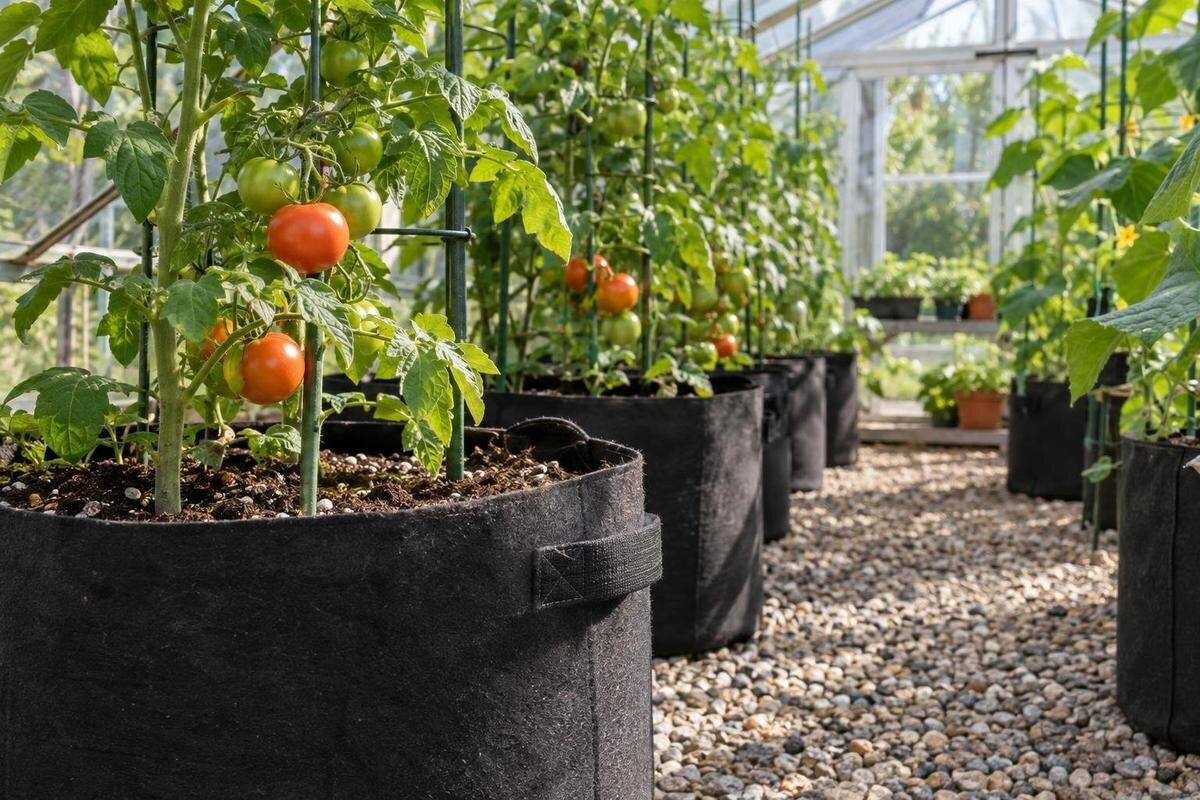
Grow bags can make a greenhouse layout easier to change, but the number of bags says little about how much root room they provide. Compare the medium actually held by each bag with the volume of a permanent bed, then test both layouts for crop spacing, drainage, watering and support. The example uses stated, hypothetical dimensions you can replace with your own.

Choose the crop before choosing a bag
Begin with the crop you plan to grow, not a bag size that happens to be on hand. Root-room needs vary with crop, variety, plant count and how long the crop stays in place. A short-season leafy crop and a large, long-season fruiting plant should not be assumed to share a container rule. Check reliable crop or variety guidance for recommended growing-medium volume and spacing, and note whether a figure refers to one plant, one container or a square metre of bed. Those measures are not interchangeable. Check that the recommendation concerns container growing rather than open-ground spacing; where advice gives a range, record its conditions instead of turning it into a universal minimum.
Distinguish the bag’s outer footprint from the volume roots can use. A wide opening does not tell you how deep the filled medium is; flexible sides may taper, and the planned fill line matters. Record both the bag footprint and filled volume per bag, then calculate the total for the row. A seller’s capacity may be quoted to the brim or calculated from an empty bag’s dimensions, so compare it only when its measurement basis is clear. Greenhouse size comes next: the Classic greenhouse range is listed from 3.77 m² to 28.08 m², but that range does not replace the selected model’s plan. Check actual interior dimensions before allocating beds, bags and access.
Measure the volume that will be filled
To estimate a rectangular bag, multiply its inside length by inside width by the medium’s filled depth. Keep all measurements in centimetres, then divide cubic centimetres by 1,000 to get litres. For a hypothetical bag with an internal filled space of 40 × 40 × 30 cm, the calculation is 48,000 cm³, or 48 L. At the same footprint and a 25 cm fill depth, it holds 40 L: a five-centimetre difference changes the comparison by 8 L. These numbers are arithmetic examples, not crop recommendations. Use the depth you will actually fill to, after settling the medium in line with its instructions, rather than the empty bag’s maximum height. Record inside measurements separately from outside measurements so the two do not get mixed up.
Flexible or tapered bags are not perfect rectangular prisms, so multiplying their widest measurements can overstate usable volume. Use a maker’s stated growing capacity if it defines the fill line, or measure the amount added at the intended level with a container marked in litres. For a permanent bed, measure inside its boundaries and use length × width × finished depth. A bed 0.8 m wide, 2.4 m long and 0.25 m deep holds 0.48 m³, or 480 L. If the surface is uneven or divided into different depths, calculate sections separately rather than using one guessed depth. A top-area figure by itself cannot compare root volume.
Match bag volume to plant count and spacing
After finding volume, decide how many plants will share it. A 48 L bag assigned to one plant contains 48 L in the simple arithmetic sense; two plants share the same 48 L, not 48 L each. That division still does not prove either arrangement is suitable: roots do not use every part of a container equally, and plant demand changes with crop, variety and growing period. Follow crop-specific advice for both volume and spacing, and look for the stated number of plants per container. Where advice gives only row spacing or bed density, preserve that measure rather than presenting it as a container-volume recommendation. Include whether the crop will be pruned or supported if that affects its spacing guidance.
Then compare the space occupied by the bag at its opening and base with the spacing needed above ground. A bag may fit neatly on paper while stems, foliage or a support occupy the aisle later; leave room to reach and harvest without stepping over containers. Mark plant centres as well as bag edges: edge-to-edge container spacing is not the same as the recommended distance between plants. Keep bag count separate from plant count; put more than one plant in a bag only when the crop guidance supports it. For a greenhouse sold with storage, such as the Limited-Edition greenhouse with built-in storage, use the selected plan to separate storage, growing and access zones. Do not count the total floor area as planting space.
Worked layout: 20 bags compared with two beds
Here is a volume-only comparison using a hypothetical clear interior 3.0 m long by 2.4 m wide. Set two side strips, each 0.8 m wide and 2.4 m long, with a 0.8 m centre aisle running the full 3.0 m length. The beds stop 0.3 m short of each end. At a finished depth of 0.25 m, each bed holds 0.8 × 2.4 × 0.25 = 0.48 m³, or 480 L; both hold 960 L. These margins are illustrative, not a standard path or door clearance. Redraw them around the actual entry, wall fittings and routine access.
Now use hypothetical bags with a 40 × 40 cm footprint and a 30 cm filled depth: 48 L each if the filled space is rectangular. Put ten in each strip, two across and five along; they occupy 0.8 × 2.0 m, leaving 0.4 m within each 2.4 m growing strip. Twenty bags total hold 960 L, matching both bed volumes on paper. This is a root-volume comparison, not a recommendation to plant twenty crops; crop spacing may leave bag positions unused. Real bags can taper, so measure each capacity. Lean-To Greenhouses are listed from 3.69 m² to 14.34 m²; use the selected plan to check dimensions rather than assuming it matches this example.
Give drainage a clear route
Drainage depends on both the bag and the surface beneath it. Confirm that the container is intended for growing and that water can leave it through its provided openings or design. Set it on a surface where runoff will not pool around roots, damage a finish or block a greenhouse drainage route. A closed tray may catch drips but can also hold standing water; check it and empty collected runoff rather than leaving the bag sitting in it. On an unpaved floor, inspect how water moves through the ground instead of assuming the covered site drains like an open garden. Keep each bag’s designed outlet unobstructed.
Before filling every bag, place one in its final position and water it to see where runoff travels; use the same base or tray arrangement you intend to keep. This can reveal low spots and conflicts with walkways before a crop is in place. Make sure an outlet or gap is not sealed by flooring, a liner or stored items, and avoid directing water toward a door or foundation. Filled bags can be awkward to shift, so settle the layout first. The limited-edition greenhouse range is listed from 3.77 m² to 28.08 m²; check the chosen configuration together with the site’s drainage routes when deciding where to place containers.
Water each container as its own root zone
Water management changes when a continuous bed becomes many separate root zones. One bag may respond differently from the next because fill level, growing medium, exposure and plant size differ; the surface can look damp while the deeper medium is not, or the reverse. Do not assume one fixed schedule will suit every container or that the edge of a bed represents its centre. Check moisture where roots are growing, and observe several containers across the layout, especially after conditions change. Use crop-specific watering guidance and the medium’s instructions rather than copying a calendar from another greenhouse. A covered space also receives little or no direct rainfall, so include irrigation in the plan.
Lay out water access before planting. Mark the supply point, route hoses or lines where they will not trip the gardener, and keep controls reachable without moving heavy containers. If each bag is watered separately, keep a simple row map so containers at the back are not missed. If you use an irrigation system, follow its instructions and confirm that delivery reaches each position evenly; a floor plan alone cannot establish flow or coverage. Where crops or media have different needs, consider whether the arrangement lets you manage them separately. The Spacious Greenhouse range is listed from 47 m² to 70 m²; on a selected large layout, draw the water route as well as the bag count, since the area figure does not indicate an irrigation setup.
Plan crop supports independently of the frame
Tall or climbing crops need supports planned while the floor is still open. Identify plants that need stakes, cages or a trellis from crop guidance, then mark where each support base will sit. In a grow bag, a narrow footprint and a taller plant can make stability an issue. Consider how the bag and support will behave once the medium is wet and the crop is mature, rather than judging stability from an empty bag. Use a support suited to the crop and container, without blocking drainage openings or narrowing the aisle. Install or position it before roots and foliage make access difficult. A permanent bed may give more options for separate supports, but the anchoring method still has to suit the support and site.
Do not assume the greenhouse frame can carry a trellis, tensioned wire or crop weight. Tension itself can place demands on a structure. Ask the greenhouse manufacturer which fixing points, if any, are intended for that use; have a qualified professional assess a support design if its anchorage or loads are uncertain. The T-shaped orangery options are listed from 16.52 m² to 30 m², but those area figures describe size, not a structural rating. Keep crop supports independent unless their attachment has been expressly approved.
Compare the flexibility of bags with a permanent bed
Grow bags make it easier to separate crops, change the growing layout or replace one portion of medium without turning a whole bed. This can suit a temporary arrangement or crops you prefer to manage in individual containers, but the convenience comes with more edges, more units to fill, and more individual watering and drainage points. Bags may be easier to carry empty than full; do not make a plan that depends on shifting wet, planted containers to reach another row. Check the maker’s directions before reusing or disposing of a bag, especially if its past contents or intended use are unclear.
A permanent bed gives one continuous growing area and fewer separate containers to manage, but its footprint is fixed and the full volume must be filled and maintained as one zone. It may suit crops that remain in consistent rows when the planned depth and growing medium fit their needs; bags may suit a layout where separation or later reconfiguration matters more. Compare both by root volume, not just surface area. The Prestige greenhouse range is listed from 3.77 m² to 28.08 m²; use the specific plan to compare an accessible continuous bed with rows of bags.
Draw the usable floor plan to scale
Scale the final drawing to the chosen interior, including the places where people and equipment need to pass. Mark door clearance, the centre aisle, bed or bag footprints, expected canopy, support bases, water routes and any shelves or storage before choosing a container count. Measure clear inside dimensions rather than relying on an overall floor-area figure: two plans with equal square metres can place their doors, corners and useful working space differently. If a row ends near an entry, draw the actual opening and approach, not a rectangle that covers it. Include the space needed to reach vents or fittings you will routinely use.
An irregular outline needs its own drawing; do not force it into a rectangle because an area total looks convenient. The Pyramid greenhouse range is listed from 5.53 m² to 18.9 m²; check the plan for the exact model against your proposed bed edges, bag positions and aisle limits. If a bed would leave an awkward corner beyond reach, compare a shorter fixed bed with modular bags there, while retaining crop spacing and support clearance. Keep drainage routes and floor-level changes in the drawing too, so a corner that looks available does not obstruct runoff or access.
Check the full growing plan before buying
Before ordering bags or filling a bed, write the comparison in one place: measured fill volume per container, container count, total litres, bed dimensions and total bed volume, crop-specific plant count, and clear access dimensions. Note the fill depth you assumed and whether each bag capacity is quoted or measured. Keep bag footprint separate from the number of plants that can fit, and list supports, hoses and shelves as space users. If crop guidance or the chosen greenhouse dimensions change, redo the count instead of carrying forward an old layout. A short record helps prevent fitting containers to the floor while leaving too little root room, or providing plenty of medium while crowding out the path needed to maintain it.
Confirm the selected greenhouse model’s exact size and layout with its current plan, then resolve questions about the floor, drainage, frame attachments or base with the relevant manufacturer or a qualified professional. Once the layout is fixed, calculate growing medium from finished internal measurements and check the purchase volume against the supplier’s capacity and fill instructions. Revisit the drawing before adding more bags; an apparently small increase can narrow the aisle or remove the only practical route to water and harvest the crop.
Frequently asked questions
How do I calculate a grow bag’s volume?
Measure the inside dimensions at the planned fill line. Multiply length × width × filled depth, then divide the result in cubic centimetres by 1,000 to get litres. For a tapered bag, use a clearly defined growing capacity from the maker or fill it with measured volumes to the intended level.
Does a 48 L bag provide the same root room as 48 L of bed soil?
The volumes are equal if measured consistently, but the root zones are not identical. A bed offers a continuous growing area; separate bags have individual walls, depths and drainage patterns. Use equal litres for comparison, then check crop-specific guidance for depth, spacing and container use.
Can I put grow bags directly on a greenhouse floor?
Only if the container and floor arrangement allow drainage without standing water or directing runoff somewhere it could cause damage. Check the bag maker’s instructions and the greenhouse or floor guidance. Test one bag in its final position before filling the whole layout.
How many plants can go in one grow bag?
There is no universal count. It depends on the crop and variety, usable bag volume, growing period, plant spacing and support needs. Follow guidance that explicitly refers to growing that crop in containers; do not treat a row-spacing figure as a per-bag recommendation.
Can I attach crop supports to the greenhouse frame?
Only if the greenhouse manufacturer identifies an attachment point and approves that use. Floor area and model name do not state frame capacity. Use a suitable independent support otherwise, and consult a qualified professional if the anchorage is uncertain.
The useful comparison is not bag count against bed area, but measured medium volume inside the footprint you can actually reach. Work from crop-specific root and spacing guidance, convert both systems to litres, then redraw the layout with paths, water routes, runoff and supports. Even when the volumes match, depth, continuity and daily management still differ; choose the system that suits the crops and the way you will care for them.
