
How to Grow Kohlrabi in a Greenhouse
Cool-season crop guide
Kohlrabi is a cool-season brassica that forms a crisp, swollen stem just above the soil. A greenhouse can help you bring a spring sowing forward or keep a fall crop sheltered for longer, but it does not make this crop a heat lover or guarantee frost-free conditions. The most reliable results come from sowing in small batches, giving each plant room to swell, keeping moisture steady and harvesting before stems become oversized. Use local weather, greenhouse temperatures and seed-packet timing together rather than relying on one fixed calendar.

Why grow kohlrabi under cover?
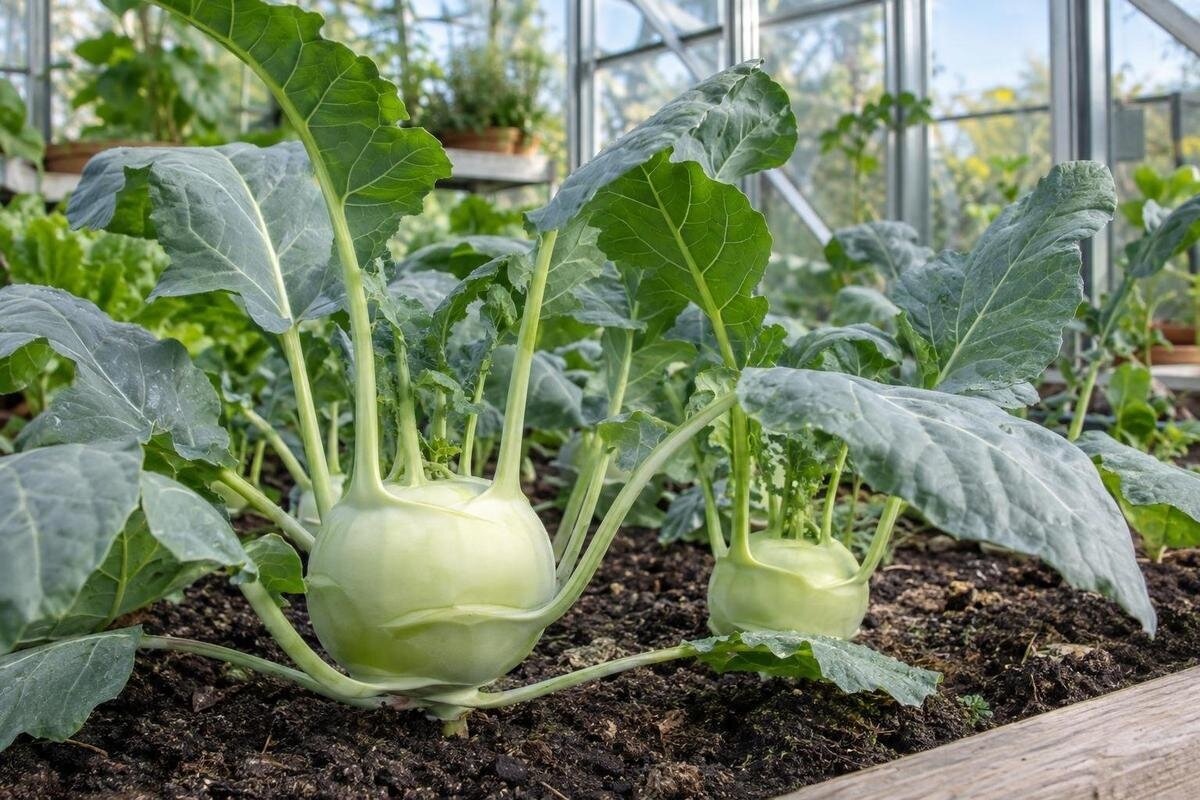
Kohlrabi belongs to the cabbage family, but the part you harvest is neither a root nor a head of leaves. Its stem swells above soil level into a round or slightly flattened shape, with leaves growing from the top. Treat it as a cool-season vegetable: it grows well when conditions are steady, but heat, drought or a long delay before harvest can affect quality. A greenhouse is most useful early and late in the growing season, when shelter and some control over sowing conditions can help.
An unheated greenhouse can buffer wind and moderate short temperature swings, but it can still become very cold at night. In sunny weather it may warm rapidly, so a crop that suits spring or fall conditions can struggle in a closed, hot greenhouse. If kohlrabi already grows well outdoors where you live, consider what you want the protected space to achieve: an earlier batch, a sheltered fall crop or a place to raise seedlings before a bed becomes available. For an initial size comparison, the classic aluminium greenhouse range offers areas from 3.77 to 28.08 m². These figures describe greenhouse area, not necessarily usable bed space or overnight growing conditions. Sketch the space needed for your intended batch alongside paths and other crops before deciding whether a larger structure would serve a useful purpose.
Set sowing dates by local conditions
For a spring crop, use your local last-frost date as a reference, not as a promise that a greenhouse bed is ready. Check whether the soil is workable and consider the overnight forecast: a roof does not warm the bed on its own, and prolonged cold can slow young plants. For autumn, count back from the expected maturity time on the seed packet, allowing for growth to slow as days shorten and temperatures fall. Cool weather suits kohlrabi, but a very late sowing may not have enough time to develop before conditions become difficult.
Check temperatures at crop height as well as outside. A sunny greenhouse can be warm during the day while the bed and air cool substantially overnight, particularly in an unheated structure. Keep early and late sowings modest until you know how your greenhouse behaves, and consider both ends of the day when deciding whether conditions suit another batch. A warm afternoon alone is not a reason to fill every available row. When comparing space for a short spring row and a later fall batch, the pyramid greenhouse sizes range from 5.53 to 18.9 m². Map where each crop would go at the time you expect to sow it. A bed that is free in spring may still be occupied when you want to start the fall crop, so the seasonal layout matters as much as the overall footprint.
Direct-sow or raise young seedlings
Direct sowing works well where the greenhouse bed is prepared and available. Sow seeds about 6 mm deep, or follow the packet’s depth, and keep the surface evenly moist while they germinate. Once seedlings have true leaves, thin them to the intended spacing. If several seeds have come up close together, snipping extras at soil level can avoid disturbing the roots of the plants you keep. Direct sowing also avoids the pause that can follow moving a seedling from a tray into the bed.
If bed space is occupied or you want to control the number of plants, start seeds in individual cells or small modules and transplant them while young, before roots become crowded. Set each plug so its original soil line is level with the bed; do not bury the swelling stem as it develops above the soil. Plan where the seedlings will go before sowing, rather than treating a full tray as a reason to crowd the bed. Trays also need temporary space that remains accessible for watering and checking growth. The greenhouse with built-in storage is listed in area options from 5.52 to 28.08 m². Compare the chosen layout with your bench and bed plan, including where trays will sit while the previous crop finishes. Keep the storage area, seedling bench and final planting space distinct when working out how much growing room you will have.
Kohlrabi spacing and bed access
For many standard varieties, plan for about 15–20 cm (6–8 in) between plants and roughly 25–30 cm (10–12 in) between rows. Treat these as starting points, not a substitute for the variety’s instructions: cultivars selected for larger stems may need more room. Crowding makes it harder for stems to develop evenly and leaves less space to reach plants for watering, thinning and harvest. For a bed planted in a grid rather than rows, check the variety’s spacing guidance in both directions instead of fitting plants tightly into the gaps between rows.
Plan the whole planting area, including a path or clear edge from which you can tend the crop. Leaves spread beyond the stem, so do not measure only the final harvest size or place plants where taller crops will shade them. Draw the rows at their intended spacing and count the planting positions that fit, leaving access outside that count. This gives you a more useful sowing quantity than estimating from the bed’s total area. The T-shaped orangery greenhouse is listed in area options from 16.52 to 30 m². Compare the selected internal layout with the beds, access routes and other crops you expect to include. Think about harvesting individual stems as well as reaching the whole row: you should be able to remove a ready plant without having to lean across neighbouring plants that still need time.

Prepare a fertile, well-drained bed
Kohlrabi grows best in soil that is workable, drains well and holds enough moisture for steady growth. Break up compacted areas before sowing, remove weeds and avoid working soil when it is saturated. In a greenhouse bed used repeatedly, a soil test can guide decisions about pH and nutrients; avoid adding lime or fertilizer by guesswork. Mature compost can help improve soil structure where needed, but it should not be treated as a complete substitute for checking what the bed requires.
Aim for balanced growth rather than a heavy application of fertilizer. Excess nitrogen can encourage abundant leaf growth without solving problems caused by crowding, heat or inconsistent watering. Brassicas also need a rotation plan: avoid growing kohlrabi year after year in the same bed or following other cabbage-family crops in that spot. Include previous crops when drawing your layout, not just the vegetables you intend to grow this season. Several separate beds are useful only if your planting plan actually moves the brassicas between them. The Prestige greenhouse with a metal base is listed in area options from 3.77 to 28.08 m². Compare the selected dimensions with the bed arrangement you have in mind, including which bed could take a later kohlrabi crop. The metal base does not, by itself, specify planting-bed depth or the amount of usable growing space.
Manage heat and moisture
Greenhouses can heat up quickly on bright days, even when outdoor weather still feels cool. Use a thermometer near the crop and check conditions at different times rather than judging by the temperature at the door. Ventilate according to the openings and instructions for your structure when the air is getting too warm. Do not assume that a greenhouse size, style or covering will keep kohlrabi cool, or that an unheated house will hold a safe temperature overnight.
Water the bed consistently so growth does not alternate between dry and saturated conditions. Check the soil itself and water when it is beginning to dry; a fixed schedule can miss changes in weather and greenhouse heat. Water near the soil rather than repeatedly wetting foliage, and make sure excess water can drain away. Arrange the bed so you can check moisture along the row, not just at its easiest-to-reach end. This becomes especially relevant when other crops or benches share the space. The lean-to greenhouse range covers area options from 3.69 to 14.34 m². When comparing a specific option, consider access for watering alongside its ventilation details. Neither the listed area nor the greenhouse style tells you how warm the crop will become, so base your watering and ventilation routine on conditions around the plants.
Use small succession sowings
A single large sowing can leave you with more mature stems than you can use at once. Instead, try a small batch every two to three weeks during the cool part of the growing season. The interval is a guide: adjust it to the variety’s stated maturity time, the light and temperature in your greenhouse, and how quickly you use each harvest. If the house stays hot through midsummer, pause sowing rather than raising seedlings that will struggle while you wait for conditions to improve.
Each batch needs enough room to reach its final spacing, so plan the next row before filling a tray with seed. Base the number of plants on how many stems you want from that batch, then reserve a separate space for the following sowing. Do not rely on harvesting the entire first row on one date, since individual plants may mature at different rates. In a greenhouse shared with other crops, mark out the kohlrabi area and consider whether taller plants will shade it later. The spacious greenhouse options range from 47 to 70 m²; kohlrabi itself does not require a structure of that size. For a mixed-crop layout, show each batch separately on the plan, together with paths and access. This makes it easier to see whether your proposed sowing interval is practical or would leave young plants waiting for an occupied bed.
Check for brassica pests and disease
A greenhouse is not automatically pest-free. Aphids can gather on young growth, flea beetles may damage leaves, and caterpillars can feed on brassicas if they get inside. Check leaf undersides and the growing point regularly, especially while seedlings are small. Remove visible pests by hand where practical, and use insect mesh only if it suits the structure and does not interfere with ventilation. Inspect new plants before bringing them into the greenhouse so you are less likely to introduce pests with them.
Keep brassica rotation in mind when a greenhouse bed is affected by persistent disease. Clubroot is one reason to avoid repeatedly growing cabbage-family crops in the same soil; rotate to a different bed where possible and clean tools after working in affected areas. Unusual wilting, poor growth or swollen roots can have more than one cause, so seek local horticultural advice if the problem is unclear. Keep track of which bed showed the problem when planning later batches, rather than treating all greenhouse soil as interchangeable. If you are comparing layouts, the limited-edition aluminium greenhouse range spans 3.77 to 28.08 m². Draw the separate beds and their crop sequence to assess whether rotation is practical. A larger footprint alone does not create a rotation plan, and moving a sowing to another part of the same repeatedly planted bed may not achieve the change you intended.

Harvest before stems become oversized
The swollen stem is the harvest cue, not the height or fullness of the leaves. For many standard varieties, harvest when it is about 5–8 cm (2–3 in) across; check the seed packet for cultivars expected to grow larger. Smaller stems are usually more tender, while leaving plants too long, especially through heat or dry spells, can lead to coarser texture. Check plants regularly once swelling starts so a ready batch does not sit in the bed while you wait for every stem to reach the same size.
Cut each plant at soil level with a clean, sharp knife, taking care not to damage neighbours that need more time. Young kohlrabi leaves are edible, but avoid stripping leaves from plants you want to keep growing. If stems in one sowing mature at different rates, harvest selectively and let the smaller ones continue. Note the size and date of the first good harvest; that information can help you adjust the next sowing and avoid leaving later batches in the greenhouse too long.
Use each harvest to improve the next sowing
A kohlrabi plant gives you one swollen stem, so plan plant numbers around how much you expect to use rather than assuming each plant will produce several harvests. A short first row is a practical way to learn how quickly your chosen variety grows in your greenhouse and how many stems your household wants at once. If you are unsure, stagger a second small sowing instead of planting a full bed on the first attempt. This keeps the harvest manageable and makes it easier to notice differences between batches.
Keep a brief record of the variety, sowing date, germination, final spacing, greenhouse temperatures and harvest size. If stems are small, review spacing, light and growing conditions before adding fertilizer. If they are coarse, consider whether they stayed in the bed too long or went through heat or dry soil. Change one factor at a time in the next batch where possible. That makes your own greenhouse observations more useful than repeating the same calendar dates regardless of season.
Frequently asked questions
Can I grow kohlrabi in an unheated greenhouse?
Yes. Kohlrabi suits cool growing conditions, and an unheated greenhouse can shelter it and warm up on sunny days. It can still get very cold overnight, though, so use your local forecast and check the bed rather than assuming the structure prevents frost.
How far apart should kohlrabi plants be?
For many standard varieties, allow about 15–20 cm (6–8 in) between plants and roughly 25–30 cm (10–12 in) between rows. Follow the seed packet if it calls for more room, especially for a variety bred to grow larger.
How often should I sow kohlrabi for a steady harvest?
Try small sowings about two to three weeks apart while conditions remain cool enough for steady growth. Adjust the interval to the variety’s stated maturity time and your household’s use; pause during a hot spell rather than raising seedlings that will sit in poor conditions.
Why has my kohlrabi turned woody?
Stems can become coarse when they are left too long, particularly if plants have also experienced heat, drought or uneven growth. Harvest standard varieties while the swollen stems are still modest in size, and check the packet for guidance on cultivars that grow larger.
Can kohlrabi grow in the same greenhouse as tomatoes?
They can share a greenhouse if there is enough bed space and light, but their timing differs. An early kohlrabi crop may be ready before tall tomato plants fill the space. Avoid leaving it shaded beneath a dense canopy, and keep its cool-season needs in mind.
Tender greenhouse kohlrabi depends less on extra heat than on a well-timed cool-season window. Give plants enough space, avoid sharp swings between dry and wet soil, and repeat modest sowings only while conditions favour steady growth. Check the swollen stems as they develop and harvest them while they are still small and tender. Your notes on timing, spacing and harvest size will make the next batch easier to plan.
