
What Causes Greenhouse Peppers to Drop Flowers?
Greenhouse crop guide
Greenhouse peppers can shed blossoms when pollination fails, root moisture shifts between dry and saturated, or the plant is coping with heat, cold or transplant stress. But a fallen petal is not always a failed flower: a tiny green pepper may already be growing at its base. Start by checking what actually fell, then compare the timing of the loss with temperature and watering records. Flower drop is a symptom, not a single diagnosis, and several stresses can overlap in a greenhouse.

Greenhouse planning check 1
Check whether the flower or just its petals fell
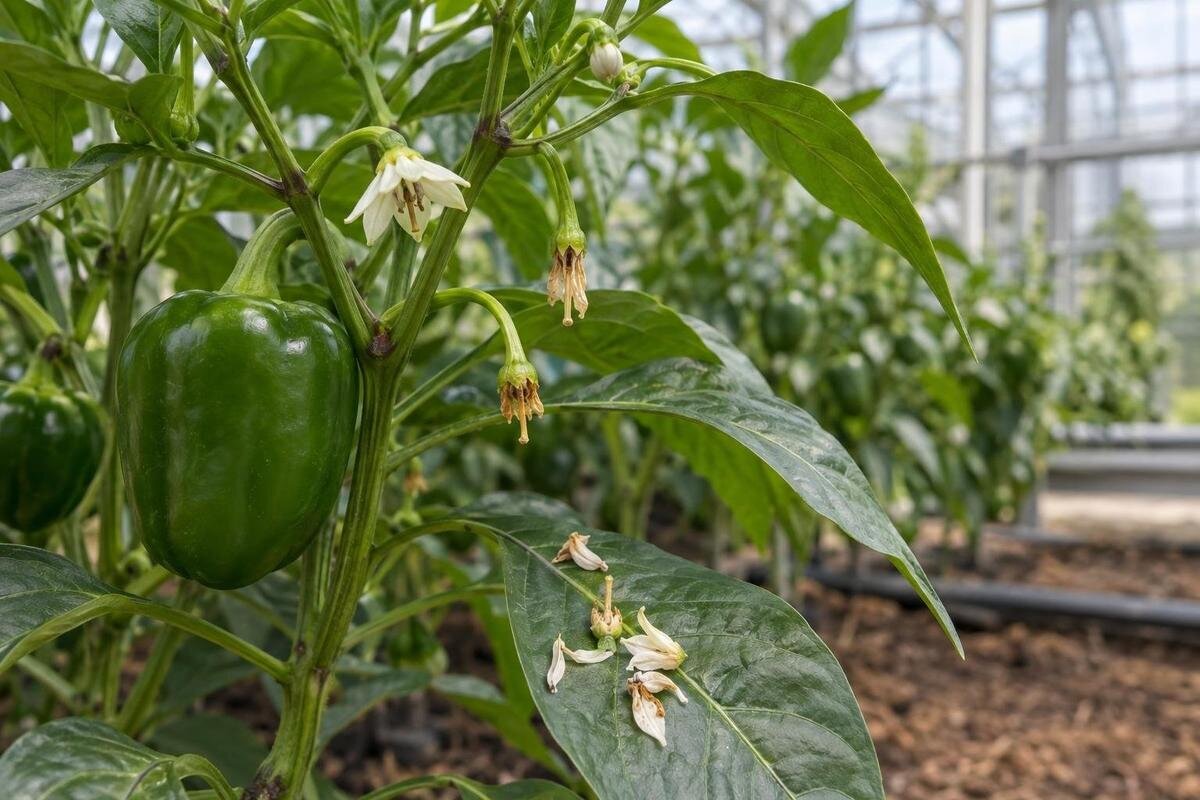
Pepper petals shrivel and fall after flowering; if the ovary at the flower’s base remains and starts to swell, fruit has set. Look closely where the flower joins its stalk, because a very small green pepper can be hidden among the leaves. If only the coloured corolla (the petals) has fallen, the crop may be developing normally. By contrast, a whole flower that detaches without a swelling ovary, or a tiny fruit that turns yellow and falls soon afterwards, points to failed set or early fruit abortion. A set fruit should continue to enlarge, although stress can slow its growth.
Check several blossoms rather than judging one. Note whether the flower stalk remains attached, whether an ovary begins to enlarge, and whether losses are limited to one branch or repeated across the plant. Separate your observations into petals falling, whole flowers detaching and tiny fruit dropping; combining all three under “flower drop” can make the pattern harder to interpret. Take dated close-ups of an attached flower and a fallen one, plus a wider photo showing the plant; use a similar angle when comparing them later. Revisit the photos over several days to see whether new flowers are affected or small peppers are developing. Occasional losses, particularly after transplanting, do not prove a deficiency or disease. A consistent pattern is more useful than a single fallen bloom, so leave other flowers in place to observe. Include flowers that develop normally in your notes, not only those that fall.
High daytime heat can disrupt pepper fruit set
Greenhouse temperatures can climb well above the outdoor reading on a sunny day, even when the morning feels mild. Repeated daytime readings around 30–32°C or higher, especially when nights remain near or above 24°C, can interfere with pollen function and fruit set. Treat those numbers as warning ranges, not exact cut-offs: cultivar, sun exposure and duration all matter. A short spike may have a different effect from several hot days in succession, and leaves can look healthy even while flowers fail to hold. Match temperature records to the days the affected flowers opened and dropped; that timing makes heat a more or less plausible explanation. Record whether each high reading was brief or persisted through the afternoon. When comparing two plants, use readings near each one rather than assuming the same maximum applied to both. This helps distinguish a shared hot period from a warmer pocket within the greenhouse.
Place a min–max thermometer or logger near the pepper canopy, away from a wall, roof or open door that may distort the reading. Record the hottest part of the day and the overnight low, not just one convenient afternoon check. A large greenhouse can have warmer and cooler pockets, so measure near the affected plants if losses are concentrated in one area. If heat builds quickly, ventilate before the peak when outdoor conditions allow; consider shading cautiously so plants still receive adequate light. If a new structure is already on your list, the lean-to greenhouse options are one product range to compare by footprint; check its specific opening details and site exposure rather than assuming the style prevents heat.
Greenhouse planning check 2
Cool nights and fast temperature swings matter too
Peppers are warm-season plants, but cold nights can also interrupt flowering and fruit set. Repeated night readings below roughly 15°C may slow pollen function and fruit development; a warm afternoon does not cancel a cold overnight period. Conditions after transplanting can be especially revealing because a cool root zone and changing light add to the adjustment. These are broad clues, not a universal cut-off: cultivar, duration and plant health change the response. A few cool hours and several cold nights are not equivalent, so check the minimum where flowers are rather than relying on the outdoor forecast or a sensor near the entrance.
Compare cold-night records with the dates and locations of losses. If plants beside a door, vent or outer wall are affected first, note that distribution; it suggests a local pattern worth investigating, not a diagnosis by itself. A greenhouse does not automatically maintain an even night temperature. The Limited Edition Aluminum Greenhouses listing includes area options from 3.77 to 28.08 m², but footprint alone says nothing about overnight warmth. Check relevant product details and conditions at your site before choosing a structure for peppers, and continue measuring at crop height after any change.
Humidity and still air can limit pollen movement
Most pepper flowers are self-fertile, so a greenhouse does not need bees to pollinate every blossom. Pollen still has to move from the anthers to the stigma, and gentle vibration can help. Very humid, stagnant air can make pollen less free-flowing; very hot, dry air can also damage pollen or flowers. Pollinating insects may assist, but their absence alone does not explain a whole-house problem. Because humidity and temperature stress can occur together, blossom drop by itself cannot show that pollination is the only issue. Compare conditions around flowers that set fruit with those around flowers that fall. If both groups share the same still air, that observation alone does not distinguish them. Keep temperature and moisture observations alongside any notes about flower movement rather than treating gentle tapping as a complete diagnosis.
Look for lingering condensation and air that barely moves around the foliage. Improve general circulation and reduce persistent dampness without creating a cold draft or directing strong airflow at a single plant. When flowers are dry, gently tap a flowering branch or move the plant lightly; this may help pollen shift, but it will not overcome temperature stress or an unhealthy bloom. The T-shaped orangery greenhouse listing gives area options from 16.52 to 30 m²; when comparing it, check any available plan and ventilation details rather than inferring air movement from the model name.

Greenhouse planning check 3
Low light and crowded foliage can weaken flowering
Light affects a plant’s capacity to keep flowering, even if it is not the only cause of a falling bloom. Cloudy stretches, nearby trees, dirty glazing and a dense canopy can reduce light at flower sites. Look for long, weak stems, sparse buds or a clear difference between the sunny and shaded sides, while remembering that each sign can have other causes. Crowded leaves also restrict air movement and make it harder to inspect flowers. Check light over the whole day, since a brief midday view may miss the hours when a wall or trees shade one side.
Observe both outer and inner branches before trimming; removing too much foliage at once can expose fruit and change the plant’s water demand. Arrange plants using the growing instructions for the variety rather than applying a universal spacing number. If you are comparing greenhouse forms, the Pyramid Greenhouse is one product listing to assess against the actual site. Its name or listed footprint cannot show how much light reaches peppers, so check glazing details, surrounding shade and orientation before treating structure choice as a light solution.
Uneven watering and saturated roots can stress blossoms
Flower and bud drop can follow sharp changes in root-zone moisture. A pepper that dries out during a hot spell and is then soaked, or sits in poorly drained, waterlogged medium, may not support flowers reliably. The top of a pot can look damp while the lower mix has dried, so check below the surface; in beds, consider both drainage and moisture where roots are active. Containers may dry faster than garden soil, but a fixed daily schedule ignores differences in pot size, plant growth and greenhouse heat. Blossom loss can occur even when there is no obvious wilting. Compare affected and unaffected plants using the same moisture-checking method, and note when each was last watered. A reading taken just after watering is not directly comparable with one taken before watering. Follow the change between checks so you can distinguish a consistently wet root zone from one that repeatedly dries out.
Use a consistent method and adjust watering frequency according to root-zone moisture and changing weather; aim for evenly moist medium, not constant saturation. Water at the base where practical, and make sure excess can drain. Note whether hot days or a new fruit load change how quickly the mix dries. If built-in storage matters to your greenhouse plan, the Limited-Edition Aluminum Greenhouses with Storage page is one product reference to compare; confirm the selected growing area and water access. Storage does not stabilize root moisture, and extra fertilizer is not a substitute for checking the roots.
Greenhouse planning check 4
Fertilizer problems need more evidence than flower drop
Nutrition can influence flowering, but falling flowers alone cannot identify a deficiency. Too much nitrogen may drive leafy growth at the expense of flower production; low nutrient availability, root damage, waterlogging or salt buildup can also reduce vigour. Pale leaves or unusually lush growth add context, but neither proves the cause without checking the root environment. Look at growth across the whole plant, including new leaves. Avoid responding with stronger fertilizer, a calcium supplement or a complete feed simply because blossoms have fallen. Blossom-end rot is a fruit symptom, not evidence that flower drop needs calcium.
Review the fertilizer label, dose and timing, including recent changes, and consider a suitable soil or growing-medium test when nutrition is plausible. For container peppers, assess the medium used for that container system; in beds, follow appropriate soil-test guidance rather than copying a recipe from another garden. If you are also planning space for beds or pots, the Prestige Greenhouse listing offers footprints to compare with your proposed layout. Keep that purchasing decision separate from feeding adjustments: use the plant observations, feeding history and test results to decide what needs changing. Then watch new growth and the next flush of flowers.
Transplant stress and fruit load can affect new flowers
Recently transplanted peppers may shed early flowers while their roots adjust to a new pot or bed. A sudden change in light, temperature or watering can compound that stress, and a small plant may flower before it has enough established growth to support fruit. If leaves and stems recover and later blossoms hold, a short early loss may be less concerning than a pattern that continues. Avoid stripping every flower or adding fertilizer by default; check whether the plant is establishing and producing healthy new growth. Comparing it with an older plant nearby can help distinguish a transplant response from a greenhouse-wide issue. Record the transplant date and any changes in position or care at the same time. If every newly moved plant loses flowers but established plants continue setting fruit, keep that contrast in your notes; it is more informative than comparing plants of different ages without their recent history.
An existing crop of peppers also uses water and sugars, so a stressed or heavily loaded plant may shed some new flowers or tiny fruit. Harvest ripe pods and note whether the next flowers hold, but remember that harvesting cannot correct heat, moisture or pollination problems. Crowding can occur at any scale if too many plants fill the floor. The Spacious Greenhouse listings run from 47 to 70 m²; use the chosen footprint and a real plan to decide plant count and access, rather than assuming a larger greenhouse prevents blossom drop.

Greenhouse planning check 5
Pests and disease usually bring other visible clues
Pests or disease deserve attention when flower drop comes with other changes. Inspect buds, flower stalks and the undersides of leaves for thrips, aphids or mites; look for scars, distorted growth, stippling or fine webbing. Those signs point to different possibilities and still need confirmation. Brown, soft or mouldy flowers after prolonged dampness differ from a cleanly detached bloom. Wilting or damage across new leaves, stems or roots is a reason to examine the whole plant, rather than treating flower loss alone as an infection. Note whether symptoms are spreading or isolated to one plant.
Take dated photos of the whole plant, the flower attachment point and affected leaves; include a healthy plant for comparison when possible. Photos show progression, but a single image rarely proves a pest, disease or nutrient cause. Pair close-ups with notes about which plant and branch they show, so a damaged leaf is not mistaken for a new symptom elsewhere. Keep the original images when taking follow-up photos; comparing the same area is more useful than collecting unrelated close-ups. If symptoms spread or plants decline despite stable care, ask a local horticultural diagnostic service to identify the problem before applying a pesticide or making major feeding changes. When planning inspection access in a new structure, the aluminum greenhouse options list areas from 3.77 to 28.08 m². Compare the selected footprint with your bed or pot layout to check whether you can reach the foliage, including plants along the sides.
A simple log helps test the likely cause
Keep a compact log for several flower cycles: daytime high and overnight low at canopy height, watering, persistent condensation, feeding, transplant or pruning dates, and which blossoms or tiny fruit actually fall. Mark plants by position, then compare the sunny end, the centre and the shaded edge. Loss in one zone may point to a local hot spot, draft, water problem or crowding. Similar losses across the greenhouse make shared temperature or care changes more plausible, but still do not prove one cause. A consistent paper chart is enough; useful notes matter more than elaborate equipment. Use the same plant labels in the chart and your photos, and distinguish a missed reading from a normal one. Include successful fruit set alongside losses so the record shows whether the problem is widespread, confined to particular plants or becoming less frequent.
Choose one correction supported by the record, such as cooling a hot peak, evening out root moisture, reducing crowding or checking suspected nutrient trouble with a test. Change one factor at a time where practical, then assess flowers that open afterwards and whether their ovaries swell. Detached flowers will not recover, so judge the next flush rather than waiting for a fallen bloom to return. If no clear pattern appears or symptoms worsen, bring your notes and photos to a horticultural adviser. Several interacting stresses may need to be considered together.
Frequently asked questions
Do pepper flowers normally fall off?
The petals normally wither and fall after flowering. If a small green ovary remains at the base and begins to grow, the pepper has set fruit. A whole flower falling without a developing fruit is a different sign.
Can heat alone make greenhouse peppers drop flowers?
High daytime temperatures and warm nights can reduce pollen function and fruit set. Heat is not the only explanation, though. Compare temperature readings with the timing of the losses, and also check root moisture and the plant’s stage of growth.
Do greenhouse peppers need bees to set fruit?
Usually not. Pepper flowers are generally self-fertile, and pollen can move within a flower. Gentle movement may help, but a lack of pollinating insects alone does not explain every failed blossom.
Should I add fertilizer when blossoms fall?
Not without evidence of a nutrient problem. Too much nitrogen can favour leafy growth, while root, temperature or water stress can also affect flowering. Review feeding history and test the soil or growing medium before adjusting.
Will a fallen pepper flower grow back?
No. A detached flower will not reopen or set fruit. Watch the next flowers for a swelling green ovary, and use their progress to judge whether conditions have improved.
Work from the flower outward: confirm whether only petals fell, check minimum and maximum temperatures near plant height, and compare affected blooms with watering, humidity, plant age and signs on leaves. Adjust the factor best supported by your observations, then judge progress from the next flush of flowers. Peppers can recover when conditions stabilize, but a dropped bloom will not reopen or set fruit; careful tracking shows whether the greenhouse is once again supporting new fruit.
