
Planning a Greenhouse Around Pets: Access, Plants and Equipment
Greenhouse guide
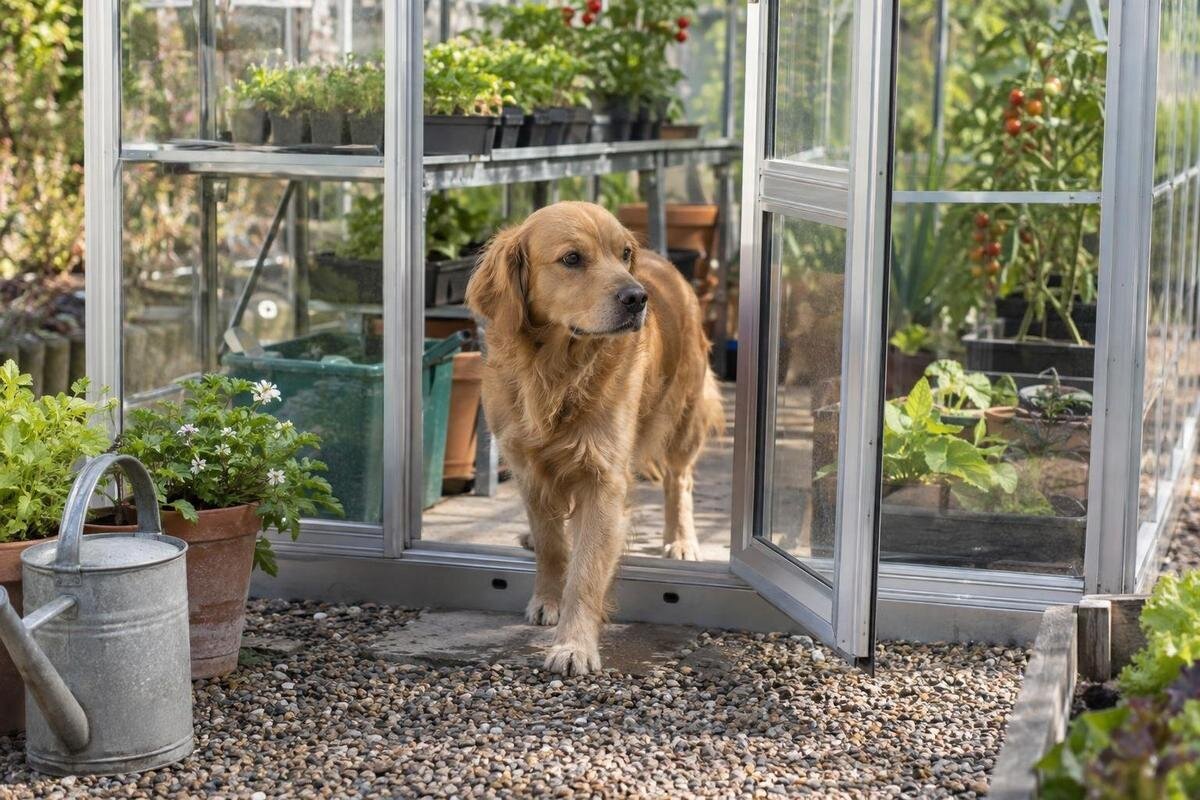
Planning a greenhouse in a home with pets takes more than choosing plants. A curious animal may follow a familiar route, push past a barrier, climb towards foliage or investigate items left on a work surface. The relevant concerns vary with the animal, the layout and the products in use, so a broad “pet-safe” label is not a complete plan. Start with everyday access: who opens the door, what a pet can reach, and where supplies and equipment will be stored. Then confirm plant identities and product instructions with veterinary and manufacturer sources before settling on a layout.

Map the full route to the greenhouse
Walk the route from the house to the greenhouse at the times pets normally use the yard. Draw gates, paths, patio doors, fences, shortcuts and the spots where someone might leave a door open while carrying trays or watering supplies. Mark the greenhouse entrance and the space needed to approach it; a barrier across the busiest path can be so awkward that household members stop using it. Compare formats such as a Pyramid Greenhouse only after sketching the route and measuring the footprint. Add the approach to that sketch, rather than measuring only the space the structure will occupy. Picture someone arriving with a tray, setting it down and opening the entrance: where would the pet be during each part of that task? Use these observations to identify the entrance details and barrier arrangements you need to discuss with the supplier.
Treat the boundary as a whole route, not a single doorway. Check whether a pet could approach from a side gate, neighbouring yard, garage or open house door, and whether an existing garden boundary suits that animal’s size and behaviour. Note what the individual pet does when a gate is open, a latch is within reach or a person is carrying something, rather than relying on a generic pet-proof label. If supervision is part of the plan, decide who will supervise and when. Don’t count the greenhouse as an animal enclosure simply because it is a greenhouse; ask for configuration details and assess the whole site.
Choose a location that supports controlled access
Choose a location that makes the intended boundary workable day after day. A greenhouse beside the main route between a pet’s resting place and a back door may create repeated opportunities to enter; a location behind an existing gate may be easier to manage, depending on the site and the animal. Note sightlines from the house and the usual gardening area, but treat visibility as a reminder rather than a barrier. Include side gates, garage doors and shared yard routes on the site sketch. Guests, children and deliveries matter too: a gate left open during yard work changes access even when the greenhouse door is closed.
If the proposed site is beside a wall, fence or patio, confirm clearances and access requirements for the exact greenhouse configuration before choosing a style. Include a Lean-To Greenhouse in the comparison if you are considering a wall-side location, but assess the particular wall and pet route rather than relying on the category name. On the sketch, mark any passage between the proposed structure and an existing boundary. Check whether people would need that passage for garden work and whether a pet could use it to reach the entrance from another direction. Your plan should show where people enter, where the pet stays during garden work, and what physical boundary remains when no one is watching. Compare possible locations using the same questions so an attractive position does not hide an awkward access arrangement. If no reliable boundary fits the site, reconsider the location or access plan.
Check the doorway, closure and opening routine
Ask for the dimensions of the selected entrance, the way its door opens, any threshold, and details about the available latch or closure. Plan whether a person can enter and close it without propping it open while carrying a tray or watering can. For a Classic Aluminum Greenhouse, use the current configuration drawing and ask what the supplied hardware is intended to do. Compare the entrance with the items you regularly carry, not just with the space needed for a person to pass through. Include a place to put those items down while operating the door, without blocking its movement or leaving supplies within the pet’s reach. Ask how the closure is operated from each side and which details apply to your chosen configuration. A photograph does not establish that a door resists pushing, pawing, climbing or chewing; describe your pet’s behaviour when discussing the entrance with the seller.
Think through moments when the door may stay open for ventilation, moving plants or bringing equipment inside. Decide whether a separate barrier is needed and, if so, confirm that it can be positioned without obstructing the door, creating an obstacle for people or conflicting with the manufacturer’s instructions. Consider who can close it from the normal approach, whether a pet could wait beside it, and how household members will check it after entry. The goal is a routine that works with hands full and with more than one person using the yard, not a rule that depends on remembering a complicated sequence.
Separate growing, work and storage areas
Separate growing, working and storage areas on paper before choosing a greenhouse. Draw the entrance, main path, benches, potting surface and places where tools or supplies would sit; use dimensions for the configuration under consideration. A route that looks clear on an empty plan can become blocked by trays, watering cans and growing plants. Include the space needed to retrieve supplies and return them after a task, not just the space occupied by a cabinet or shelf. If stored products are part of the plan, compare the Limited-Edition Aluminum Greenhouses with Storage and confirm the actual compartment layout. Mark where its doors would open and how you would reach it from the potting area. Then distinguish items you need during every visit from those used occasionally. This gives you a practical way to assess the layout without assuming that built-in storage is suitable for every supply.
Built-in storage is a feature to assess, not proof that chemicals or tools can be kept safely there. Check how the selected compartment opens and closes, what it is intended to hold, and whether its configuration suits the storage conditions on each product label. Ask for measurements and details rather than assuming it has a lock, seal, ventilation or pet-resistant closure. If a compartment is unsuitable for a particular item, plan another pet-inaccessible place instead of relying on a high shelf or on keeping the greenhouse door shut.

Identify plants using veterinary toxicity references
Create a plant register before buying or moving plants into the greenhouse. Record the botanical name, cultivar if known and common name; ask the nursery or supplier to clarify a tag that gives only a trade name. Common names can refer to different plants, and a photo match may not be enough to confirm identity. Check a current veterinary plant-toxicity reference for the species of pet in your home, rather than relying only on a general gardening list. A plant should not be treated as harmless because it is familiar, sold as a houseplant or growing behind glass.
Look up each plant in a current veterinary reference such as ASPCA Animal Poison Control’s plant list, and ask your veterinarian or an accessible veterinary poison-control service when identification or applicability is unclear. Check the entry for your pet’s species and the details it provides about the plant; don’t treat a “non-toxic” entry as permission to let an animal chew it. An absent entry is not confirmation of safety. Keep the botanical name and reference consulted in your garden record, and recheck if the plant identification changes.
Place plants and handle cuttings with pet access in mind
Map where containers, hanging planters, seedlings, bulbs and fruit will sit, then compare the layout with how your pet actually moves. Consider whether the animal climbs, jumps, noses into pots or knocks containers over; don’t assume a shelf makes a plant inaccessible. Ask for the configuration plan for a Bloomcabin Prestige Greenhouse and use it to assess where benches and work surfaces could go. Draw the proposed containers as well as the furniture, including plants that may extend beyond the edge of a bench. Consider the arrangement during watering and repotting, when a container may temporarily be on the floor or a lower surface. Keep the access assessment separate from the toxicity record: knowing a plant’s identity does not tell you whether your pet can reach it. Revise any placement that depends on the animal ignoring an accessible pot or staying off a surface it already uses.
Plan for plant material that is present only during care: cuttings, seedlings, bulbs, pruned leaves, dropped fruit and bags of growing medium. A pet could reach these while you are planting or cleaning even if finished benches are usually out of reach. Schedule plant work when the animal can stay elsewhere, and clear the work surface and floor before restoring access. Keep detached plant material in a pet-inaccessible place until you have checked how it should be handled or disposed of. Follow relevant product instructions during cleanup, and don’t guess at the identity of a plant you can’t confirm.
Store fertilizers and pest-control products by label
List the garden products you expect to use, including fertilizers, pesticides, herbicides, slug or rodent controls, rooting products and cleaners. Record the exact product name and keep each item in its original labelled container so the instructions remain available. After use, return products to storage that your pet cannot reach or open; a convenient spot beside the potting bench may be easy for an animal to investigate. Include seeds and soil amendments in the inventory when their labels give storage or handling directions.
Read each label for storage, handling, cleanup and disposal instructions instead of assuming all garden products can be stored or used in the same way. Don’t transfer them into food or drink containers, and don’t assume an ordinary greenhouse compartment meets a product’s requirements. If the label sets conditions for application or access afterward, follow those directions rather than making up a timetable. If the storage or cleanup instructions are unclear, contact the product manufacturer or a qualified professional; don’t improvise around a pet.
Include tools, water and powered equipment in the plan
Inventory the loose items used for greenhouse work: pruners, blades, stakes, wire, labels, twine, hoses, trays and buckets. Decide where each will go between tasks, and avoid leaving tools on a surface the pet may be able to reach. Include open water containers and equipment that will be moved around, so they don’t appear unexpectedly in a route or work area. When considering a T-Shaped Orangery Greenhouse, plot benches, tools and equipment on the actual configuration plan to assess the clear aisle space. Trace a typical task from collecting tools to putting them away, noting where loose items would be set down. Give frequently used items a defined storage place rather than leaving their location to chance after each visit. Include the return trip with used trays or a hose in the layout review, so the route remains workable during cleanup as well as at the start.
List any powered items you plan to use, such as lights, fans, pumps, automatic controls or heating equipment, and consult each manufacturer’s instructions for placement and access limits. Product pictures and greenhouse category names do not provide those details. For electrical connections, mounted equipment, heaters or other fixed installations, follow the maker’s instructions and have a qualified professional assess the exact setup. Don’t improvise wiring, clearances or weather protection from generic advice. Keep relevant manuals with your garden records so seasonal changes don’t leave equipment in a new position without review.

Prepare for regular work, visitors and maintenance
Set an access sequence for regular care. Before opening the greenhouse, put the pet in its planned area or confirm the separate barrier is closed; after watering, checking ventilation, harvesting or collecting tools, check the door and boundary before leaving. Assign responsibility when more than one person uses the yard, and make the arrangement clear to anyone who may help. A visible reminder along the route can prevent confusion, but it should not replace the physical boundary. Revisit the routine if someone’s work schedule or the pet’s habits change.
Deliveries, moving growing media, repairs and seasonal rearranging can keep an entrance open longer than ordinary care. Decide where the pet will stay, tell anyone assisting which gate or door is part of the boundary, and keep the temporary route clear. Use the actual plan for a Spacious Greenhouse to assess whether work and storage areas can be arranged separately. Mark where incoming supplies will be placed while the work is underway, along with any shelves or equipment that must be moved. Agree who will check the boundary before the pet returns to its usual area; do not leave that responsibility unclear when several people are helping. Review access again after the work, since changes can affect routes and sightlines. Treat the revised arrangement as a new layout to assess, rather than assuming that the previous routine still works simply because the greenhouse entrance has not moved.
Review the pet-specific details before choosing a model
Before selecting a greenhouse, bring together the site sketch, notes on your pet’s behaviour, proposed plant list, product and tool inventory, and daily access routine. Ask the supplier for configuration-specific details, including entrance dimensions, door operation, available closures, storage and site clearances. Compare confirmed details with your plan rather than inferring features from a photograph. The Limited Edition greenhouse can be one point of comparison. Use the same set of questions for each option, and distinguish confirmed details from choices you have not yet resolved. If a barrier, compartment or equipment addition is essential, check its compatibility and whether it is included or separate. Note how each unresolved choice affects the layout: for example, whether you can settle the entrance position before deciding where a barrier would go. This keeps the comparison focused on your household’s actual access and working requirements.
Keep a household record with plant identifications, product labels, equipment manuals, access responsibilities, and the contact information for your veterinarian and an appropriate animal poison-control service. A clear photo or copy of a label can help if packaging is moved or a plant tag fades. Review the record when a new plant or product arrives, or when a pet’s habits change. If you suspect your pet has ingested or contacted a plant or product, contact a veterinarian or veterinary poison-control service promptly and share the exact plant or product information. Follow their case-specific guidance.
Frequently asked questions
Is a greenhouse automatically a safe enclosure for pets?
No. Don’t assume the greenhouse itself keeps a pet contained. Check the doors and openings in the chosen configuration, then assess the full route against your animal’s behaviour. If you need a separate barrier, confirm that it can be used without obstructing the structure or conflicting with its instructions.
How can I check whether a plant is toxic to my pet?
Identify the plant by its botanical name, then consult a current veterinary reference for your pet’s species. ASPCA Animal Poison Control’s plant list is one reference; ask your veterinarian or an accessible veterinary poison-control service about uncertain plant identities or entries.
Are plant shelves enough to keep pets away?
Not necessarily. Consider whether your pet can climb, jump, reach or knock over containers, and account for that animal’s actual habits. Plan for cuttings, dropped leaves and seedlings during plant care, too. A shelf or hanging planter is not, by itself, proof that a plant is inaccessible.
Can I store fertilizer or pesticides inside a greenhouse?
Only if the storage conditions suit each product and the arrangement prevents your pet from reaching it. Check the product label and the exact storage configuration; built-in storage does not automatically mean a compartment is lockable or suitable for every product. Keep items in their original labelled containers.
What should I do if I suspect my pet has been exposed to a plant or garden product?
Contact your veterinarian or a veterinary poison-control service promptly for case-specific guidance. Have the plant’s botanical name or the product label available, if possible. Don’t rely on a general plant list or internet advice to decide whether further action is needed.
A workable greenhouse plan matches the access boundary to a routine your household can maintain. A greenhouse name, photograph or plant-list entry cannot establish whether a particular animal can enter, reach a plant or get to a stored product. Use the measured layout to plan access and work areas, and current veterinary and manufacturer guidance for the plants, supplies and equipment inside. Review the arrangement whenever a pet, plant, product or household routine changes. The aim is a growing workspace whose access and storage arrangements remain practical throughout everyday gardening.
