
Greenhouse Polycarbonate: Signs a Panel Needs Replacing
Greenhouse repair guide
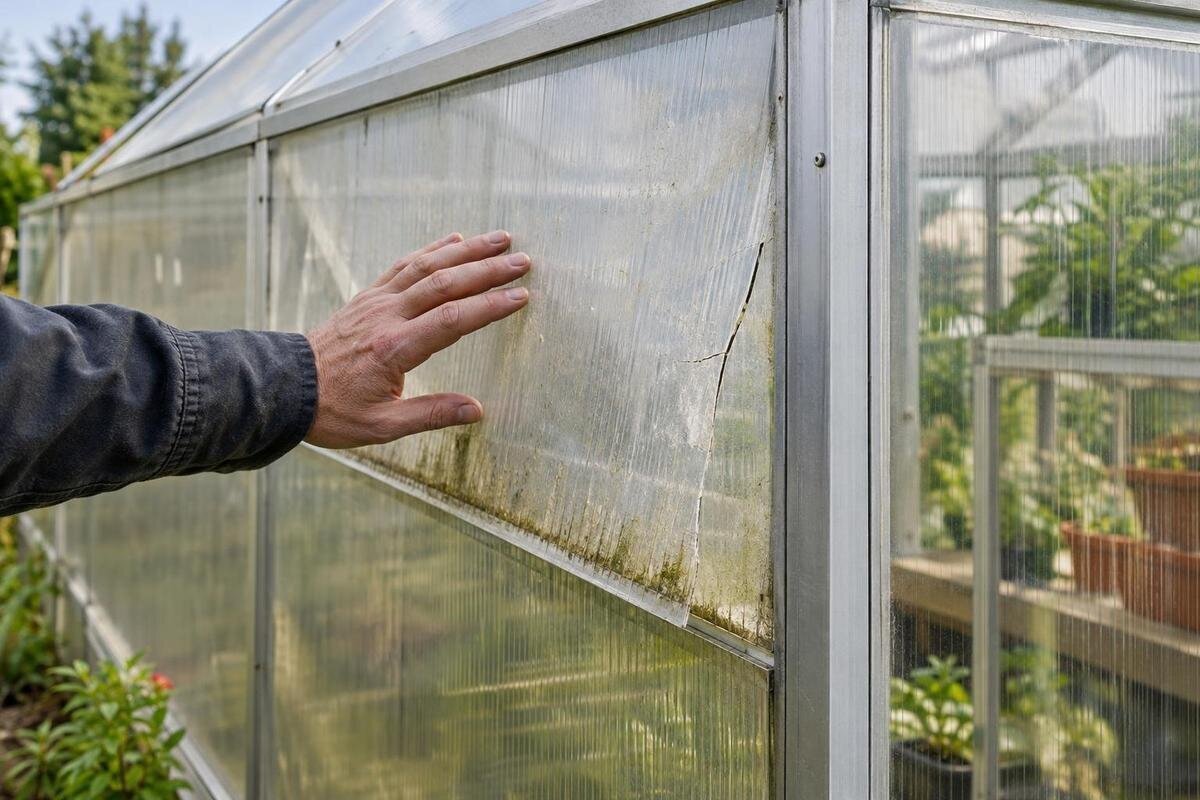
Greenhouse polycarbonate can become cloudy or discoloured without having failed. Dirt, surface wear and permanent ageing are different from a crack, puncture, split edge or panel that has slipped out of position. The useful test is not appearance alone: check whether the sheet is intact and retained, whether water or debris is trapped within it, and whether the change affects how the greenhouse functions. Confirm the existing panel and model before ordering; a sheet that looks similar may not fit or be approved for your frame.

Confirm the panel type and position
Start by confirming the affected glazing is polycarbonate, not glass or another sheet material. A greenhouse may use different glazing in separate areas, and a photo of the whole structure does not identify a replacement part. Check the original order record, model or serial label, assembly manual and any parts list; copy the maker’s exact panel description and part identifier. Note whether the panel is in a roof slope, side, end wall, door or another position. Sheets that look alike may differ in thickness, length, edge profile, channels or orientation, so appearance alone is not a safe basis for ordering. If there is no label, check purchase records rather than guessing from the model name.
Make a position-by-position record without removing any sheet. Note haze, cracks, holes, loose edges, surface condensation or moisture between layers, and whether neighbouring panels show the same sign. Photograph the overall bay and a close view from a safe ground-level or interior position; include the date and when you first noticed the change. A wide view helps identify the location, while a close-up shows the panel edge and visible damage. If a crack seems to be growing, compare dated photos instead of pressing on the sheet. Never climb onto a greenhouse roof; a loose or damaged overhead panel needs qualified assessment.
Clouding and colour change do not prove failure
Haze, yellowing, dullness or a loss of gloss deserves attention, but none by itself proves that a panel has reached the end of its usable life. Dust, deposits and surface residue can change the appearance; permanent weathering or a damaged surface may not wash away. Use only cleaning products and methods allowed by the panel maker, since an abrasive pad or unsuitable chemical can scratch the sheet or affect a treated surface. Cleaning can help separate removable dirt from a persistent change, but it cannot mend a crack, restore a broken edge or reverse material ageing. Avoid scraping at a mark to test whether it is damage.
After permitted cleaning, note whether the change is uniform or confined to a spot and whether the sheet remains intact, seated and shaped as the manual shows. Widespread, permanent change may matter if the amount of light entering the greenhouse is important to your growing plans, but looking through a panel cannot measure its performance. Ask the manufacturer whether it remains suitable before treating colour alone as a replacement trigger. If a complete greenhouse is already under consideration for wider reasons, include the Pyramid Greenhouse in that comparison. The product links in this guide lead to complete greenhouses, not replacement panels, and do not establish compatibility with your existing structure.
Cracks, holes and broken edges are functional damage
Cracks, holes, punctures, splits or a missing piece are more decisive than general clouding. A crack that passes through the sheet, branches, grows or reaches an edge can admit water or leave less material holding the panel in place. A damaged edge matters especially when the sheet sits in a channel or retainer. A fine surface line may be only a scratch, so do not assume every mark is a fracture. If you cannot tell, photograph it and ask the maker or an installer to identify it rather than bending or pressing the panel. Check for small openings too, not just breaks across the centre.
A through-crack or puncture is a reason to arrange an approved repair or replacement, not merely polish the surface. Avoid relying on general-purpose tape, silicone or a patch unless the greenhouse manufacturer specifically approves that method for this panel and position; a surface patch may not restore the fit or intended protection. Note how many sheets are affected and whether the damage is near an edge or fixing point. A repair that hides a mark is not enough if a hole or split remains. If several damaged panels prompt you to consider a new greenhouse, use the recorded repair scope when comparing that option with the T-Shaped Orangery Greenhouse.
Distinguish surface condensation from moisture inside a panel
Condensation on an exposed panel face can form when moist greenhouse air meets a cooler surface; by itself, that does not establish that the polycarbonate has failed. Water, dirt or growth visible between the walls of a multiwall sheet is different: it is inside the panel, not on a wipeable face. It can point to water entering at an edge, a damaged layer or a sealing detail, but its significance depends on the panel design. Identify where the moisture is before deciding the sheet itself must be replaced. Not all polycarbonate panels have internal channels, so describe what is actually present.
Photograph whether moisture sits on the inside or outside face, within channels, or around a panel edge, and note when you notice it. Check the manual for the original edge treatment; do not drill drainage holes, pull off caps, remove tape or apply sealant as a test. Cleaning cannot remove contamination sealed inside a panel, but internal moisture does not by itself prove which component has failed. Another part of the glazing assembly may be involved. Ask the manufacturer or a qualified installer to identify the source and confirm whether the panel, edge components or another part is the appropriate replacement. That can prevent ordering a sheet when the issue lies elsewhere.

Check the fit and retention of a shifted panel
Look for a new gap, an edge that has moved out of its retaining position, a panel that rattles or lifts, or a shape change that leaves it unsupported. A gentle curve can be part of a panel’s intended shape, so curvature alone does not make it defective. Compare its position, edge engagement and profile with the assembly instructions and neighbouring panels. A panel can look clear and still be loose, so assess fit as well as surface condition. Do not push, pull or wedge a roof sheet back into place; it may shift suddenly or expose you to a fall. Record the change without testing how firmly it is held.
Note where the edge sits and whether nearby retainers, seals or frame sections appear loose or out of line, without dismantling them. If a sheet has slipped, or a gap returns after an earlier repair, the issue may involve fit or the retaining system rather than the polycarbonate alone. Ask an installer to review the assembly before ordering parts; do not substitute clips or alter the frame to hold the panel. Where several areas need work, that assessment helps define the extent of the repair. If you are also considering the Limited-Edition Aluminum Greenhouses with Storage, keep that broader purchase separate from deciding which existing panels or retaining components need attention.
Look for patterns across affected panels
One isolated scratch or impact mark has a different scope from several panels showing similar edge damage, movement or clouding. Map affected sheets by roof or wall position and note whether the signs appeared together or over time. This can help show whether the request is for one replacement panel or a wider repair, but it does not identify a cause on its own. Similar marks may have more than one explanation, and a visual check of the sheet cannot confirm whether the surrounding support is sound. Share the map and photos with the manufacturer or an installer rather than making a structural diagnosis from the panel alone.
If damage recurs, do not order another sheet until the replacement method and retention details have been checked against the manual. Replacing a panel without addressing a confirmed fit or installation issue can leave the same symptom in place. Avoid trimming, drilling, shimming or changing supports unless the manufacturer provides an approved procedure. Ask an installer what evidence supports any wider work before comparing complete replacements. A comparison with the Bloomcabin Prestige Greenhouse becomes relevant only if you are considering renewal of the whole structure. Keep the pattern of recurring damage in the discussion so that a new purchase is not treated as a substitute for understanding the existing problem.
When replacing one panel may be appropriate
Replacing one panel is most straightforward when the damage is confined to that sheet, the correct manufacturer-approved part can be identified, and the remaining glazing and surrounding frame show no sign of similar damage. These are conditions to verify, not a guarantee that the job is simple. An installer may need to check how the original is retained and whether adjacent seals or other parts can be reused. If the frame is visibly distorted, pause a panel-only decision until it has been reviewed. For an overhead sheet, an awkward location or a panel that has come loose, ask for qualified assessment rather than treating the work as routine handling.
Ask the manufacturer whether the proposed part is approved for the exact model and panel position, and whether a matching retainer or edge component is also required. If the exact part is unavailable, ask about a documented alternative or upgrade path instead of guessing from width, colour or online photographs. Establish those options before deciding that the whole greenhouse must be replaced. If you have reached that broader choice, the Spacious Greenhouse is one model to examine. Keep any response about replacement-part availability with your repair records, rather than treating a new-model enquiry as confirmation that the existing sheet cannot be replaced.
Assess the repair scope when several panels are affected
Several damaged, displaced or permanently clouded sheets change the scale of the question, especially when they are spread across more than one face of the greenhouse. Count the affected panels and separate physical damage from cosmetic change. Ask for a quote that identifies which panels and related glazing components are included, and whether assessment or installation is part of the proposed work. Compare the repair scope with the condition of the rest of the frame and the availability of approved parts. There is no universal panel count that makes full replacement preferable; access, model support and the remaining structure all matter.
A broader quote can help compare panel-by-panel repair with replacing the whole greenhouse, but it should not assume a new structure will solve an unresolved cause of recurring damage. Ask the installer to explain any frame or retention concerns and what supports the proposed scope. If complete replacement is genuinely under consideration, include the Classic Aluminum Greenhouse in your comparison. Keep the repair quote itemized so you can distinguish the affected sheets, related components and installation work. The decision should reflect the condition of the remaining structure and the availability of approved parts, rather than the number of marked panels alone.

Match an approved panel to the exact greenhouse
Before requesting a panel, gather the manufacturer, exact model, serial or purchase details, any part number and the sheet’s position. Use the manual or parts diagram to confirm the dimensions and features that apply there: length and width, thickness, solid or multiwall construction, profile, channel direction, colour or tint, UV-protected face orientation and edge treatment can differ. Not every system uses all these descriptors. A measurement taken from a damaged sheet may be incomplete or distorted; have the manufacturer verify the replacement against the model rather than relying on one dimension or a generic polycarbonate sheet. If a protected face is specified, record its marking rather than guessing at orientation.
Send an overview photo, a close-up, the marked panel location, quantity and any label or drawing reference. If a damaged panel is unsafe to reach, do not remove it just to measure; ask the manufacturer or installer how to identify it. Request confirmation that the suggested panel is approved for that exact structure and ask what installation parts or professional work are required. If you are also comparing Lean-To Greenhouses as a new purchase, identify that as a separate enquiry. Keep the existing model and panel position clearly stated in the parts request so that information about a new greenhouse is not confused with a replacement recommendation.
Plan the inspection and replacement safely
Do routine checks from ground level or a safe interior position. Do not walk or lean on greenhouse glazing, climb onto the roof, or try to restrain a loose overhead sheet. Keep people away from the area below a panel that is visibly cracked, displaced or loose, then contact a qualified installer. Polycarbonate is not glass, but another section of the greenhouse may use a different glazing material, and frame parts may also be exposed. Do not assume the whole structure is safe to handle because one panel is plastic. Manufacturer instructions and an on-site assessment should guide removal and refitting; avoid working from an improvised ladder beside a damaged panel.
Before a parts enquiry or appointment, have the model records, dated photos and a short description ready: where the panel sits, what changed and whether other sheets show the same signs. Ask the installer to distinguish panel damage from a retaining or frame issue and to identify the approved part before work begins. The assessment should leave you clear about whether the proposed work concerns a sheet, its retaining components or the wider structure. If the outcome is a full-model change, you can then review the Limited Edition Aluminum Greenhouse as a purchase option. Keep the inspection findings with your records so the reason for the repair or replacement remains clear.
Frequently asked questions
Does cloudy polycarbonate always need replacing?
No. Clouding can come from dirt or deposits, or from permanent ageing; clouding alone does not prove the panel has failed. Clean only as the manufacturer allows, then assess the sheet’s edges, fit and surface for cracks or other damage. If the change is permanent, ask whether the panel remains suitable.
What kinds of damage mean a panel should be replaced?
A through-crack, hole, split or broken edge is functional damage, especially if the panel has shifted or no longer sits securely. A superficial scratch is different. Do not bend or press the sheet to test it; have a qualified installer assess a loose or overhead panel.
Can I replace only one greenhouse panel?
Sometimes. A single-panel replacement makes sense when the damage is isolated, the exact approved part is available and the surrounding frame and retainers are sound. The model manual or an installer should confirm the part and installation method; similar dimensions alone do not establish a fit.
Does moisture inside a panel mean it has failed?
Not necessarily. Surface condensation can occur without panel failure. Moisture inside a multiwall panel is a separate sign that may involve an edge, layer or sealing detail; the panel design matters. Photograph its location and ask the manufacturer or installer to confirm which component, if any, needs replacing.
What details should I provide when asking for a replacement?
Provide the manufacturer, exact model or serial number, purchase details if available, panel position, part number and clear overview and close-up photos. Include measurements only where the manual explains how to take them. Ask for confirmation that the replacement is approved for that model and location.
Use appearance as a prompt to inspect, not as the replacement test. A cloudy but intact panel may not need changing; a crack through the sheet, broken edge, confirmed damage between layers or loss of secure fit calls for professional assessment and may require replacement. Match any part to the exact model and location, and have recurring damage investigated before replacing another sheet. The aim is to preserve sound glazing while addressing damage to the panel or the components that hold it securely.
