
Greenhouse Shelves and Hanging Baskets: Check Loads First
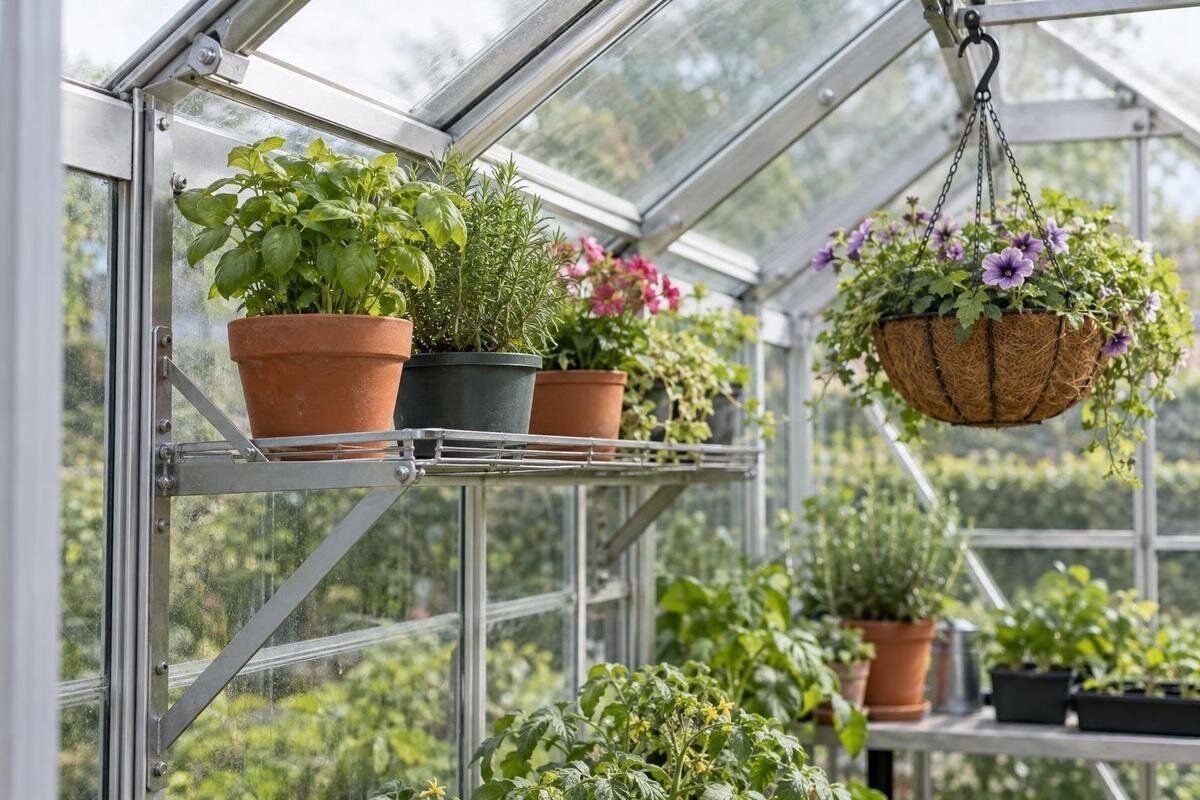
Greenhouse accessories
Greenhouse shelves and hanging baskets can make a growing area easier to organize, but every addition transfers weight to a specific support. The empty accessory tells you little about its loaded condition, and a familiar-looking rail or roof member is not automatically a fixing point. Before choosing an accessory, identify the exact greenhouse model, locate the relevant manufacturer instructions, and confirm both the approved attachment and the documented load. The checks below help distinguish a verified installation from an unsupported assumption.

Before choosing an accessory 1
Account for the full load after watering
An empty wire basket or narrow shelf tells you little about the load it will place on a greenhouse. Count the complete assembly in use: the basket or shelf, its mounting hardware, container, growing medium, plant and any water retained after watering. Damp or saturated medium weighs more than dry medium, and a plant changes as it grows. Include drip trays, hooks or extensions that stay in place. Plan for the heaviest ordinary setup you expect, not the lightest day of the season. Use the accessory manufacturer’s stated loading conditions, and ask what a rating includes if the instructions do not say. Write down the full setup before comparing accessories.
Make the inventory specific enough to describe your intended use. Record how many pots or baskets you want, which trays and containers will remain in place, and whether you expect to replace small plants with larger ones during the season. For shelves, note where you intend to group the containers; for baskets, include the hooks or extensions in the proposed assembly. If you are planning accessories for a model in the Aluminum Greenhouses range, use this inventory when asking about approved configurations. A list of the actual contents is more useful than a request for a shelf that can hold “a few plants,” and it gives you a reference when the setup changes.
Identify the exact greenhouse and accessory
Start with the exact greenhouse identification, not just a broad type such as aluminum, lean-to or freestanding. Record the model name, approximate purchase date, size or configuration stated in the original paperwork, and any serial or order number available. Keep the assembly manual, parts list and accessory sheet together. Check that drawings and part codes match the structure actually installed: a manual for a neighbouring model, a later revision or a visually similar frame may describe different fittings. Note any replacement parts or earlier additions, because a document for an unaltered greenhouse may not describe the current setup.
Look for the named accessory, approved fitting position, specified brackets or fasteners, load wording and any restrictions. A diagram of an open channel or hole is not approval for every attachment unless the instructions say so. For a wall-adjacent greenhouse, the Lean-To Greenhouses product page can help identify the catalogue family, but match the installed model to its own assembly sheet. When records are missing, contact the manufacturer or a qualified installer with full-view and accessible close-up photos, model details and accessory or part identifiers. Take photos only from a safe position; do not remove glazing to expose a profile or obtain a better view.
Before choosing an accessory 2
Understand exactly what a load rating covers
A rating answers only the question it was written to answer. It may cover the shelf itself, a named accessory rail, one mounting point or a complete kit, and a value for one item may not describe the installed assembly. Note whether the limit is per shelf, per support, per location or for the whole accessory; also note whether it is a total or assumes an evenly distributed load. If the document names a particular position or configuration, keep that condition with the number. A basket on one hook is a different arrangement from several baskets spaced along a rail, even if the combined weight seems similar.
Do not add separate limits together, estimate how much each bracket carries, or transfer a figure from a similar greenhouse unless the manufacturer provides that method. Those shortcuts can give a reassuring total without establishing the capacity of the actual fixing. When considering a Limited Edition Aluminum Greenhouse, ask which load guidance applies to the particular model and accessory configuration you want. Keep any stated conditions with the rating so that you can compare like-for-like arrangements. Do not substitute the shelf maker’s number for the greenhouse maker’s limit. If you cannot interpret a rating or its conditions, ask the manufacturer to explain them before buying or installing the accessory.
Use only documented fixing points
Use only a fixing point that the greenhouse manufacturer or an approved accessory instruction explicitly identifies for the exact shelf or basket. Follow the named position and mounting method, including any requirement for a particular rail, bracket or fastener. A visible slot, channel or hole may serve a different purpose; its presence is not evidence that it can carry a storage load. A fitting that grips firmly by hand is not a capacity test either. If instructions show a designated point, do not move it to a more convenient span unless the manufacturer approves that alternative.
Do not drill, screw into, clamp or glue an accessory to a frame member unless the method is documented for the exact model. Do not use glazing bars, panel-retaining parts, glass panes, door frames, vent operators, gutters or decorative trim as anchors by assumption. These parts may have another function, and an improvised attachment can interfere with neighbouring panels or moving hardware. Instructions for a shelf kit may specify a compatible bracket as well as the shelf itself. If no approved location appears in the manual, ask the manufacturer or a qualified greenhouse installer to identify a documented option. Do not load an unverified point to see whether it holds.

Before choosing an accessory 3
Roof attachments for hanging baskets
The roof is where an unsupported hanging load can be easiest to assume and hardest to justify. A ridge, roof bar, glazing bar or roof vent frame may look sturdy, but appearance and material do not establish a basket rating. The roof’s intended role in the greenhouse assembly is not proof that it can carry a concentrated hanging load. Do not hang a basket from the ridge, a cross-member or a pane unless the instructions for your exact greenhouse explicitly identify that point and the matching accessory. A general impression that the frame is strong is not enough, whether the proposed load looks small or not.
A basket can move when touched, watered or exposed to air movement, and it may strike glazing, a vent, plants or someone working below. That movement is a separate concern from the basket’s still weight. Keep hanging items clear of opening parts and walkways, but remember that clearance does not make an unapproved fixing safe. Do not climb onto or lean against glazing to reach a proposed support. If the manufacturer documents an overhead kit, use only its specified locations, hardware and stated loading conditions. Without those instructions, choose a documented alternative rather than improvising a roof attachment.
Check the shelf, brackets and frame separately
For a shelf, check each part that carries the load: the shelf surface, brackets, any accessory rail and the greenhouse attachment. The shelf manufacturer’s capacity and the greenhouse manufacturer’s fixing approval answer different questions. Confirm that the listed brackets and position match the shelf, and whether the instructions require an evenly spread load. Several pots placed close together can create a different arrangement from items spread along the shelf; do not assume surrounding frame members share the weight. A limit for one shelf does not automatically authorize stacked shelves or a second shelf on the same rail.
Keep pots and trays within the footprint and limits shown in the instructions, without letting a projecting container strike glazing or obstruct an opening. Do not use a shelf as a step, seat, ladder support or handhold. If you are planning shelving for a T-Shaped Orangery Greenhouse, identify the proposed shelf position on the matching accessory drawing rather than choosing a span by appearance or convenience. The greenhouse outline alone does not establish the capacity of that attachment. Check the manual for the specified shelf and brackets at that location. If you are considering an extension or replacement bracket, verify that it is documented for the same shelf and greenhouse.
Before choosing an accessory 4
Plan around doors, vents and daily greenhouse work
Plan the layout on paper before fixing accessories. Mark the door swing, vents and their operating paths, main walking route, work surface and plants you need to reach for watering, pruning or harvesting. A shelf that leaves the aisle technically open may still make it difficult to carry a tray or work without bumping pots. Keep access to vents and routine maintenance clear; move a basket that blocks a vent or door even when its attachment is approved. Think about the everyday route with a watering can or seed tray in hand, not just how the greenhouse looks when empty.
Hanging baskets also affect light and what sits underneath them. Check whether a full basket shades plants, drips onto a crop or work area, or swings into glazing when you pass. Consider the space occupied by the plant as well as the container, and reconsider the arrangement as it grows. When planning the interior of a Pyramid Greenhouse, mark these clearances separately from any proposed attachment points. The greenhouse form does not establish which overhead positions are approved for suspension. Keep the layout decision separate from the load check: an attachment needs documented support even when the basket fits comfortably in the available space.
Verify replacement parts before modifying the frame
Treat replacement and add-on parts as model-specific until the manufacturer confirms otherwise. A shelf that fits a channel or a bracket with a similar shape may still be wrong for the rail profile, position or intended load. Check the exact accessory identifier, greenhouse model and revision, included fixing parts and published loading conditions; generic measurements or another owner’s installation are not proof of compatibility. Use only the fasteners and materials named in the instructions, and do not mix a spare bracket from one system with another just because the pieces appear to fit. If a part may have been superseded, ask for a current identifier documented for your model.
If you are comparing the Limited-Edition Aluminum Greenhouses with Storage, distinguish the storage described in the listing from any extra shelves or baskets you intend to add. The product description does not establish that an unrelated roof or frame point accepts an additional hanging load. Identify each proposed addition separately and check its fitting requirements. If installation seems to require drilling, cutting, bending, shifting glazing or replacing a structural part, stop and request manufacturer guidance and an installer review. Check the manual for any conditions associated with accessory fitting rather than assuming an apparently minor alteration has no effect. Do not handle or remove glass to make a retrofit possible.

Before choosing an accessory 5
Watch for movement or damaged fittings
Inspect a shelf or basket and its fixing from a safe position before loading it, after fitting, and during ordinary use. Look for a bracket that has shifted, a shelf that is no longer level, visible bending, a loose connection, damaged fittings, unusual frame movement or glazing that appears displaced. Pay attention as basket contents grow or change after watering. Do not push, shake, hang extra weight on or repeatedly tighten an assembly as a way to test it. A visual check cannot establish a missing load rating, but it can reveal a reason to stop using an accessory and seek help.
If anything moves, slips, bends or damages adjacent glazing, keep people clear and stop using that shelf or basket. Remove its contents only if you can do so safely from a stable position without reaching over or disturbing glass; otherwise ask a qualified installer to handle it. Do not stand beneath a suspect hanging load or improvise a replacement fixing. For a parts enquiry involving the Bloomcabin Prestige Greenhouse, provide the exact component identifier and details of the installed model, including any previous alterations. A current catalogue listing alone does not confirm compatibility with an older structure. If glazing is cracked or displaced, keep clear and do not try to reseat it.
Get confirmation when the documentation is incomplete
If the manual does not name a suitable support, or its load wording is unclear, do not fill the gap with a guess. Ask the greenhouse manufacturer or a qualified greenhouse installer to confirm the exact accessory, attachment point, matching hardware, documented limit and any conditions for the installed model. Provide the model and revision if known, order details, clear photos from accessible positions, and the accessory’s part number or instructions. Ask whether the existing frame and fittings need to be assessed before an addition is approved. A generic answer about a similar greenhouse may not verify an older or altered structure; get confirmation that applies to the one you have.
If there is no documented support for a hanging basket, leave it off the frame rather than trying another roof bar. A freestanding shelf may be an option only when its own instructions allow the intended load and its feet can stand independently without bearing on glazing, doors or vents. When comparing replacement options such as Bloomcabin’s Spacious Greenhouse range, request the assembly manual and accessory guidance before treating a larger interior as an opportunity for more shelving. Separate the floor-space plan from the supported accessory configuration: room for more plants is not itself a load rating. Even a ground-standing rack needs a suitable position with clear access to doors and vents.
Frequently asked questions
Can I hang a basket from a greenhouse roof bar?
Only if the instructions for your exact greenhouse explicitly approve that location and identify the accessory and its load limit. A bar that looks sturdy is not enough evidence. If the manufacturer does not document an overhead fixing, do not use the roof for a hanging load.
Does a shelf’s weight limit cover the greenhouse frame?
Not necessarily. A shelf rating may apply only to the shelf or its brackets, while the greenhouse attachment needs separate approval. Check what the stated limit covers and whether it applies to the installed position and hardware.
Should I count water and potting mix when checking a load?
Yes. Consider the complete setup in use, including the basket or shelf, brackets, container, growing medium, plant and water retained after watering. Follow the rating’s stated conditions; if it is unclear whether they include these items, ask the manufacturer.
Can I drill or clamp a support onto an aluminum frame?
Do so only if the instructions for your exact model approve that fixing method and location. Do not assume that a channel, glazing bar or other frame part is a load-bearing attachment point, and do not use glass as a support.
What if I can’t find the greenhouse manual?
Identify the model and any available order or serial number, then contact the manufacturer or a qualified greenhouse installer. Share accessible photos and the accessory’s part number. Do not test a suspected fixing point with a load or remove glazing to identify it.
Shelves and baskets are useful only when both the accessory and its exact greenhouse attachment have documented support. Count the full, watered setup, follow the named fixing locations and keep the roof out of the plan unless the instructions for your model explicitly approve an overhead arrangement. If the paperwork is missing or the frame has changed, pause for confirmation instead of testing a rail with a pot. A thoughtful layout preserves access and growing space without asking an unverified part to carry a load it was never shown to support.
