
Why Greenhouse Tomatoes Crack: Causes and Next Steps
Tomato crop troubleshooting
Cracks in greenhouse tomatoes often appear close to harvest, when fruit is expanding and its skin can no longer stretch evenly. A change in soil moisture is a common clue, but a split alone cannot confirm what happened; fruit stage, cultivar, heat and root conditions also affect risk. Start with the crack’s location and appearance, then compare root-zone moisture and recent watering across affected plants. That approach helps narrow the cause before you change irrigation or add fertilizer.

Read the crack pattern
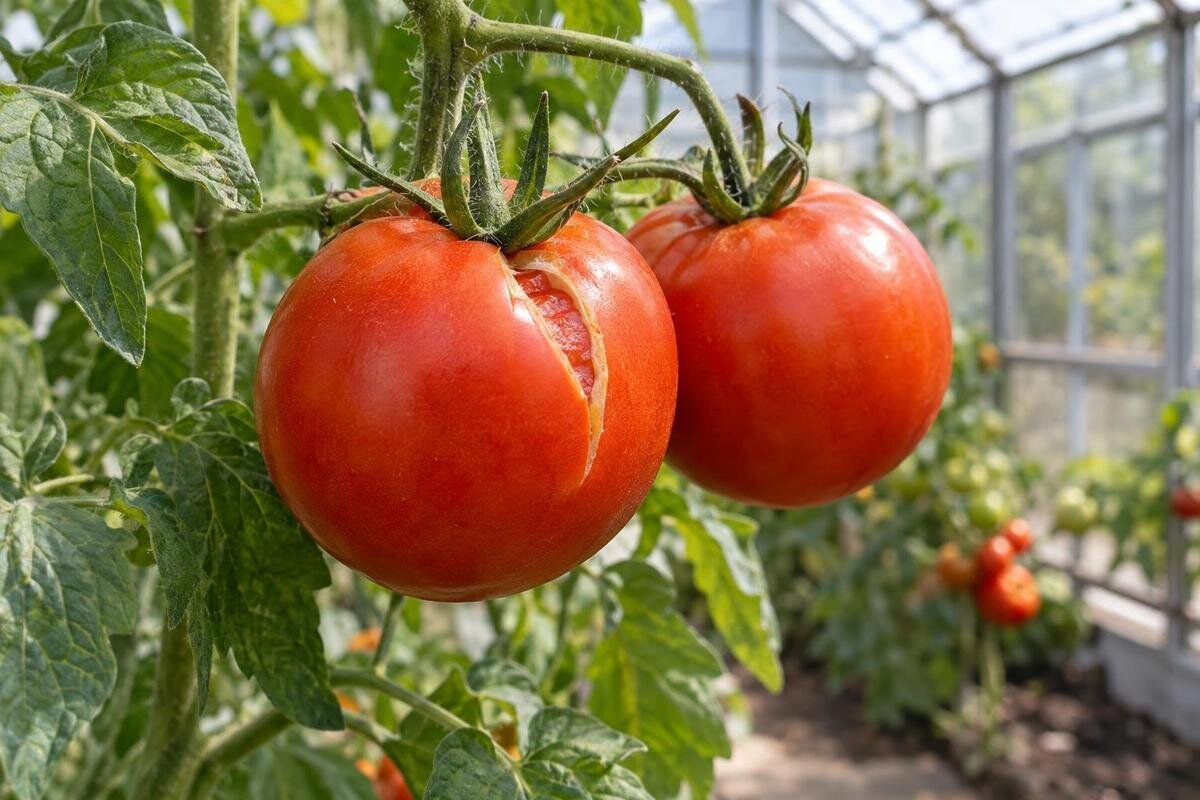
Tomato cracking is a tear in the fruit skin, often beginning around the stem scar. Radial cracks run lengthwise away from that point; concentric cracks form curved rings around the shoulder. A split may be a fine surface line or an opening deep enough to expose the flesh. Both patterns can appear in a greenhouse, sometimes on different fruit from the same plant. Cracking happens when expanding fruit puts more strain on the skin than it can accommodate. Note whether the tomato is still firm and whether the edges look fresh and dry or soft and discoloured; that helps you judge what to do with the fruit.
Shape is a clue, not a diagnosis. Photograph the whole tomato with the stem end visible, then take a close-up. Note its colour stage and whether it was still on the plant when you first saw the split; discovery may come after the skin actually broke. A dark, sunken patch at the blossom end, a hole, or tissue that looks water-soaked is not automatically the same problem as a clean crack. Compare the fruit with its cluster and the rest of the plant. Describe what you can see separately from what you suspect caused it: “a fresh split beside the stem on a colouring tomato” is a more useful observation than “overwatered fruit.” One close-up rarely shows enough to identify the cause or tell you whether the damage is still changing.
Watering swings are a common trigger
A rapid change in water available to the roots is a common cause of cracking. After the root zone dries, substantial watering can let the plant take up water quickly; fruit already near full size may then expand faster than its skin can stretch. A split after thorough watering does not prove the plant has received too much water overall. The shift from dry to wet is often more revealing than one watering in isolation. A missed irrigation, a hot spell that dries the bed, or a heavy catch-up watering can all be useful clues when you look back at the days before the split appeared.
A covered greenhouse often keeps ordinary rainfall off the bed, but water can still reach it through an open doorway, an edge or a leak; irrigation changes may be the more likely source. Check whether a timer, hose or watering routine changed, and remember that the fruit may have split before you noticed it. When planning a growing area, compare the space available with the number of beds you can inspect and water consistently. The Limited Edition Aluminum Greenhouses are listed in sizes from 3.77 to 28.08 m². Use that range to narrow your size options, then consider the watering routine your proposed planting area would require.
Check moisture where the roots are
Check the soil or growing medium below the surface, where the roots are taking up water. The surface can look dry while the bed is still damp underneath, or look moist when the root zone has dried out. Compare a few places: near an emitter, between plants and toward the end of an irrigation line. A moisture meter can help you compare the same locations over time, but one reading is not a universal target; soil texture, bed depth and container mix affect what it means. Wilting in a hot greenhouse is not a dependable moisture test on its own.
Look for delivery problems as well as dry soil: blocked or displaced emitters, a timer that missed a cycle, a leaking joint, or water running off before it soaks in. In pots, check deeper in the mix and make sure drainage is open; neighbouring containers can dry at different rates. Persistently saturated soil is not a reason to add more water, and cracking alone does not diagnose a root problem. For layout planning, the T-Shaped Orangery Greenhouse listing gives an area range from 16.52 to 30 m². Compare the published dimensions with your row plan, including access to the far ends of beds and irrigation lines. Make sure your plan leaves those inspection points reachable once the plants are full-sized.
Fruit stage and cultivar affect susceptibility
Cracking often appears as fruit approaches full size, particularly around the time its colour begins to change. At that stage, a quick increase in fruit growth can put extra strain on the skin. Tomatoes do not all respond alike: some cultivars are more prone to splitting than others, and larger-fruited types can be vulnerable. Size alone does not identify the cause, though. Record the variety and the fruit’s stage, then compare similar fruit on the same plant or the same variety elsewhere in the greenhouse.
If one cultivar splits repeatedly while nearby varieties remain intact, that is useful evidence, not proof that watering is perfect. Check whether those fruit were at the same stage and growing in similar conditions. The first fruit to crack may also be the most exposed or the most mature, so do not generalize from a single tomato. A variety’s susceptibility can combine with a moisture swing or heat; it does not rule out those conditions. For a useful comparison, record intact fruit as well as cracked fruit. A note that several nearly ripe tomatoes of one variety remained sound provides context that a list of damaged tomatoes alone cannot give. Keep the comparisons within similar maturity stages rather than grouping green and ripe fruit together. Notes on cultivar and maturity help separate a recurring variety pattern from a problem affecting a whole bed.

Greenhouse heat can compound water stress
Greenhouses can warm quickly on sunny days, and heat can increase water demand and speed fruit growth. A bed that seemed adequately moist in cooler weather may dry faster during a hot spell. If new cracks appear after several bright, warm days, record that timing even if you have not changed your watering routine. Where possible, compare fruit from sunny and more shaded parts of the same crop, and check conditions at plant level rather than relying only on how the air feels near the door.
Use ventilation consistently with the conditions and the design of your greenhouse; there is no single schedule that suits every structure and weather pattern. Avoid treating a closed, hot greenhouse as the only explanation, since root moisture and fruit stage still matter. If you are comparing structures, check the ventilation details for the exact configuration rather than inferring airflow from its shape. The Pyramid Greenhouse listing covers sizes from 5.53 to 18.9 m². Consider those size options alongside the stated ventilation arrangement and your intended crop layout; the outline alone does not tell you how the growing area will be ventilated.
Keep root-zone moisture more even
Once you have a likely moisture issue, aim for an even supply through the root zone rather than alternating between very dry and saturated. Base watering decisions on the bed or container condition, recent weather, plant size and how quickly the growing medium dries. Water thoroughly enough to reach the active roots, but avoid runoff that leaves parts of the bed dry. Do not copy a fixed daily schedule from another greenhouse: the same calendar can overwater one bed and leave another short of water. Separate the question of when to water from the question of whether water reaches the intended roots. If one part of a bed stays dry, simply extending every watering cycle may not address the uneven delivery. Recheck the locations that first revealed the problem so you can judge whether your adjustment has made moisture more consistent across the bed.
Check containers individually, especially during hot spells, and review emitters after maintenance or a water interruption. Suitable mulch can slow surface drying, but it does not replace checking below the surface. Avoid responding to cracks with extra fertilizer or calcium by default; a split is not a nutrient test, and excess fertilizer can create other root-zone problems. If storage is also part of your greenhouse planning, the Limited-Edition Aluminum Greenhouses with Storage are listed from 5.52 to 28.08 m². Confirm the storage details for the selected configuration and account for that space in your layout, keeping access to beds and watering equipment in mind.
Harvest and handle split tomatoes
Check fruit regularly once it is full-sized and beginning to colour, particularly if the crop has split before. Picking at that point can reduce the time fruit remains exposed to changing moisture and heat, though it cannot undo a crack or guarantee later fruit will stay intact. Avoid harvesting clearly immature tomatoes solely because a ripe one split; use the variety’s normal development as your guide. Regular picking also makes it easier to notice new cracks before they deepen or the fruit starts to deteriorate.
Do not leave split tomatoes on the plant through more warm, humid conditions. A small, fresh crack with firm, clean surrounding flesh is perishable; inspect it carefully and use it promptly if it seems sound. Discard fruit that is mouldy, leaking, soft, smells fermented or has heavy soiling inside an open crack. Frequent inspection is easier when rows are accessible. The Bloomcabin Prestige Greenhouse listings range from 3.77 to 28.08 m². Compare the actual footprint with your planned beds and harvesting access, including whether you can inspect fruit without reaching across another row. Listed area alone does not show how convenient that layout will be.
Compare affected plants and growing zones
Look at how widespread the splits are. If several tomatoes on one row crack after the same watering change, check the shared irrigation line and compare moisture along it. If one plant is affected, compare its emitter, soil depth, shade, cultivar and fruit stage with its neighbours. Similar cracks across several varieties may point you toward a recent change in water or heat, but do not prove a single cause. Note which beds, rows and clusters are affected, and whether the fruit is at a similar stage. Also mark comparable plants without cracks. That distinction helps you avoid describing an entire row as affected when only its most mature fruit has split. If the pattern changes with later fruit, update the record rather than assuming the first distribution still describes the crop.
A rough map can help distinguish a local dry patch from a greenhouse-wide event. Mark where the affected fruit grew and where watering lines or containers sit, rather than writing only “tomatoes cracked.” Give each bed or container group a simple label that you also use in your notes and photographs. The Spacious Greenhouse listing gives an area range from 47 to 70 m². When planning a growing area of that size, sketch the beds and irrigation zones within the proposed footprint so you can compare observations by location. Use the same labels when checking moisture along a line; otherwise, observations from different places can be mistaken for changes over time. Smaller spaces benefit from the same simple record.

Review the growing-space layout
A greenhouse’s layout can make consistent care easier or harder. Check whether the splits cluster near the warmest wall, in direct sun, beside a doorway or at the end of one watering line. These are clues about conditions within the crop, not proof that a particular greenhouse style is responsible. Note whether you can reach each row to check the soil, see irrigation lines and inspect fruit as it colours. Keep observations tied to the plants rather than relying on a general impression of the space.
If you are considering a different growing area for broader reasons, compare its stated footprint with the beds and access you intend to use. Aluminum Greenhouses are listed in sizes from 3.77 to 28.08 m²; that range alone says nothing about watering consistency or how warm a site will become. Check the actual configuration and assess sun, ventilation and water access at the intended location. A new greenhouse is not a treatment for a dry-to-wet cycle in an existing bed.
Use a short record to guide the next change
For each new wave of cracks, record the date, variety, fruit colour stage, location, crack pattern, root-zone moisture and any recent watering or heat changes. Use the same whole-fruit and close-up views described earlier, and label the bed so the images can be compared later. The split may have formed before you noticed it, so record both when you found it and what was happening in the growing area beforehand. Keep observations and adjustments in separate parts of the log: one describes the problem, while the other records what you changed. If you alter a watering cycle, note which bed it serves and when the adjustment began. That gives you a clear point from which to compare later fruit, rather than treating every split found afterwards as a new failure. A brief, consistent log is more useful than trying to remember several changes at once.
If cracking continues despite steadier moisture, share your photos and notes with a local horticultural extension service or an experienced grower, especially if fruit has unusual lesions or the plants are also declining. Change one care factor at a time where practical, and judge the result on later fruit rather than splits that formed before the adjustment. Keep replacement-greenhouse planning separate from those crop observations. If you are considering the Lean-To Greenhouses for other reasons, the listed sizes range from 3.69 to 14.34 m². Compare the specific site and configuration with your intended beds, water access and inspection routine; changing the structure is not itself a response to an unresolved watering pattern.
Frequently asked questions
What usually causes greenhouse tomatoes to split?
A sudden increase in water available to the roots is a common trigger, particularly after the growing medium has dried and fruit is close to full size. Heat, cultivar and maturity can add to the risk. Look at the root zone and recent watering rather than assuming one watering caused every split.
Should I stop watering when tomatoes start to ripen?
No. Letting the root zone dry out and then watering heavily can create the very fluctuation that encourages cracking. Keep checking the soil or growing medium and adjust watering to the conditions, aiming for an even supply rather than a rigid schedule.
Do radial and concentric cracks have different causes?
Radial cracks run away from the stem scar, while concentric cracks form rings around the shoulder. The patterns help describe the damage, but neither identifies a single cause. Compare the fruit stage, cultivar, root moisture and conditions across the greenhouse.
Can I eat a cracked tomato?
A fresh, shallow crack with firm, clean surrounding flesh is perishable, so inspect it carefully and use it promptly if it seems sound. Discard fruit that is mouldy, leaking, soft, smells fermented or has heavy soiling inside an open crack. Do not store split fruit as you would an intact tomato.
Will adding calcium prevent tomato cracking?
Not necessarily. A clean skin split is not a reliable sign of calcium deficiency, and adding fertilizer or calcium without a diagnosis may not help. Blossom-end rot usually appears as a dark, sunken area at the blossom end, which is different from a typical stem-end crack.
Treat each split as one clue among several. The crack pattern, fruit stage, root-zone moisture and distribution across the greenhouse can help you narrow the cause without blaming a single watering. Steadier moisture, regular inspection and timely harvesting can reduce repeat problems, though some cultivars and conditions will still produce the occasional cracked tomato.
