
Why Greenhouse Tomatoes Have Hard Green Shoulders
Greenhouse crop troubleshooting
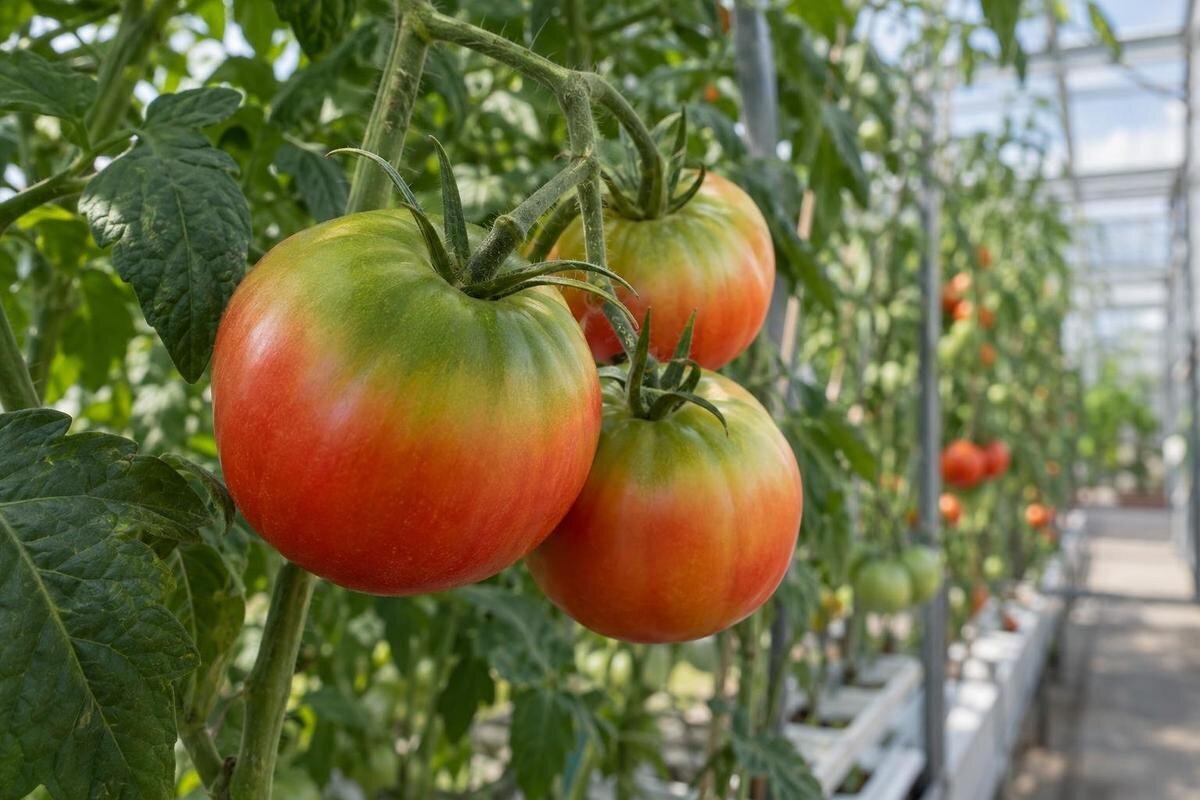
When greenhouse tomatoes colour on most of the fruit but stay green and firm around the stem, the contrast can look like a crop problem. Sometimes it is simply a cultivar trait; heat during ripening, strong fruit exposure or an issue affecting the root zone can also delay colour. The pattern across varieties and greenhouse positions is more useful than one fruit alone. Compare like with like, note the fruit’s stage and look for other symptoms before adding fertilizer, stripping leaves or changing irrigation. The checks below help narrow the possibilities without treating a visual clue as a diagnosis.

01
What hard green shoulders look like
The term green shoulders describes green tissue around the point where a tomato’s stem attaches, not the green sepals—the calyx—that sit outside the fruit. In a typical case, most of the tomato develops the cultivar’s mature colour while tissue around the stem stays darker green and firmer. That area may soften more slowly than the rest, and it can remain visible even when the tomato otherwise looks ripe. If the whole fruit is green, it may simply be immature; some cultivars also stay green when ripe. The phrase describes an appearance, not a disease or proof that the plant is short of nutrients.
Look for a fairly consistent cap or band at the stem end, then compare several fruits of the same variety at a similar stage. Sunscald is more likely to appear as a pale, bleached, dry or leathery patch on the side exposed to direct sun, rather than as a green cap. Heat can be involved in either pattern, so location and surface appearance matter. Cracks, soft rot, mould or irregular sunken patches are not the classic green-shoulder description. Firmness alone is not enough to identify the cause; fruit size and maturity also affect texture. If marks spread or other symptoms appear, take photos of the whole plant and fruit and ask a local horticulture service.
The tomato variety sets the baseline
The tomato variety is the first thing to check. Cultivars differ in how uniformly they lose green chlorophyll as fruit begins to ripen. Some naturally keep a darker, firmer shoulder while the rest turns red, pink, yellow, orange or another mature colour; others colour more evenly. Green shoulders occur in some heirloom and older types, but those labels do not guarantee the trait. Seed-catalogue descriptions and ripe-fruit photos for the exact cultivar are more useful than assumptions based on fruit size or the word heirloom. A single green-shouldered tomato is not evidence that the greenhouse conditions are wrong.
Keep cultivar labels with each planting and compare multiple fruits from the same plant or sowing. If nearly every ripe fruit of one variety has the same green cap while another variety beside it colours evenly, cultivar is a plausible explanation. A green-when-ripe type needs its own maturity cue: note the colour change described by the supplier and typical softening rather than waiting for red. When seed labels are missing, ask the supplier or compare with a reliable image of the named cultivar. Treat that comparison as a clue, though, because growing conditions can alter the final appearance.
02
Follow the colour change as fruit ripens
Tomatoes do not always colour uniformly or all at once. The shoulder can lag behind the rest of the fruit as green chlorophyll breaks down and mature pigments develop; a firm patch may therefore reflect a stage difference rather than a permanent defect. Follow several fruits from the same truss over a few days, noting whether the green area is shrinking, changing shade or staying fixed while the rest softens. Compare fruit that set at similar times, not only tomatoes picked on the same morning, because trusses and fruit sizes develop at different rates. A brief delay on one fruit is weaker evidence than a repeated pattern.
Take a dated photo in similar light and note the variety, truss, fruit position and how much of the fruit has changed colour. Keep these records with a sketch of the growing rows so you can return to the same plants. When planning a growing space, distinguish its overall area from the positions you will use for comparisons: the greenhouse with built-in storage comes in sizes from 5.52 to 28.08 m², but those figures do not describe individual beds. Record where each sample grew rather than relying on the greenhouse’s size or model name. Cutting one representative fruit across the shoulder can show whether firm green tissue is limited to the outside or extends inward. Add that observation to the record without treating it as proof of a particular cause.
Greenhouse heat can delay colour development
High greenhouse heat is an important environmental factor to investigate. Repeated hot periods during fruit development can interfere with normal colour formation, including red pigment development, so fruit may colour unevenly or stay green near the stem. A pattern that begins after a hot spell and affects several cultivars is more suggestive of an environmental influence than a trait confined to one variety. It is not proof: cultivar, fruit exposure, plant load and other conditions can overlap. Warm days can be deceptive if the house cools quickly at night, so consider both daytime peaks and overnight conditions rather than relying on a single midday reading.
Measure where tomatoes are actually growing, not only near the roof or doorway. A min/max thermometer around fruiting height, checked in more than one area, can show whether beds experience different peaks. Record the date and weather alongside fruit-set and harvest notes, and identify the thermometer’s position so later readings remain comparable. For a greenhouse in the Prestige greenhouse range, which covers 3.77 to 28.08 m², the useful question is where the crop and measuring points sit within the chosen layout. The listed area is not a temperature rating. Check trends over several days, since one reading cannot represent a fruit’s full development, and compare those trends with when the shoulder pattern first appeared.

03
Sun exposure changes from one bed to another
Light and heat at the fruit surface can differ from the air temperature measured nearby. A tomato on the sun-facing edge of a bed may warm more than fruit deeper in the canopy. Sunscald usually presents as a pale, bleached, dry or leathery patch on exposed skin; green shoulders remain around the stem. High heat can contribute to uneven ripening without creating a sunscald lesion, so the two patterns can coexist but are not interchangeable. Leaves shade fruit and support plant growth, so stripping them to force colour can leave fruit more exposed and should not be the first response.
Track how sunlight moves across the greenhouse at different times and compare outer-row fruit with fruit on the same variety farther inside. Nearby buildings, trees, glazing, season and orientation all affect what reaches a particular bed. If you are considering a lean-to greenhouse for a future growing space, include the adjoining building in your assessment of the site’s light pattern. For the current crop, mark the positions of affected fruit and note whether the green cap occurs mainly on exposed fruit or also within the canopy. Keep the distinction between a green shoulder and a bleached patch in your notes. This gives you a more useful comparison than assuming that more sun or more shade is automatically the remedy.
Nutrient balance needs more than a visual check
Potassium supports fruit development and colour, and poor potassium availability can be associated with uneven ripening. However, hard shoulders alone cannot diagnose a potassium shortage. Low availability can relate to growing-medium pH, stressed roots, moisture conditions or an imbalance involving other nutrients—not just too little fertilizer applied. Excessive feeding can create problems too; high nitrogen may favour leafy growth and delay fruit maturity, but that does not make green shoulders a nitrogen diagnosis. Look for a broader pattern in plant growth and fruit, not one isolated patch. Leaf symptoms can add context, but they are not a test by themselves.
Before adding a potassium product or changing the feeding program, review what has already been applied and test the soil or growing medium using a method suited to how the tomatoes are grown. Follow the test interpretation or ask a local horticulture service for help; a general-purpose feed may not address the cause. In planning beds for a Classic aluminium greenhouse, available from 3.77 to 28.08 m², keep the growing medium and feeding history of each bed separate from the structure’s overall dimensions. For an existing crop, sample the actual container medium or tomato bed rather than a nearby patch. Label the sample’s location and compare its results with the feeding record for those plants, not with an assumed greenhouse-wide nutrient level.
04
Water and root conditions can complicate ripening
Uneven watering can stress roots and change how nutrients are taken up, which may affect fruit development, but watering variation is not a unique explanation for hard shoulders. A plant that dries severely between waterings or sits in poorly drained medium may show other signs, such as changes in vigour or leaf condition. Those clues still need context. The same crop can have different water needs as plants grow and weather shifts, so a fixed schedule copied from another greenhouse is not a reliable diagnostic. Do not increase watering simply because one fruit is green at the stem end.
Check moisture in the active root zone and compare affected beds with unaffected ones, especially if they use different containers, soil, irrigation lines or watering routines. Note the time and location of changes rather than relying on memory. A watering map should show those differences as well as the outline of the growing space. The Limited Edition greenhouse range spans 3.77 to 28.08 m², but the practical comparison within any chosen size is between the beds or containers and the way each is watered. Mark which plants share an irrigation line or routine, then compare that information with the shoulder pattern. A repeatable association is more useful than a single moisture check made after the symptom appears.
The pattern across plants helps narrow the cause
Distribution across plants often narrows the possibilities. If green shoulders recur on the same cultivar in different parts of the greenhouse, a variety trait becomes more plausible. If several varieties develop the issue during the same hot period or on one exposed side, a shared environmental factor deserves attention. If only a few fruits on one plant are affected and leaves or stems also look unusual, investigate the plant as a whole rather than blaming the variety. These are comparison clues, not rules: one greenhouse can have a cultivar difference and a local hot spot at the same time.
Make a simple record for each sample: variety, planting location, truss or fruit-set date if known, harvest date, shoulder appearance, firmness and other symptoms. Give each bed or row a clear label so that a photograph, temperature reading and fruit sample can be traced to the same position. For a layout such as the T-shaped orangery greenhouse, listed from 16.52 to 30 m², a sketch of the actual bed positions is more informative than the total area alone. Mark areas with different exposure and keep their results separate. Then compare both within a variety and between varieties: pooling every tomato into one group can hide the difference between a cultivar trait and a local growing condition.

05
Assessing changes to growing conditions
Change a condition only when your observations point to it, and avoid changing fertilizer, irrigation and leaf cover at the same time. If heat seems likely, review the pattern of hot periods and conditions around the growing area; if fruit exposure is the clue, preserve normal leaf cover and assess the affected row before making a broad change. Adjustments to shade, pruning or ventilation can affect the rest of the crop as well as the shoulders. Keep notes and judge the next set of developing fruit. Tomatoes already ripening may not become uniformly coloured even after conditions improve, so assess fruit developing after the change rather than expecting an existing green cap to disappear.
Rearranging or replacing a greenhouse is not a treatment for a fruit symptom. If you are already planning a new growing space, use what you have learned about the current crop to identify the layout questions that matter. The Oasis pyramid greenhouse is listed in sizes from 5.53 to 18.9 m²; that range helps define the space under consideration, not whether the shape prevents green shoulders. Consider where beds would sit, how you would compare their conditions and which ventilation specifications need checking. Keep that purchase decision separate from the crop trial. For the current tomatoes, record what you changed, when you changed it and which developing fruit you will follow.
When the symptom needs a closer diagnosis
Get another opinion if fruit has irregular patches beyond the stem area, unusual internal tissue, spreading lesions, or discolouration alongside distorted growth, leaf symptoms or plant decline. Those signs can have several causes and are not reliably identified by the phrase green shoulders alone. Photos are helpful when they show the whole plant, a typical affected fruit, an unaffected comparison and both the outside and a cut surface. Include the cultivar name and notes on greenhouse conditions. A local horticultural extension service, knowledgeable nursery or crop specialist can advise what further check makes sense.
If a crop spans multiple rows or zones, keep samples separate rather than treating a large greenhouse as one uniform environment. The spacious orangery greenhouse is listed from 47 to 70 m², a scale at which your sample labels should still identify the particular row and plant rather than just the structure. Share your position map, temperature notes, watering and fertilizer history with anyone helping diagnose the crop. Include both typical affected fruit and an unaffected comparison where available, and explain whether the pattern is stable or changing. A consistent green cap on an otherwise normally ripening fruit may be a varietal feature; broader or changing symptoms warrant a closer assessment.
Frequently asked questions
Are green shoulders normal on some tomato varieties?
Yes. Some cultivars retain a green, firm area around the stem even as the rest reaches its mature colour. Compare several ripe fruits of the same named variety and check the supplier’s description. If only one cultivar shows the pattern across the greenhouse, genetics may be involved; that is a clue, not proof.
Does a hard green shoulder prove potassium deficiency?
No. Low potassium availability can contribute to uneven ripening, but cultivar, heat and root-zone conditions can look similar. Avoid adding potassium based on appearance alone. Review past feeding and use a soil or growing-medium test suited to how the tomatoes are grown.
Can greenhouse heat cause green shoulders?
It can contribute. Sustained high temperatures can disrupt normal colour formation, and fruit in hotter zones may ripen unevenly. Compare affected dates, varieties and positions, and measure near the fruiting area. An outdoor weather reading or one midday measurement cannot represent the full ripening period.
How can I tell green shoulders from sunscald?
Green shoulders stay around the stem end and are green, often firm. Sunscald is more likely to appear as a pale or bleached, dry or leathery patch on the fruit’s sun-exposed side. Heat may contribute to either pattern, so appearance and location are useful clues, but not a certain diagnosis.
Will a green shoulder turn red after picking?
Fruit may continue to colour after harvest if it has reached a suitable mature stage, but a cultivar that naturally retains green shoulders may keep the cap. Mature colour and ripening cues depend on the variety; picking does not guarantee that every patch will turn red.
Hard green shoulders do not automatically mean that greenhouse tomatoes need more fertilizer. The most useful distinction is between a consistent trait of one variety and a pattern linked to growing conditions or other plant symptoms. Compare fruit at similar stages, use your records to assess any change and seek another opinion if the marks become irregular or the plants decline. The aim is to understand the pattern, not to make every variety ripen to the same colour.
