
How to Find Parts for a Discontinued Greenhouse
GREENHOUSE PARTS GUIDE
Finding a part for a discontinued greenhouse is less about spotting something that looks similar and more about building a reliable identification trail. The most useful evidence is the original model and revision, photographs showing the component in context and close-up, accurate measurements, and the manufacturer’s own parts information. Gather those details before contacting a supplier so they can rule out near-matches and tell you what remains uncertain. The same record also gives a qualified installer a clearer starting point if the part needs professional assessment.

Identify the damaged or missing component
Begin by naming the component and the problem separately. Is it a pane, a retaining strip or cap, a frame member, a door or vent fitting, a connector, a seal, or a fastener? Record where it sits—roof, end wall, side wall, ridge, eaves, door or vent—and whether it is missing, cracked, bent, loose, or no longer moving as expected. If more than one item is affected, list each one separately and note which nearby pieces appear intact. Describe what you can see rather than guessing at a cause: “the lower door fitting on the hinge side is missing” tells a supplier more than “door problem.”
Add when you first noticed the issue, whether you know of an earlier repair or part change, and anything relevant from purchase or installation records. This history can help explain why two similar-looking pieces may differ, but it cannot identify a part on its own. Photograph the assembly before moving anything. If glazing is cracked, a frame looks distorted, or a component is overhead or unstable, keep clear and ask a qualified greenhouse installer or service professional to assess it. Do not remove glass, straighten a frame, drill new holes, or improvise a structural repair just to make identification easier. If a part is already detached and safe to handle, keep it with the photos and leave it unaltered.
Find the original model and revision
Search the original assembly manual, invoice or order confirmation, packaging, installer paperwork and any accessible product label. Record the manufacturer, exact model or range name, serial or product code if present, purchase or installation year, and any revision or size shown. Keep the wording exactly as printed, including hyphens and suffixes; a single letter can distinguish one series from another. A label may be missing, so leave unknown fields blank rather than inferring a name from appearance. Do not climb onto the roof or remove trim to find a label. Note the overall dimensions, roof style and opening layout only as stated in paperwork or clearly observed.
A broad family name is not enough for a parts match. The Classic Aluminum Greenhouse illustrates the distinction between a range name and an individual component identifier: “classic” alone cannot establish which discontinued model or revision you own, or whether a component is shared. Pair any remembered range name with the order record, product code and configuration, and tell the supplier where each detail came from. If documents disagree, send both versions instead of silently choosing one; the discrepancy may help trace the right manual. Include known overall dimensions if they are recorded, but don’t use them as a substitute for an exact part identifier.
Take photos that show context and detail
Take overview images from ground level, if you can reach each side safely. Include the ends, roof outline, entrance, vents, any storage section, and the damaged area. A wide view helps a supplier see whether a component belongs to the roof, side wall, end wall or opening, and whether a close-up is upside down or mirrored. Add a middle-distance image that locates it beside a corner, bar or frame junction. Avoid standing on glazing or leaning on an unstable frame; if a useful angle is unsafe, say so rather than climbing for it.
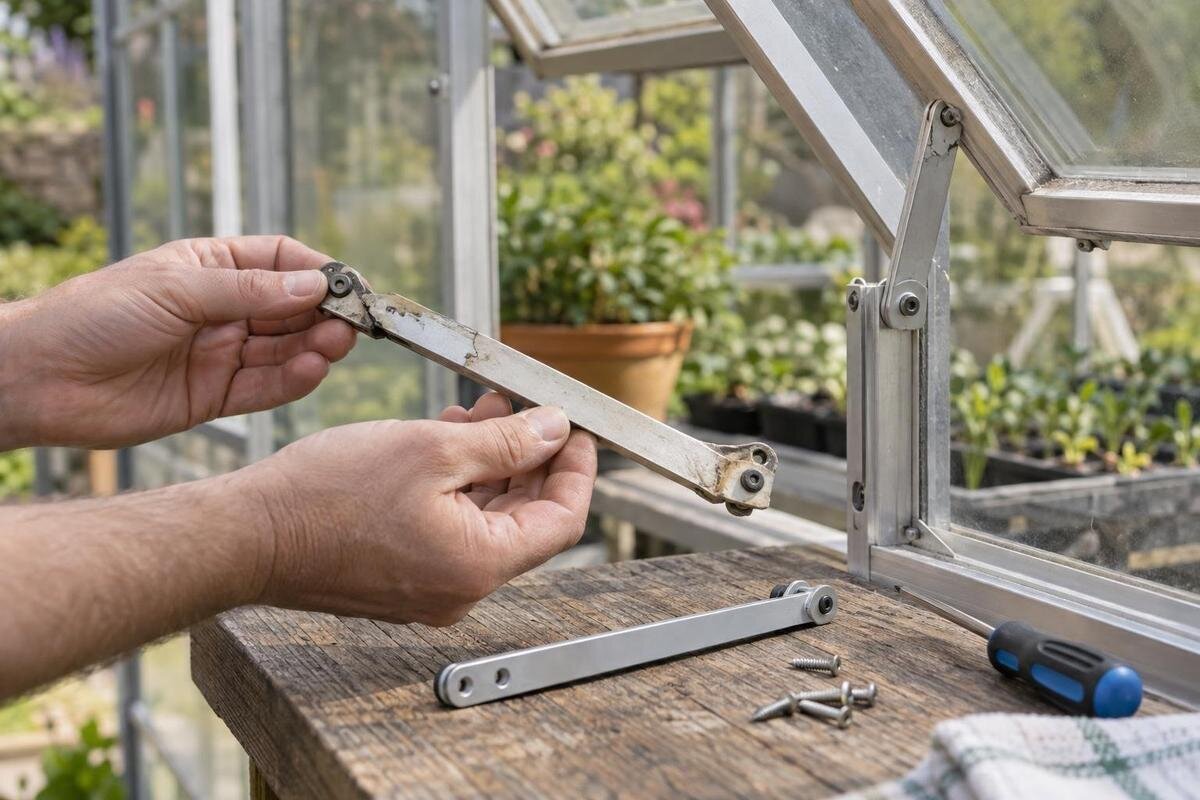
For detail, photograph the whole component in place, its connection points, any identifying mark, and a second angle that shows its depth. Put a ruler beside a small part without resting it on fragile glazing; if it is already detached and safe to inspect, include a straight-on image of its end. Keep unedited originals and add arrows or labels only to a copy, so a supplier can distinguish the real shape from your notes. Name each file by location and part rather than sending an uncaptioned batch. If you include a catalogue image, such as one from the T-Shaped Orangery Greenhouse listing, label it as a reference rather than a photograph of your greenhouse. Keep it separate from the images showing the actual fitting and its location.
Describe the part’s profile and cross-section
Many replacement parts are identified by their cross-section, not by colour. For a bar, cap, seal or connector, record the shape and overall width and depth, any groove or lip, the face that points outward, where the fixing holes sit, and which other components meet it. If the part has already come off and is safe to inspect, photograph one end straight on with a ruler beside it; include both ends if they differ. Do not remove a component merely to expose its profile, and do not cut, file or bend it to see whether it fits.
Keep the shape of the complete greenhouse separate from the cross-section of an individual part. A roof that looks alike from a distance can still use a different bar or connector, so compare manufacturer drawings or part identifiers instead of relying on a silhouette. A name such as Pyramid Greenhouse describes the whole structure, not the profile or fixing pattern of a particular component. In your request, distinguish the greenhouse’s overall form from the small-scale details of the part you need. If you cannot describe a profile in words, a straight-on photo with a scale and a note about which side faces out may be clearer.

Measure the component and the opening separately
Use millimetres for component measurements, and label what each number represents. Depending on the part, useful dimensions may include total length, the width and depth of a cross-section, distance between hole centres, edge shape, or spacing between fixing points. Measure the same feature more than once when it is accessible and note whether the reading is exact or approximate. For a left- or right-hand part, state the viewing direction; for a loose component, identify which end is at the top. Numbers without a labelled sketch or photograph can be misread.
Do not confuse the visible opening with the size of the pane or infill that sits in it. Frame dimensions, glazing dimensions and a manufacturer’s stated size can refer to different edges, so use the original drawing or ask which measurement is required rather than removing a panel to check. If a complete replacement is also under consideration, measure the site footprint separately from the damaged part. When comparing a listing such as Lean-To Greenhouses, keep those site measurements in a separate record; they do not establish whether an existing base, opening or component will match. Note obstacles and clear access paths for any later site discussion, and label each measurement so it cannot be mistaken for a replacement-part dimension.
Identify glazing without removing it
Use paperwork or the original parts list to identify the glazing material and specification; a clear view through a panel is not enough to tell a supplier exactly what it is. Record any printed designation, the panel’s location and orientation, the visible edge arrangement, and whether neighbouring panels appear different. Do not infer thickness, type or part number from a photograph, and do not assume roof and wall panels are interchangeable. If the manual gives a part identifier, copy it exactly, including any suffix, and ask the supplier to confirm that it belongs to your model revision.
Do not touch or remove cracked, overhead or unstable glazing to make a template. Photograph it from a safe position, include the surrounding frame, and send your records to the manufacturer or a qualified installer for identification and measurement advice. If you are considering a full replacement and the greenhouse includes a storage section, note that as a separate requirement. A listing such as Limited-Edition Aluminum Greenhouses with Storage can be kept with that replacement inquiry, while the glazing request remains tied to the records for your existing greenhouse. Make clear whether you need a panel for the growing area or the storage section, rather than treating the two locations as interchangeable.
Use the manual and parts list for exact identifiers
Look for a manual that matches the exact model, size and build revision rather than one that merely has the same brand or frame style. An exploded drawing may show the official name or callout for a component, while a parts table may give an order identifier; record both the manual’s title or revision and the identifier. A number taken from a similar manual may refer to a different component or assembly. If the original manual is missing, ask the manufacturer or original retailer whether an archived copy or parts list exists. Don’t assume a copy has been retained or that a part is still supplied.
When you contact the manufacturer or original retailer, include the model and serial or product code, approximate age, full-structure photos, close-ups and the measurements you have gathered. Ask specifically for documentation or part identification for that version, not simply “a part for an old greenhouse.” Distinguish an archived assembly manual from a current sales page such as Limited Edition Aluminum Greenhouses; similar range wording does not prove that a fitting is shared. State which document supplied each identifier, and flag any number copied from a manual whose revision is uncertain. Keep any reply with the manual and order information so you can trace how the component was identified.
Send a complete replacement-parts inquiry
Make the first message easy to answer by grouping the information under the greenhouse identity, the affected component and the attached evidence. Give the model name exactly as printed, any serial or revision, purchase year if known, component location, what happened, how many pieces are needed, and whether the item is still installed. Refer to the relevant photograph or labelled measurement beside each description, rather than asking the supplier to work out which attachment shows which part. Include a part number only if it came from a document or a clear label. Mark unknown or uncertain details explicitly so they are not mistaken for confirmed identification.
Ask for direct confirmation: What is the exact part identifier for this model and revision? Is it compatible with this location, and does the manual specify a related seal, fixing or paired component? If the original is obsolete, is there a manufacturer-confirmed successor, or is installer review needed before ordering? This separates identification from availability, which cannot be inferred from a photograph. If the discussion turns to a complete structure such as the Bloomcabin Prestige Greenhouse, make that a separate product inquiry. State whether you are still seeking a repair or also considering replacement, so the reply addresses the choice you actually need to make.

Confirm compatibility and installation before ordering
Before ordering, compare the proposed part with the exact manual callout, model and revision, profile, dimensions, orientation and connection points. Ask the supplier to confirm any ambiguous detail in writing, especially if the recommendation is described as an equivalent or newer replacement. Request the identifying number and the basis for the match rather than accepting “looks about right.” A visually similar shape, shared colour or matching length alone may not establish that the part connects with or retains the surrounding components as intended.
Treat glazing, roof components and frame members as work for a qualified installer if access, breakage or structural function makes removal or fitting uncertain. A professional can review whether the part is right for the assembly and whether there is related damage; this matters particularly if the frame has shifted or openings no longer line up. Follow the manufacturer’s instructions for the exact model, and do not cut, drill, force, substitute fasteners or alter the structure to accommodate an unverified part.
Options when the exact part is unavailable
Ask the manufacturer or supplier whether the part is discontinued, temporarily unavailable, superseded by an identified part, or not supplied separately. These are different answers, and only a model-specific confirmation can establish whether a proposed successor fits. If you look for a used component, check its exact identifier, revision, dimensions and condition before treating it as a match; a piece from the same colour or model family may still have a different profile. Don’t buy or install an unverified substitute simply because the original part is hard to find.
If no supported part or repair route can be confirmed, compare the scope of professional repair with a separate complete-replacement inquiry. Consider the existing structure’s condition, site footprint, access for installation and which features need to be retained; have an installer assess whether the site and any existing base can support the option you are considering. Compare the work involved as well as the component itself. If you explore the Spacious Greenhouse as a complete-product option, keep that comparison separate from the search for a legacy part. Retain the repair records, including any unresolved compatibility questions, so the replacement discussion starts with a clear account of why repair remains uncertain.
Frequently asked questions
Can you still get parts for a discontinued greenhouse?
Possibly, but a discontinued model does not confirm or rule out parts supply. Contact the manufacturer or original seller with the model, revision and part identifier, and ask whether the exact part or a manufacturer-confirmed successor is available. A visual match or an old product listing does not prove compatibility or current supply.
What if I don’t know the greenhouse model?
Gather any purchase or installation records, accessible labels, overview photos, close-ups and measurements. Describe the model as unknown rather than guessing from its appearance. A manufacturer, supplier or qualified installer may be able to use those clues to identify it, but the details still need to be checked against the correct documentation.
Are photos and measurements enough to confirm that a part will fit?
They help identify what to check, but they may not show the part number, revision or connection details. Ask the supplier to compare your information with the parts list or drawing for the exact greenhouse model. Get confirmation for the specific component and location before ordering.
Can I use a part from a similar greenhouse?
Not without confirmation for your model and revision. Parts can look alike while differing in profile, dimensions or fixing pattern. Ask the manufacturer or supplier to confirm the exact part number or an approved successor; don’t rely on colour, general shape or a similar model name.
Should I remove broken glazing to measure it?
No. Don’t touch or remove cracked, overhead or unstable glazing to make a template. Photograph it from a safe position, gather any original records, and ask the manufacturer or a qualified greenhouse installer about identification and measurement. Keep clear if the pane or surrounding frame appears unsafe.
Finding discontinued greenhouse parts is a matching exercise: identify the greenhouse revision, show where the component belongs, describe its profile and dimensions, and confirm its identifier against manufacturer records. When any part of that trail is uncertain—especially for glazing or a frame component—pause before ordering or altering the structure. A verified repair route makes the remaining decision, including whether to explore a complete replacement, easier to assess.
