
Selecting Peat-Free Media for Greenhouse Crops
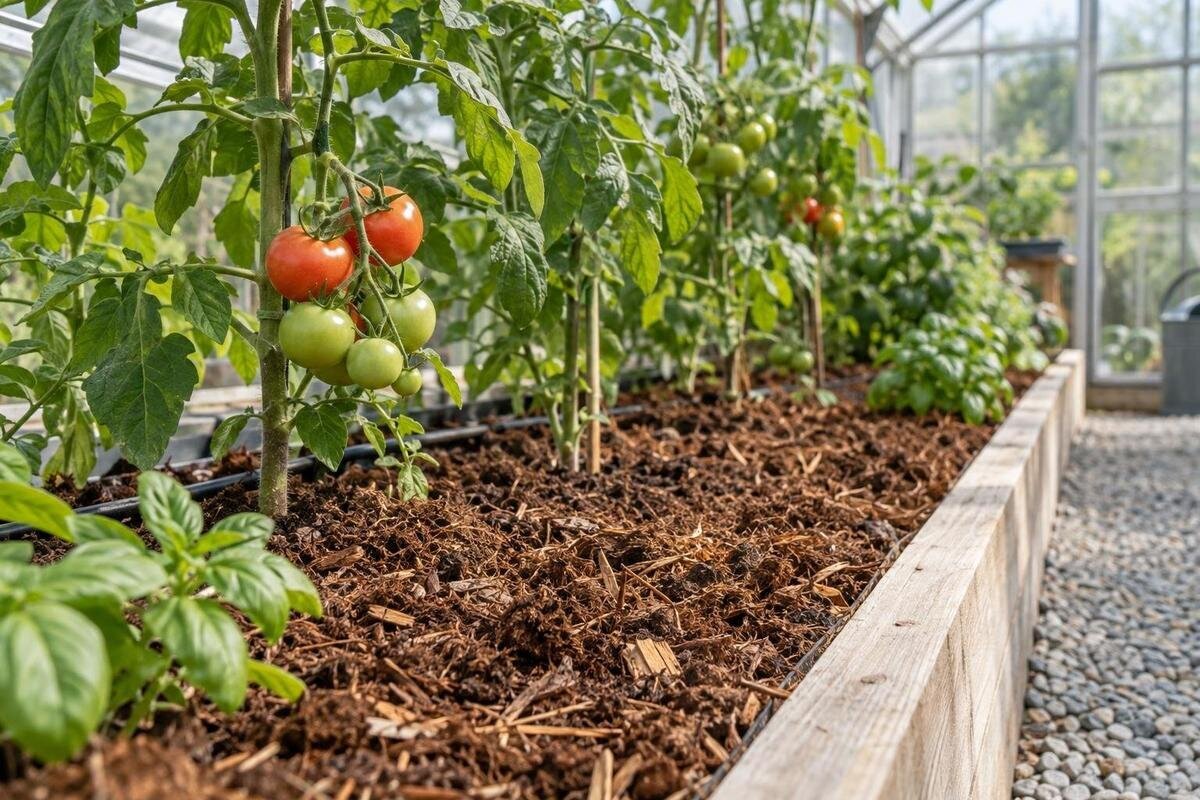
Greenhouse growing media
Peat-free growing media can work well for greenhouse crops, but the label does not tell you how a blend will drain, re-wet or supply nutrients. Ingredients and particle size vary, so two mixes carrying the same label can behave differently in a pot or bed. Compare the crop and growing system first, then check the blend’s physical properties, nutrient content, watering needs and supplier information. A small, measured trial is a safer guide than assuming the schedule used for peat-based media will suit a new mix.

What a peat-free label tells you
A peat-free label tells you that a growing medium contains no peat. It does not identify one standard recipe, particle size, water-holding capacity or nutrient level. Products may combine coir, wood fibre, composted bark, green-waste compost and mineral components in different proportions; processing, particle size and blending matter too. Two bags with a peat-free label can still wet, drain and settle differently. The wording alone also does not tell you whether the blend needs preparation before use or contains added nutrients. Treat it as a starting point, not a performance specification. Read the directions and ask the supplier about intended use and batch consistency.
Use claims matter as much as ingredients. A medium designed for seed starting may have a finer structure and a different nutrient charge from a potting mix for established vegetables. A product sold for containers is not automatically a good replacement for soil in an in-ground greenhouse bed: the existing soil, organic matter and drainage all affect the root zone. Check whether the medium is meant to be used on its own, blended with another material or added to existing soil. That distinction helps prevent buying a large quantity for a purpose the supplier did not intend.
Match the mix to the crop and growing system
Begin with the crop and its growth stage. Seeds and young seedlings can be sensitive to uneven moisture and coarse pieces, so a fine, consistent propagation medium is often easier to manage than a rough blend. Established fruiting crops in pots have a longer root-zone demand and different water and nutrient needs from short-lived seedlings. Leafy crops, herbs and fruiting vegetables also differ in crop duration and rooting pattern. Match the product’s stated use to the crop, container and expected time in the medium. A blend chosen for germination may not be intended to carry a plant through a full greenhouse season.
Decide whether plants will grow in pots, grow bags, raised beds or the greenhouse’s existing soil. Container media must retain water while still draining freely; a bed also interacts with the material beneath it, so a bagged potting mix may not be formulated for that job. The footprint matters when working out how many beds or containers will fit alongside access space. The T-Shaped Orangery Greenhouse listing gives an area range of 16.52 to 30 m², but that figure is not the dimensions of a particular bed, bench or aisle. Measure the planned growing area before calculating media volume.
Read the blend composition and technical data
Ingredient names offer clues, not a complete forecast. Coir-based materials, bark, wood fibre and compost can contribute differently to water retention, pore space and weight, and particle size changes how they behave in a pot. Compost may add nutrients, but its nutrient content, pH and soluble-salt level can vary with feedstock and processing. Wood fibre can influence structure and nitrogen demand depending on how it is made and blended. Coir’s preparation and grading matter as well. Ask about the finished mix rather than applying one rule to every ingredient listed on the bag.
Look for details that support the use claim: intended crop or growth stage, pH, electrical conductivity (EC), initial fertilizer charge, and any information about drainage or water retention. EC measures dissolved salts, but a result is useful only when you know the test method and how to interpret it for that product. Particle-size or air-space data can help compare structure when suppliers provide them. Do not rank two mixes by one isolated pH or EC result if samples were prepared or tested differently; ask for the method and follow the product’s directions.
Balance moisture retention with air space
Water and air need to coexist in the root zone. After irrigation, a suitable medium holds some water while excess drains and air returns to larger pore spaces. A fine, compacted or settled blend can stay wet for too long; a very coarse, freely draining blend may lose water quickly in a small pot. Neither texture is automatically wrong: the crop, container depth and irrigation control determine whether it is workable. Where available, compare water-holding and air-space information from suppliers, while remembering that figures from different test methods may not be directly comparable.
Try a small sample in the actual pot or a small area of the intended bed before filling the whole growing area. Pre-moisten it as directed, fill using your usual approach, water evenly and let it drain. Note whether water spreads through the mix or runs down one side, then check the root-zone moisture before the next irrigation. Pot weight can be a useful relative cue when you compare the same container over time. Test more than one greenhouse position if conditions differ. If you are comparing the Pyramid Greenhouse size options, listed from 5.53 to 18.9 m², sketch the proposed growing areas and identify where you would assess the mix. Keep observations from each trial position separate.

Adjust greenhouse watering after changing media
Do not carry over a watering calendar unchanged when you switch from peat-based media. A peat-free blend may take up, hold or shed water differently, and some dry media need careful initial wetting; behaviour depends on the formulation. Start by checking at root depth and noting container weight, how quickly water moves through and whether the root zone wets evenly. A dry surface does not prove the bottom is dry, while a damp surface does not confirm moisture around deeper roots. Sun, ventilation, plant size, pot size and crop stage also change water use under cover.
Adjust one part of the routine at a time and record it: how much water you applied, how you applied it and how the medium responded. With drip or hand watering, check that water reaches the whole root area rather than making a single wet channel. Inspect drainage and a second spot in the container as well. Moisture sensors can help track trends, but readings depend on the medium and should be checked against a physical observation. When planning crop zones in one of the Classic aluminium greenhouse models, listed from 3.77 to 28.08 m², use the exact chosen footprint and mark representative moisture-checking locations. Return to those locations as you adjust the watering routine.
Plan feeding for the medium and crop
Find out whether the mix contains starter fertilizer, what kind of nutrient supply it includes and which crops or growth stages it is meant to support. Some peat-free products arrive with nutrients and others do not, so adding a routine feed before reading the label can duplicate what is already present. A short seedling phase and a long fruiting crop may need different feeding plans; neither is decided by the peat-free label. Follow the product’s crop directions, then assess growth and root-zone conditions before changing the plan. The ingredient list alone is not a fertilizer prescription.
Keep feeding observations separate from watering observations. Record fertilizer type and timing, irrigation water source, crop stage and any pH or EC measurements taken with a consistent method. If leaves or growth change, consider moisture, roots and nutrition together rather than treating one symptom as proof of a deficiency. For a greenhouse divided into crop groups, identify which beds or containers share a medium and feeding routine. If you are considering the Prestige greenhouse size options, listed from 3.77 to 28.08 m², use the chosen layout to map those groups. Label them clearly so that each feeding record can be matched to the right crop and blend.
Check what the supplier can document
A reliable supplier should be able to explain what the mix is intended for and what it contains. Ask whether the ingredient list is complete, whether proportions are stated by volume or weight, how the product is prepared for use and whether nutrition is included. For a coir-based or compost-rich medium, useful questions include whether the final blend is ready to use and whether pH and EC information is available. Request a batch or lot identifier, and ask whether the formulation may change between batches. Consistent information makes products easier to compare and can help explain differences after planting.
Peat-free is not a complete statement about environmental impact. If sourcing matters to your decision, look for specific information about feedstock, component origin, processing and packaging rather than assuming all peat-free recipes have the same footprint. Plan where bags will stay dry and identifiable until use, following the supplier’s storage directions. The limited-edition greenhouse with built-in storage may be worth examining as part of that layout comparison. Its product name, however, does not establish how much media will fit or whether the storage conditions suit growing-medium bags. Check the actual dimensions and storage guidance before allocating space for your order.
Calculate media volume from beds and containers
Work out the amount of media from the growing containers, not the greenhouse’s total floor area. Measure a rectangular bed’s internal length and width and the intended fill depth. Multiply the three dimensions in metres to get cubic metres, then multiply by 1,000 for litres. For example, a bed measuring 2.4 m by 1.2 m with a 0.25 m fill depth holds 0.72 m³, or 720 L, before accounting for settling or handling loss. For pots and troughs, measure the usable space inside them. Split irregular beds into simple shapes and add their volumes.
Bag volume and weight are not interchangeable, and some products are compressed or change volume when moistened. Check whether a supplier’s stated volume is loose or compressed and follow its instructions for estimating what to order; avoid applying one extra percentage to every blend. Subtract aisles and work areas before scaling up the growing plan. The Spacious Greenhouse listing gives area options from 47 to 70 m², but total structure area is not bed volume. Use the dimensions of the actual beds and containers, along with the exact greenhouse configuration.

Trial a new blend before switching the whole greenhouse
Trial one candidate blend with a limited, representative group before replacing everything. Where practical, use the same crop, age, container size and planting conditions for the current medium and the new one, and change only one blend at a time. Record how much water you apply, how quickly the root zone dries, whether the medium wets evenly, how it drains and how the plants develop. If you alter watering to suit the new mix, write down each change and the observation that prompted it. This helps you distinguish the blend’s behaviour from the effects of a revised watering routine.
A short trial cannot show how a blend will settle or perform through every crop stage, but it can reveal persistent saturation, rapid drying or difficult rewetting. Keep monitoring as plants grow, since roots and canopy change water demand. If appropriate for the crop, retain a comparison group in the current medium and avoid several fertilizer changes during the test. When planning a trial within one of the lean-to greenhouse options, listed from 3.69 to 14.34 m², check the chosen configuration’s actual layout. Identify comparable positions for the two groups, and note any differences in their growing conditions when interpreting the results.
Fit the media plan to the greenhouse layout
Use the greenhouse layout to organize filling and handling before the main media purchase. Identify the beds, pots and crop groups that will receive each blend, and leave access to water and space to handle bags without blocking aisles. Keep different blends clearly labelled, including any reserved for propagation or trial plants. If you are choosing the greenhouse at the same time, the Limited Edition aluminium greenhouse range lists sizes from 3.77 to 28.08 m². Compare the exact model dimensions with your plan, including work areas as well as planted space. Match the order to the measured containers and beds assigned to each blend.
Review the records for each growing area before choosing media for the next crop. Compare the blend and batch, crop, planting date, irrigation changes, fertilizer and any pH or EC results alongside observations about initial wetting and drainage. Look at how often plants needed water as they developed, rather than judging the medium from one unusually wet or dry day. These comparisons help distinguish a blend issue from a change in weather, crop stage or watering practice. A satisfactory medium does not need replacing just because it is peat-free or a new season has begun; respond to its observed condition and the crop’s needs.
Frequently asked questions
Is every peat-free mix suitable for greenhouse vegetables?
No. Peat-free describes an ingredient choice, not a crop or use specification. Check whether the mix is intended for propagation, containers or beds, and whether its structure and nutrient supply suit the crop. If you are unsure about using it in an in-ground bed, ask the supplier and test a small area first.
Do peat-free mixes always dry out faster?
No. Peat-free blends vary, and their behaviour depends on ingredients, particle size, processing, container depth and greenhouse conditions. Some hold water well; others drain or re-wet differently. Check the root zone and adjust watering to the particular blend rather than relying on a general rule.
How can I tell whether a mix holds enough water?
Try it in the container you plan to use. Follow the product’s wetting directions, water evenly, let it drain, then check moisture below the surface before the next irrigation. Comparing the weight of the same pot over time can help you track changes, but it is not a universal moisture reading.
Do I need to feed plants in peat-free media?
Check the label first. Some products contain an initial fertilizer charge, while others do not or are intended for a particular growth stage. Follow the supplier’s crop directions and keep records of feeding and watering. Do not add fertilizer automatically without finding out what is already in the mix.
Can I put peat-free potting mix straight into an in-ground bed?
Not automatically. A mix made for containers may not be intended to replace bed soil, and the existing soil and drainage affect how it performs. Check the supplier’s use directions and consider the condition of the bed before buying in quantity. A small trial can help reveal problems before a full change.
A useful peat-free medium is one that fits the crop, growing format and greenhouse routine—not simply one that carries a particular ingredient label. Check the intended use, physical structure, nutrient charge and supplier information, then test a manageable quantity in the containers or beds you will actually use. Track moisture and feeding as the crop develops. That measured approach makes it easier to choose a blend that is predictable in your greenhouse and to refine the routine without changing several things at once.
