
Automating a Greenhouse Without Mains Electricity: Practical Options
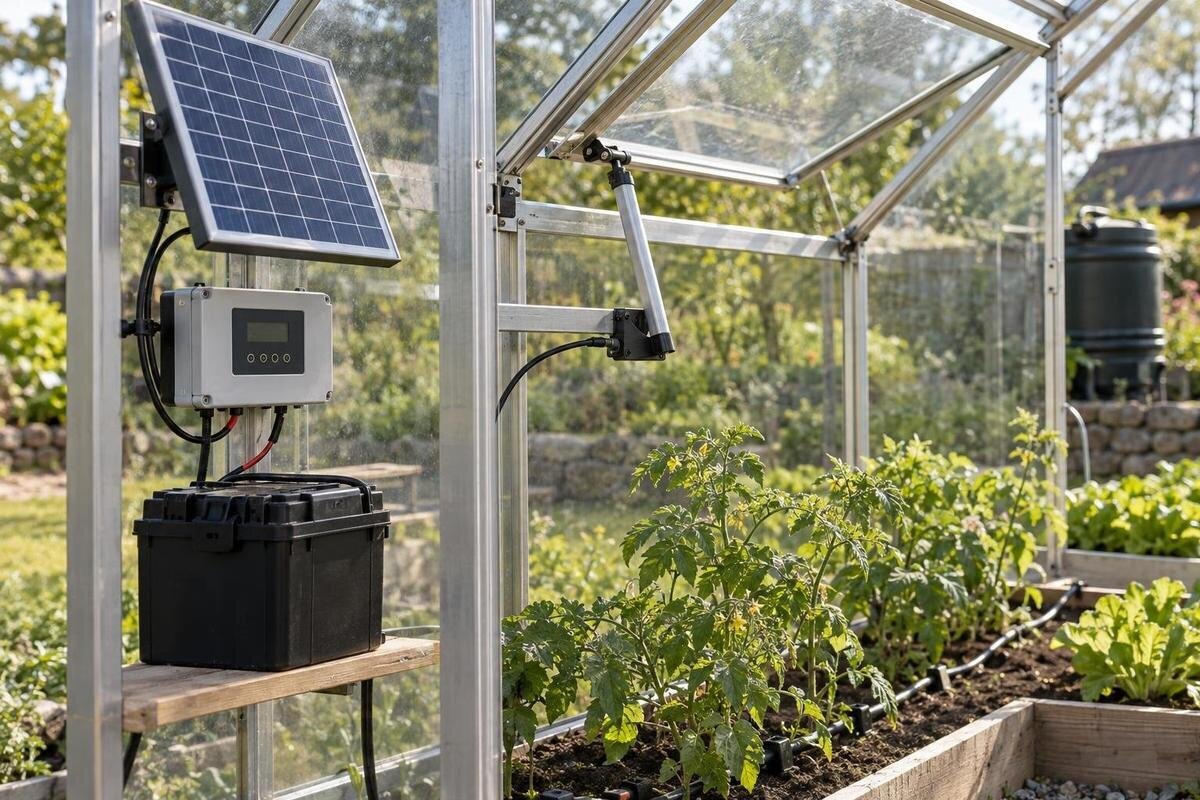
Greenhouse automation
Automating a greenhouse without grid power is practical when the task and its limits are clear. A mechanical vent opener can respond to warmth without electricity; a battery-powered controller can operate selected equipment; and gravity-fed irrigation may avoid a powered pump if its pressure and flow suit the system. None of those, on its own, makes a greenhouse self-managing. This guide separates passive movement, stored electrical power and water supply, then explains what to verify and which manual checks still matter.

01
Define the job before choosing a power source
“Off-grid” can mean several things in a greenhouse: no powered controls, a mechanical device that acts without electricity, or electronic controls supplied by a battery or a solar-charged battery. Those are different levels of independence. Hand-opening vents or carrying water uses no power, but depends on someone being present; a thermal opener handles one movement; a controller may run only selected functions. List ventilation, irrigation, pumping, monitoring and alerts separately. For each task, note whether it must work when no one is on site, what failure would look like, and who could respond. Describe the result you need as well as the action: opening a vent is an action, while maintaining acceptable conditions around the plants is the aim. Record when you currently intervene and why. This gives you a practical basis for deciding which task deserves automation first, rather than choosing a power system before knowing what it must do. This short audit stops “automatic” from being confused with “unattended.”
Separate the energy source from the job it performs. A thermal opener can move a compatible vent without a grid connection, but it cannot move water; a pump may add a separate electrical load. The T-shaped orangery greenhouse is listed in sizes from 16.52 to 30 m², which can help you compare growing-space options. That area range does not specify vents, controls or irrigation equipment. Before selecting any hardware, confirm the exact greenhouse configuration and record which tasks you will still inspect manually.
Passive greenhouse ventilation has specific limits
Manual opening and passive automatic venting are not the same. A manually opened sash uses no electricity, but still needs someone to open it. A common mechanical thermal opener responds to warmth at the unit and moves a compatible vent without an external power supply. It only acts on the opening it is designed for; it does not detect humidity, rain, wind or moisture around plant roots, and it cannot run a fan. A moving vent is not proof that conditions are managed throughout the greenhouse. Air exchange also depends on the other openings and the path air can take through the space.
Ask the opener maker or greenhouse supplier to confirm compatibility with the exact vent type, including the sash’s weight, required travel, mounting points and the device’s stated operating range. Find out whether the vent can still be operated manually, how to respond if the mechanism sticks and what routine inspection it needs. A classic aluminum greenhouse is listed in area options from 3.77 to 28.08 m², but floor area does not identify its vent type or count. Confirm the vent layout for your chosen configuration before buying an opener.
02
Match vent placement to the greenhouse layout
Treat vents as part of an airflow layout, not as isolated accessories. Mark each opening and door on a drawing, including the direction it moves, then add paths, shelves and likely plant positions. Full shelves or tall crops can obstruct access or change the air path. A sensor or thermal opener beside a sunlit pane may also respond to conditions that differ from those around the beds. Observe how shade shifts across the site and keep handles and manual controls reachable. A thermometer near the plants can help you compare conditions with a reading at an opening.
The Pyramid Greenhouse is listed in sizes from 5.53 to 18.9 m². Use that range to compare footprint options, not to infer how many vents a particular configuration has or where they are located. Ask for the vent layout for the size you are considering and confirm which vents can accept a compatible opener. If more than one opening is involved, find out whether the mechanisms can operate independently and how you can close or secure the vents when site conditions change.
Battery-powered greenhouse controls need a load plan
A battery-powered controller can handle selected tasks, but its capabilities depend on the parts it is designed to operate. List the controller, sensors, valves, actuators, pumps and any communications device separately. A controller may switch an output without supplying all the power an actuator needs; a sensor can measure a condition but cannot move a vent or open a valve by itself. Confirm the supported sensors, number of outputs or zones, compatibility with each device, and whether the controls still work locally if an internet connection is unavailable. Fans and pumps need their own power plan. A simple connection diagram can make these distinctions easier to discuss with the supplier: show what measures conditions, what makes the control decision, what performs the action and what powers each part. For a watering system, for example, identify the timer or controller, valve and any pump separately. This helps you compare complete arrangements rather than treating a controller’s battery specification as the specification for the whole system.
Ask the equipment maker for runtime assumptions under the intended use, including standby consumption, temperature limits, low-battery warnings, and how recharging or replacement works. Find out what the equipment does when its supply runs low and whether a manual fallback is available. The lean-to greenhouse range is listed from 3.69 to 14.34 m²; that area does not tell you how many openings or control outputs your selected configuration needs. Keep the exact size and vent details with your controls enquiry.

03
Solar charging and battery runtime
A solar panel changes where electricity comes from; it does not remove the need to match supply with demand. Charging varies with exposure, shade, clouds, snow and season, while some sensors, displays and communications devices use power even when no actuator is moving. Cold conditions can also affect battery performance. Ask for runtime and charging information based on your equipment and expected site conditions, rather than relying on a demonstration during bright weather. Check whether the system can keep operating through a stretch with less charging and how you will know if its reserve is low.
Do not assume an ordinary garden greenhouse roof is designed to carry a solar panel or its associated loads. Ask the structure supplier and a qualified installer to confirm an acceptable arrangement; this is not something to infer from the greenhouse’s appearance. The Limited-Edition Aluminum Greenhouse with Storage is listed in sizes from 5.52 to 28.08 m². Its product name and area range do not establish that the storage space is suitable for batteries or electronics, or that the structure is suitable for panel mounting. Verify environmental limits and placement separately.
Plan watering around the actual water source
A water supply and an electricity supply are separate parts of the plan. Hand watering needs no powered controller but depends on regular visits. Gravity-fed watering may avoid a pump only when the source provides suitable pressure and flow for the chosen filter, tubing, valve and emitters; not every timed valve is designed for low pressure. A well or other source that relies on a pump adds an electrical requirement. Rain collection also depends on storage and replenishment, so it cannot guarantee water through a dry stretch. Base an estimate on planted area, crops and the time of year, not greenhouse floor area alone.
Before choosing an irrigation timer or valve, ask the supplier to state its pressure and flow requirements, power needs and water-quality or filtration limits. Trace the proposed route from the source to the plants and list the components along it. Ask whether the proposed combination meets those requirements, rather than checking each item in isolation. Include how the system will be refilled and whether that step depends on powered equipment elsewhere on the property. This keeps the water-supply plan consistent with the aim of operating without mains electricity. Decide who will refill a tank, how you will check its level, and what you will do if a line leaks or the source runs low. If your site freezes, ask how exposed water components should be handled seasonally. The Spacious Greenhouse is listed in sizes from 47 to 70 m²; use the exact planted layout to estimate watering needs, rather than assuming all floor space is planted or that water equipment is included.
04
Set irrigation controls for the beds, not the calendar alone
A timer repeats a schedule whether or not the growing medium is dry, while a moisture sensor reports conditions only where it is placed. Soil type, growing medium, plant size and bed position can all affect how representative that reading is. Follow the sensor maker’s placement guidance and consider whether different crops need separate zones or individual checks. A single reading may not describe every bed. When planning zones, mark which containers or beds would receive water together. Compare their needs before assigning them to one control setting, and decide which plants still need separate attention. The useful question is not simply how many zones a controller offers, but whether those zones match your planting plan. Revisit that plan when crops or containers change rather than assuming the original grouping still suits them. Confirm what the controller does if a sensor reading is missing or outside its normal range; do not assume it will make the same choice you would.
Problems can occur in the water path as well as in the electronics: a tank may be empty, an emitter may be blocked, a valve may fail to open or close, or a sensor may be displaced. Check that water actually reaches representative plants rather than relying only on an app or controller display. Keep a manual watering method available and know how to stop the supply if a leak is found. If someone else may need to respond, make sure they know what to inspect and how to switch to the manual method.
Alerts still need a person who can respond
A warning system has its own requirements: a powered sensor, a working communications route, a receiver and someone who notices the message in time. Wi-Fi or cellular service can be unavailable or interrupted, and a notification is not a mechanical backup. Check whether a control can be operated locally if an app or connection fails. Ask what alerts are available for low battery or unusual readings, and test the entire notification route rather than assuming that setup is complete once an alert appears on a screen.
The Bloomcabin Prestige Greenhouse is listed in sizes from 3.77 to 28.08 m². Use the exact layout you are considering to plan a clear route to manual vent controls and water shut-offs, plus an accessible place to read and service equipment within its stated conditions. The area range does not specify where controls can be mounted. Decide who receives alerts and who can reach the greenhouse; automation cannot make an intervention possible if nobody is available to act.

05
Test each function and keep a task log
Before relying on a system, test each function according to its maker’s instructions. Observe the vent through a complete operating cycle, check that the controller responds to its intended input, and confirm that water reaches the intended outlets. Try the manual fallback and ask the supplier to explain how the equipment behaves when a battery is low or a sensor is unavailable. Do not create a risky power or weather condition just to test a failure. A demonstration on a mild day can show basic operation, but it does not establish how the setup will perform under every condition.
Keep a simple record of inspection dates, outdoor conditions, vent positions, battery indicators, water levels and any manual adjustments. Note what you observed in the growing beds, as well as what a sensor reported; the difference can reveal whether its reading is representative. Keep observations separate from explanations: record that a vent remained closed before deciding why it happened. When you change a setting or replace a component, note that too, so later entries can be interpreted in context. A brief record of time spent refilling, charging and correcting problems also lets you assess whether automation is reducing the work you originally wanted to avoid. Over time, the log can show recurring issues, such as a vent that often needs help or a tank that runs low sooner than expected. Use those observations to adjust checks and maintenance, while remembering that one successful season does not guarantee the same result in different conditions.
Choose a setup you can verify and maintain
Choose the simplest arrangement that addresses a real missed task. Manual ventilation and watering avoid powered equipment but still depend on someone being present. A passive thermal opener can take one vent movement off the routine, while leaving other openings, weather checks and watering to manage. Battery controls make sense when a specific function needs automation and you have a clear plan for runtime, servicing and failure. Solar charging may extend that supply if the equipment and site suit it. Compare options against the same task list: what each handles, what remains manual and what servicing it adds. For example, if vent opening is the only task you need help with, assess that function before including irrigation or remote alerts in the purchase. This makes the comparison useful even when the options have very different features. More equipment can solve more tasks, but it also adds components to inspect and maintain.
Before ordering, obtain details for the exact greenhouse configuration and the equipment you intend to use: compatible vents and openers, controller inputs and outputs, power requirements, runtime assumptions, water pressure and flow, failure behaviour, and maintenance needs. The Limited Edition Aluminum Greenhouse is listed in sizes from 3.77 to 28.08 m²; use the selected size and opening details rather than the model name alone when checking compatibility. Where electrical work or structural loading is involved, confirm the arrangement with an appropriately qualified professional.
Frequently asked questions
Can an automatic greenhouse vent opener work without electricity?
Yes. A mechanical thermal opener can move a compatible vent without grid power. It controls only that opening, though, and does not replace checks on airflow, weather or other greenhouse conditions.
Will solar power make greenhouse controls reliable year-round?
Not on its own. Available charging depends on sunlight, shade, snow and the system’s energy use. Check the maker’s runtime assumptions and battery operating limits for your site, and plan for periods when charging is reduced.
Can gravity-fed watering work without a pump?
It can if the water source provides enough pressure and flow for the chosen valve, filter, tubing and emitters. Some timers also need their own power, so confirm both the water-delivery and control requirements.
Does a battery controller mean I can leave the greenhouse unattended?
No. Batteries can run down, sensors can give unrepresentative readings, and water sources or delivery lines can fail. Keep a manual fallback and arrange in-person checks that reflect how quickly a problem could affect your plants.
Can a passive opener and a powered actuator control the same vent?
Only if the equipment makers confirm that the combination is compatible. Two mechanisms acting on one vent may not work together as intended, so verify how they interact and what happens when power is lost.
Practical greenhouse automation without mains electricity is usually a mix of passive mechanisms, carefully chosen battery controls and a dependable water plan. The reliable setup is not necessarily the one with the most devices; it is the one whose limits, fallback options and maintenance needs are understood. Keep in-person checks in the routine, and let observed performance—not the word “automatic”—set your expectations.
