
Heating Seedling Benches Instead of the Whole Greenhouse
Greenhouse heating
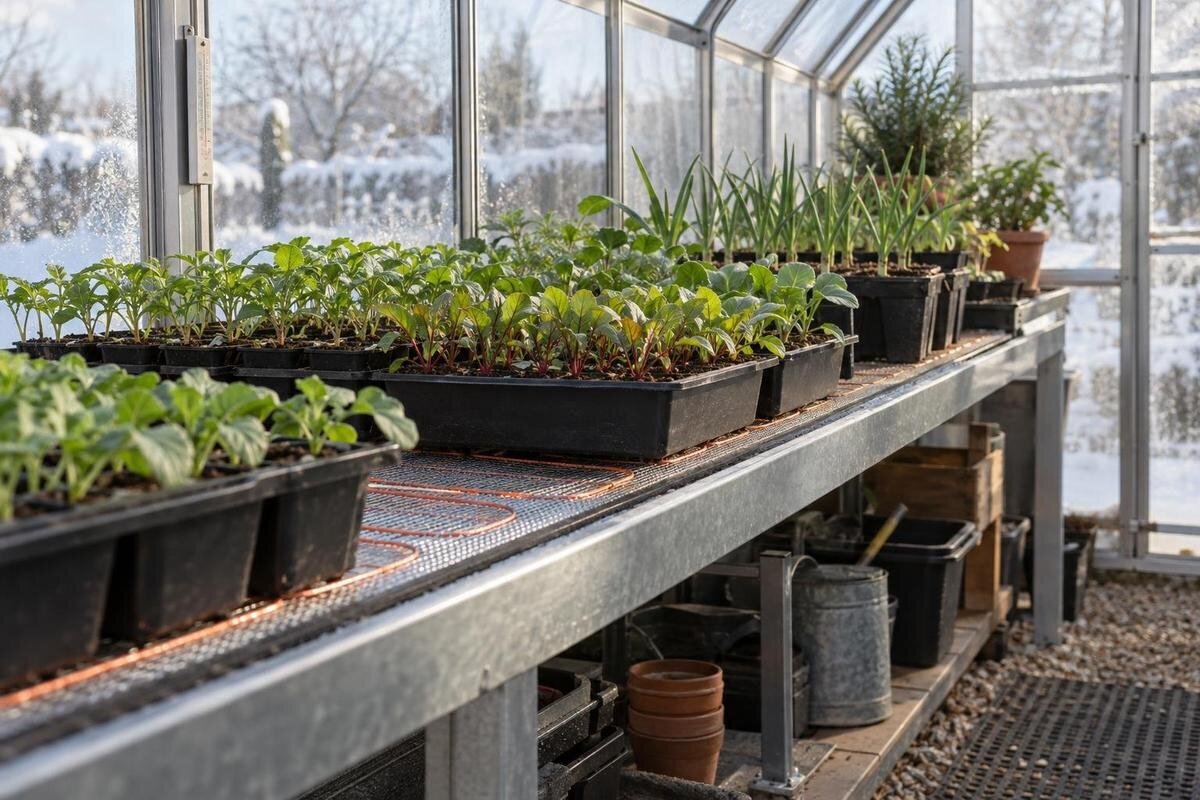
Seedling propagation does not always call for a warm greenhouse. Germination may depend on the temperature of the growing medium, while the air around emerging leaves has a separate target. A heated bench or seedling heat mat concentrates heat around a defined tray area; a space heater warms greenhouse air and has to offset heat leaving through the enclosure. Local heat suits some sowing and rooting tasks, but it is not a substitute for whole-space control when the canopy or other plants also need warmth. The choice depends on crop stage, bench layout, night conditions, ventilation, insulation and the documented limits of the equipment.

Match heating to the propagation stage
Before choosing equipment, separate germination from growing on. Seed packets or crop-specific guidance may state a temperature range for germination; read whether it refers to the seed environment, growing medium, air or more than one. After emergence, seedlings also respond to air temperature, light, airflow and watering. Cuttings can have their own rooting requirements. Some seeds tolerate or prefer cooler germination, so more heat is not automatically faster or better. The useful target depends on the plant and stage; avoid applying one setting to mixed trays simply because they share a bench.
Write down what the heated area needs to do: start a sowing, root a batch of cuttings, support early seedling growth or protect several kinds of plants overnight. Those jobs can overlap, but their heating needs may not. A mat can serve trays while the wider space stays cooler only if that air suits the crop. Heating the greenhouse to satisfy one seed tray may warm space that does not need the same target; heating only a mat will not maintain conditions for foliage elsewhere. Consider how long each batch will need heat and where it will go afterwards. This helps distinguish a temporary propagation need from an ongoing need to heat the greenhouse.
What a heated bench can and cannot control
A heat mat or heated propagation bench supplies warmth near its working surface. How much reaches each tray depends on the equipment design and how the trays sit on it. The bench does not control greenhouse air temperature. The medium, tray, bench and air can change temperature at different rates, and readings may differ between the middle and edge of the heated area. A tray partly outside the working footprint may not receive the same treatment as one in the centre. Some heat escapes into the surrounding air, but that incidental effect is not controlled space heating. Check the growing medium as well as the heater’s control reading, and follow the maker’s instructions on coverage and tray placement.
A whole-space heater warms greenhouse air, which then transfers heat to plants, benches and other contents while heat continues to leave through the enclosure and ventilation. It serves the occupied zone rather than one tray, but it does not guarantee identical temperatures at every shelf. Requirements depend on the selected greenhouse, outdoor conditions, target, openings and documented insulation—not area alone. For example, the Classic Aluminum Greenhouses listing gives a stated area range of 3.77–28.08 m²; those figures indicate scale, not heater capacity or heat retention. Exact model details and site conditions are still needed for a meaningful comparison.
When a heated bench is enough for the task
Root-zone heating is most relevant when a defined batch needs a warmer growing medium for germination or rooting, while greenhouse air can remain suitable for the same crop. It can be practical in a partly used greenhouse: heat the trays in active propagation and leave other benches and open floor outside the intended heated area. This may suit staggered sowing, when only part of the space holds temperature-sensitive starts. The warmed trays are not isolated from their surroundings, though; the equipment releases some heat outward and the greenhouse still responds to outside conditions. Treat bench heating as targeted warmth within the greenhouse, not as a separate climate.
Local heating may reduce how much greenhouse air you deliberately heat, but that does not guarantee a lower electricity bill. Run time, heated surface area, outside temperature, air leakage, moisture and controller behaviour all affect energy use. If propagation is your main need, the Limited Edition Aluminum Greenhouses range is one model family to compare with a planned bench footprint. Confirm the dimensions of the version you are considering: a stated greenhouse area is not usable bench length. Sketch tray capacity, working space and storage before deciding how much active surface you need. Include any separate air heater required to keep surrounding plants at their appropriate conditions.
When greenhouse-air heating is still needed
Whole-greenhouse heating becomes relevant when leaves and stems—not just the growing medium—need maintained air conditions, or when several benches and other plants share that requirement. It is also the direct approach for protecting a wider collection from cold, though the target depends on the plants and the purpose. Root-zone heat cannot prevent cold air from chilling foliage or protect plants on unheated shelves. Conversely, warm air does not guarantee that every pot or tray reaches the same medium temperature, especially after a cold period. Decide whether the goal is active growth or protection, then check the relevant zone; these are different targets and may call for different operating plans.
Space heating has to keep up with heat leaving through glazing, gaps and necessary ventilation; a heater’s setpoint does not prove that all plant positions will match it. The Lean-To Greenhouses listing shows a stated area range of 3.69–14.34 m², but area alone does not describe a chosen configuration’s heat loss, ventilation or insulation. Do not infer thermal performance from the format or product image, including an assumption that a nearby wall provides a particular benefit. Check the exact product details and documented ventilation or insulation options before deciding what whole-space control needs to cover. If relevant information is unavailable, avoid turning area into a heater-capacity estimate.

Size the heated area around trays and access
Map the heated bench around the trays you expect to use, not just the longest bench that will fit. Note how many flats will be active at the same time, whether trays are different sizes, which batches need different treatment and when trays may move off the heat after emergence. A mat may be too small for a busy sowing period or unnecessarily large for a few trays; equipment coverage should follow the actual propagation plan. If crops with different needs share a heated surface, group or label them rather than assuming one setting suits all. Keep unheated space for plants that do not need the same root-zone warmth.
Access is part of the layout. Leave room to lift trays, inspect them, water without knocking over containers and reach doors or vents; benches, storage and walking routes all use the greenhouse footprint. The Limited-Edition Aluminum Greenhouses with Storage listings give a stated area range of 5.52–28.08 m², and the model name identifies a storage feature. Confirm how the chosen plan allocates that space rather than assuming the listed area is all planting or heated bench area. Include the path you need when potting on or removing trays, not only the arrangement on a quiet day. Product drawings and measurements are more useful than an exterior image for this check.
Measure growing-medium and air temperatures separately
Treat the growing medium and canopy air as separate measurements. A thermostat attached to a bench heater controls according to its sensor and instructions; it cannot tell you what the air around the leaves is doing. Check the medium in a representative tray and air temperature at plant height with suitable thermometers. Take readings at more than one point if the bench or greenhouse has obvious warm and cool areas, and at times that matter, especially before morning sun changes conditions. Record each reading’s location and time. An average can hide an edge tray or overnight low that matters to a particular sowing.
Use the heater maker’s stated coverage, input and controller requirements; do not assume a mat covers trays beyond its designed area or that a generic thermostat is compatible. Follow instructions for equipment in a damp growing space, and ask a qualified electrician about electrical-supply suitability where needed. When planning a setup in the Bloomcabin Prestige Greenhouse, identify the benches and plant positions you will monitor in the chosen configuration. Keep those locations consistent so that readings remain useful as batches change. Test the loaded setup with ordinary trays before relying on it for valuable seed, and adjust from observed medium and air temperatures rather than the heater’s surface reading.
Manage moisture and ventilation as well
Local warmth does not manage humidity or air exchange. Growing medium can dry at a different pace when warmed, so check the medium itself and adjust watering to the crop and conditions rather than relying on a fixed calendar. Covered trays or propagator lids also change the environment inside the cover; follow crop guidance on when to use or remove them. Avoid crowding trays so tightly that you cannot inspect them or maintain the air movement the plants require. Root-zone heating is not a reason to seal the greenhouse or leave ventilation decisions unattended.
Vent positions, plant density and access routes around benches shape how air moves through a greenhouse. When considering a T-Shaped Orangery Greenhouse, check the drawing and documented vent arrangement for the exact selection rather than inferring airflow from its shape. Locate the trays in relation to those openings, and keep propagation equipment clear of them as directed. Opening vents may release warm air, but closing them simply to save heat can conflict with the plants’ ventilation needs. Whether you use bench heat, whole-space heating or both, ventilation remains a separate part of managing conditions for each crop.
Compare energy use with local rates and real conditions
Compare energy use with the same assumptions. For each system, record the documented power input and actual running time, or use a suitable meter, then relate consumption to the electricity rate on your bill. If the rate changes by time of day or usage tier, use the applicable rate for the hours tested; separate fixed bill charges from energy charges when estimating the heater’s running cost. If a heater cycles, its rated input alone does not tell you weekly consumption; actual operating time or metered energy matters. A root-zone unit may serve a smaller area but run for long periods, while a space heater may cycle as conditions change.
Keep outdoor weather, temperature targets, ventilation habits, greenhouse configuration and trial length in view; a sunny day or mild night is not a fair comparison with a cold, windy spell. The Spacious Greenhouse listing covers a stated area range of 47–70 m², illustrating why a whole-space estimate needs exact conditions; area alone does not reveal enclosure losses or heater use. There is no reliable saving figure without those inputs. A measured comparison across similar conditions is more informative than assuming bench heat always costs less, and both plant air requirements and medium targets need to stay comparable.

Greenhouse layout, covering and insulation options
Before choosing a greenhouse for propagation, check the exact usable interior dimensions against bench depth, working routes and the door or vent access needed for daily work. Then look for documented details on the covering, ventilation and any compatible insulation options. These are practical parts of a heating decision: ventilation exchanges air, and enclosure details affect heat loss. Consider the layout and enclosure together, rather than choosing the bench arrangement first and leaving heating requirements until later. Allow for the trays you expect to add, while retaining the access needed to water, inspect and move them. Adding heat alone does not guarantee that a seasonal structure will provide suitable winter-growing conditions.
The Pyramid Greenhouse range lists areas from 5.53 to 18.9 m². Use product drawings or exact specifications to see how the selected configuration accommodates your propagation plan; the total area does not describe bench dimensions or vent positions. Check how any proposed insulation option works with the selected covering and ventilation rather than assuming add-ons are compatible. For an existing greenhouse, measure the actual benches and note the covering, openings and draught paths. Those observations give you a clearer basis for comparing local and whole-space heating than the model name or exterior appearance. Keep the planned bench footprint separate from the total greenhouse area in your comparison.
Use both systems when the crops need two temperature zones
Using both methods can make sense when germination medium needs extra warmth but the rest of the plants need a cooler air environment. Set the greenhouse-air requirement for foliage and other plants first, then use a separate, appropriately controlled bench zone for trays that need warmer medium. Keep the two readings distinct in your log. A bench heater should not be treated as backup space heating, and a whole-space heater should not be assumed to give every tray the same root-zone temperature. Decide which equipment responds when a cold spell arrives rather than discovering after emergence that only one part of the greenhouse is controlled.
Plan what happens as seedlings emerge or move to another bench: follow crop guidance to reduce or discontinue root-zone heat when it is no longer required, and keep checking canopy conditions. If cold conditions could damage the rest of the collection, decide how the air-heating system will respond independently; a heated bench serves only its own area. On mild days, a crop may need medium heat but not warm air; in colder weather, the reverse can be true. Use your temperature and energy records to revise the operating schedule as batches develop. Note when trays move or bench heat is reduced, so you can interpret subsequent readings in the context of those changes.
Frequently asked questions
Can a heated bench keep the whole greenhouse frost-free?
No. Bench heat warms the trays and growing medium within its working area; it does not control the surrounding air or protect plants elsewhere. If the wider collection needs protection, assess the air conditions separately and use suitable whole-space heating.
Do all seeds need bottom heat?
No. Germination requirements vary by species, and some seeds tolerate or prefer cooler conditions. Check whether your seed-growing guidance refers to the medium, air or both, and use a heat mat only when it suits the crop and the equipment.
Should I turn off a heat mat after germination?
Not automatically. Requirements can change as seedlings emerge, but some plants may still need warmth around their roots. Follow crop-specific guidance, check the air around the leaves as well as the growing medium, and adjust the setup to the stage of growth.
How can I compare running costs?
Compare measured energy use, or documented input and actual running time, with the rate on your electricity bill. Keep the test conditions and temperature targets similar. A smaller heated area may help, but it does not guarantee lower costs.
Can one thermostat control both the bench and greenhouse air?
Only if the equipment is specifically designed for that arrangement. A sensor controlling a bench heater does not show what the air around the leaves is doing. Measure both zones separately and follow the manufacturers’ requirements for compatible controls.
Choose the heating zone to match what the crop actually needs. If selected trays need a warmer medium and the canopy air is already suitable, a heated bench is the more targeted tool. If plants throughout the greenhouse need warmer air, plan for whole-space heating and check conditions beyond the heater’s sensor. When both needs exist, manage and measure each zone separately. A trial with actual trays, ventilation habits and local electricity rates gives a sounder comparison than assuming local heat will always cost less.
