
Compost for Greenhouse Beds: How to Avoid Overfeeding
Greenhouse soil guide
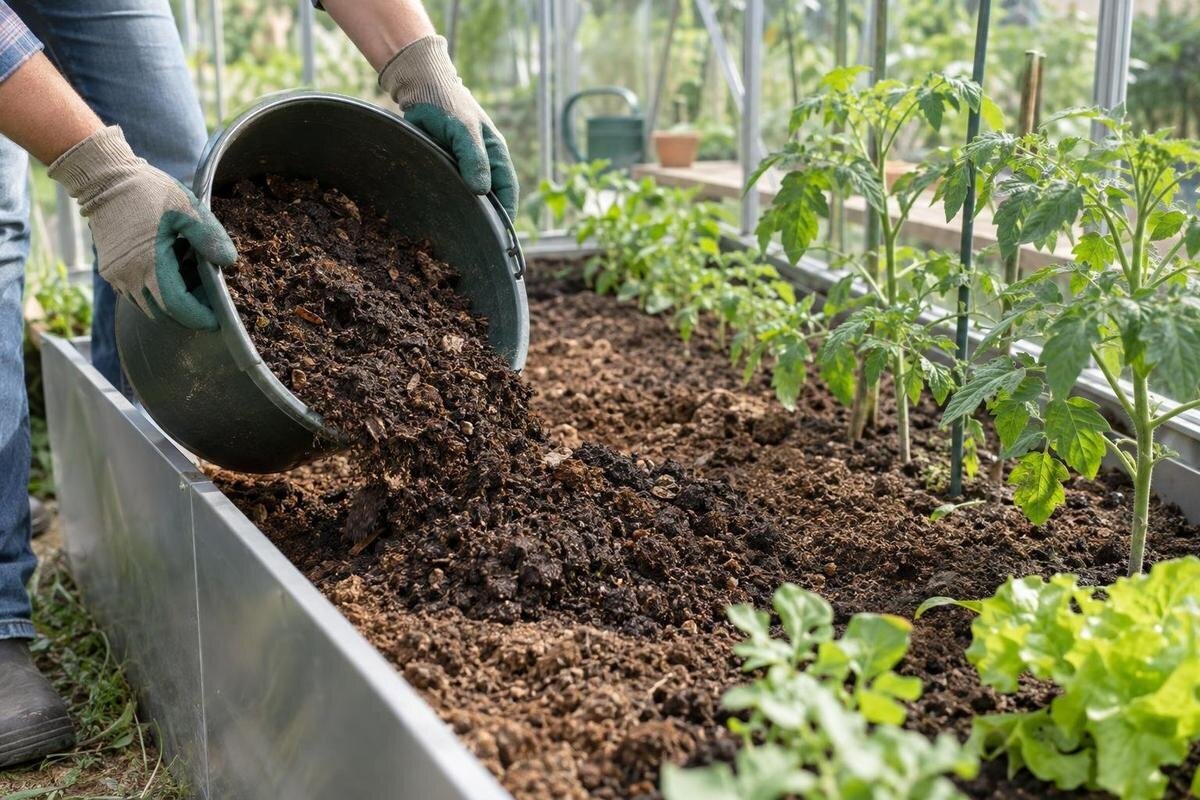
Compost can support a greenhouse bed, but repeated additions are easy to misjudge. It supplies organic matter along with nutrients and soluble salts, and its composition varies by batch. A covered bed may also receive little direct rainfall, so its history matters. Before topping up, check that the compost is mature, read its analysis, test the existing soil and measure the bed area. That makes the choice specific to what the bed needs instead of a routine dose.

How repeated compost additions can overfeed a bed
Compost adds organic matter, but it also carries nutrients and soluble salts. In a covered greenhouse, beds usually receive little direct rainfall, so soluble material may not move through the soil as it can outdoors. Irrigation, drainage, crop uptake and the compost itself all affect what remains; the roof alone does not prove that nutrients have accumulated. Still, repeated additions can quietly raise nutrient or salt levels, especially when each growing season begins with a fresh top-up. The key distinction is between improving soil structure and supplying nutrients. A bed may need one without needing the other, and compost is not a neutral way to increase organic matter.
Overfeeding is usually a cumulative pattern rather than one dramatic mistake: compost is added, then composted manure, fertilizer or a nutrient-rich growing mix contributes more, and no one totals the inputs. Some crops may respond with excessive leafy growth or uneven development, but weak flowering, pale leaves and poor fruit set can have other causes; appearance alone cannot identify excess compost. Check the history and test results before changing the recipe. When planning beds in a Bloomcabin Prestige Greenhouse, include paths, benches and non-soil growing areas in your sketch. Its listed sizes range from 3.77 to 28.08 m², but only the intended planting surfaces belong in a bed amendment calculation. This distinction matters from the first fill onward: record what goes into each bed rather than treating the greenhouse as one undifferentiated growing area.
Maturity and nutrient strength are different checks
Maturity describes how far the ingredients have decomposed and stabilized; it does not tell you how nutrient-rich the finished compost is. Mature material is often cool, crumbly and earthy-smelling, with most starting materials broken down. Those are useful clues, not a lab result. Compost that is still heating, has a sharp ammonia or sour odour, or contains a lot of fresh material may continue changing after it reaches the bed. That can make nutrient release unpredictable, temporarily tie up nitrogen or be hard on new roots. If a batch is questionable, ask the supplier about its condition before using it around established crops or seedlings.
Once compost is mature, its nutrient content still depends on the ingredients and process. Two finished batches can differ substantially: one may be nutrient-rich or salty while another contributes less. A mature product is not automatically appropriate in unlimited amounts. A home germination test may flag an obvious problem, but it does not measure nutrient content or confirm suitability for every crop. Keep the questions separate: first, has the material stabilized? Then, what does it contribute, and does the bed need those inputs? A positive answer to the first question is not a reason to skip the other checks.
What to look for in a compost analysis
Ask for a report tied to the actual batch, rather than relying on a general description such as rich in organic matter. Test panels vary, so check whether the report includes nitrogen, phosphorus and potassium; pH; electrical conductivity (EC) or another soluble-salt measure; moisture; and organic matter. Ask whether nutrient figures are total or available, and whether maturity information or a carbon-to-nitrogen ratio is provided. EC is a broad measure of soluble ions, not a verdict on one nutrient or a substitute for soil testing. If the report does not say what was tested, ask the supplier or laboratory before treating a figure as an application recommendation.
Read the units and reporting basis as carefully as the values. Some results are expressed on a dry-weight basis, while delivered compost contains moisture; total nutrient content also does not mean that all nutrients become available to roots at once. Release depends on the material and growing conditions, so a total-nitrogen figure alone cannot tell you what a crop will use this season. Ask how to compare the results with your soil test and whether the laboratory can interpret them for your crop and bed. Check the feedstocks and any screening information relevant to the product’s intended use, especially for food-growing beds. If batch information is missing, request it rather than guessing at a large addition.
Test the greenhouse bed before adding more
Test the growing bed itself, not a handful from the compost pile or one visibly different spot. Follow the laboratory’s sampling instructions; that may involve taking several small samples from a consistent depth in one bed zone and combining them. Keep areas with different histories separate, and avoid sampling directly from a recent compost pocket or fertilizer band, which may not represent the rest of the bed. Tell the laboratory that the sample is from a greenhouse, list recent amendments and crops, and ask which panel will report the pH, nutrients and soluble salts relevant to your decision.
Use the result as a baseline and compare like with like over time. Test panels and interpretations differ, so rely on the laboratory’s guidance for the crop instead of treating one number as a universal target. If its interpretation says nutrients or salts are already adequate or high, do not add compost simply because the calendar says it is time. When planning beds for the Spacious Greenhouse, mark the sampling zones on your layout and give each one a clear name. Match those names to the sample labels and laboratory results so you can identify which recommendation belongs to which bed. Keep zones with different management histories distinct. A bed can also have a structural issue when its nutrient levels are already adequate, so do not assume more compost is the answer.

Measure the bed, not the greenhouse footprint
Measure beds before converting any suggested application into a quantity. For a rectangular bed, multiply its inside length by its width. Divide an irregular layout into simple shapes, calculate each area and add them together. Count only the soil you intend to amend: leave out paths, benches, shelves, hard surfaces, containers and unused floor space. If part of a bed has a different crop or management history, keep that zone separate so you can make a separate decision instead of averaging it into one figure. The greenhouse’s gross footprint and the surface of its soil beds are different measurements.
The Classic aluminum greenhouse listing gives model areas from 3.77 m² to 28.08 m²; use the selected footprint to plan the structure, then measure the bed surfaces inside it. For example, a bed 3 m long and 1.2 m wide has 3.6 m² of surface, even if the surrounding greenhouse is larger. That figure becomes useful only when paired with an application rate or layer depth recommended for the compost, crop and soil. Do not infer a bed’s usable area from a product category or its overall area range; check the specific layout you are considering.
Calculate compost volume from area and depth
If guidance recommends a surface layer, convert it to a measured volume rather than estimating by the wheelbarrow. One square metre covered to a depth of one millimetre equals one litre. For example, a 3.6 m² bed at an illustrative depth of 5 mm would take 18 L: 3.6 × 5. The 5 mm figure is arithmetic only, not a recommended compost depth. Let the soil and compost analyses, crop guidance and intended use determine whether a layer is appropriate and how deep to apply it. If guidance describes incorporation by volume, follow the stated volume or proportion rather than substituting a surface-layer calculation.
A volume calculation does not convert a mass-based rate into litres. Compost density varies with its ingredients, moisture and how firmly it is packed, so a bucket of one product may not weigh the same as a bucket of another. Keep to the units in the supplier’s directions or ask for a bulk-density conversion. If you are planning beds for the aluminum lean-to greenhouse, write the units beside every quantity on your layout: bed area in square metres, layer depth in millimetres and the resulting volume in litres. This makes it easier to compare the calculated amount with the package quantity without confusing area and volume. Measure the compost consistently too, since settling or packing it tightly can change the volume in a container.
Amend only the beds that need it
Use the test results to decide which bed receives compost and whether the need is related to soil structure, nutrients or both. If the laboratory reports that nutrient levels are already adequate or high, do not keep adding nutrient-rich compost just to make the soil feel looser. Ask a qualified horticulture adviser or laboratory whether another approach is suitable for that crop. Equally, a low result is not automatic permission to add any compost: check the batch analysis and crop guidance first. Turn the recommendation into a separate measured allowance for each bed that needs an addition. Keep that allowance attached to the bed’s name or number so it is not accidentally shared across neighbouring beds.
Beds with different histories should not share one blanket allowance. A bed that received compost last season may have a different test profile from a newly filled bed, even if both are in the same greenhouse. When considering the Limited Edition aluminum greenhouse, use your proposed bed layout to organize those decisions before ordering compost. Beside each bed, note its test results, past inputs and calculated allowance; where no addition is needed, record that explicitly rather than leaving an ambiguous blank. Add up only the allowances supported by the results. This gives you a purchase quantity tied to actual needs and avoids treating the entire growing area just because one section needs attention.
Apply compost differently to beds and containers
Apply mature compost according to the recommendation for the bed, distributing it consistently rather than leaving piles beside individual plants. Whether it should stay at the surface or be mixed into the soil depends on the growing system, crop and roots, as well as the advice you are following. Avoid deep digging around established roots, keep compost away from stems and crowns, and do not fill planting holes with an unmeasured scoop. For a surface application, calculate the layer before spreading and stop at the planned amount instead of judging by colour or coverage after each pass. A neat-looking layer is not evidence that a bed needs more.
A permanent soil bed, a pot, a grow bag and a seed-starting tray do not have the same root volume or growing medium. Copying a bed amendment amount into a container can change moisture, air space and nutrient levels more than intended; follow the medium supplier’s directions for containers and seed mixes. If you are considering the T-shaped orangery greenhouse for a layout with several growing systems, identify each system separately on the plan. Record soil-bed areas for bed calculations and container volumes for medium-specific guidance. Do not combine them into a single compost allowance merely because they share the same structure. Keeping these quantities separate also makes it clear which recommendation applies when you move from planning to filling or amending.

Plan compost purchases for additional beds
Adding another growing bed changes the total amount needed only if that bed also needs compost. Where the same recommendation applies to both beds, multiply the area-based rate by the added bed surface, or use the specified volume when the guidance is volume-based. Do not increase the rate simply because a larger structure is being filled. A new bed containing imported topsoil or a purchased growing mix may have a different starting point from existing soil, so obtain the supplier’s information or test the new material before copying the old bed’s plan. Calculate its allowance separately, then add it to the purchase total. Expansion is a reason to review quantities, not to assume every bed should receive the same treatment.
When comparing sizes of the Oasis pyramid greenhouse, draw the beds you intend to add and distinguish them from beds that will remain unchanged. Keep the planned compost quantity beside each bed rather than attaching one total to the product size. Before ordering, compare that total with the quantities available from the supplier and decide how you will handle any difference. Buying more than the calculated amount does not justify spreading the surplus on beds that already have adequate nutrient levels. If the added space uses bags or containers instead of in-ground soil, keep their growing-medium requirements separate from the bed-compost order. That way, the purchase follows the planting plan rather than the available floor area.
Keep records before repeating an application
Record each addition by date, bed, compost source and batch, analysis, amount, bed area, and whether it was spread on the surface or mixed in. Note other recent nutrient inputs and the date of the soil test so later results can be interpreted. Include what was growing and any clear change in soil handling or crop performance, but do not attribute every symptom to compost; temperature, water, pests and other factors can overlap. Keeping a simple log turns a recurring habit into a decision you can review before the next purchase. Use consistent units so amounts remain comparable from one season to the next.
A layout sketch helps when the greenhouse includes storage, access routes or more than one growing system. When considering the Limited Edition greenhouse with built-in storage, mark the intended beds and storage area separately, then use the same bed names in your amendment log and sampling records. Update the sketch if a bed is divided, enlarged or converted to container growing; otherwise, an old quantity may appear to apply to a layout that has changed. Before repeating an application, review the latest bed test, the compost analysis and the previous amount together. If results are already adequate, record the decision to wait rather than topping up just because a new growing season has begun.
Frequently asked questions
How can I tell whether compost is mature?
Mature compost is often cool, crumbly and earthy-smelling, with most of its starting material broken down. These are clues, not proof. If it is still heating, has a sharp odour or contains a lot of fresh material, ask the supplier about its condition or have it assessed before using it in a planted bed.
Can mature compost still overfeed a greenhouse bed?
Yes. Maturity describes decomposition, not nutrient strength. A finished batch can still contain substantial nutrients or soluble salts, and repeated applications can add up. Check the compost analysis alongside a test of the bed before deciding whether more is appropriate.
How much compost should I add?
There is no single rate for every compost, crop and bed. Use the soil and compost results with crop-specific guidance to choose an amount, then base the calculation on the measured bed area. If guidance gives a layer depth, area in square metres multiplied by depth in millimetres gives litres; the formula does not set the right depth.
Should every bed receive the same amount?
Not necessarily. Beds may differ in their previous compost additions, soil, crops and test results. Keep separate records and, where their histories differ, assess them separately. An amount that is appropriate for one bed is not automatically appropriate for another.
Can I use the same compost amount in pots or grow bags?
Do not transfer a bed rate automatically. Containers have different root volumes and growing media, and compost can change their nutrient levels, water retention and air space. Follow the guidance for the specific medium and crop instead.
Think of each compost application as an input with a measured area and a known history. Confirm the batch is mature, read what it contributes, and compare it with a representative test of the bed. Once the recommended amount is worked out, keep the calculation specific to the soil surface and record it. That pause before each top-up helps greenhouse soil stay productive without adding nutrients it already has enough of.
