
Deciding When to Replace Greenhouse Soil
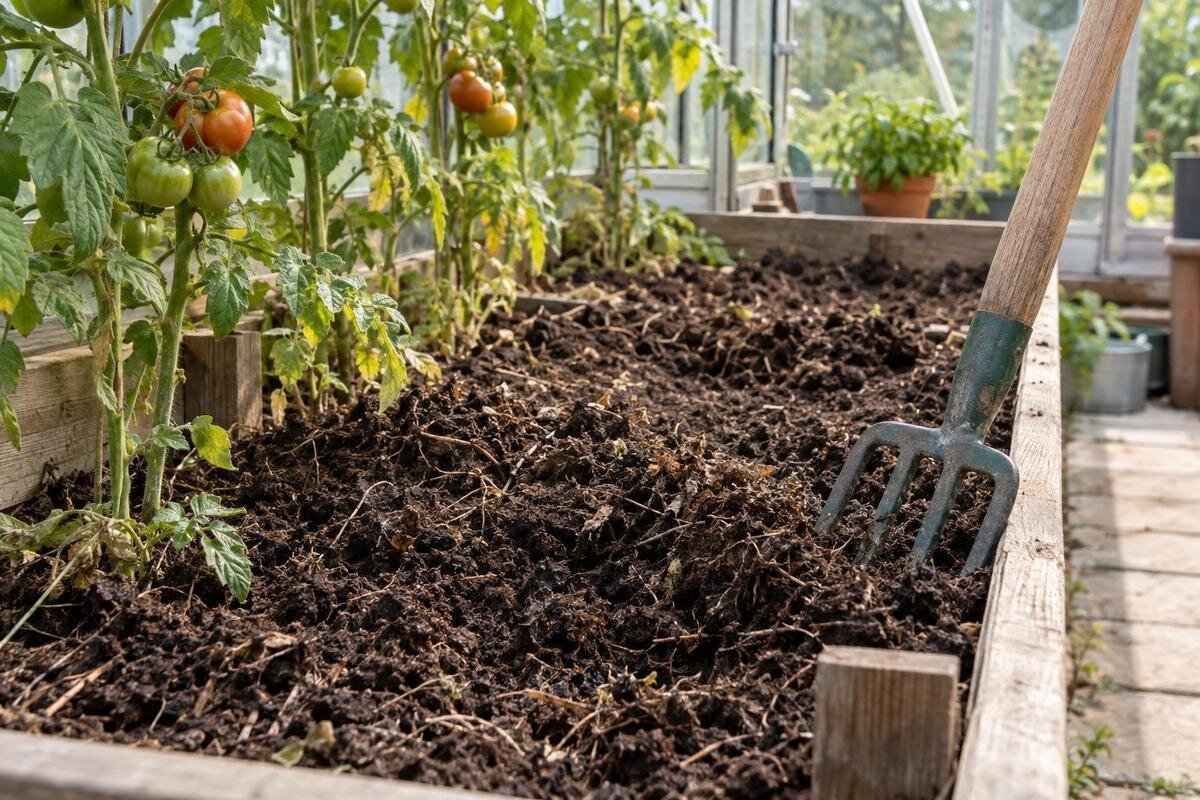
GREENHOUSE SOIL GUIDE
Greenhouse soil can support crops for years when it still drains well, has a workable structure and produces healthy roots. Under cover, it receives little direct rainfall, while harvests remove nutrients and irrigation or amendments can change what remains. That makes annual replacement a poor default: the same symptom may call for a nutrient test, an improvement to soil structure or a disease investigation. This guide explains how to tell those situations apart, when partial or full replacement may be justified, and how to calculate the replacement material needed without treating the whole greenhouse floor as a bed.

Before replacing soil 1
Greenhouse soil does not need annual replacement
A greenhouse bed has no fixed renewal date. Every harvested crop carries away some nutrients, but the rate depends on what you grow and how much you remove. Irrigation, fertilizer, compost and drainage also change the balance. Because the roof excludes most direct rainfall, soluble salts can build up in some conditions instead of being washed down through the bed. These processes vary from site to site, so age alone says little. Soil used for several seasons may remain productive, while newer soil can already have a problem that needs attention.
Treat the end of a crop as an opportunity to assess the bed, not as a cue to strip it out. Clearing crop residues is separate from replacing healthy soil. If growth is consistent, roots look sound, water behaves normally and relevant test results are suitable, continued management is reasonable. Replacement makes sense when evidence identifies an issue that cannot be corrected in place or a qualified adviser recommends removal. Otherwise, fresh material can become a costly reset that hides a continuing water, nutrient or crop-health problem rather than resolving it.
Record where and when crop symptoms appear
Pale leaves, slow growth, wilting, poor fruit set or small plants can signal a soil problem, but none proves that soil needs replacing. Similar symptoms can follow uneven watering, temperature swings, limited light, root damage, pests, crowding or a change in crop variety. Note whether trouble begins at the same crop stage, affects one kind of plant or several, and appears in one patch or throughout the greenhouse. Also record whether it follows a watering change or a new input. A recurring pattern is more informative than a single disappointing harvest.
Before disturbing the bed, record the crop and variety, planting date, symptom timing, irrigation changes and any fertilizer or amendments. Compare affected plants with healthy ones, including their roots, and mark their locations on a bed sketch. If you are planning a growing layout for the Pyramid Greenhouse, listed in sizes from 5.53 to 18.9 m², give each intended bed a clear label so observations can be tied to a specific location. In an existing greenhouse, use the same labels throughout your notes rather than describing a problem only as being near the door or at the back. Record what differs between healthy and affected areas, as well as what they share. Note whether the problem returns in the same spot after a crop change; that pattern can help distinguish a local issue from a greenhouse-wide one and gives an adviser a clearer starting point.
Before replacing soil 2
Test the soil before adding fertilizer or amendments
A lab test is most useful before fertilizer, compost or replacement soil is added. Follow the laboratory's sampling directions and collect soil from the growing area being investigated. Keep a thriving bed separate from a failing one; mixing samples can hide an important difference. Depending on the question, an analysis may report pH, available nutrients and soluble salts, often assessed through electrical conductivity (EC). Ask which tests fit your crop and soil type. Explain whether you are investigating weak growth, deciding on an amendment or considering removal, so the request has a clear purpose. Label each sample to match your bed sketch and keep a note of when it was taken and what had already been added. This connects the report to the conditions you observed. If you suspect an issue with the irrigation supply, ask whether a separate water test would help interpret the result.
Read the results as a set rather than as a single grade. A pH outside the crop's suitable range can affect nutrient availability, while elevated soluble salts can hinder growth even when some nutrients are present. When mapping a greenhouse that includes storage, such as the Limited-Edition Aluminum Greenhouse with Storage, mark that zone separately: samples should represent growing beds, not floor space used for another purpose. Keep the report with your bed map and ask the lab to explain what the findings mean for the crop you plan to grow.
Distinguish low nutrient levels from poor nutrient availability
A low nutrient reading with workable pH, salt levels and structure may point to replenishment rather than soil removal. Harvested crops export nutrients, but repeated additions can also leave an imbalance or raise salt levels. Weak growth is not proof that nutrients are missing: when pH affects availability, roots may struggle to access nutrients already present. Water quality and how a bed drains can also influence what accumulates over time. Crop history and a test result are more useful than applying a general fertilizer schedule based on appearance alone.
Use crop-specific interpretation from the lab or a horticultural specialist to choose a targeted correction, then follow any advice about timing and retesting. Avoid adding fertilizer or compost simply because leaves look pale; extra material can worsen an existing salt or nutrient imbalance. If test results do not explain the symptoms, look into watering, temperature, roots and possible disease rather than replacing soil as a guess. Keeping records of irrigation sources and past amendments makes it easier to understand why results may have changed between seasons.

Before replacing soil 3
Assess soil structure and drainage
Structure concerns show up in how a bed handles water and supports roots, not just in nutrient numbers. Compacted soil may resist a hand tool, form a hard surface crust, hold water on top or let water channel away without wetting evenly. Roots may be shallow or bent where they meet a dense layer. Look for patterns under ordinary watering and across more than one part of the bed; a single observation after an unusually heavy watering does not show that the whole bed has deteriorated. Describe the behaviour precisely: where water collects, where the soil remains difficult to work and where roots change direction. Compare these locations with areas that perform normally. The aim is to identify whether the concern is widespread or confined to a particular part of the bed before deciding how much soil needs attention.
Before adding organic matter or replacing soil, consider why the structure has changed. Repeated foot traffic, the bed's texture and past amendments can all affect how it behaves, so a large dose of an untested material may create another drainage or fertility problem. If you are also reconsidering the greenhouse layout, use the Bloomcabin Prestige Greenhouse listing alongside a sketch of proposed beds and working paths. Check the dimensions under consideration against the access you need to tend those beds without walking on them. A layout change addresses access; assessing the actual soil establishes whether compaction also needs treatment.
Investigate recurring crop-health problems
A possible soil-borne problem needs a different investigation from low fertility. Repeated wilting, stunting or root discolouration in the same bed, especially when a susceptible crop returns, can justify closer attention, but these signs are not a diagnosis. Waterlogging, temperature stress and other causes can look similar. Look for a pattern across plants and seasons. A plant's appearance alone cannot identify a pathogen or nematode, so avoid naming a disease before the cause has been checked.
If the same crop-health issue recurs, contact a local plant diagnostic service or qualified horticultural professional before moving soil, tools or residue between beds. Ask whether the problem is soil-borne and how widely it is distributed; replacing soil without that answer may leave the cause in crop debris, containers or water. For a larger growing layout, such as one planned within the Spacious Greenhouse, listed from 47 to 70 m², keep observations tied to individual beds. The structure's total area does not establish the extent of a crop-health problem. Identify which beds show symptoms and which do not before discussing local removal or a wider response.
Before replacing soil 4
Decide how much soil, if any, needs removal
Removal is most defensible when testing or diagnosis identifies a concern that cannot be corrected safely in place, or when the bed's physical condition is beyond practical restoration. If a qualified assessment supports local removal, limit disturbance to the area it identifies and protect neighbouring beds from moved soil. Do not skim an arbitrary surface layer: the relevant boundary and depth depend on the crop roots and the problem being managed. A poor harvest by itself does not establish that a bed needs to be emptied.
A whole-bed change may be appropriate if an issue is widespread through that bed or contamination is suspected, but first establish what is present and what replacement material would address it. Soil removal alone may not control a living problem if affected residue or contaminated equipment remains, so follow diagnostic advice about handling and cleanup. Before arranging the work, distinguish the soil to be removed from neighbouring soil you intend to keep, and record the proposed boundary and depth. This gives the removal decision a defined scope rather than leaving it to whatever is easiest to excavate. If a greenhouse renovation is happening too, use the Aluminum Greenhouses listing to compare the structure options separately. Consider the proposed access for removing and bringing in material, but do not let the building purchase determine the soil decision. Choosing a new greenhouse model is not evidence that the existing bed needs to be emptied.
When to restore rather than replace soil
If test results point to a manageable fertility issue and the bed still drains and supports roots, improving the existing soil may be more appropriate than replacing it wholesale. Use only an amendment that addresses the measured need and is suitable for the bed. Materials vary in pH, nutrient content and soluble salts, so a large dose of compost or fertilizer is not automatically restorative. In a covered space, repeated additions can accumulate. Take account of previous inputs and avoid using material of unknown composition.
Where the problem is physical, base any loosening or organic-matter addition on the soil type and the compaction pattern. Correcting the cause, such as repeated traffic across the bed, matters as much as changing the soil. Crop rotation can reduce repeated pressure from the same crop group, but it is not a cure for a confirmed soil-borne disease. If you are also planning a new growing arrangement, use the Lean-To Greenhouses listing when comparing your proposed beds and access routes. Check that the intended arrangement leaves workable access to the beds you plan to retain, rather than assuming a different structure will resolve their soil condition.

Before replacing soil 5
Choose replacement material and calculate bed volume
Choose material for the actual growing system. Soil added to an in-ground bed needs to work with the bed's existing texture and drainage; a growing medium intended for containers may behave differently when used in bulk. Ask the supplier about composition and recommended use, and compare available information on pH, nutrients and salts with the soil test. Do not assume that a material labelled garden soil, topsoil or planting mix suits every greenhouse bed. If disease or contamination prompted replacement, use diagnostic advice to check the proposed source and handling.
Estimate only the area you plan to refill: multiply each bed's length by its width and the intended fill depth, using the same units to get a volume, then add the beds together. For an irregular bed, divide it into measured shapes. If only part of a bed is being replaced, measure that portion rather than including soil that will remain. Where the planned removal depth differs, calculate those portions separately and keep the measurements with your bed sketch. The Limited Edition Aluminum Greenhouses are listed from 3.77 to 28.08 m², but greenhouse area is not the volume of soil to order. Paths, storage and retained soil do not belong in the replacement calculation. Ask the supplier how loose or settled volume is quoted before ordering, and describe the space you intend to refill so the quantity is based on the same measurements.
Keep a bed-by-bed record
Keep a simple record from one crop to the next: draw the beds, identify the crop and planting dates, note irrigation changes and amendments, and map symptoms and test results. Once you have chosen a response, add what was removed, retained or amended, where the work took place and when it was done. At the next assessment, compare the same locations rather than relying on a general impression of the greenhouse. Record whether the original concern persists, improves or appears elsewhere, alongside any changes in crops or management. This helps you review the response without assuming that every later change is due to the soil work. The record can be brief; consistent bed labels, dates and descriptions matter more than a lengthy gardening diary.
When planning beds in a greenhouse or reworking the current layout, mark growing areas separately from paths and other floor uses. If you are considering a T-shaped layout such as the T-Shaped Orangery Greenhouse, draw each intended bed separately rather than treating the building outline as one soil unit. Retain those bed labels if the layout changes, or note clearly which new area replaces an old one, so earlier observations remain understandable. At the end of a crop, review the records alongside test results, root condition and drainage. Satisfactory conditions support continued management, not automatic replacement. A defined problem calls for a response matched to that bed, whether it needs a targeted correction, further investigation or removal.
Frequently asked questions
Do I need to replace greenhouse soil every year?
No. Harvests and irrigation change soil over time, but there is no universal annual replacement schedule. Check crop performance, soil structure and relevant test results. If the bed is still suitable and no unresolved problem is identified, keep managing the existing soil.
What should a greenhouse soil test include?
Ask a soil laboratory which tests suit your crop and growing system. A report may include pH, nutrients and soluble salts, often assessed through electrical conductivity. Keep samples from healthy and affected beds separate, and ask the lab to interpret results for your situation.
Can I replace only part of a greenhouse bed?
Sometimes. Partial removal may make sense when a problem is limited to a defined area and an assessment supports treating that area separately. Do not remove an arbitrary surface layer: the affected boundary and depth depend on the crop and the issue.
Will compost fix tired greenhouse soil?
Not necessarily. Compost can change nutrient levels, pH and soluble salts, and it will not diagnose a drainage or disease problem. Check what the bed needs first, then use a suitable material in a measured amount rather than adding it automatically.
What should I do if the same crop keeps failing in one bed?
Record the pattern and seek advice from a local plant diagnostic service or qualified horticultural professional. Repeated failure can have several causes, so do not assume a soil-borne disease or replace soil before investigating. Avoid moving suspect soil or residue to other beds while the issue is being assessed.
Replacing greenhouse soil is a decision about its condition, not the age of the bed. Use crop history and inspection to identify the concern, test when nutrients or salts may be involved, and seek a qualified diagnosis for recurring disease-like symptoms. If the issue is manageable, restore the existing soil with a targeted approach. If removal is justified, define its scope and measure only the bed area that needs new material. A bed-by-bed record makes that choice easier to review after each crop.
