
White Crust on Greenhouse Soil: Salts, Minerals or Growth?
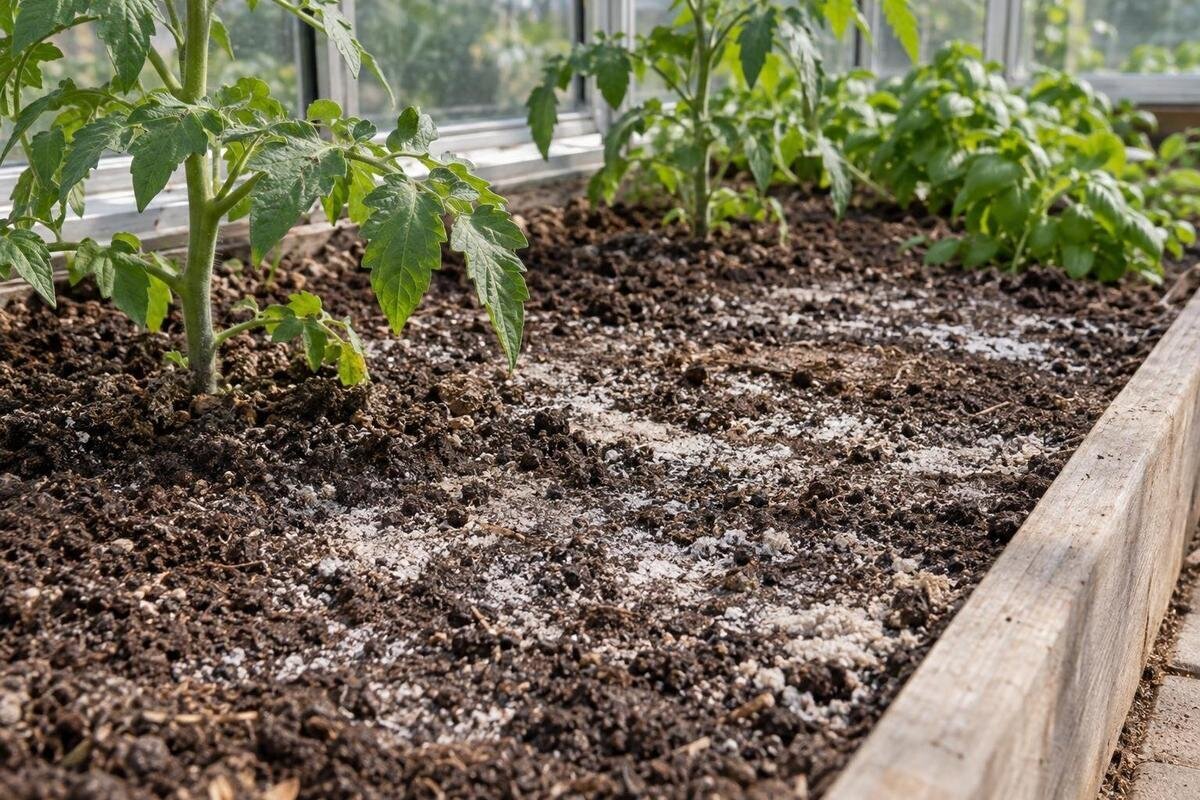
Greenhouse soil
A pale layer on greenhouse soil is easy to mistake for one problem. It may be soluble salts left as water evaporates, mineral residue carried in irrigation water, or growth on a damp surface. Pale particles in the growing medium can look similar, too. Colour alone is not enough to choose a fix. Note where the material appears and what has been added or watered there, then compare irrigation-water and growing-medium test results before changing fertilizer, flushing or removing soil.

What a white surface layer can be
White material on greenhouse soil is an observation, not a diagnosis. Soluble salts can crystallize as water evaporates; mineral-rich irrigation water can leave a residue; and damp organic matter can support pale fungal threads. Algae more often appear as a green film, while pale particles may simply be perlite, lime-containing amendments or fertilizer granules. Once dry, these different materials can look much alike. A patch can also contain more than one thing, especially where water and fertilizer are applied repeatedly.
Texture and shape offer a first clue, but not a reliable field test. A firm ring may point to a dried deposit, while a soft film or fine threads may suggest growth. Look without disturbing the patch, take a photo and note whether it is on a bed, a pot or a tray. A surface crust does not reveal the salt level around the roots, and scraping it into a soil sample can mix two different materials. Keep the visible deposit and the root-zone growing medium separate unless your lab advises otherwise.
How soluble salts build up
Soluble salts are ions dissolved in the root zone. They can come from fertilizer, irrigation water and the growing medium itself. As water evaporates from the surface or leaves through plant transpiration, some dissolved ions remain behind. Repeated watering and feeding can concentrate them when drainage does not carry them away. Covered beds also receive less direct rainfall than open garden soil, so they may get less natural flushing. A crust can form where drying occurs, but its position does not show how far dissolved salts have moved below the surface.
A white deposit is not a measurement of salinity, and plant symptoms do not confirm it. Slowed growth, wilting or leaf-edge damage can occur with elevated salts, but other root, water and growing conditions can produce similar signs. Check the medium with a suitable EC test and interpret it for the crop and growing system. For permanent beds, leave access to repeat sample points in your layout; compare the bed-and-aisle plan with the 47–70 m² area options listed for the Spacious Greenhouse.
Mineral deposits from irrigation water
Irrigation water can leave minerals behind as it evaporates. Hardness generally refers to calcium and magnesium, while alkalinity describes the water's capacity to neutralize acids and is often associated with bicarbonate. These are related but not interchangeable measurements. Depending on the water chemistry and conditions, minerals may precipitate as a pale scale on soil or nearby surfaces. Minerals already present in a growing medium or amendment can also contribute, so a crust does not prove the water is the source.
Look for a pattern rather than relying on colour: residue on several pots or trays watered from the same source is worth noting, but it is not conclusive. Record which water source serves each affected area and whether fertilizer is added before that water reaches the plants. This distinguishes observations about the source water from observations about the final watering solution. Test the water you actually use, and ask for hardness and alkalinity as well as EC and pH. If you are planning separate watering arrangements for beds and containers, allow space for both in your drawing. The Classic Aluminum Greenhouses listing covers 3.77–28.08 m²; compare those area options with the complete plan, rather than assuming the listed area establishes a suitable internal layout.
When the white layer is living growth
A pale, web-like layer can be fungal growth feeding on organic matter near the surface. Algae are more often green and may form a slick film where light and moisture are present. These signs are not definitive: mineral residue can be soft, and growth may be mixed with soil particles. Nor does visible growth by itself establish that a crop is infected. Note whether it spreads across damp areas, follows plant debris or appears in containers as well as beds.
Persistent surface wetness can favour growth, but the root zone still needs water appropriate to the crop and medium. If growth is suspected, review the watering pattern and the condition of the surface before applying a treatment. Avoid using a fungicide, acid or extra fertilizer just because the material is white; a remedy for one cause may create another problem. In a mixed growing area, note whether pots and beds show the same surface change rather than treating them as one system. For a proposed arrangement with pots beside a bed, the Lean-To Greenhouses listing provides a 3.69–14.34 m² area range to compare with your drawing.

Patterns worth recording
Map where the deposit appears before brushing it away. Mark bed edges, containers, emitters, paths and any visibly wet or dry patches. Note whether the material follows one irrigation point, forms a ring around a pot, appears across several growing areas or is confined to a single patch. Those patterns can help you compare water, fertilizer and growing-medium history, but none identifies the material on its own. A deposit near an emitter, for example, could reflect how water dries there rather than prove a specific water-quality problem.
Record the date, crop, growing medium, water source and recent fertilizer or amendment use. For fertilizer, note the product, mixing rate and application dates so that a later change can be traced to a specific part of the routine. Take a photo from the same angle when you revisit the area, and keep notes for affected and unaffected zones separately. Label each photo with the location shown; several close-ups without location labels can be difficult to compare later. A simple greenhouse drawing can serve as the reference map for these records. If you are planning a new growing area, the Limited Edition Aluminum Greenhouses listing gives area options from 3.77 to 28.08 m²; use the exact size you are considering when drawing and labelling its proposed growing zones.
Test the water you actually use
Collect water from the source used for irrigation, following the laboratory's sampling instructions. If you use more than one source, such as a tap supply and stored rainwater, keep samples separate. When sources are blended, ask whether the lab wants samples of each source and of the final mix. If fertilizer is added through the watering system, distinguish a source-water sample from the mixed solution; otherwise, the result may not answer the question you are investigating. Label each sample with its source, collection date and whether it contains fertilizer. Keep the same information in your greenhouse notes, along with the areas supplied by that water. Before collecting anything, confirm the lab's requirements for containers, sample amounts and handling so the samples can be assessed as intended.
Ask about EC, pH, hardness and alkalinity, and whether other ions should be tested for your crop and water source. EC estimates the overall amount of dissolved ions; it does not say which ones are present. pH is not a measure of salinity, hardness or alkalinity. Use the lab's interpretation rather than a universal cutoff, since the relevant ranges depend on the crop and system. For a new greenhouse, mark the proposed water access point and any separate watering lines on the plan. The T-Shaped Orangery Greenhouse listing spans 16.52–30 m²; compare the area options with a drawing that includes those practical requirements.
Sample the root zone, not just the crust
A test of the growing medium answers a different question from a water test. Ask the lab which test suits your greenhouse soil or potting mix and how it wants samples collected. For a bed, take samples from the affected area at a consistent depth, following the lab's instructions. Keep a comparison sample from a separate unaffected area if useful, rather than combining both and averaging away a difference. Do not put a visible crust into the root-zone sample unless the lab specifically requests it. Describe the crop, medium and location of each sample, and explain whether you are investigating the visible deposit, conditions around the roots or both. Agree on a sampling approach before collecting material from several beds or containers, so each result remains tied to a clearly identified growing area.
Growing media and field soil can require different extraction methods, and EC readings from different methods are not directly comparable. Ask for pH and EC, along with any nutrient tests that fit the crop and the question. If the main question is what the crust itself contains, ask whether the lab can analyse it separately. In a proposed bed-and-container layout, check that you can reach the growing medium in each area, not just see its surface from the path. The Pyramid Greenhouse listing covers 5.53–18.9 m²; use the chosen size as an area comparison while checking the detailed layout separately.
Match the response to the results
Read water and growing-medium results together. A high water EC can indicate a substantial dissolved-ion load, while a high medium EC indicates elevated soluble salts in that tested sample; neither reading identifies every compound or proves the crust's origin. Hardness and alkalinity results may help explain mineral residue, but they do not replace a medium test. Keep the sample labels, test methods and units with the results, and ask the lab to explain what each result means for the named crop and medium. If water and medium results seem inconsistent, review where and when each sample was collected before choosing a response. If the results still do not explain what you see, ask whether a separate deposit analysis or a crop-specific diagnosis is appropriate.
For confirmed soluble-salt concerns, review fertilizer inputs, water quality and drainage before considering any flushing. Leaching is only an option when the crop, medium, drainage and water source make it suitable; follow test interpretation or crop-specific advice rather than a set volume. If water minerals are implicated, assess an alternative source or blend only after testing it. For surface growth, focus on its identification and growing conditions. If the findings lead you to revise the arrangement of beds and containers, compare that revised plan with the 5.52–28.08 m² options for the Limited-Edition Aluminum Greenhouses with Storage. Keep each growing medium identified on the drawing rather than treating the entire floor area as one bed.

Track changes after treatment
When results point to a cause, change the factor they support and leave other parts of the routine stable where possible. Changing water, fertilizer and surface materials all at once makes it hard to learn which adjustment mattered. Follow the crop's needs and the test guidance; do not add fertilizer, amendments or cleaners simply to make the visible layer disappear. Removing loose residue may improve appearance, but it does not correct salts or minerals dissolved below the surface.
Return to the same marked area and record whether fresh material forms, how long it takes and whether nearby zones change too. If you repeat a test, use the same sampling approach and, where possible, the same method so results can be compared. Keep the original result beside the follow-up result, with the date and the adjustment made between them. Note changes in crop, medium, water source and feeding; a new crust after a source change is a reason to retest, not proof by itself. If moving to a different greenhouse, update the location map rather than carrying over labels that no longer describe the beds. The Bloomcabin Prestige Greenhouse listing gives area options from 3.77 to 28.08 m² to compare with the revised plan.
Plan a growing area that is easy to monitor
A greenhouse may contain in-ground beds, raised beds, pots or more than one type of growing medium. Keep those systems distinct in your notes because sampling and interpretation may differ. Label each zone and its water source, and leave room to inspect the surface and take a root-zone sample without disturbing another area. Where different crops have different salt sensitivities, record them by zone so a result can be considered in context rather than applied to every plant in the greenhouse.
When comparing greenhouse options, sketch the intended beds, containers, paths and access to irrigation before treating listed floor area as growing area. A product's area range alone does not establish its internal dimensions or suitability for your chosen layout, so check the details for the exact model and size you are considering. The useful setup is one where you can identify each growing medium, collect representative samples and return to the same locations if a white deposit appears again.
Frequently asked questions
Can I tell soluble salts from mineral residue by touch?
Texture can offer a clue: crystals or a firm ring may be a dried deposit, while pale threads or a soft film may be growth. But the materials can overlap, and touching or scraping them cannot identify their chemistry. Use observations to decide what to test, not to choose a treatment.
Does high soil pH prove the crust is lime?
No. A pH reading describes acidity or alkalinity in the tested sample; it does not identify a white deposit or measure soluble salts by itself. Water hardness and alkalinity are separate measurements too. If the deposit's composition matters, ask a lab whether it can analyse a separate sample of the crust.
Should I flush the bed as soon as I see white crust?
Not on appearance alone. Flushing may help with confirmed soluble salts only when the crop, growing medium, drainage and water quality make it appropriate. If drainage is poor or the irrigation water contains substantial dissolved salts, adding more water may not solve the problem. Get test results and crop-specific guidance first.
Can white growth on the soil harm my plants?
It depends on what is growing. Some pale fungal growth feeds on organic matter, while other growth may need closer identification; a damp surface can also support algae. The appearance does not establish a plant disease. Record it, check the growing conditions and seek a crop-specific diagnosis if plants are affected.
What should I send for testing?
Ask the lab what it needs before collecting samples. In general, test irrigation water separately from the growing medium, and keep an obvious crust separate unless the lab asks you to include it. Tell the lab what crop and medium you use, and follow its instructions for sample depth, amount and handling.
A white deposit is a clue to investigate, not a treatment plan. A location map, a test of the irrigation water and a properly collected root-zone sample can distinguish likely causes far better than appearance alone. Once results point to soluble salts, mineral residue or surface growth, make a crop-appropriate change supported by that evidence and monitor the same area again.
