
Aluminium vs Wood Pergola | Which Material Is Better?
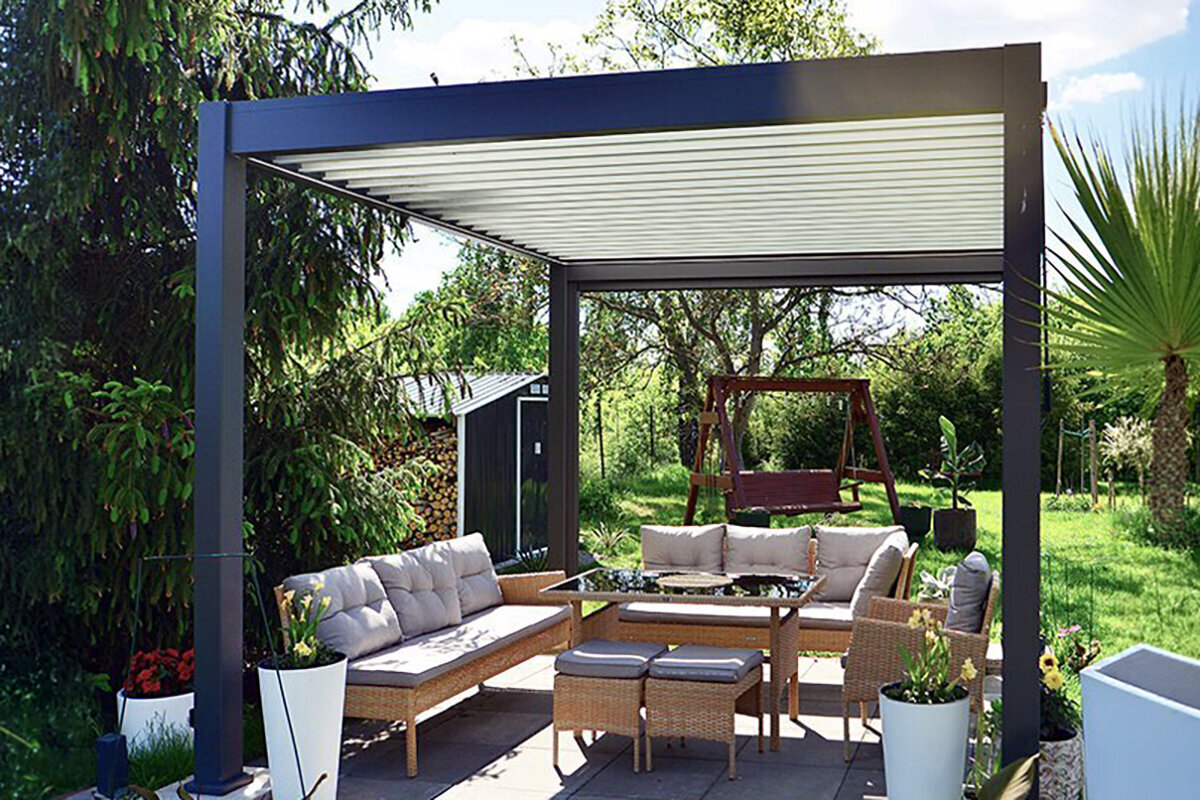
Malta • Pergola material comparison • Bloomcabin Journal
Aluminium vs Wood Pergola
Which material works best for durability, maintenance, appearance, weather, cost and modern terrace living?
A fair comparison
The strongest case for aluminium starts by recognising what wood genuinely does well.
A timber pergola can be beautiful. Natural grain, colour variation and tactile warmth cannot be fully copied by a metal finish. Wood is also familiar to carpenters and DIY builders, easy to cut, drill and alter on site, and particularly suited to traditional, rustic or timber-rich homes.
Aluminium solves different challenges. It does not absorb humidity or swell and shrink like timber. It cannot rot and is not a food source for wood-destroying fungi or insects. Extruded aluminium sections can combine structural support, drainage, cable routing and mounts for moving louvres.
The real question is therefore not which material is absolutely better, but which best suits how you want to use and maintain your pergola over the coming years.
For a fully engineered outdoor-living solution, compare the Bloomcabin aluminium pergola, the bioclimatic aluminium pergola and the wall-mounted pergola.
01 • Direct comparison
Aluminium vs wood pergola: a quick comparison
| Category | Aluminium | Wood | Advantage |
|---|---|---|---|
| Maintenance | Clean; inspect fixings and drainage | Regular checks and refinishing, depending on timber and finish | Aluminium |
| Rot and insects | Does not rot; not food for termites or fungi | Durability depends on timber, protection, moisture and design | Aluminium |
| Moisture movement | No moisture absorption or moisture-related swelling | Hygroscopic; moisture changes alter dimensions | Aluminium |
| Natural appearance | Precise architectural finish | Real grain, texture and warmth | Wood |
| DIY adaptation | Engineered system; alterations require planning | Easy to cut, drill and shape on site | Wood |
| Bioclimatic louvres | Ideal for precise moving systems | Possible, but less typical for complex sealed mechanisms | Aluminium |
| Integrated drainage | Can be built into hollow sections and posts | Usually needs separate gutters and drainage details | Aluminium |
| Surface temperature | Dark profiles can become very hot | Usually feels more thermally neutral | Wood |
02 • Durability
Why aluminium is easier to own outdoors long term
Aluminium has been used in construction for decades because it resists corrosion, forms readily and performs well. A protective oxide layer forms naturally; powder coating or anodising adds further protection and design options.
That does not mean an aluminium pergola needs no care. Remove salt, dirt, leaves and airborne deposits, and inspect coatings, fixings and water outlets regularly. Crucially, the frame does not need protection against biological rot.
Malta brings intense sun, coastal salt exposure, occasional heavy rain and local differences between sheltered towns and exposed sites. Aluminium removes a major category of long-term biological risk from a year-round pergola. Compare detail quality as well as material: coating, drainage routes, fasteners and separation between dissimilar metals matter for aluminium. For timber, end grain, horizontal surfaces, post bases and poorly ventilated joints are particularly important. Any structure that sheds water quickly performs better than one where moisture remains. With wood, however, a detailing error more often directly increases moisture exposure in the structural material.
03 • Moisture and dimensional stability
Wood is hygroscopic – important outdoors
Wood absorbs moisture from its surroundings and releases it again. This cycle changes its dimensions. Correct drying, suitable species, coatings and protective design can reduce movement, but cannot remove it completely.
Outdoor components can therefore shrink, swell, crack or distort seasonally. Good timber construction allows for these properties and avoids water traps. This is not a material defect, but a fundamental characteristic of wood.
Aluminium moves too: it expands as temperatures rise and contracts in cooler conditions. Good systems accommodate this thermal movement. The difference is that aluminium does not absorb humidity and does not follow the same moisture-driven swelling and shrinking cycle.
04 • Rot, fungi and insects
Here aluminium has a clear material advantage
With the right selection and design, wood can perform for very long periods. But where components stay wet regularly or for extended periods, demands on natural durability, treatment, finish and moisture-conscious detailing increase.
Durable timber species, suitable treatment, effective water run-off, stainless-steel fixings and separation from persistently damp surfaces all improve lifespan significantly.
Aluminium does not rot and is not consumed by wood-destroying fungi or insects. Coatings, fixings, seals and accessories still need care, but the structural sections themselves are not biologically degradable.
Conclusion: Aluminium clearly wins on resistance to rot and insects.
05 • Maintenance
Which pergola needs less upkeep?
Aluminium day to day
Clean. Check. Keep water outlets clear.
Wash off dirt, pollen and salt deposits.
Inspect joints and seals.
Keep gutters, downpipes and moving louvres clean.
Wood day to day
Clean. Inspect. Renew finishes when needed.
Check cracks, joints and water-holding details.
Maintain stain, paint or protective systems for product and exposure.
Repair damaged surfaces early.
Unprotected exterior timber changes visibly: colour, roughness and surface cracks develop through weather and UV exposure. Some owners like this natural patina. For a more consistent appearance over many years, powder-coated aluminium is simpler.
06 • Appearance
Where wood genuinely wins
No powder coating is real wood. Solid timber has grain, knots, tonal variation and warm tactility. It ages visibly, can be sanded, stained, painted and shaped with traditional carpentry details. For traditional homes or gardens rich in timber, a wooden pergola may be the best aesthetic choice.
Heavy beams, exposed rafters, decorative brackets and heavily planted pergolas often look especially natural on a timber frame. The home's architecture should guide the choice too. Beside exposed concrete, broad glazing or dark window frames, a slim aluminium pergola can look entirely at home. With traditional timber construction or deliberately rustic gardens, real wood may be more harmonious. Consider the material not only technically, but with the façade, terrace, furniture and planting.
Aluminium aesthetics
Precise, consistent and architectural.
Choose aluminium when you want slim lines, crisp joints, even colour and a deliberately modern overall appearance.
07 • Construction
Why modern bioclimatic pergolas naturally favour aluminium
A classic open timber pergola is mechanically simple: posts, beams and rafters create shade. A modern bioclimatic pergola is a technical outdoor system with adjustable louvres, a motor, internal gutters, post drainage, LED channels, screens and optional sliding glass elements.
This is where extrusion excels. Aluminium profiles can form complex cross-sections and undertake several jobs at once: carry loads, hold louvre bearings, conceal cables and guide water. This system logic matters to buyers. A quality aluminium profile is not merely an attractive metal beam: its section can already incorporate spaces for seals, screw channels, cables, water and accessories. Sliding glass walls, screens or lighting can then be added far more neatly than with an improvised retrofit. For a pergola intended as an additional outdoor room rather than simply a climbing frame, this difference strongly favours aluminium.
For real weather control
The Bloomcabin bioclimatic aluminium pergola is designed for an adjustable louvred roof and integrated comfort.
For a simpler freestanding structure, compare the classic Bloomcabin pergola .
08 • Cost
Which costs more: aluminium or wood?
There is no honest universal answer. A simple pressure-treated timber pergola is very different from a bespoke structure in high-quality wood. Equally, a fixed aluminium pergola cannot be compared directly with a motorised bioclimatic system with louvres, drainage and glazing. Installation method also affects the total cost. A pre-engineered system can be installed predictably when foundations and dimensions are right; individual timber work offers more freedom but generally needs more work on site.
Wood can win at entry level
A simple DIY timber pergola can be among the most affordable ways to create an open overhead structure.
Aluminium can simplify ownership
For premium ready-made systems, assess refinishing, repairs, maintenance time, drainage, roof control and accessories, not simply the frame price.
For practical sizes and formats, use the local Bloomcabin pergola size guide.
09 • Installation and repairability
Wood is easier to improvise with. Aluminium is easier to plan as a system.
For carpenters and capable DIY builders, timber has a real advantage: if a beam must be shortened, a bracket added or a detail altered, wood can be worked flexibly with ordinary tools. Individual parts can often be replaced selectively.
An aluminium pergola works differently. Profiles, roof components, gutters, brackets and fixing positions are designed to work together. This reduces improvisation, but structural profiles should not be cut or drilled without planning.
10 • Roof function
Choosing a material also means choosing roof function
If you only want an open structure for climbing plants and shade, wood is highly competitive. Its roof construction is simple and can be tailored precisely to architecture and plants.
When the pergola must actively manage sun and rain, the task changes. Adjustable louvres need precise axes, seals, movement mechanisms and water management that remain correctly aligned through many cycles.
That is why aluminium dominates premium bioclimatic systems. Read the Bloomcabin comparison of bioclimatic and classic pergolas.
11 • Heat in sunshine
Does an aluminium pergola get hot?
Yes. Dark powder-coated aluminium profiles can become hot in direct sun. Aluminium conducts heat very well. Wood has much lower thermal conductivity and often feels less hot to touch.
That does not automatically mean the seating area beneath aluminium will be hotter. Comfort depends more on shade, air movement, roof geometry and sun angle. On a bioclimatic pergola, louvres can block direct sun while still allowing ventilation.
12 • Fire behaviour
Aluminium does not make a pergola “fireproof” – but its frame is not timber
Wood is combustible, and its fire performance is assessed through ignition, charring, section size and, where applicable, fire treatment. Aluminium supplies no fuel like wood in a fire, but can lose strength at high temperatures. Coatings, motors, cables, screens and furniture may also be combustible.
Never describe an aluminium pergola broadly as fireproof. The accurate point is simply that its frame does not provide timber fuel. The frame alone does not settle fire safety or spacing, so seek project-specific advice from the relevant professionals.
13 • Sustainability
Which material is more sustainable?
Without a product-specific life-cycle assessment, we would not declare a universal winner. Responsibly sourced wood is renewable and stores biogenic carbon while in use. With suitable origin and long service, that can be a major benefit.
Aluminium has a different circular advantage: it is highly recyclable and retains substantial material value. Recycled aluminium needs only a fraction of the energy required for primary production.
Our view: compare the actual timber species, certification, wood protection, recycled aluminium content, coating, expected lifespan and end-of-life recovery. Broad material claims are less useful than real product data. Service life also matters when buying. A material with greater manufacturing input may still make sense through long life and high-value recovery; responsibly sourced timber can likewise be compelling when maintained and used for decades. Judge the specific pergola by its timber or alloy, coating, repairability and expected use, rather than inferring an environmental benefit from its material name alone.
14 • Climate
Aluminium vs wood in Malta's climate
Humidity and rainMalta has strong sunshine, coastal exposure and occasional intense rain. For wood, moisture-conscious design, rapid drying and suitable durability remain especially important. Aluminium removes this biological moisture issue from the frame, although drainage still matters.
Coastal salt exposureSalt makes routine cleaning and a high-quality finish important for aluminium. Timber also needs suitable fittings and sound detailing. Coastal locations demand more attention with either material.
Strong sun and heatDark aluminium can become hot, while timber surfaces visibly change through UV and weather. Under high solar exposure, an adjustable louvred roof offers additional value.
Snow and frostSnow is not usually the design driver in Malta. Structural design, spans, roof setting, anchoring, wind exposure and site-specific load assumptions matter more than the simple choice between aluminium and wood.
15 • The honest split
Who should choose wood – and who aluminium?
Choose wood if …
natural timber appearance is your highest priority.
you want heavy beams and traditional carpentry details.
the pergola will be self-built or heavily adapted on site.
regular surface maintenance is acceptable.
certified, suitable and durable timber is available.
Choose aluminium if …
low maintenance is important.
you want clean, modern lines.
adjustable louvres or a bioclimatic roof are planned.
integrated drainage, lighting, glass or screens matter.
you prefer a factory-engineered outdoor-living system.
16 • Our recommendation
Why we prefer aluminium for a modern premium pergola
Bloomcabin sells aluminium pergolas, so our commercial preference is transparent. The reason is not that wood is a poor building material. The modern pergola has evolved from a simple shade structure into a technical outdoor room.
Once you want adjustable roof control, integrated water management, concealed connections, consistent colour, slim profiles and glass or screen systems, aluminium becomes the more natural platform. It also avoids timber moisture movement, biological rot and regular refinishing of the structural frame.
For most buyers of a ready-made premium pergola, we would therefore recommend aluminium.
Explore the bioclimatic aluminium pergola17 • FAQ
FAQ: aluminium vs wood pergolas
Does an aluminium pergola rust?
Aluminium does not rust like iron. It develops a protective oxide layer. Salt, chemicals, damaged coatings or unfavourable metal contact can still cause corrosion issues, so sound design and cleaning remain important.
Can a wooden pergola last a long time?
Yes. With suitable timber, treatment, effective drainage, appropriate fittings and maintenance, wood can achieve a very long service life.
Is aluminium better for bioclimatic pergolas?
In our view, yes. Precise profiles, integrated drainage and moving louvres make aluminium particularly suitable. See the Bloomcabin pergola systems comparison.
Which pergola is easier to adapt?
Wood wins for spontaneous changes on site. Aluminium wins for factory-planned features such as louvres, drainage, lighting, screens and glass.
What works best directly against the house?
Both can work. For a modern integrated terrace solution, see the Bloomcabin wall-mounted pergola and the wall-mounted vs freestanding pergola comparison.
What should I check before buying?
Check structure, foundations, drainage, roof system, finish, local wind exposure and accessories. Use the Bloomcabin foundation guide.
Sources and further information
- Thünen Institute — Wood-water interactions
- Thünen Institute — Wood research and durability
- DIN Media — Timber durability: moisture dynamics CEN/TS 16818
- European Aluminium — The Material
- European Aluminium — Aluminium in Use
This guide compares typical material characteristics for pergolas in Malta. Actual performance depends on alloy, timber species, treatment, coating, fixings, structure, exposure, installation and maintenance. Have a perit confirm the Planning Authority classification, site conditions and any required permissions for your project.
