
Should You Restore or Replace Greenhouse Soil?
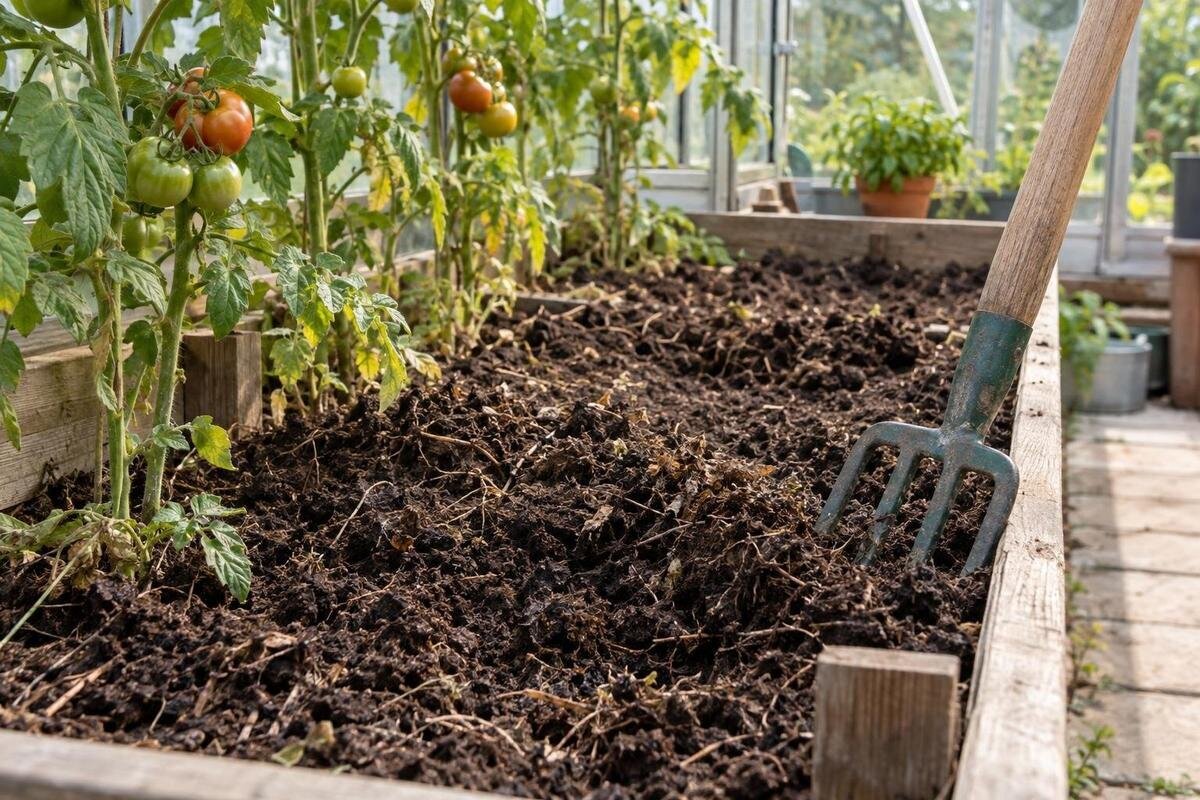
Greenhouse soil guide
Greenhouse beds can support crops for many seasons, so the soil does not automatically need to be emptied each year. A weak harvest, pale leaves or slow drainage may point to a problem, but these signs do not identify its cause. Low nutrients, an unsuitable pH, declining structure, excess salts, watering patterns and soil-borne pests or disease call for different responses. This guide helps you decide whether to restore the bed, investigate further, replace part of it or use new growing media, without treating full replacement as a routine task.

Before buying growing media 1
Does greenhouse soil need replacing every year?
Not as a rule. Soil in a permanent greenhouse bed can be maintained over successive crops. Plants take up nutrients, organic matter breaks down, and watering or foot traffic can change conditions; these changes call for assessment, not automatic removal. A bed that grows well, drains appropriately for its crops and has no unresolved health concern may need only a targeted correction. The useful question is not how many seasons the soil has been there, but whether its fertility, structure, pH and crop-health record still suit what you intend to grow. Age alone is a weak reason to empty a bed.
Distinguish in-ground soil from growing medium in pots. Containers hold a limited, isolated volume: nutrients and structure can change more quickly, and roots cannot extend into surrounding ground. Their medium may need partial or full renewal according to its condition and crop history, but that does not make annual removal appropriate for greenhouse beds. If you are also choosing a greenhouse, decide how you will divide the space between beds, containers and paths before estimating soil needs. The Pyramid Greenhouse size options range from 5.53 to 18.9 m²; the listed area is a starting point for planning the layout, not the volume of soil a bed will hold.
Diagnose the pattern before blaming the soil
Poor growth, pale leaves, wilting or a low harvest can have several causes. A single plant may be affected by watering, root damage or pests, while a whole section of a bed may point to a shared issue. Trouble that repeatedly affects the same crop in the same spot is a useful clue, but it does not prove a soil problem. Note whether the symptoms follow a row, a low or wet area, one crop type or the whole bed. Also consider changes in watering, recent amendments and other growing conditions. The pattern helps narrow the investigation; it is not a diagnosis by itself.
Compare affected plants with healthy ones growing under similar conditions, and look at the bed rather than one leaf in isolation. If a crop has been removed, checking representative roots can help you decide what information to give a horticultural adviser or diagnostic service, but visible symptoms still may not reveal their cause. Keep a simple map of the affected areas, crops, dates, watering changes and materials added. That record can distinguish a recurring local issue from a problem affecting the whole greenhouse, and gives a soil test or professional assessment useful context.
Before buying growing media 2
Test fertility before adding nutrients
A suitable soil test can help assess pH, which describes acidity or alkalinity, and the nutrient status relevant to the crops you grow. Ask a soil laboratory which test fits the question: a routine fertility test does not identify every possible problem, such as a soil-borne pest or disease. Follow the laboratory’s sampling instructions, and take representative samples from beds with different histories rather than mixing them all together. Keep a visibly affected area separate from healthy soil so a local concern is not diluted in the sample. Where possible, sample before applying fertiliser or compost, unless the laboratory advises otherwise.
Interpret results alongside crop requirements, previous additions and, where relevant, the quality of the irrigation water. A result is not a reason to add a product without checking what the crop needs; excessive inputs can create new imbalances. Relate each sample to a marked bed or area so you can apply the findings where they belong. If you are considering the Limited Edition Greenhouses with Storage, listed from 5.52 to 28.08 m², include those sampling areas on your proposed growing plan. Beds with different histories may need separate assessment even when they share one greenhouse. Keep the laboratory results with that plan rather than treating a result from one bed as a recommendation for all of them.
Check soil structure, drainage and compaction
Look at how the soil behaves as well as how plants grow. A surface crust, clods that are difficult to break apart, water lingering on the surface or water running away unusually quickly can all prompt a closer check. Compare several parts of the bed at a similar moisture level; soil that is saturated or very dry can give a misleading impression of its texture. One observation does not confirm that the whole bed needs replacing. The aim is to find out whether the difficulty is widespread, confined to a particular area or linked to the way water reaches the bed.
Check for likely causes around the growing area, including repeated foot traffic, a leaking or unevenly used irrigation line, or a low spot where water collects. If the main issue is how water is applied or where it drains, changing the soil alone may not solve it. Access also deserves attention when comparing the Prestige Greenhouse sizes, which range from 3.77 to 28.08 m². Sketch where you would stand to tend each bed and which routes you would use regularly. A layout that requires you to step onto growing soil leaves the cause of compaction unresolved, even if you replace the soil. Assess those working routes alongside the condition of the bed.

Before buying growing media 3
Investigate recurring crop-health problems
Repeated trouble in the same bed, particularly when the same crop or plant family returns, raises the question of a soil-borne pest or disease. It does not settle it: poor drainage, root damage and nutrient or watering problems can produce similar symptoms. Record which plants are affected and whether the issue returns in the same place. If crop-health problems recur or spread, seek an appropriate diagnosis rather than treating the symptoms as proof that the soil is infected. Knowing what is responsible matters because different problems require different responses, and removing soil without identifying the cause may not resolve the issue.
While you investigate, avoid carrying suspect soil or plant debris into healthy beds, and keep the affected area identifiable on your growing plan. If a diagnostic assessment confirms a serious soil-borne problem, follow its advice on whether to retain, manage or remove the affected soil. Replacement does not necessarily remove a problem that remains in plant debris, tools or surrounding ground. When planning a growing area using the Spacious Greenhouse range, listed from 47 to 70 m², mark individual beds rather than recording crop health only for the greenhouse as a whole. The record should show where trouble occurred and which areas remained unaffected. This preserves the distinction between a local problem and one that may require a wider response.
Restore a bed when its soil is otherwise sound
When a suitable test identifies a nutrient shortfall and the bed has no separate structural or crop-health concern, a targeted fertiliser or other appropriate input may be enough. Choose it for the crop and the test result, and follow the product directions rather than applying a general dose across every bed. Take account of fertiliser and compost used previously: adding more without a reason can over-supply some nutrients or contribute to salt build-up. If only one crop or patch is struggling, check that area before changing the whole greenhouse’s feeding routine.
Treat pH correction as a measured response, not a precaution; the appropriate material and amount depend on test results and growing conditions. Suitable, mature organic matter may help maintain a bed, but its nutrient contribution varies, so it should not be used as an unmeasured substitute for diagnosis. If you are choosing among the Aluminium Classic Greenhouse sizes, listed from 3.77 to 28.08 m², establish whether your growing plan uses in-ground beds, framed beds or containers before buying bulk amendments. These are not interchangeable growing systems, and an addition intended for one bed should not automatically be applied throughout the greenhouse. Record the material and amount used in each area so that future feeding decisions take previous additions into account.
Before buying growing media 4
Improve physical condition without clearing the whole bed
If fertility is adequate but soil is compacted or difficult to manage, adding more fertiliser will not correct the physical problem. Keep regular traffic on defined paths and avoid walking on growing beds. Where an appropriate organic material can help, check that it is suitable for the crops and soil before adding it; mixing in an unsuitable material can leave drainage or texture harder to manage. Make changes in stages and compare how the same part of the bed behaves afterwards. This is more informative than replacing all the soil before finding out whether the problem was local or linked to access.
Partial renewal may be reasonable when a problem is confirmed in a limited part of a bed and can be separated safely from the rest. A surface addition can help only when the issue is at the surface; it cannot repair a deeper root-zone problem. Check the proposed material before placing it over existing soil, and do not use a top-up to conceal persistent poor drainage or crop-health trouble. For a project involving one of the Wall Greenhouse sizes, listed from 3.69 to 14.34 m², mark both the affected patch and its position within the bed. This helps define the intended work: improving a surface layer, renewing a local area or investigating a deeper problem are different tasks, not equivalent ways to refresh the soil.
When soil removal or replacement is justified
Full or partial removal becomes a serious option when there is a confirmed problem that cannot be corrected reliably in place. Examples include a diagnosed soil-borne issue for which removal is advised, suspected contamination that needs investigation, or a persistent physical or chemical condition that remains unsuitable after assessment. The extent of removal should match the evidence: a problem confined to one bed does not automatically justify clearing every bed. A poor harvest, an old bed or an untested suspicion is not enough on its own. If salts or unsuitable pH are suspected, investigate their cause as well as the soil; otherwise the replacement material may face the same problem.
Before bringing in new material, confirm that it is intended for greenhouse beds and suitable for the crops and growing system. Ask about its source, pH, nutrient content and drainage properties rather than assuming that generic topsoil will be appropriate. Keep material from a suspected problem separate while you follow diagnostic advice, and do not reuse it elsewhere without confirmation that this is suitable. The Limited Edition Aluminium Greenhouse sizes are listed from 3.77 to 28.08 m², but greenhouse area is not replacement volume; measure the affected beds and the planned fill depth before ordering.

Before buying growing media 5
Crop rotation and records for long-term soil care
A planned crop sequence helps you avoid growing the same plant family repeatedly in the same bed and makes it easier to spot patterns. It can reduce repeated pressure from problems linked to particular crops, but it is not a guaranteed cure for a confirmed disease or pest. Keep track of which crops grew in each bed and when. If a greenhouse has only one continuous growing area, rotation may be less flexible, so even a simple bed map can help you decide which crop goes where and prevent accidental repetition. Containers can be recorded separately from in-ground beds because their growing medium has a different history.
Note soil-test results, amendments, crop performance and recurring trouble in the same record. That makes it easier to compare a later season with the previous one and see whether a correction helped. When considering the T-Model Orangery Greenhouse sizes, listed from 16.52 to 30 m², use a sketch of the proposed beds to plan crop groups across successive seasons. The useful detail is which crop follows which in each bed, rather than a single list of everything grown inside. Keep containers identifiable separately where their medium has a different history. If a problem later recurs, you can then trace it against both the crop sequence and the changes made to that particular growing area.
Choose a response and judge whether it worked
Consider all the evidence when deciding what to do, rather than relying on one symptom or a fixed annual schedule. If the bed is productive, its structure is manageable and no unresolved crop-health issue is present, retain it and continue to monitor it. If testing identifies a correctable nutrient or pH problem, make a targeted correction. If the concern is confined to one section, investigate that section before extending the response to the rest of the greenhouse. If a serious health or contamination issue remains uncertain, pause before moving soil and seek suitable diagnostic guidance.
After making a change, record what you did, which bed it affected and which crop followed. Where practical, avoid changing several things at once; otherwise, a better or poorer result will be difficult to interpret. Compare like with like, since different crops and growing conditions do not provide a simple test of the same soil. If the problem persists, revisit the diagnosis or test rather than escalating automatically to full replacement. This process makes renewal a considered response to the bed’s actual condition, not a task repeated simply because another season has begun.
Frequently asked questions
Should I replace greenhouse soil every year?
No. A permanent bed does not need replacing simply because another growing season has passed. Check its fertility, structure and crop-health history, then correct a diagnosed issue or retain the soil if it is performing well.
Do yellow leaves mean the soil has run out of nutrients?
Not necessarily. Watering problems, unsuitable pH, root damage, pests and other growing conditions can cause similar signs. Compare affected plants with healthy ones and use a suitable soil test before adding fertiliser.
Can I replace only the top layer?
Possibly, if the issue is genuinely confined to the surface. A top-up will not solve a problem deeper in the root zone, and it may hide rather than correct poor drainage or a soil-health issue. Establish the cause first.
Can I reuse soil after a diseased crop?
That depends on what affected the crop; symptoms alone do not confirm a soil-borne disease. Keep suspect soil separate while you seek suitable diagnostic advice. Follow that advice on whether it can be retained, treated or removed.
What should I check when buying replacement soil?
Confirm that the material is intended for the growing system and crops, and ask about its pH, nutrient content and drainage properties. Check its source and suitability rather than assuming that any general-purpose soil will suit a greenhouse bed.
Greenhouse soil is not due for replacement just because it has supported several crops. Test and observe the bed, distinguish a correctable fertility or structure issue from a possible crop-health problem, and match any removal to what the evidence shows. Retain sound soil, improve it where that is appropriate, and replace only the part and amount that a diagnosis justifies.
