
Buying a Greenhouse for a Windy Garden: Site and Specs
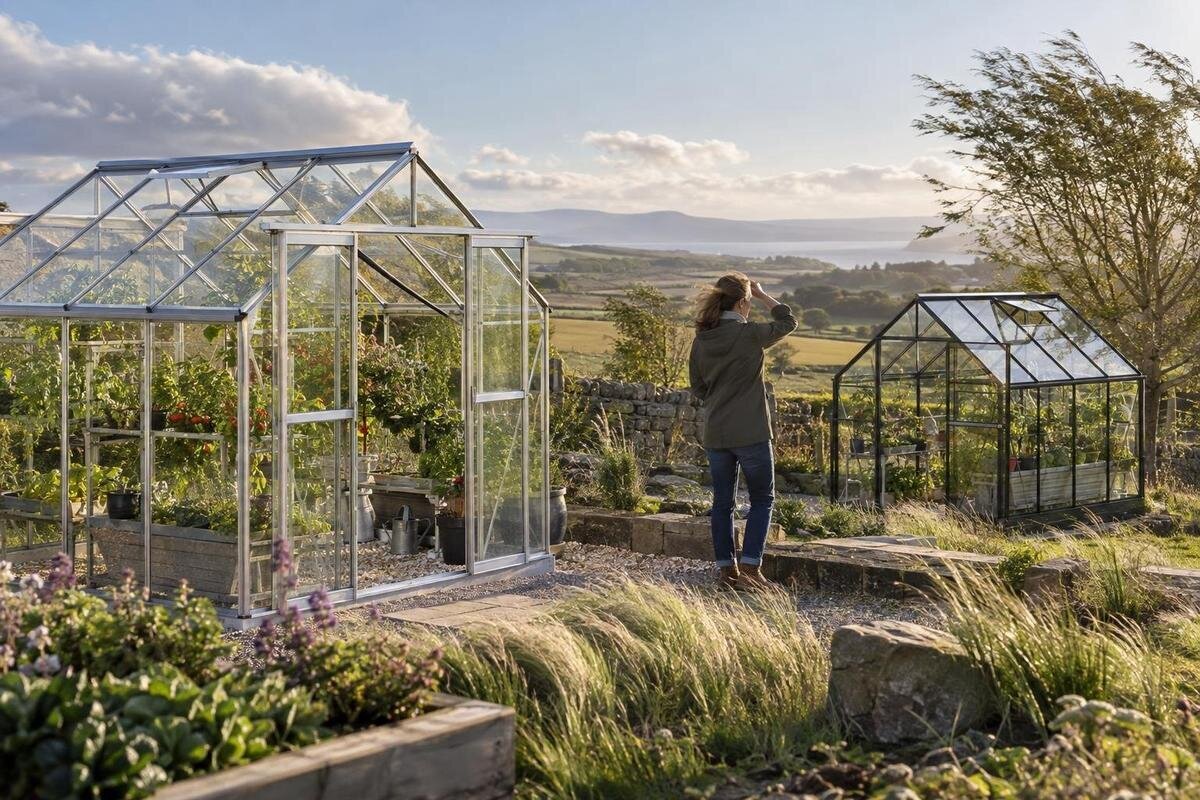
Greenhouse buying guide
Choosing a greenhouse for a windy garden takes more than comparing footprints or choosing a frame that looks sturdy. Wind varies across a plot: walls, fences, gaps and open ground can all change how it reaches the proposed position. The most useful comparison is between the actual site and the complete greenhouse assembly—frame, glazing, base and anchoring—not a material label in isolation. Note the exposure first, then check what the product documentation says about limits, support and installation. If a key detail is missing, ask before ordering rather than treating a sheltered corner or a heavy-looking base as proof of suitability.

Assess wind exposure across the garden
Assess the exact position rather than labelling the whole garden as open or sheltered. Visit the proposed footprint in different ordinary weather and note the usual direction of stronger gusts, whether they are sustained or arrive in bursts, and how they reach each end of the space. Judge conditions at the height of the greenhouse sides and roof, not only by how plants move close to the ground. Record differences between the centre and the edges; even a short footprint may cross more than one airflow pattern. A spot that feels calm on one fine day is not a dependable guide to exposure.
Use observations from routine weather and any local weather records as context; broad-area information cannot describe every corner of one plot. Note open runs across the site, higher ground and gaps between nearby buildings. The aim is to give a supplier or installer a clear description, not to calculate a wind load yourself. Include changes that may affect shelter over time, such as trees that could be pruned or removed and temporary screens that will not always be in place. If different parts of the garden experience different conditions, record them separately. It is useful to make a simple site sketch showing the intended footprint, fixed boundaries, nearby structures and the directions from which stronger winds have been noticed. Photographs taken from several sides can also help explain the position, provided they supplement rather than replace measurements and product documentation.
Look for turbulence as well as shelter
Wind does not simply stop at an obstacle. A solid barrier may create a calmer area on one side, while its ends or a gap between buildings can redirect gusts. The windward side faces incoming flow and the leeward side lies behind it, but neither label tells you how steady the air will be at the proposed greenhouse. Trees and hedges can also affect exposure; branch movement, maintenance and changes in cover make them uncertain as the sole protection. Consider how the position behaves with wind from more than one direction.
A wall may appear to make a useful windbreak, but being close to it is not a performance rating: gusts can still reach the roof, open face, ends or gaps. If you are considering a lean-to-style product, such as the Aluminium Lean-to greenhouse listing, check the installation drawing for its intended relationship to a wall and its exposed edges. The title alone cannot establish that your wall or location is suitable. Compare the documented installation with the exposure you observed. Also look beyond the immediate boundary: a passage between houses, a gate opening or the end of a long wall can channel air towards the site. Observe whether these features affect the position when wind changes direction, rather than relying on a single sheltered view.
Check the ground and access around the proposed site
Check the whole area where the greenhouse and its fixing points would sit, not just the centre of the footprint. Find out whether the manufacturer calls for a level prepared base or another specific support. Soft, recently disturbed, sloping or waterlogged ground, as well as uneven paving, may affect whether the recommended support can be installed. Do not assume that compact soil or a level-looking patio will suit every fixing system. If the surface or slope is uncertain, ask an installer to assess it before committing to a model.
Leave practical room to bring components to the site, assemble the greenhouse according to its manual and reach it later for maintenance. Check that the entrance will not be blocked by a fence, planting or another structure, and that you can approach it without squeezing along a wet or unstable edge. Consider nearby runoff if water could affect the ground or access route. A position that suits the wind but cannot accommodate the specified base or workable access is not a practical purchase. Think about where tools, panels and packaging can be set down during assembly without blocking paths or damaging planting. Clear access around the outside also makes it easier to inspect glazing, seals and fixings after windy weather, instead of leaving vulnerable sides inaccessible.
Choose a footprint that fits the exposed plot
Compare the greenhouse’s external width and length, side and ridge heights, roof profile and any projections against the space available. These dimensions matter for growing room, access and wind exposure. A larger exposed surface gives wind more area to act on, but size alone does not establish a model’s wind capacity; a smaller greenhouse is not automatically suitable either. Use the product drawing rather than a photograph or name, and leave the clearance needed for assembly, maintenance and access around the structure. Marking the proposed outline on the ground can reveal conflicts with gates, paths, drainage channels and overhanging planting that are easy to miss on a plan. Check the space with doors and vents in mind, so routine use does not require standing in an exposed, awkward or obstructed position.
Orientation can also affect which sides face the wind, but there is no universal direction that suits every garden. Check whether the manufacturer specifies an orientation or installation layout, and ask if the documentation is unclear. For a candidate such as Bloomcabin Orangerie, use the published plan and elevations if they are available; the model name alone does not tell you the dimensions, exposed profile or wind rating. Compare those details with your site observations before deciding whether the footprint works.

Compare the frame and its connections
Do not use the frame material as a shortcut for judging wind performance. A material label does not show the profile or thickness of the members, how they meet at corners and roof joints, or whether the design includes bracing. Look for model-specific drawings or specifications that explain the frame construction and the connections between its parts. The strength of a complete greenhouse depends on how its components work together, not on a single material description.
Ask whether any published wind limit or test information applies to the complete model and the configuration you intend to buy. Check whether the details cover the standard glazing, doors, vents and specified base, or whether a change to an option affects the stated conditions. A title such as Aluminium Classic greenhouse identifies a listing, but it cannot replace frame information or a stated performance limit. If those details are not available, request a clear answer before comparing it with other models. When comparing documents, make sure each description refers to the same size, glazing choice and base arrangement you intend to order. A general brochure, a photograph of another version or a claim about one component may not describe the assembled greenhouse at your site. Keep the model-specific information together so differences are visible before you make a decision.
Check how the glazing is retained
Compare the glazing type and thickness, panel sizes and the way each panel is supported and retained in the frame. Wind can press on the outside of the structure and create suction elsewhere, so the glazing and its fixings matter alongside the frame. Look for details of the bars, clips, seals or other retention parts specified for the model. A photograph may show the panels, but it cannot tell you how their edges are secured or what conditions the complete assembly is designed to handle.
If the manufacturer provides wind information, ask whether it assumes all panels are installed with the specified retaining parts. Check how replacement panels and fixings are identified, and whether the manual explains what to inspect after severe weather. Do not assume that a panel type or apparent thickness alone makes the greenhouse more secure. For the Classic Plus 385 listing, as with any candidate, look for model-specific glazing and retention details rather than inferring them from the name.
Match the anchoring system to the ground
Treat anchoring as part of the greenhouse specification, not as an optional finishing detail. Find out whether a base is supplied, whether fixings are included or separate, where the frame connects to the base, and what surface the instructions require. Soil, paving and a prepared slab are not interchangeable just because each appears firm. A base description on its own does not explain the fixing method or confirm that it matches the ground at your chosen site.
The fixing system must connect the greenhouse to the support specified by its manufacturer. Avoid substituting fasteners or adding improvised anchors: an unapproved change may not match the complete design. A model name such as Prestige greenhouse with metal foundation makes the foundation part of the listing’s identity, but the name alone does not say what is included or how it connects to your surface. Check the product information and installation instructions, and seek professional advice if your ground does not clearly match them.
Confirm what a masonry or wall base requires
An existing masonry edge, paved area or supporting wall should not be assumed to meet a greenhouse’s requirements. Product instructions may specify a particular base shape, support arrangement or fixing position; the surface available in your garden may differ. Check the exact model documentation for the support it calls for and ask whether your planned surface fits. A masonry base is not automatically suitable simply because it is made of masonry, and a nearby wall should not be confused with a specified structural support.
A listing named Pyramid greenhouse for masonry base is a useful prompt to ask what the model’s instructions mean by masonry base: what form of support is required, where the fixing points go and what is included. Do not infer compatibility with an existing patio, wall or other construction from the name. If the instructions do not clearly cover your proposed support, have a suitably qualified professional assess it rather than adapting the base by guesswork.

Check doors, vents and parts that need securing
Consider how the door and any vents are positioned relative to the wind and the access route. Check whether the model information explains how these openings are retained and secured when closed, and whether they can be operated without obstruction. A door beside a fence may be difficult to use; an opening exposed to gusts may need particular care when handled. Do not assume from a product photograph that a latch or vent arrangement is suitable for the conditions at your site.
Ask what the manual says about inspecting the frame connections, glazing retainers, seals, hinges and other moving parts, and how to identify the correct replacements. Routine care does not change a greenhouse’s stated wind limits, but missing or damaged parts should not be ignored. The name Aluminium Limited Edition greenhouse does not describe how its openings or panels are retained; use the listing and model-specific instructions to check those details before choosing.
Get the relevant specifications before ordering
Before deciding, gather the information for the exact model, size and configuration you plan to buy. Ask for the installation manual or drawings, any published wind limits and the conditions they cover, frame and glazing details, base requirements, and anchoring instructions. Confirm whether the information applies to the complete assembly rather than one component. Also check what is included, what needs to be obtained separately and whether the proposed ground and orientation match the documented installation.
Keep a note of any unanswered questions and get important clarifications in writing. For a product listed as T Model greenhouse orangery wall base, for example, ask for documentation that defines the model’s base and wall interfaces; its title alone does not give those details. If the site is notably exposed or the support conditions remain unclear, have the proposed location and installation assessed by a suitably qualified professional before ordering. A clear comparison is more useful than a confident guess.
Frequently asked questions
How can I tell whether one part of my garden is more exposed than another?
Observe the proposed position during different kinds of ordinary weather, and note the direction and pattern of stronger gusts at both ends of the planned footprint. Nearby walls, gaps and open ground can change the airflow. Local weather records give useful context, but they cannot describe every corner of a garden.
Does an aluminium frame automatically make a greenhouse suitable for a windy garden?
No. A material name does not tell you the frame profile, how its parts are joined, what bracing is supplied or how the complete greenhouse is anchored. Compare the manufacturer’s details for the exact configuration, including its glazing and base, rather than judging performance from the material or appearance alone.
Is a position beside a wall enough to protect a greenhouse from wind?
Not necessarily. A wall may shelter one area, while corners, gaps or the exposed sides of a greenhouse remain affected by wind. The result depends on the site layout and wind direction. Check the manufacturer’s installation information and do not treat the wall as proof that the greenhouse is suitable.
Does a greenhouse with a foundation in its name include all the anchoring I need?
The name alone does not confirm what is included, how the base connects to the greenhouse or what surface it is designed for. Check the model’s listing and installation instructions for the base, fixings and site requirements. If your ground or existing base does not clearly match, ask for advice before ordering.
What should I confirm before placing an order?
Ask for the model-specific manual or drawings, any published wind limits and the conditions they cover, plus details of the frame, glazing retention, base and required anchoring. Confirm what is included and whether your planned surface matches the installation requirements. Get a qualified professional’s advice if the site or fixing details remain uncertain.
The soundest choice is the one whose documented frame, glazing and anchoring requirements match the actual site. A calm-looking corner or a substantial-sounding model name cannot establish that match. Compare the exposure, support surface and complete product configuration together, and resolve any uncertainty about limits or installation before placing an order. Where the garden is particularly exposed or the ground is unclear, professional advice can help establish whether the proposed location and support are appropriate.
