
Buying a Greenhouse for Snowy Winters: Structural Load Questions
Greenhouse buying guide
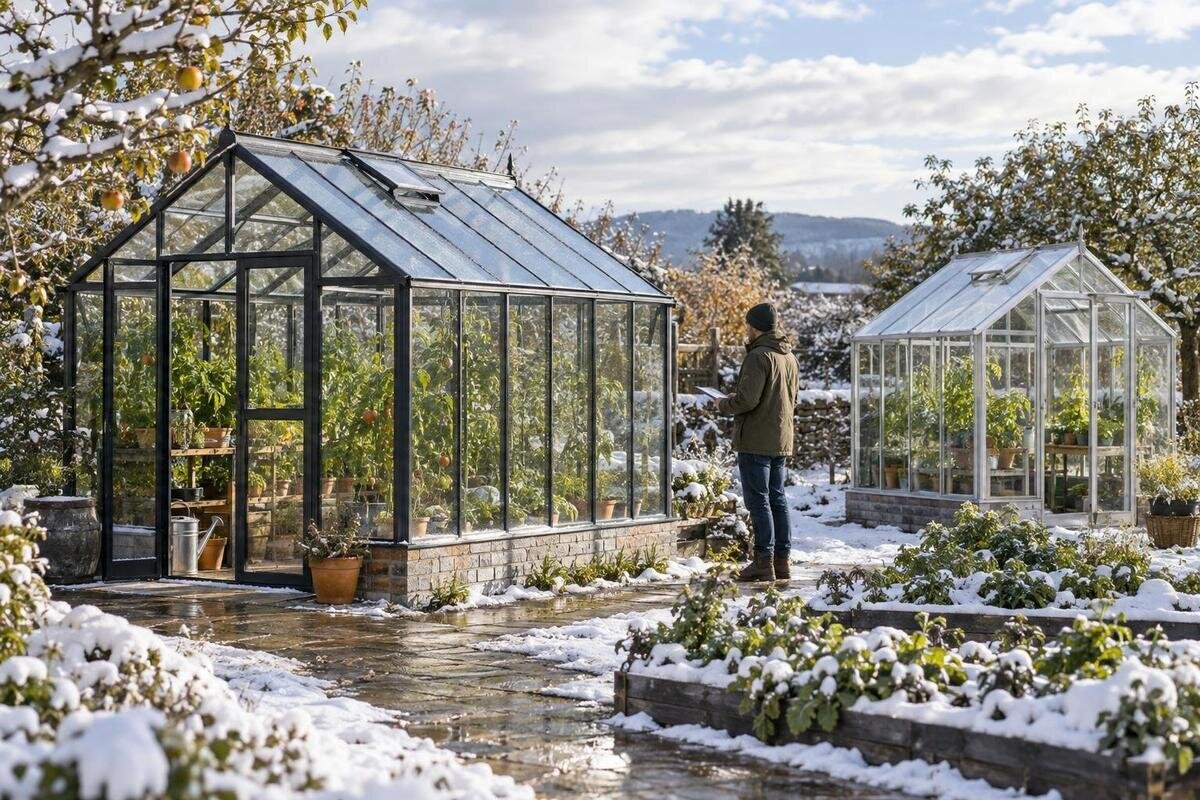
Buying a greenhouse for snowy winters is a structural decision, not just a choice of size, glazing or appearance. A roof that looks sturdy and a frame that sounds substantial do not show how the complete structure handles snow. Before choosing a model, ask for a written snow-load capacity that applies to the exact configuration and find out what it covers: roof, frame, connections, glazing and base. The comparison should also reflect the intended site, because the rating’s assumptions may not match local exposure. The questions below help you separate documented performance from a product name or general winter claim.

Buyer checklist 1
Why snow load needs a model-specific answer
Snow on a greenhouse roof is a structural load that passes through the roof members, frame, connections and supports. That complete path matters more than how substantial a roof looks in a photograph. The glazing, overall size or a descriptive product name cannot establish the structure’s snow capacity, and a statement about one component may not cover the assembled greenhouse. For a purchase decision, look for a written figure that applies to the exact model and configuration, with the conditions and parts it covers explained. Without that context, apparently similar claims may not be comparable.
Conditions at the site also matter. Wind can move snow and create uneven drifts; nearby walls, roof edges or trees may affect where it collects. Wet snow and ice present different loading conditions from loose, light snow, so a guessed depth is not a reliable way to assess capacity. Ask whether the manufacturer’s rating covers only an even load or also relevant uneven cases. It is also worth asking whether the stated figure assumes that snow can shed freely from the roof, because obstructions or adjacent structures may affect accumulation. Keep a note of any site feature that could cause snow to gather in one area rather than another. If the site conditions or the wording of the documentation are unclear, ask a qualified structural professional to interpret the information rather than relying on appearance or a general winter description.
Ask for a stated snow-load rating
Ask the manufacturer or seller for the documented snow-load capacity of the exact greenhouse model, then check the number and the unit together. A value might be given in kN/m² or kg/m², but the unit alone does not explain how the load was assessed. Ask whether the figure refers to snow on the roof, a ground snow value, a uniformly distributed load or another condition. These figures are not automatically interchangeable. The listing for a Prestige greenhouse with metal foundation identifies a model name; the name does not provide its snow-load capacity or the conditions behind it.
Clarify whether the figure is a design capacity, a stated limit under particular conditions, a test result or a maximum reached during testing. A test or failure value should not be assumed to mean the same thing as a design rating for use. Ask what assumptions apply, how the load is distributed and whether the rating covers the whole roof or only a particular part. Check whether the document identifies the exact model size and roof arrangement, since a figure supplied for another version may not apply to the option in your basket. Retain the written reply or technical sheet with your comparison notes, including its date and the configuration discussed. If the answer uses terms you cannot interpret, request a plain-language explanation in writing. That makes it easier to compare one greenhouse with another on a like-for-like basis.
Buyer checklist 2
Check the roof and frame as one structure
A snow-load claim is useful only when you know which parts of the greenhouse it covers. The roof members transfer load into the frame through joints, fasteners and any braces; a figure for one beam or frame component does not establish the capacity of the assembled structure. Ask for documentation that identifies the roof and frame configuration assessed, including the connections and any required reinforcement. A specification drawing can help you match the stated capacity to the model being considered, rather than relying on a general description of its construction.
Check whether the rating changes with the greenhouse’s size, roof layout, openings or optional components. Ask whether it applies to the complete structure as supplied, and whether any particular parts or bracing are assumed. For a listing such as Bloomcabin Orangerie, the useful comparison is the manufacturer’s load information for the exact configuration, not an assumption based on the model name. If separate figures are given for the roof and frame, ask how they relate to the assembled greenhouse and which figure is relevant to snow.
Find out what the glazing rating covers
Glazing and its supports are part of the roof assembly, but a panel’s individual properties do not establish the snow capacity of the whole greenhouse. A statement about impact resistance, thickness or material is not automatically a snow-load rating. Ask whether the manufacturer’s assessment includes the panels, their edge supports and retaining components, as well as the roof frame. If the documentation gives a capacity for the frame only, check separately how the chosen glazing configuration is covered before treating the figure as an overall roof rating.
Confirm that the documentation matches the glazing option you intend to order and the way it is held in place. Ask whether changing a panel type or using a replacement part affects the stated load conditions; do not assume that alternatives are interchangeable. For Classic Plus 385, for example, the question to resolve is what the manufacturer’s documentation says about the exact assembly, not what the model name suggests. Keeping the glazing information alongside the roof and frame rating avoids comparing a complete-system figure with a claim that covers only one component.

Buyer checklist 3
Confirm how the load reaches the base
Roof load has to pass through the frame and supports to the base and the ground or other supporting structure. A roof rating cannot answer whether the whole load path is covered if the base, its connections or the supporting surface are outside the assessment. Ask which base arrangement the stated rating assumes, whether that arrangement is included with the model and how the manufacturer describes the required support. Do not infer structural capacity from the presence of a base in a product title or photograph.
The title T-model greenhouse orangery with wall base makes the base arrangement something to verify, not a snow-load specification. Ask whether the documentation applies to that exact base and to the intended support, and whether any anchoring or other components are part of the rated configuration. If the greenhouse will connect to an existing wall or foundation, do not assume that the existing structure is suitable. A qualified professional can assess the support and explain what information is needed; avoid making engineering judgements from a product image or a general installation description.
Consider roof shape and uneven snow
Roof shape and pitch can affect where snow gathers or moves, but neither is a substitute for a documented capacity. A sloping surface may allow snow to slide, yet it does not prove that the roof will remain clear or that the structure is rated for the resulting conditions. Snow may also collect unevenly when wind shifts it or where nearby structures change its movement. Ask whether the manufacturer’s information covers the load patterns that could be relevant, rather than assuming that snow will fall evenly across the roof.
A product title such as pyramid greenhouse for a masonry base does not explain how snow behaves on the roof or what the complete structure can carry. Look for the rating and its stated assumptions, including whether it applies to an even distribution or addresses uneven accumulation. Also consider whether snow could move from a neighbouring roof or other raised surface towards the greenhouse. If the site has an unusual arrangement or you cannot tell whether the documented load case is relevant, take the information to a qualified structural professional before using the roof shape as a reason to choose a model.
Buyer checklist 4
Match the rating to the intended site
A published capacity needs to be understood in relation to the conditions where the greenhouse will stand. The manufacturer may base a figure on a particular load case or set of assumptions; it may not describe every combination of snow, wind and uneven accumulation at your site. Ask what information is needed to assess the intended location and whether the stated value is a roof rating or a different snow measurement. If a figure is given without its basis, do not assume it can be applied directly to the site.
Site details such as exposure and nearby walls, roofs or trees can help a professional understand whether drifting or uneven loading deserves attention. The listing title Aluminium Classic greenhouse does not answer that site-specific question, regardless of its wording. Ask the manufacturer what the documented rating covers, then have a qualified structural professional interpret it if the site conditions fall outside the stated assumptions or the data is unclear. This is not a request to calculate a load yourself; it is a way to make sure the information used for the buying decision is relevant.
Compare complete specifications, not product names
Build a written comparison for each model you are considering. Record the exact model and configuration, the stated snow-load value and units, whether it is a roof or ground figure, and whether it is a design capacity or a test result. Note which parts are included, what roof and frame arrangement the figure assumes, and whether the base and glazing match the option you plan to order. Add the source of each figure, such as a technical sheet or a written response from the manufacturer, so that a sales description is not confused with technical documentation. Where wording is qualified, record the qualification rather than reducing it to a single number. For example, note whether a value assumes an evenly distributed load, specified bracing or a particular support arrangement. A product page can help identify a model, but a title or broad description cannot replace this technical information.
Treat missing information as unknown, not as evidence that a greenhouse has either a high or a low capacity. The listing for an Aluminium lean-to greenhouse can be recorded as an option, but compare it with other models only when the relevant documentation is available for the intended configuration. Ask the manufacturer for a technical sheet or written clarification where a key detail is absent. This simple record also prevents confusing a value for one model, size or arrangement with the rating of another.
Buyer checklist 5
Clarify assembly and snow-management guidance
Before ordering, make sure the rating and instructions refer to the same model, options and support arrangement as your order. Ask whether the documented capacity assumes a particular assembly, specified components or additional bracing, and whether changes to the configuration affect that assessment. If someone else will assemble the greenhouse, provide them with the manufacturer’s instructions and confirm that the planned work follows the documented configuration. Do not alter structural parts on the assumption that a modification will improve snow capacity.
Ask the manufacturer what inspections and snow-management steps it recommends, and whether there are conditions under which the area should be kept clear or professional help sought. A title such as Aluminium Limited Edition greenhouse does not provide those instructions; they need to be associated with the exact model. Do not improvise a snow-removal method or climb onto a loaded roof. If you notice movement, damage or another sign of concern, keep people away from the structure and seek guidance rather than attempting a repair under load.
Use the documentation to decide whether to order
Before making a final choice, check that you can answer the key questions for the exact configuration: what snow-load value is stated, what it measures, which parts it covers and what conditions it assumes. Confirm that the roof, frame, glazing and base described in the documentation correspond to the greenhouse you intend to buy. Compare the model designation, size, roof layout and listed options on the order information against the documents you received. This check is particularly useful where accessories, a different glazing choice or a base arrangement may change the configuration discussed. Keep the specification and written clarification together so you can identify any discrepancy before the order is finalised. If any central detail is missing, mark it as unconfirmed rather than filling the gap with an estimate based on the roof shape, product wording or appearance.
A clear written rating makes comparison more useful because it shows what evidence is available and where advice may still be needed. If the manufacturer cannot clarify a value, or if the site does not fit the stated assumptions, pause the decision and ask a qualified structural professional to interpret the information. That is more dependable than choosing a greenhouse on the strength of a general winter claim. The right comparison is not simply which model looks strongest; it is which documented configuration can be assessed against the intended conditions.
Frequently asked questions
Can the roof shape tell me whether a greenhouse will withstand snow?
No. Roof shape can affect where snow gathers or moves, but it does not establish the capacity of the completed greenhouse. Look for a model-specific snow-load rating and check which load conditions it covers. If snow may build up unevenly at your site, seek qualified advice on how to interpret the rating.
Does a frame rating automatically cover the glazing?
Only if the documentation says it covers the complete assembly. Ask whether the panels, their supports and retainers, roof members, joints and any bracing are included. A figure for the frame alone does not confirm that every part of the roof can carry the same load.
Is a maximum test load the same as a snow-load rating?
Not necessarily. A test or failure figure may describe a different condition from a declared design capacity for use. Ask what the value represents, which units and test conditions apply, and whether it is specifically a snow-load figure for the model you are considering.
What should I do if the product page gives no snow-load figure?
Treat the capacity as unconfirmed and request technical documentation or written clarification for the exact model and configuration. Do not infer a rating from the product name, appearance or general description. If the information is unavailable or difficult to interpret, consult a qualified structural professional before deciding.
Can I rely on clearing snow instead of checking the rating?
Snow removal should not be treated as a substitute for confirming the greenhouse is appropriate for its intended conditions. Ask the manufacturer for its inspection and snow-management guidance, and do not improvise a removal method or climb onto a loaded roof. Seek qualified help if you are unsure what to do.
A sound buying decision rests on documentation rather than visual cues. For snowy winters, check the load statement for the exact roof, frame, glazing and base configuration, then confirm what conditions the rating assumes. Note whether it refers specifically to snow and whether uneven accumulation is addressed. If a crucial answer is missing or the site does not match the stated assumptions, treat that as an open question rather than a reason to guess. This approach gives you a fair comparison and keeps the decision grounded in evidence about the greenhouse you intend to order.
