
Will Water Barrels Keep a Greenhouse Warm at Night?
Greenhouse heating and winter energy
Water barrels can moderate a greenhouse’s overnight temperature drop, but they cannot guarantee frost protection or maintain a chosen temperature on their own. Their role is thermal storage: water warmed during daylight releases some energy as it cools. The maximum store is easy to estimate; for example, 200 litres cooling by 10°C hold about 2.3 kWh before losses. Whether that is useful depends on how warm the water gets, the temperature range available overnight and the greenhouse’s heat loss. A simple calculation, paired with readings from several nights, gives a more reliable answer than choosing a barrel count by guesswork.

Before choosing a greenhouse 1
What water barrels can do overnight
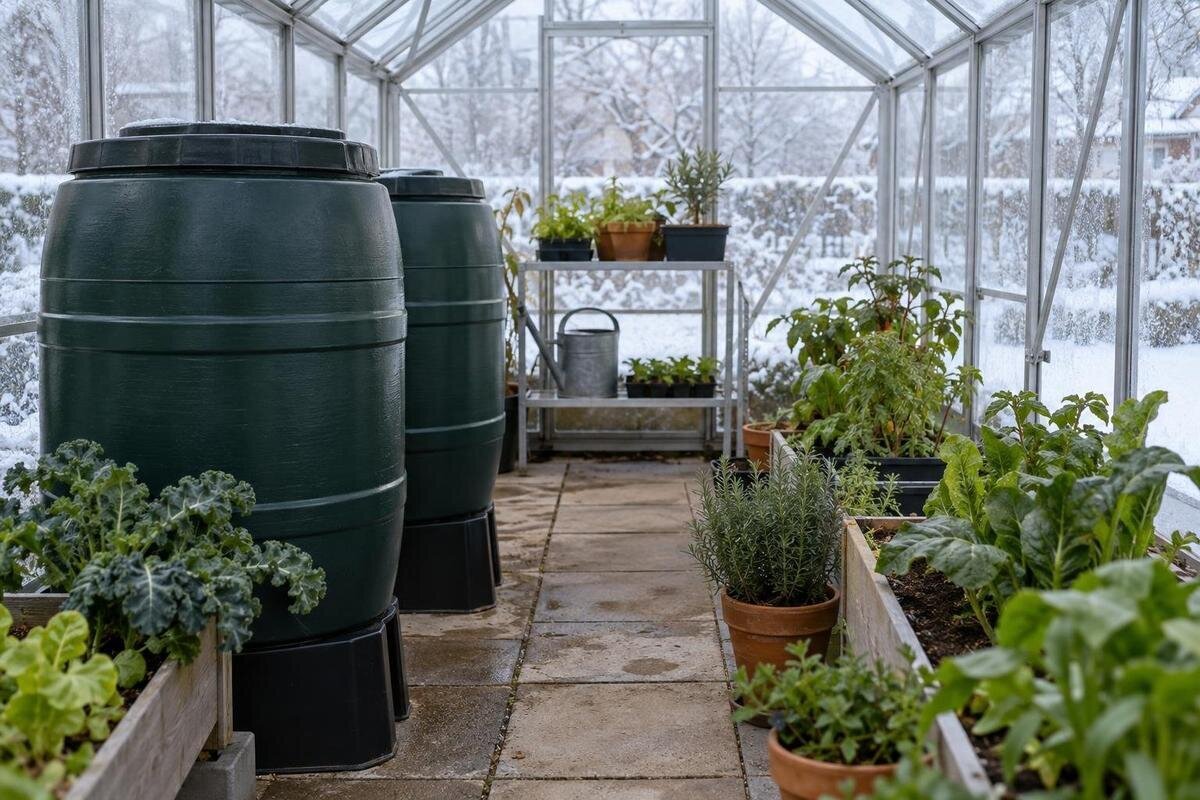
Water has a high specific heat capacity, so a substantial volume can absorb energy as it warms and return some as it cools. In daylight, barrels exposed to solar gain can collect part of the energy entering the greenhouse. After sunset, water warmer than the nearby air transfers heat back to the space. This may slow a temperature drop or moderate brief swings. It is thermal storage, not a heat source: without energy gathered during the day or supplied another way, the water cannot keep the greenhouse warm indefinitely.
Think of a barrel as a buffer whose effect depends on how warm the water is at dusk, how far it can cool while still being useful, and how quickly the greenhouse loses heat. A large volume that never warms much has little overnight energy to give. A well-warmed volume can still be outweighed by high heat loss. No barrel count alone predicts the minimum air temperature or guarantees frost protection; the practical test is whether the water and plant-zone readings show a useful contribution through the hours that matter.
Calculate the heat stored in the water
A useful estimate comes from water’s specific heat capacity: about 4.186 kJ per kilogram per degree Celsius. Since one litre of water has a mass close to one kilogram, the gross stored heat in kWh is approximately litres of water × the temperature drop in °C × 0.001163. For example, 100 litres cooling by 10°C hold about 1.16 kWh; 200 litres hold about 2.33 kWh, and 500 litres about 5.82 kWh. To follow the 200-litre example, multiply 200 by 10, then by 0.001163. Keep the volume and temperature drop separate in your notes so you can replace either with a measured value. These are theoretical amounts before allowing for heat that does not reach the growing area when it is needed.
Use the volume of water actually in the containers, not their advertised capacity, and use a measured temperature drop rather than assuming the water cools to zero. Distinguish water used for thermal storage from storage space for gardening equipment. The Limited Edition greenhouse with built-in storage is listed as having built-in storage, but that description does not establish a water-based heat store. When planning the layout, account separately for the space occupied by water containers and the storage you need for tools or supplies. The formula describes energy in the water; it does not predict a specific greenhouse temperature.
Before choosing a greenhouse 2
Compare the store with overnight heat loss
For a simple comparison, let H be the greenhouse’s overall heat-loss coefficient in watts per degree Celsius. It combines heat passing through the enclosure and heat lost through air exchange. If the average indoor temperature is ΔT degrees above outdoors for t hours, an approximate loss is H × ΔT × t ÷ 1,000 kWh. For illustration only, assume H is 100 W/°C, the average temperature gap is 5°C and the night lasts 12 hours: the estimated loss is 6 kWh. The assumed H is hypothetical, not a rating for any particular greenhouse.
The estimated loss of 6 kWh in this example is greater than the roughly 2.33 kWh in 200 litres cooling by 10°C, even before transfer losses are considered. Compare the figures over the same period: an overnight heat-loss estimate should be set against the water’s useful cooling over that night, not its entire possible temperature range. The difference indicates an energy shortfall in this example, not how many degrees the greenhouse air will cool. In practice, the temperature gap and heat-loss rate change during the night, so split the period into shorter intervals if you have suitable records. Note which inputs are measured and which are assumptions; this makes it easier to see why the estimate changes between nights. Floor area alone cannot supply H. The Spacious Greenhouse listing covers 47 to 70 m², but that size range does not establish the heat loss of a selected model or site.
Use the temperature drop that is genuinely available
The water’s useful drop is not automatically its temperature at sunset minus an arbitrary low figure. For heat to flow from the water into the greenhouse, the water must be warmer than the surrounding air. If you want it to help keep the growing area above a chosen minimum, count only the cooling that is useful before the water approaches that temperature. The suitable minimum depends on the plants, so use reliable crop-specific guidance rather than applying one greenhouse temperature to every crop.
Stored energy is not the same as heat-delivery rate. If a theoretical 2.33 kWh store were released evenly over 12 hours, its average contribution would be about 0.19 kW; actual release is not even, and it may be lower as the water cools. The water’s exposed surface and the temperature difference affect how quickly heat moves. This distinction matters when interpreting an overnight total: some heat released earlier in the evening does not demonstrate that enough remains available during the coldest hours. Look at the timing of the water’s cooling alongside the air-temperature record, rather than judging the store only by its starting temperature. When comparing the Limited Edition Aluminium Greenhouses, listed from 3.77 to 28.08 m², consider the demand of the exact size alongside the heat the water can release over the relevant hours.

Before choosing a greenhouse 3
Account for glazing, openings and wind
Overnight heat loss depends on the whole enclosure, not just its floor area. The covering, total exposed surface, frame, door and vent seals, open ventilation, and wind exposure all affect how quickly heat leaves. Compare documented information for the exact model and configuration where it is available. The name Aluminium Greenhouses identifies a product category; the word aluminium alone does not tell you the heat-loss value of its covering or how much air enters through a particular installation.
Include the greenhouse’s normal ventilation arrangements in your assessment. An opening left open can increase air exchange, while closing or altering ventilation simply to retain heat may conflict with the growing conditions your plants need. Note whether vents and doors are open or closed during each temperature test, and look for changes in conditions rather than assuming the barrel explains every difference. Wind, cloud cover, outdoor temperature and how the structure is used can make two nights with similar forecasts behave differently.
Place barrels for sunlight and safe support
If the water is meant to store daytime solar heat, position containers where the intended daylight can reach them. Leave room for plants, access and the greenhouse’s normal airflow; a barrel that shades a crop or obstructs an opening may create a different problem. Keep its position consistent during a trial, since moving it changes both the sunlight it receives and its relationship to the growing area. A covered container also avoids relying on an open water surface to exchange heat through evaporation.
Water is heavy: as a rule of thumb, each litre weighs about one kilogram, before the container is included. A 200-litre barrel therefore contains roughly 200 kg of water. Keep full containers on a stable, level surface and do not assume that a bench or elevated platform can carry the load. The Bloomcabin Prestige Greenhouse listing identifies a model with a metal foundation, but that feature name is not a load rating for a particular barrel arrangement. If support capacity is uncertain, ask a qualified professional to assess it.
Before choosing a greenhouse 4
Use temperature records to test the effect
A minimum-and-maximum thermometer gives more information than a single glance, while a data logger can show when temperatures fall and for how long. Place the indoor air sensor in the representative plant zone, away from direct sun, the barrel, a heater and a vent. Measure the water at a repeatable depth and record its temperature at sunset as well as during the night. If you can, record outdoor air in a shaded, sheltered position too, so you can compare the greenhouse with the conditions outside.
Keep a short log of water volume, sunset water temperature, indoor and outdoor readings, wind or cloud conditions, and the position of doors and vents. Use the same recording times and sensor positions throughout the trial, so a change in measurement method is not mistaken for a change in performance. Read the records together: note when the water cooled, when the plant zone reached its minimum and what was happening outdoors at that time. Compare several nights with broadly similar conditions; one unusually calm or cloudy night cannot establish a general result. If conditions differ substantially, keep those results separate rather than treating them as a direct comparison. Temperature records show what happened, but by themselves they do not reveal the greenhouse’s heat-loss coefficient unless you also know the heat supplied. For a Wall Greenhouse, record the actual conditions at the adjoining wall rather than assuming it provides a fixed amount of warmth.
Scale the water volume to the exact greenhouse
There is no universal number of litres per square metre. Two greenhouses with the same floor area can differ in exposed surface, layout and air leakage, while the same barrel volume can behave differently in each. Start with the exact greenhouse size and the temperature range you actually measured in the water. The T-Model Orangery Greenhouse is listed in sizes from 16.52 to 30 m²; those figures can help identify a footprint, but they do not specify its overnight heat demand or the amount of water that will be useful.
For a rough planning comparison, every 100 litres cooling by 1°C represents about 0.116 kWh; a 10°C drop would therefore be about 1.16 kWh. Work from the usable drop in your own conditions, not a standard figure, and remember that this is gross energy rather than a promise of heat delivered to plants. If you compare different water volumes on paper, keep the assumed temperature drop unchanged to see the effect of volume alone. Then consider whether your records support that temperature drop for the proposed arrangement. Check that containers fit without taking away essential growing space or blocking access. If you compare one large barrel with several smaller ones, total water volume sets the theoretical store, while surface area and placement influence how quickly it releases heat.

Before choosing a greenhouse 5
Check product details and any cost saving
When comparing greenhouse models, use the exact size and configuration rather than assuming a style name signals heat retention. The Pyramid Greenhouse range is listed from 5.53 to 18.9 m²; that range identifies available floor areas, not a heat-loss rating. For any model you are considering, look for documentation that applies to the chosen version, including details of the covering, ventilation and relevant seals. Do not infer insulation, ventilation performance or overnight temperatures from an image or a product name.
A water store offers a financial benefit only if it measurably reduces energy that a heater would otherwise use. If sunlight warms the barrels, compare heater input on similar nights with and without the store, where a fair comparison is possible. Keep the heater’s temperature setting and the greenhouse’s normal use consistent, and record any differences that could affect the comparison. A warmer night with lower heater use is not, on its own, evidence of a saving from the barrels. If a heater warms the water, the barrel shifts heat in time rather than generating it, and heat loss may offset any benefit. Use the heater’s documented specifications and the current tariff on your own bill. Apply that tariff to the measured reduction in purchased energy, not simply to the calculated heat stored in the water. Keep any result tied to the conditions tested rather than presenting it as a guaranteed nightly saving.
Keep a backup plan for the plants’ minimum temperature
Before relying on thermal storage, decide what temperature the plants need and where that temperature should be measured. Requirements vary by crop, so check suitable horticultural guidance rather than choosing a single minimum for the whole greenhouse. Then compare that threshold with plant-zone records from representative cold nights. If the barrels slow the fall but readings still go below the required minimum, they are contributing some heat without meeting the growing objective.
Where a minimum temperature matters, plan for suitable supplemental heating rather than assuming the barrels will cover the deficit. Check documented heater output and operating information for the actual greenhouse, and have electrical or fuel equipment installed and used in line with its manufacturer’s instructions, with a qualified professional where needed. No calculation here guarantees a temperature or a running cost: the value of the barrels is the measured contribution they make alongside the greenhouse, the weather and any other heat source.
Frequently asked questions
How many litres of water do I need?
There is no reliable litres-per-square-metre rule. Use the formula litres × usable water-temperature drop in °C × 0.001163 to estimate stored energy, then compare it with a transparent estimate of overnight heat loss. The usable temperature drop and the heat loss both depend on the actual greenhouse and conditions.
Will 200 litres keep my greenhouse above a particular temperature?
Not necessarily. If 200 litres cool by 10°C, the water contains about 2.3 kWh of heat in theory. That figure does not predict the greenhouse air temperature: losses, the rate of heat transfer, the weather and the water’s starting temperature all matter.
Do black barrels store more heat?
A dark surface may absorb more sunlight when the barrel is exposed to it, but colour does not increase water’s heat capacity. Check the actual water temperature at dusk and overnight; a barrel that stays cool has little energy to release, whatever its colour.
Is one large barrel better than several smaller ones?
For the same total volume and temperature drop, the theoretical stored energy is similar. Surface area and placement affect how quickly heat moves into the greenhouse, while several containers may be easier to position. Compare the measured temperature effect and make sure the floor can support the full water weight.
Can water barrels replace a greenhouse heater?
Do not rely on them as guaranteed frost protection. They may buffer a temperature fall, but whether they meet a particular plant’s minimum depends on the store and overnight losses. Compare plant-zone readings with reliable guidance for the crop, and plan appropriate backup heat if the threshold matters.
Water barrels are most useful when daylight warms them and their measured temperature drop provides a meaningful share of the overnight heat the greenhouse loses. Use actual water volume, plant-zone readings and outdoor records to judge that contribution. If the records show that the required minimum is still missed, treat the barrels as a buffer and plan for appropriately specified supplemental heat.
