
Can an Aluminium Greenhouse Be Extended Later?
Greenhouse planning
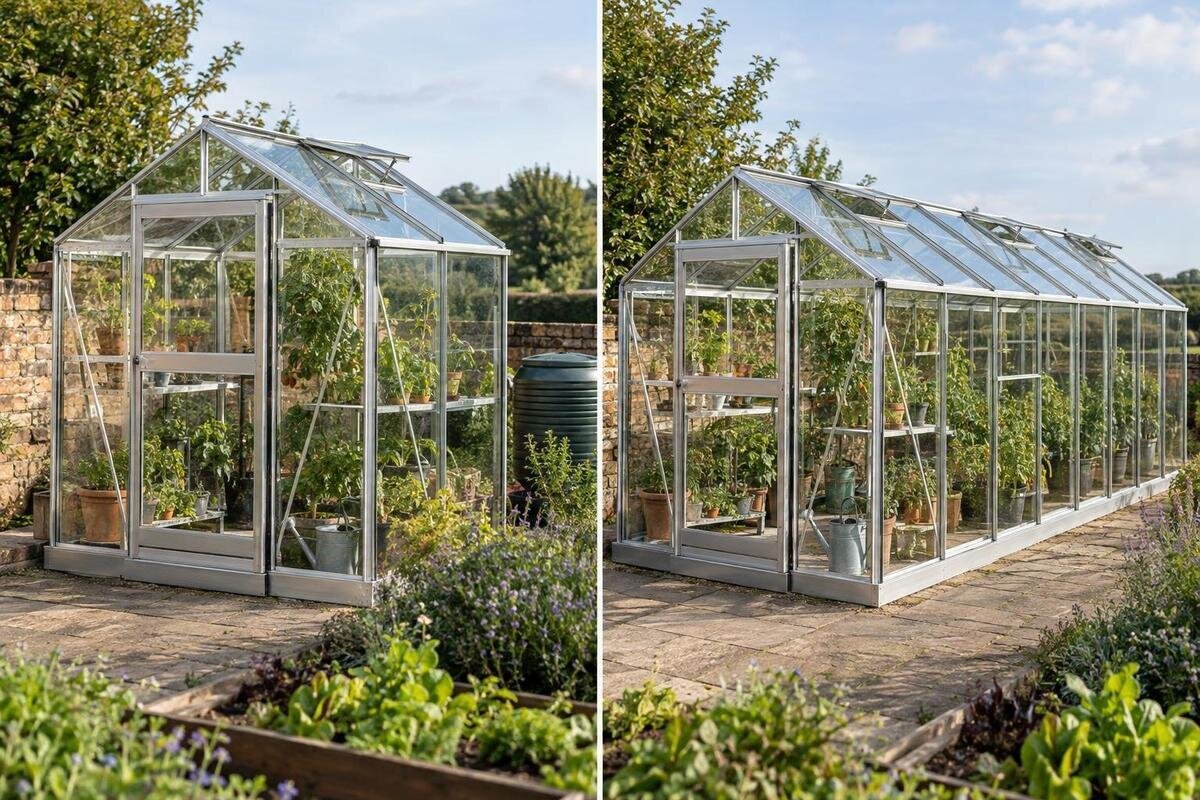
An aluminium frame does not, by itself, make a greenhouse modular. Some designs may have an approved way to add length; others are built for a fixed footprint or depend on parts that are no longer available. If future expansion matters, check the exact model and version, compatible components and the base before buying. For an existing greenhouse, the same checks apply, with the added question of how safely the current frame can be altered.

When an extension is genuinely possible
Yes, an aluminium greenhouse can sometimes be extended, but only where the manufacturer or a suitably qualified supplier confirms that the exact design allows it. The extension needs to connect to the existing frame in the intended way, form a continuous roof and side structure, and use parts specified for that model. It is not enough for a new section to look similar or to have a frame made of aluminium. Profiles, joints, panel sizes and end-wall positions can differ between ranges and production versions. Assess how the added section fits into the complete greenhouse, rather than considering it in isolation. Ask whether approval applies to your exact width, glazing and assembly version.
Treat 'extension-ready' as a claim that needs evidence. Ask for a drawing of the current greenhouse and the proposed enlarged arrangement, with the added parts identified. The drawing should show what changes at the join and at the new end, rather than only the final outside measurements. A published choice of size is not the same as a later extension kit: the Classic aluminium greenhouse is listed from 3.77 m² to 28.08 m², but those figures alone do not establish that an installed unit can be lengthened from one size to another. Ask whether the listed sizes are separate configurations or whether a defined kit can convert one into another; do not infer this from photographs or dimensions.
Define the change you want
An addition can mean several different things: adding one or more bays along the length, increasing the width, changing the ridge or eaves height, moving the entrance, or joining a second structure. These are not interchangeable. A length extension may keep the same width but still require a revised end wall; widening the footprint changes more of the frame and base. If your aim is more headroom or storage rather than more growing area, say so, because a height change may affect more than a repeated length bay. Write down the intended finished dimensions, the current position of doors and vents, and which parts need to remain in place. 'More space later' is too vague for a supplier to confirm.
If the greenhouse is attached to a wall, extending it also raises questions about the wall connection and the available wall run; a freestanding structure presents different site questions. A format such as an aluminium lean-to greenhouse should be identified accurately before you discuss changes; its product category is not evidence that it can be lengthened. Make a simple plan showing the wall or boundaries, door swing, access route and proposed new edge. The supplier can then say whether the requested change belongs to that system, needs a different configuration or is not supported. For a wall-attached structure, ask how the added length finishes at the far end and whether any wall-side component changes.
Check the exact model and production version
Modularity belongs to a particular frame system, not to aluminium as a material. Even within one product family, a revision to an extrusion, connector, roof profile, glazing retention or assembly method can make an older unit different from the current one. Record the full model name, size or configuration, approximate purchase date and any serial or order reference you have. A drawing for another size can be misleading if the bay spacing or frame differs, so ask the supplier to mark your exact unit against the proposal. If you are buying now with a later addition in mind, ask which version will be supplied and whether a future extension is intended to use the same components.
Request drawings that identify whether the frame uses repeating bays, which pieces continue through the added section, and what must be removed or replaced. Do not assume that the existing end frame can simply be moved to the new end: the proposed design may require changes to that frame or different components for the new outer end. When comparing the Limited Edition aluminium greenhouse, use the exact model name to locate the relevant drawing and parts list, not as proof that components from another frame or finish will fit. If you bought the greenhouse second-hand, photographs or a previous owner's description may not identify its version; labels or the original order record can help. Ask for compatibility to be confirmed against the actual unit.
Confirm which parts are available
An approved design is only practical if the necessary parts can be supplied. Ask for a complete list, not a broad assurance that spare parts are available. Depending on the approved design, the list may include frame sections, connectors, fasteners, glazing panels, seals, retaining pieces, or revised end and roof components. Ask whether the extension is supplied as a defined kit or assembled from individually identified parts, and whether every item is currently obtainable. Check which items can be ordered separately and whether any minimum quantities apply. A supplier's answer about current availability is not a promise that an unconfirmed part will still be available years later.
Ask the supplier to identify each part reference on a drawing and distinguish components shared with the existing greenhouse from those specific to the extension. A similar colour or appearance does not confirm compatibility, and a panel that seems to fit an opening may not be the specified size or fixing type. When requesting details for a T-Model Orangery Greenhouse, use that exact model designation rather than relying on a photograph or a general orangery label. Confirm whether parts are tied to a current product line, and what information you should keep for a future request. Save the reply, drawing and parts schedule with the assembly instructions so a future owner or installer can identify the same system.

Review glazing, doors and ventilation
Extending the frame changes more than the quantity of aluminium. The new section needs glazing that matches the specified openings and retention system, and the adjoining panels, seals and frame lines need checking in the revised layout. The change can also alter where roof or side vents sit, how the entrance is approached and where water is collected or discharged. An extra bay changes the enclosed volume and the arrangement of openings, so ask the supplier to show the vent positions on the updated drawing. Do not assume an existing door, vent or gutter can be moved to a new position without a revised plan.
Roof shape and panel layout matter as well. A part designed for a straight, repeated bay may not suit every frame geometry, and a visually similar panel or connector is not a substitute for a specified component. When assessing a named design such as the Bloomcabin Oasis Pyramid Greenhouse, compare the actual plan, elevations and parts references with the proposed alteration; the model label alone says nothing about extension compatibility. Ask the supplier or installer to identify any changes to openings, joints or the glazing arrangement before you commit to extra parts. Even where the outside lines appear unchanged, panel sizes and opening locations may follow the specific drawing.
Check whether the base can be altered
The base often sets the practical limit. An extension changes the area that needs support, so the present base may need to be extended beyond its existing end, rebuilt or replaced; do not assume it can simply stay as it is. A plinth or foundation may have been designed around the current perimeter and anchoring points, and its appearance does not show whether it suits a different arrangement. Ask for a proposed drawing showing the new base outline and how it relates to the greenhouse frame. The base also needs a suitable finished level and alignment for the planned assembly, but the details depend on the structure and site.
Check what the current base is made from, how it was installed, and whether its condition and dimensions are documented. For a configuration that includes an integrated feature, such as the Aluminium Limited Edition Greenhouse with Built-in Storage, request the complete base plan, including that feature, rather than estimating from the main growing area. Do not cut, extend or anchor a base on the assumption that the new frame will fit. If the change affects the base, support or anchorage, have the design and site checked by a competent installer or other relevant building professional. Include any changes in ground level or drainage since the first installation in that review.
Recheck the site around the new footprint
An extension can be compatible with the frame and still be unsuitable for the available space. Mark the complete proposed footprint on the ground using the manufacturer's dimensions, then check circulation around it, entry access and the space needed for doors to open. Consider the position of paths, beds, walls, drains, service routes and stored items. Check that you can still bring in watering equipment, reach plants, clean glazing or replace a panel without making the new edge inaccessible. Measure more than the extra bay: the greenhouse, usable access and any changed entrance all need to fit without blocking ordinary movement or maintenance.
Look at the site at the times when you expect to use the greenhouse. Nearby structures or planting can affect light and access as they change, and a revised footprint can affect how water runs across the area. Use the exact configuration drawing for whichever model you choose, for instance the Bloomcabin Prestige greenhouse, when mapping the proposed addition; a product name or photograph cannot show whether the extended footprint fits your site. If the new edge comes close to a wall, boundary or shared access, check the relevant site requirements before buying and ask an installer or appropriate professional about the layout.
Compare an extension with buying a larger size now
If expansion is only a possibility rather than a firm plan, compare its likely cost and disruption with choosing the required size at the outset. An extension may involve new frame parts, matching glazing, base changes, removal and reinstatement of existing panels, and installation work; ask for the full scope rather than comparing the price of a kit alone. For example, the Bloomcabin Orangerie Spacious Greenhouse is listed from 47 to 70 m². That published range shows stated area options, not that one installed configuration can be converted into another later. If plants or equipment will be inside, ask how the work affects their access and where they need to go during installation.
Compare like with like: the finished footprint, door and ventilation positions, glazing, base work and any site alterations. An initial size that meets your needs may avoid later disassembly, but it commits you to a footprint you must be able to place now. An extension preserves a smaller starting footprint only if the design supports it and the base can be adapted. Ask for separate written proposals for both routes, with exclusions and installation work made clear. Area figures alone say little about access or usable growing space once storage and circulation are included. If neither route has been confirmed for the exact model and site, do not base a budget or schedule on a hoped-for extension.

Get a written answer before you buy
Send one clear request with the model, configuration, site plan and intended final dimensions. Ask whether this exact greenhouse is designed for the proposed change, which components including glazing and openings will change, whether the parts can be obtained now, and whether later supply can be guaranteed or only checked at the time. Ask whether the current base needs altering and which drawing records the revised outline. Include clear photographs of the existing frame if you already own it, but use them alongside model details and measurements, not as a substitute for identification. Specific questions are easier to compare than a general enquiry about whether a product family is modular.
Ask for the answer to refer to the exact product version, not just to a current catalogue family. Keep the revised drawing, parts schedule, installation guidance and any written conditions with the invoice and original manual. If the work may affect product support or an applicable warranty, ask how the manufacturer treats an approved change; do not assume a modification is covered. If the supplier cannot confirm the proposal, request that answer clearly too, so you can decide whether to choose a different size. A verbal 'it should fit' leaves important details unresolved, especially if the product range changes before you are ready to extend.
Choose a size that works without an unconfirmed extension
If the supplier cannot confirm a suitable extension system, choose the greenhouse on its verified current footprint rather than treating later growth as part of the purchase. Think about what you need to grow and store, the access you want, and the room left for circulation, then compare available configurations. If you have not installed the greenhouse yet, do not choose a minimal size on the assumption that an unverified addition will make up the difference. A nearby second greenhouse or separate growing area may also be worth comparing, but it has its own footprint and base requirements; it is not automatically a substitute for extending the existing frame.
Where later expansion is essential, make confirmation part of the buying decision: obtain a model-specific design, identify the required parts and ask what happens if one is discontinued. Where expansion is only a possibility, select an initial size that works without it and treat any future alteration as a separate project. If plans, budget or site access may change, consider whether you can make good use of the present footprint in the meantime rather than relying on structural expansion as the only way to gain space. This keeps your decision grounded in what is confirmed for the greenhouse you are buying.
Frequently asked questions
Can every aluminium greenhouse be extended?
No. Aluminium describes the frame material; whether the greenhouse can be lengthened depends on its specific design, configuration, compatible parts and manufacturer approval. Ask for confirmation against the exact model and a revised drawing.
Can parts from a newer version fit an older greenhouse?
Not necessarily. A similar model name or appearance does not confirm that profiles, joints, glazing or fixings match. Give the supplier the model and version details, then ask for a parts list that identifies compatibility with your actual greenhouse.
Can I keep the original base?
Possibly, but do not assume so. The base must support the enlarged frame and align with it, which may mean extending or rebuilding the base. Have the proposed base plan checked against the existing installation and site by a competent professional.
What if compatible parts are no longer available?
Ask whether the supplier can identify an approved replacement or another model-specific solution. Do not substitute generic profiles, panels or fixings based on appearance alone. If no supported arrangement is available, compare a replacement or a separate structure.
Does a listed range of sizes mean a greenhouse can grow later?
No. A page showing several areas may describe separate configurations; it does not establish that one installed unit can be enlarged. Check the exact proposed change and the parts it requires in a model-specific drawing.
An aluminium greenhouse is extendable only when the exact frame system, its compatible components and the revised base are confirmed for the proposed change. A product family with several listed sizes is not proof of an upgrade path, and parts available now may not remain available indefinitely. If future space is important, obtain a model-specific drawing and parts plan before purchasing. If no approved arrangement can be confirmed, choose a size that works as installed and treat any later addition as a separate decision.
