
How to Grow Cape Gooseberries in a Greenhouse in Malta
Greenhouse growing guide
Cape gooseberries need warmth, light and time: their branching plants must establish, flower and carry fruit through to ripeness. In Malta, a greenhouse can extend the growing season, but it can also trap summer heat. Plan for ventilation, steady moisture, support and a long wait from sowing to the first golden berries.

Is a greenhouse worthwhile for cape gooseberries in Malta?
Cape gooseberry (Physalis peruviana) is not the familiar European gooseberry: it belongs to a different plant group and bears small berries inside papery husks. Check the botanical name when buying seed or a young plant, because common names for physalis vary. Cape gooseberry likes warmth and good light, and needs a long spell of suitable conditions for flowers and fruit to develop. A greenhouse can shelter it and extend the shoulder season, but does not guarantee a harvest. If your garden already has a sunny, sheltered outdoor position, it may grow there; decide what cover would solve before allocating a greenhouse bed.
In Malta, the key question is whether a greenhouse extends the usable growing period without becoming a heat trap. An unheated structure can buffer wind and some cool spells, but it follows outdoor temperatures and is not a dependable warm room overnight. In summer, closed glazing can make the air hotter than outside. Compare the greenhouse position with a sheltered outdoor site through the day, not only in the morning. A location where you can ventilate promptly and add temporary shade when needed is more useful than extra enclosed space that you cannot cool.
How long does the crop need to mature?
Work backwards from the period when plants can grow steadily and their fruit has time to mature. Seedlings develop slowly in cool conditions; sow seed in warmth and good light well before transplanting, or start with a healthy young plant to skip part of that early stage. From seed to the first ripe berries is a matter of several months, not a few weeks. The interval varies with variety, start date, light, temperature, watering and plant health, so avoid planning around one promised number of days. Allow time for establishment, flowering, fruit development and ripening in the same season. When comparing seed with a young plant, consider which of those stages you can accommodate. Seed gives you responsibility for the early growing period, whereas a young plant has already completed part of it. Neither option removes the time needed for flowers to develop into ripe berries, so leave room in the plan for more than leafy growth.
Use a calendar based on your own greenhouse rather than relying on a fixed sowing date. Note sowing, germination, potting-on, planting in the final position, first flowers and first coloured fruit; these dates show where time is being lost. If flowering starts late, berries may not finish before cooler weather. An earlier start helps only when seedlings have enough light, warmth and root space: putting small plants into an already hot greenhouse can set them back. For a first season, one well-spaced plant and a clear record often teach more than several plants competing for the same space.
Space for a branching plant
Plan for a branching shrub rather than a narrow upright vegetable. A well-grown cape gooseberry can spread beyond its pot, and fruiting branches may extend sideways or arch. Give the canopy room to receive light and allow air to move through it; leave a route to reach flowers, tie stems, inspect leaves and gather fallen berries. Mark the plant area on a greenhouse plan, then add space for a path, watering access and neighbouring crops. Include the expected spread of the branches, not just the position of the pot or planting hole. Check whether you could reach the far side without leaning across another crop, and whether a watering can or hose could pass without catching stems. A crowded layout is difficult to support and harvest even when the greenhouse’s headline floor area looks generous.
The Bloomcabin Prestige Greenhouse is listed in sizes from 3.77 to 28.08 m². Treat the stated area as a starting point, not as net planting space: compare the chosen model’s plan, door position and usable floor layout, then reserve room for the plant and a clear route around it. One plant may fit into a compact growing plan; several need separate canopies and access rather than a continuous thicket. Do not decide from a gallery image alone, as it does not show the exact option or internal layout.
Managing greenhouse heat and airflow
Cape gooseberries need good light, but more sun inside an enclosed structure is not always better. Malta’s strong summer sun can drive greenhouse temperatures above those outdoors, especially if doors and vents are shut. Prolonged heat can stress growth, cause flowers to drop or reduce fruit set; hot, dry air also makes pots and shallow beds lose water quickly. Check the greenhouse through the warmest part of the day, not just early in the morning. Keep plants where openings can be used promptly, and where temporary shade can be added if the canopy is exposed to excessive heat.
Ventilate as conditions warm, while balancing airflow with protection from weather and pests. Make sure branches will not rub against doors or obstruct access when openings are in use. Light, temporary shade during the harshest period can reduce exposure, but dense permanent shade limits the light needed for flowering. The Aluminium Greenhouses listing covers options from 3.77 to 28.08 m²; those area choices do not tell you how much ventilation or shading a particular version provides. Check the exact specification for openings and compatible shade options, and do not assume an unheated greenhouse will protect fruiting plants from every cool night.

Soil, watering and feeding
Choose a fertile, free-draining root zone. In a border, loosen compacted soil and incorporate well-rotted organic matter if the soil needs it; do not plant where water remains after irrigation. A container can work where greenhouse beds are unavailable, but it needs drainage and enough root volume for a vigorous, long-season plant. Small pots need more frequent attention and can heat up and dry quickly, so check their moisture below the surface rather than judging by appearance alone. Use a suitable growing medium and avoid letting a container stand in water.
Keep moisture reasonably even from flowering through fruit growth. Water the soil rather than repeatedly wetting foliage, and check more often during hot weather. Make the moisture check part of the decision to water rather than following a fixed routine regardless of conditions. With a container, check the growing medium below the surface; with a bed, check the soil around the plant rather than judging from the path or a neighbouring crop. Feed according to the product label and the plant’s growth: excessive nitrogen can favour leaves over flowers and fruit. If you are considering a wall greenhouse, the Wall Greenhouse listing gives options from 3.69 to 14.34 m². Allow for both the root zone and the practical business of watering it. A container that fits beside a wall still needs to be accessible once the branches have spread.
Support for heavy branches
Put support in place while stems are still easy to guide. Cape gooseberry produces many branches; as the canopy grows, fruit-laden limbs can lean, sprawl into a path or break under their own weight. A sturdy stake, plant cage or separate trellis can hold the main stems and outer branches. Use soft ties and leave room for stems to thicken; add ties as the plant grows rather than pulling every branch into one tight bundle. Support close to the plant makes it easier to pick ripe berries without pulling on the branches.
Do not assume the greenhouse frame is designed to support a plant; use it for that purpose only if the manufacturer confirms it is suitable. Prune sparingly: remove damaged or badly crossing growth, but avoid stripping healthy shoots or making severe cuts that remove developing flower-bearing growth. Leave clearance for the mature canopy and check ties after rapid growth. Look at each supported branch separately: the aim is to hold its weight while leaving space around it, not to compress the whole plant against one stake. If a branch is entering the path, consider how it can be supported before cutting it away. The T-Model Orangery Greenhouse is listed in sizes from 16.52 to 30 m². Check the selected layout for the height and spread of your separate plant support, since floor area alone does not describe that space.
Pollination under cover
Cape gooseberry flowers have both male and female parts and are generally self-fertile, so one plant can usually set fruit without a second plant. A closed greenhouse may receive fewer visits from pollinating insects than an outdoor position. When practical, allow suitable ventilation and insect access, while taking account of local weather and pest management. Watch the flowers as they fade: a swelling behind a flower is an early sign of fruit developing, while flowers that drop without setting call for a closer look at growing conditions.
If healthy flowers repeatedly fail to set, first review excessive heat, dry soil, heavy feeding and whether flowers are being visited. Distinguish a plant with few flowers from one that flowers freely but fails to develop fruit: the latter is the reason to look more closely at pollination as well as growing conditions. You can gently tap flowering stems while flowers are open to help release pollen; avoid shaking brittle growth hard. A small soft brush can also transfer pollen between open flowers on the same plant. Keep the flowers accessible when arranging supports so that you can do this without pulling branches towards you. The Limited Edition Aluminium Greenhouses listing gives sizes from 3.77 to 28.08 m², but a footprint does not describe the openings. Compare ventilation and insect access for the selected model rather than assuming that growing under cover will ensure pollination.
Inspecting foliage and keeping plants healthy
Keep the canopy open enough to inspect. Crowded leaves make it harder to spot pests and reach flowers and ripe fruit; guide branches as they expand and remove damaged growth that is touching the soil. Check the undersides of leaves and young tips regularly for aphids, whitefly or spider mites, which can become troublesome in protected growing spaces. Look for curled tips, sticky deposits, pale stippling or fine webbing, then inspect the whole plant rather than treating one symptom as a diagnosis. Identify a problem before choosing a control, and follow directions for any product used.
Remove fallen fruit and plant debris promptly, and keep the path clear so you can see both sides of the canopy and work without damaging stems. Avoid stripping healthy leaves just to make the plant look tidy; they support growth and fruiting. Plan an inspection route that lets you see the lower foliage as well as the more visible outer tips. If one side becomes inaccessible as the plant grows, adjust the supported branches rather than leaving that part unchecked. The Pyramid Greenhouse listing spans 5.53 to 18.9 m². Use the selected option’s plan to work out where you would stand to inspect the plant, including branches facing the glazing; the stated area alone cannot show whether that access will be comfortable.

How to recognise ripe fruit
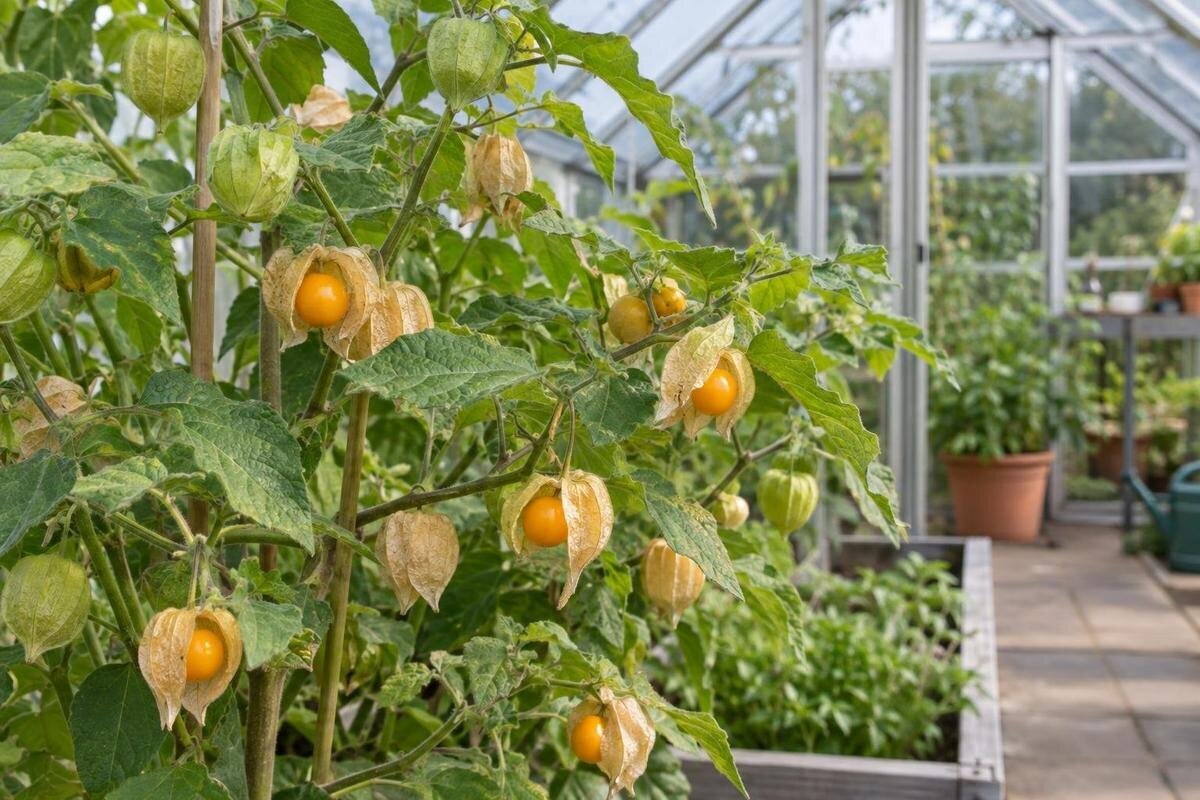
Each berry develops inside a green, papery husk, which gradually dries and becomes straw-coloured as the fruit matures. The berry itself should be golden yellow to orange, depending on variety, rather than green. Use both signs: a dry husk with a pale or green berry is not a reliable signal that it is ready. Check regularly because fruits at different stages can ripen at different times on the same plant. Size alone does not tell you whether a berry has reached maturity; allow it to develop its colour before picking.
Ripe fruit often drops naturally or comes away easily, so gather fallen berries promptly and look beneath the foliage where they can be missed. Leave green fruit on the plant if conditions allow it to finish. Keep the husks on during handling and separate damaged or unripe fruit from the ripe harvest. Open enough husks to check the berry colour rather than sorting the entire harvest by the appearance of the husks alone. As you pick, distinguish fruit ready to use from berries that still need time on the plant; there is no need to clear a whole branch at once. If you are comparing a greenhouse model listed with storage, the Aluminium Greenhouses with Storage – Limited Edition has options from 5.52 to 28.08 m². Work out how the storage area and growing area are arranged, leaving a clear route for collecting fruit beneath the canopy.
Overwintering and planning another crop
Decide whether to treat cape gooseberry as an annual crop or attempt to keep it longer. It is tender: in suitable frost-free conditions it can persist, but cold can damage it, and an unheated greenhouse does not promise frost-free roots or leaves. A protected plant may produce over a longer period, yet a garden bed or container still responds to the temperatures around it. Remove declining or diseased growth and fallen fruit, and check plants kept over for pests before a new season begins. There is little value in retaining a tired, pest-ridden plant solely because it may be perennial.
Assess the project by the fruit you harvest, the time spent supporting and picking, and the work needed to control heat. Separate problems with timing from problems with space: a plant that flowers too late raises a different planning question from one whose branches block access. That distinction helps you decide whether to change the start date, grow fewer plants or rearrange the growing area. If extra heating would be needed to bridge a short cool spell, compare that commitment with starting a new plant next season; greenhouse size cannot remove an unsuitable climate or timetable. The Spacious Greenhouse is listed in sizes from 47 to 70 m², but its footprint does not indicate energy use or crop capacity. Consider a larger growing area only in relation to the crops you intend to keep there and the work involved in managing them.
Frequently asked questions
Can cape gooseberries grow outdoors in Malta?
Yes. A sunny, sheltered outdoor position may suit them; a greenhouse is not automatically necessary. Growing under cover can help extend the growing period, but the greenhouse also needs good ventilation and may become too hot in summer.
Does one plant need another for pollination?
Usually not. Cape gooseberries are generally self-fertile, so one plant can set fruit. Insects can help, and in a closed greenhouse you can gently tap flowering stems or transfer pollen between open flowers with a soft brush.
How long does it take to get fruit from seed?
Plan for several months from sowing to the first ripe berries. The timing varies with the variety, light, warmth and care, so allow time for the plant to establish, flower and ripen its fruit.
How can I tell when a cape gooseberry is ripe?
Look for a golden-yellow to orange berry inside a husk that has become dry and papery. A dry husk alone is not enough if the berry is still green. Ripe fruit may fall naturally, so check beneath the plant too.
Can I keep the plant through winter?
It can persist in suitable frost-free conditions, but it is tender and cold can damage it. An unheated greenhouse does not guarantee frost-free conditions, so treat overwintering as a possibility rather than a certainty.
A successful cape gooseberry crop depends on matching a long growing season with a greenhouse that can be cooled when Malta’s summer heat builds. Give the branching plant room and support, check flowers and foliage as it grows, and use the colour of both berry and husk to judge ripeness. The first fully mature fruit will also show whether your timing worked for your own garden.
