
Direct Sowing or Raising Transplants for Greenhouse Crops?
Greenhouse crop guide
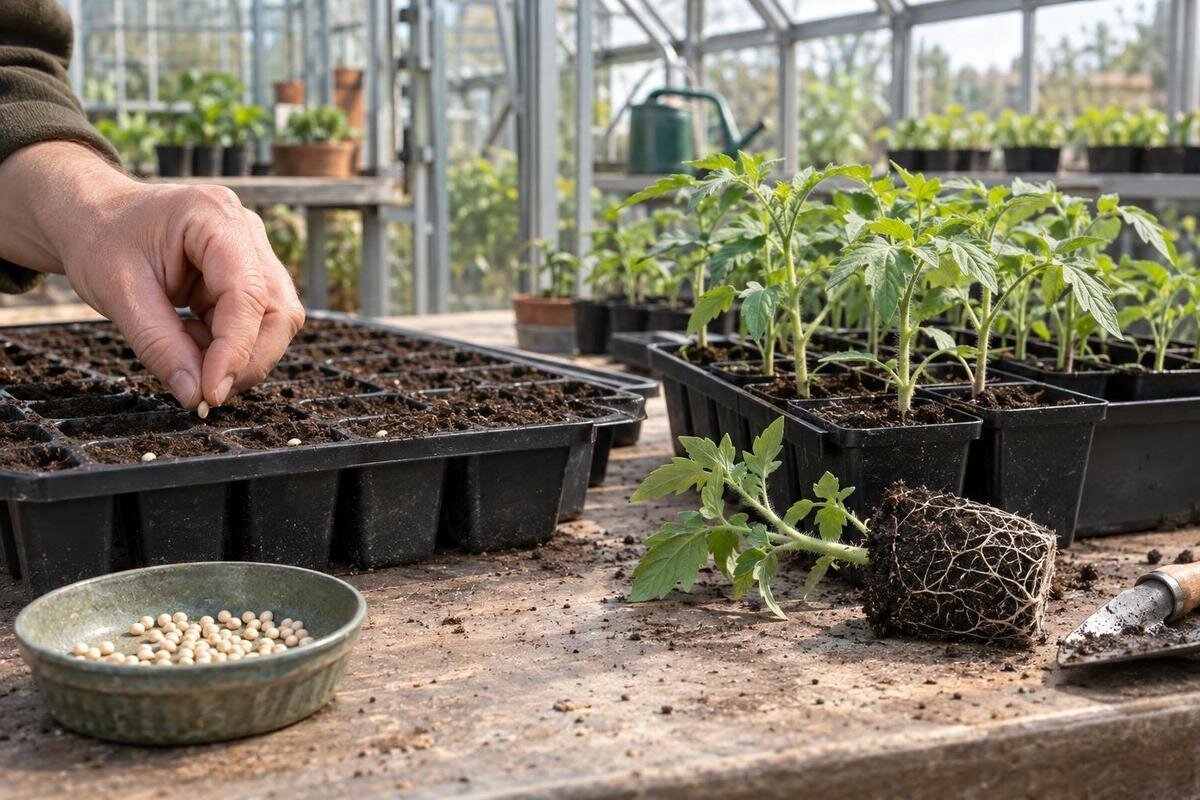
In a greenhouse, both methods can work, but they use the growing area and crop calendar in different ways. Direct sowing puts seed where the plant will finish growing; raising a transplant means germinating it in a module, tray or pot, then moving the young plant. The sensible choice depends on the crop’s roots, how easily it establishes in its final position, whether that position is free and how much handling the seedling tolerates. A mixed plan is often more practical than using one method for every crop.

What the two methods mean for a greenhouse crop
Direct sowing means placing seed in the bed or container that will hold the crop through its main growth. Seed started in a small pot and kept in that same pot is not a transplant; the defining step is moving a young plant to a separate final position. A pot used for an eventual container crop is its final container, while a small pot used only to raise a seedling is a nursery container. Decide where the plant will finish before selecting a method, particularly if the greenhouse has permanent growing positions as well as a small propagation area.
Crop choice depends on root sensitivity, how readily seed establishes in its final position, whether that position will be free and whether you want a counted set of evenly spaced plants. Those factors do not all point in the same direction. A crop that establishes reliably in place may be simpler to sow in its bed, while another may benefit from being raised separately until planting space is available. Conditions at a bench can differ from those in a bed, so a successful start in a tray does not automatically mean direct sowing will work equally well in the final position. Use crop-specific seed instructions as your starting point.
Direct sowing occupies the final growing position
With direct sowing, seed goes straight into its final bed or final container. The young plant does not need to be lifted from a module, so there is less potting and transplant handling. This can suit crops whose roots dislike disturbance, or quick crops where separate modules add work without much benefit. Sow at the depth and spacing given for that crop, and thin seedlings if the instructions call for it; direct sowing does not mean scattering seed densely. Follow the guidance for thinning rather than assuming spare seedlings should be moved elsewhere.
The trade-off is that the intended position is occupied before you know how many seeds will emerge. A patchy row may need gap-filling or another sowing, and early seedlings can be harder to distinguish from unwanted growth in a bed than in labelled modules. In a mixed greenhouse, that can affect what else the bed can hold. If you are comparing structures as part of the plan, Aluminium Greenhouses are listed in sizes from 3.77 m² to 28.08 m². Treat this as overall area, not a measure of free planting or bench space; check the layout for the selected size before allocating it.
Raising transplants separates germination from planting
Raising transplants means sowing into a tray, module or pot, then planting each selected seedling in its final position. It lets you count the plants you want and keep the main bed available while seeds germinate. Separate modules can also make it easier to identify a crop and handle seedlings individually than in a crowded communal tray. You can remove weak or poorly formed seedlings before they take up permanent space. This method often suits crops grown as individual plants, or sowings where even spacing matters more than having a continuous row.
That control has a cost: trays need labels, regular attention and a temporary place, and planting out adds handling. A seedling that is too small, too large or disturbed at the roots may pause rather than continue smoothly, so follow crop guidance instead of leaving a batch in its modules indefinitely. If propagation space is part of a greenhouse purchase decision, Limited Edition Aluminium Greenhouses are listed from 3.77 m² to 28.08 m². That range indicates overall size choices, not usable bench dimensions. Check the selected layout for a place to hold trays without blocking access to the final crop.
Root crops usually benefit from staying in place
Carrots and parsnips are usually simplest to sow where they will grow. Their developing main roots can be disturbed during lifting, which may lead to forked or misshapen roots; direct sowing avoids that particular setback. It also avoids trying to separate a fine-rooted seedling from a module without damage. Keep rows or sowing patches clear enough to identify, and thin according to the seed instructions. For these crops, the advantage is not just less work: the main root develops without an unnecessary move. A tray start is rarely worth the extra handling unless the crop guidance gives a specific reason.
Radishes are also commonly direct-sown because they grow quickly, and moving small seedlings seldom brings a useful gain. Beetroot is more flexible: many growers sow it in place, while young seedlings raised in cells can be planted out carefully if the root ball stays intact. Beet seed may produce a cluster of seedlings, although single-germ types are also sold, so check the packet before planning spacing or thinning. Do not assume that every vegetable harvested below ground behaves like a carrot. Consider whether disturbance is likely to affect the crop and whether the cultivar’s instructions explicitly allow transplanting.

Leafy crops can use both methods
Leaf crops are a good example of why the intended harvest matters. Rocket, spinach and baby-leaf mixes are often sown directly in short rows or bands when the aim is to cut leaves from a continuous patch. Direct sowing is convenient for small repeat batches and avoids moving many individual seedlings. Lettuce can also be direct-sown, but modules are useful when you want separate plants at regular distances, especially for whole heads rather than a dense baby-leaf harvest. The seed may suit either method; the harvesting style and available space help decide which is more convenient.
With repeat sowings, direct-seeded patches can overlap, so mark each batch and allow for its growing period. A tray-started batch can develop away from the main bed, but it needs temporary space and another planting session. Cabbage, kale and similar brassicas are often raised in modules for planting at set spacing, though direct sowing can suit some crops and schedules. The Wall Greenhouse catalogue range is 3.69 m² to 14.34 m². When comparing these sizes, mark areas by harvest style: continuous leaf patches or individual plants. This makes the planting space required clearer than grouping all leafy crops together on the plan.
Tomatoes, peppers and aubergines are often started in modules
Tomatoes, peppers and aubergines are commonly raised in trays or individual pots and moved to their final greenhouse position. Starting them separately keeps the growing bed free while seedlings develop and makes it easier to plan a known number of plants. Peppers and aubergines can have a slower early phase than many quick leaf crops, so a module start can fit a longer period of establishment without occupying the final space. You can also plant out selected seedlings rather than committing every sowing position in the bed. A tray does not, however, make up for unsuitable growing conditions or inadequate care.
Direct sowing these crops in their final place is possible where the seed guidance and conditions support it, but it means waiting for emergence in a location that could otherwise be used or prepared for another crop. You may also need to thin seedlings if more than one emerges at a position. When considering the T-Model Orangery Greenhouse, listed in sizes from 16.52 m² to 30 m², use the number of final tomato, pepper and aubergine positions as a starting point for your space comparison. Mark any temporary tray area separately, so you do not count the same space as available for both seedlings and mature crops at once.
Cucumbers and other cucurbits need careful timing
Cucumbers, courgettes, pumpkins and melons are often started in individual modules or pots, particularly when the grower wants young plants ready before the final bed is available. These crops can grow quickly once established, so a separate start may be useful, but seedlings should not be held simply because the module method was chosen. Follow each crop’s guidance on when and how to plant out, and move the root ball carefully. The benefit is a controlled number of young plants; it is not a guarantee that transplanting will make every crop earlier or stronger.
Direct sowing is a reasonable alternative when the final position is free and has suitable conditions. It removes the planting-out step but leaves the crop in place during germination, which can complicate a sequence of greenhouse crops. Consider how the mature plant will use its allotted bed or container as well as how it starts; the cultivar’s eventual growth habit matters to the layout. The Pyramid Greenhouse listings cover 5.53 m² to 18.9 m². When comparing those options, mark the space intended for the mature cucurbit crop rather than using the size of its seedling pots as a guide. A small batch at sowing time does not describe its eventual space requirement.
Direct sowing and module starts for peas and beans
Peas and beans are often direct-sown in their final position because the seed is large and individual seedlings can establish without a potting stage. This avoids unnecessary handling and keeps the method simple for a row or a small group of plants. Module sowing can still be useful when you need a known number of plants or want seedlings available for a later planting slot. If you choose that route, use individual cells or pots and plant out while the root system can be moved intact. A tray start adds little if roots become tangled before the final position is ready.
Treat peas and beans separately rather than assuming that one rule covers both. Peas can be sensitive to root disturbance, so direct sowing is often the safer default; young plants raised for transplanting need careful handling. Beans are also frequently sown in place, while a module start can suit a limited batch if the final position is not yet ready. Check the seed packet for the recommended method and spacing. If you are considering Aluminium Greenhouses with Storage – Limited Edition, listed from 5.52 m² to 28.08 m², distinguish storage from growing space on your plan. An area allocated to equipment cannot also accommodate a direct-sown row or a temporary batch of seedlings.

Match the method to beds, trays and crop sequence
Decide by mapping the crop’s route through the greenhouse, not just by counting from the day the seed is sown. Direct sowing starts in the final position, so the bed may be committed while seedlings establish. Module sowing separates those stages: another crop can use the final bed in the meantime, but a bench or other temporary surface has to hold the young plants. For example, if a bed is still carrying a quick crop when tomato seedlings are ready, modules can keep the tomato plants separate until the bed is free. If the bed is available and the seed establishes reliably, the extra stage may not earn its keep.
Write down the intended sowing period, planting position and method for each crop, then look for overlaps between trays and crops already in the beds. Use the seed packet’s crop-specific timing guidance, adjusted to the conditions in your greenhouse, rather than relying on a single calendar for every plant. A larger greenhouse does not automatically solve a poor layout, and a smaller footprint does not dictate a sowing method. For scale comparison, Spacious Greenhouse options are listed from 47 m² to 70 m². Even at that scale, a dated crop plan matters: show which beds will still be occupied at each sowing date and which will be available for planting out.
Choosing a sowing method for each crop
Use four questions for each crop: will its roots tolerate being moved; can its seed establish reliably in the final position; will that bed be free when the crop needs it; and do you need an exact number of evenly spaced plants? Root sensitivity or reliable establishment in the final position often favours direct sowing. A need to free the bed, select plants or place individual seedlings precisely can favour modules. These are prompts, not a score: crop instructions can override a general rule, and the same plant may suit either method in a different greenhouse plan.
If you are unsure, compare methods on a small, clearly labelled batch rather than changing the whole crop plan at once. Record what emerged, how much thinning or planting out was needed, and whether the plants settled into their final positions without a noticeable pause. Note the crop and method alongside the result; that gives you useful experience from your own greenhouse without assuming one season predicts every one. If your greenhouse comparison includes the Bloomcabin Prestige Greenhouse, listed from 3.77 m² to 28.08 m², use the same crop list for each proposed layout. Keeping plant numbers consistent helps you compare the space needed for direct sowing with the combination of beds and nursery space needed for transplants.
Frequently asked questions
Which greenhouse crops are usually best direct-sown?
Carrots, parsnips and radishes are common examples because moving young root systems can disturb the crop. Peas and many beans are also often sown in their final position. Treat these as starting points, not fixed rules: check the seed packet and the conditions in the intended bed.
Which crops are commonly raised as transplants?
Tomatoes, peppers, aubergines and headed lettuce are often started in modules or pots, as are many brassicas. This gives you a batch of plants to place at chosen spacing. Some can also be direct-sown; use modules when a separate start solves a real timing, spacing or bed-availability problem.
Does raising seedlings in trays guarantee an earlier harvest?
No. It can let a crop begin away from its final growing position and may suit a longer early growing phase, but a transplant still needs suitable conditions and can be set back by rough handling or a poorly timed move. Direct-sown plants can catch up when the bed and conditions suit them.
Can I sow seed straight into a greenhouse pot?
Yes. If that pot is where the plant will remain, sowing into it is direct sowing in its final container. If the seedling will later be moved into another pot or bed, you are raising a transplant. Check that the crop suits the container you plan to use.
What if the seed packet recommends both methods?
Choose the option that suits the crop’s root sensitivity, the availability of its final position and your ability to care for seedlings in modules. If the instructions allow both, try a small batch of each and record emergence, planting effort and establishment. Do not use both methods simply to fill spare greenhouse space.
The most practical plan rarely relies entirely on direct sowing or on transplants. Sow carrots, parsnips and other root-sensitive crops where they are to mature; start crops such as tomatoes or headed lettuce separately when even spacing and keeping the final bed free justify the extra handling. For flexible crops, check root tolerance, bed availability and the seed instructions. Put the method beside each crop on your greenhouse plan, so the plant’s needs—not a blanket rule—determine whether it begins in the bed or in a module.
