
How to Choose an Outdoor Sauna for a Coastal Property

OUTDOOR SAUNA BUYING GUIDE
An outdoor sauna beside the sea should be chosen for the exposure it will actually face, not simply because a listing calls it suitable for outdoor use. Salt in the air, wind-driven rain, strong sun and sheltered, slow-drying spots can affect timber finishes, metal fittings and electrical components in different ways. Start with the proposed position, then check the exact model’s material and hardware specifications, installation guidance, care instructions and written warranty. A name, product photograph or general “coastal” claim is not proof of marine suitability. This guide shows how to evaluate the evidence and identify questions that need an answer from the manufacturer or a qualified installer.
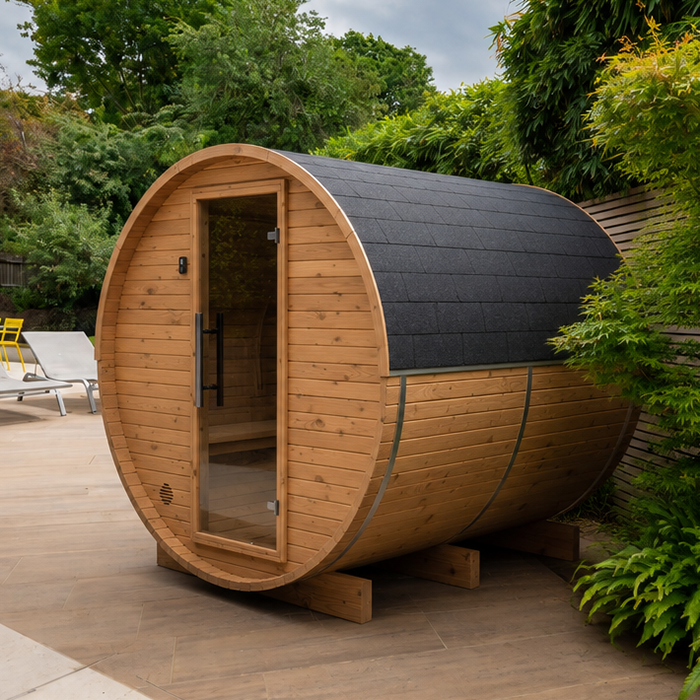
Before you buy 1
Assess salt, wind and damp at the proposed site
Coastal exposure is not one uniform condition. Salt carried in sea air can settle on exposed surfaces, while wind-driven rain, strong sunlight and humid or slow-drying corners affect different parts of a sauna in different ways. Two properties at a similar distance from the water may receive very different deposits because wind paths, elevation, nearby walls and other screening vary. Begin with the proposed position, not a broad label such as “coastal”. Look at surfaces already exposed there: outdoor metalwork, glazing and railings can show where salt collects. These observations help you frame questions for a manufacturer; they do not prove that any material or model is suitable.
Make a short site record on several different days, especially after windy or wet weather. Note which side faces open sea, where spray or rain strikes, whether salt residue returns quickly after cleaning, and which areas stay damp. Record any roof runoff or other regular source of moisture separately. A hedge, wall or neighbouring building may reduce direct exposure, but it can also slow drying or redirect gusts. Distance from the shoreline is therefore only one clue, not a stand-alone measure. Take photographs of the exact proposed location and any nearby corrosion, then share them with the supplier or installer when asking about the model. If conditions are unusually exposed, request an answer that names the location and configuration rather than a generic “outdoor use” assurance.
Check materials and finishes component by component
Request a component-by-component specification for the exact model. The exterior cladding, supporting frame, floor, roof covering, door, benches, seals and coatings may not all use the same material or finish, so a general timber description leaves practical questions unanswered. Ask for the material or treatment used on each exposed part, whether it is factory-finished, and what maintenance the maker recommends in a coastal position. A product label helps identify a model, but is not proof of a marine-use specification: Sauna HC-150 should be assessed from the supporting documents, not the name alone. Get the specification in writing and make sure it refers to the configuration and finish being offered.
Then ask what evidence backs any claim such as weather-resistant, treated or suitable for outdoor use. Find out what the claim covers, what conditions it assumes and what it does not cover; a coating on the exterior, for example, does not automatically describe the frame, joints or hardware. Ask whether repeated salt deposits, strong sun and wetting affect the finish or change the care instructions. If a surface needs treatment after installation, confirm the approved product and timing with the manufacturer rather than choosing a generic wood preservative. Ask whether cut ends, hidden joints or later repairs need a different approved treatment. This lets you compare complete assemblies instead of relying on a single material term.
Before you buy 2
Identify the metal fittings and their protection
Salt-related deterioration can first become visible on small metal items rather than on the largest surface. Check the specification for screws, hinges, latches, straps, brackets, vents, handles and exposed fixings; ask what alloy or protective coating is used and where it is located. A phrase such as “corrosion-resistant fittings” is too broad unless the supplier identifies the parts and states the limits. Ask whether a coating can be damaged during assembly or cleaning and what to do if it is scratched. Include parts hidden at joints, as they may be difficult to inspect later. A replaceable hinge and a concealed structural fastener also have different repair implications.
Ask how unlike metals are separated or otherwise made compatible in the assembly, and whether approved replacement parts are available for each fitting. You do not need to specify a metal grade yourself; request the manufacturer’s written information and have the installer raise any compatibility issue before assembly. If you are considering Sauna HC-225, tie the questions to that model and its selected configuration rather than accepting a general answer about the range. Include anchors or support hardware in the enquiry if they form part of the supplied system, and confirm separately what the installer proposes to use. Ask how fittings should be inspected and how salt can be removed without damaging nearby finishes.
Allow space for drying, inspection and maintenance
Position affects both the amount of salt and the time surfaces remain damp. A more sheltered part of a garden or terrace may reduce direct spray, but shelter is not automatically better: tight corners, dense planting, walls or roof drips can restrict drying or direct water onto the sauna. Avoid choosing solely for the shortest route from the house or the best view. Consider whether you can reach the exterior, inspect the base and fittings, and clean the sides that face the wind. Keep the installation area accessible for routine checks and for any access specified in the maker’s manual. Also consider where water used for cleaning will run.
Ask for the manufacturer’s installation drawing for the exact model, including the required support surface, anchoring, drainage and service clearances, then let a qualified installer assess those details for your property. A catalogue entry such as Sauna N-210 identifies what you are discussing, but its name is not an installation plan or proof that a particular terrace or garden base is adequate. Check how rainwater will move away from the selected position and whether runoff from adjacent roofs or paving reaches it. Do not assume that raising, screening or enclosing the unit improves coastal durability; changes to the intended installation should be approved by the manufacturer and installer.
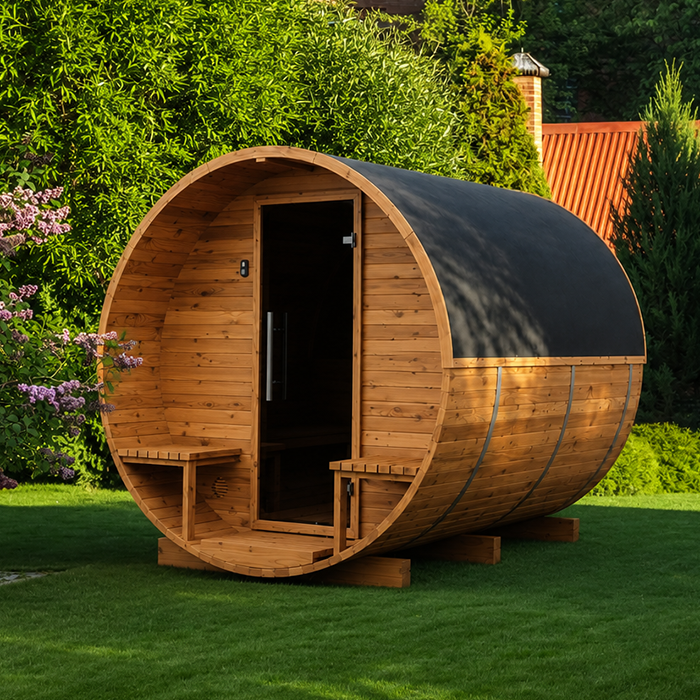
Before you buy 3
Request model-specific wind and rain information
An outdoor designation does not establish performance in a fully exposed coastal position, and a barrel shape or substantial appearance is not a storm rating. Ask whether the exact model and configuration have documented limits for wind and wind-driven rain, what test or design conditions those limits refer to, and which parts they cover. Check the roof covering, joints, door openings and seals as a complete assembly, not as separate reassuring words in a brochure. If no rating or exposure limit is published, ask the manufacturer to state that clearly and explain whether the intended site falls within its approved conditions. Do not infer that an unmentioned test has been passed. Ask about any inspection or use limitations linked to severe weather.
Wind resistance is also a question of the whole installation, not only the shell. The base, fixings, anchoring method and local exposure must be assessed against the maker’s instructions by a qualified installer; structural design or calculations belong with an appropriate professional. When enquiring about Sauna N-250, request a drawing and written guidance for that precise configuration, and ask which on-site conditions would make further assessment necessary. Do not copy another property’s fixing details or rely on photographs to judge storm performance. If strong winds can carry debris or push rain under overhangs, describe that exposure plainly and ask how the manufacturer’s limits apply.
Agree a cleaning and maintenance routine
Coastal upkeep is not just an occasional wipe of the visible exterior. Ask the manufacturer how to remove salt from each surface, whether a fresh-water rinse is appropriate, which cleaners are permitted, and how to protect electrical or other sensitive components from water during cleaning. Avoid assuming that pressure-washing, abrasive pads or a familiar household product are safe; use them only if the product instructions explicitly allow it. Ask how to inspect metal fittings, joints, roof details and finishes, and which early signs call for repair. The right method depends on the actual materials and assembly, so one generic cleaning routine may not suit every component.
Ask for a written care schedule with inspection and finish-maintenance intervals for the exposure the manufacturer considers acceptable. A site with recurring visible deposits may need closer attention than a more sheltered plot, but the maker should define the method and interval rather than leaving you to guess. Before buying Sauna LC-260, or any other model, confirm that the care instructions match its offered finish and components. Find out which coating or repair product is approved, how damaged areas should be handled, and whether unapproved treatment could affect the stated warranty. Keep a dated record of cleaning and maintenance, along with receipts for any approved products.
Before you buy 4
Read the warranty terms for coastal exposure
Read the warranty with coastal exposure in mind. Find the written terms for corrosion, salt air, marine or seaside use, wind-driven rain, finish deterioration and individual fittings, checking whether cover applies to the whole unit or only named parts. These are questions to verify, not exclusions to assume: a general outdoor warranty may or may not say anything specific about salt exposure. Check the definitions and any location conditions, and distinguish a cosmetic change from a problem the manufacturer describes as a defect. The name of a warranty or a salesperson’s summary cannot replace the exact terms supplied for the model and configuration. Check whether the exterior finish is covered separately from the underlying material.
Read the conditions alongside the maintenance instructions. Look for requirements about approved coatings, inspections, installation, repairs by authorised personnel or proof of care, and ask what happens if a fitting corrodes or a finish needs attention. If you are reviewing Sauna HCF-300, request the warranty document that applies to the exact model offered locally and ask for a written clarification where coastal exposure is not expressly discussed. Note any time limits, parts excluded and steps required to report an issue, without assuming that a verbal assurance changes the terms. Retain the warranty, care schedule and answers you relied on, and check whether alterations require prior approval.
Use area figures and drawings for different purposes
An area figure in a listing is not automatically an external footprint, internal floor area or required installation clearance. Confirm exactly what is being measured and obtain a dimensioned drawing with overall length, width and height, door opening, service space and any distances the maker requires. For example, the listing records 6.89 m² for Sauna LCF-300, but the figure alone does not tell you how the sauna fits on a site or how much room remains around it. Compare like-for-like measurements, and include access for cleaning, repairs and approved maintenance rather than measuring only the space occupied by the product. Ask whether the drawing includes any roof overhang or other projections.
Check the full route from the delivery point to the prepared position as well as the final footprint: gates, steps, turns, slopes and narrow passages may affect what can be brought in or assembled. Ask which parts arrive assembled, what access is required and whether the installation method changes with site constraints; do not assume from a product image. If the planned position is on a raised deck or another structure, have a qualified professional assess the support and anchoring rather than estimating loads or adapting the base yourself. A drawing for a different model or configuration is not a substitute for the one you intend to order.
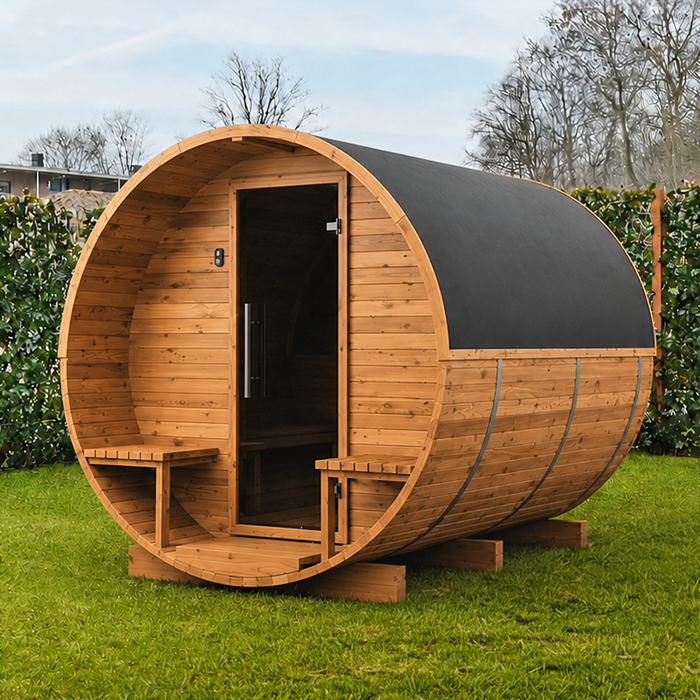
Before you buy 5
Confirm inclusions and electrical services separately
Catalogue titles and area figures do not establish what is supplied with a particular configuration. Ask for an itemised list covering the sauna structure, heater if offered, controls, lighting, electrical components, any roof covering and fittings, plus anything you must source separately. Do not assume a heater or controls are included just because a model is called a sauna; ask which exact components the seller is supplying and whether they are appropriate for the stated outdoor exposure. A listing for Sauna S-140 identifies a model, but only the written inclusion list can settle what arrives with the configuration you plan to buy. Check that the documents refer to the precise version offered.
Where the chosen setup includes electrical equipment, give its manufacturer documents and the site’s coastal exposure details to a qualified electrician before planning the supply. Ask the electrician to confirm that the equipment and external components are appropriate for their proposed locations, and ask the sauna manufacturer about limitations on exposed controls, connections or service parts. This is a coordination question, not a reason to guess from a general product description or improvise changes to the sauna. Confirm who handles servicing and how access can be maintained without altering the supplied assembly. Record separately any equipment you will need to source yourself so that it is not overlooked when comparing configurations.
Compare written evidence for the exact configuration
Create one record for each model you are considering, with separate rows for exposed materials and finishes, hardware, wind-and-rain limits, installation requirements, cleaning method, maintenance interval, warranty wording and equipment inclusions. Beside each item, note the document that supports the answer and any condition attached to it. This prevents a broad assurance about “outdoor use” from appearing to answer a specific question about salt air, a fitting or an exposed location. Mark unanswered points as unresolved, not as an implied yes. Use the same questions for every seller so the comparison reflects the evidence rather than the order in which information was presented. Note who supplied each answer and when.
Before you commit, check that the documents name the exact model, finish and supplied configuration, and that the proposed site is described accurately. Ask the manufacturer to explain any coastal-suitability statement in terms of components, exposure limits and required care; ask a qualified installer to assess site-specific support and anchoring, and a qualified electrician to review electrical elements where relevant. Verify current local availability and configuration with the store, since model names and catalogue entries alone do not confirm what is available. A clear answer may include limitations; the useful question is whether you can meet them and maintain the sauna as specified. Keep the final documents with your site notes.
Frequently asked questions
Does an “outdoor sauna” label mean it will withstand salt air?
No. “Outdoor” is a broad description; it does not, by itself, show that exposed finishes, fittings or seals have been assessed for salt air. Request model-specific material details, maintenance instructions and documented exposure limits, then ask for a written response about your site.
Does a timber-treatment term in a product title prove coastal suitability?
No. A product name or treatment term does not identify every component, its finish, the exposed-metal specification or any test limits. Ask for a component schedule and care requirements for the exact model; do not treat a word in the title as a marine-use warranty.
How can I compare salt exposure at two possible locations?
Look at the actual wind paths, surrounding shelter, rain exposure, drying conditions and salt residue on nearby surfaces. Distance from the sea is only one clue. Notes and photographs taken after different weather conditions can help the manufacturer or installer assess the proposed position.
What should I ask about wind and storm exposure?
Request model- and configuration-specific information about wind, wind-driven rain, tested conditions and limitations. Ask for the installation drawing, too. A qualified installer should assess the proposed support and anchoring; do not infer storm performance from a product shape or photograph.
How do I check what a warranty covers near the sea?
Read the written terms for corrosion, salt air, finishes, fittings, weather exposure and maintenance conditions. Check which parts are covered and what is excluded. If coastal conditions are not clearly addressed, ask for a written explanation for the exact model before you buy.
A sensible coastal purchase depends on whether the evidence covers the whole sauna and the conditions at its proposed position. Consider the material specifications, fittings, wind-and-rain guidance, care requirements and warranty together, rather than relying on separate reassuring labels. If an important claim remains vague, treat it as unresolved rather than as approval for a sea-facing site. Choose a model whose documented limitations you can meet and whose maintenance you can realistically carry out.
