
Choosing Private or Shared Saunas for Glamping Accommodation
Glamping sauna planning
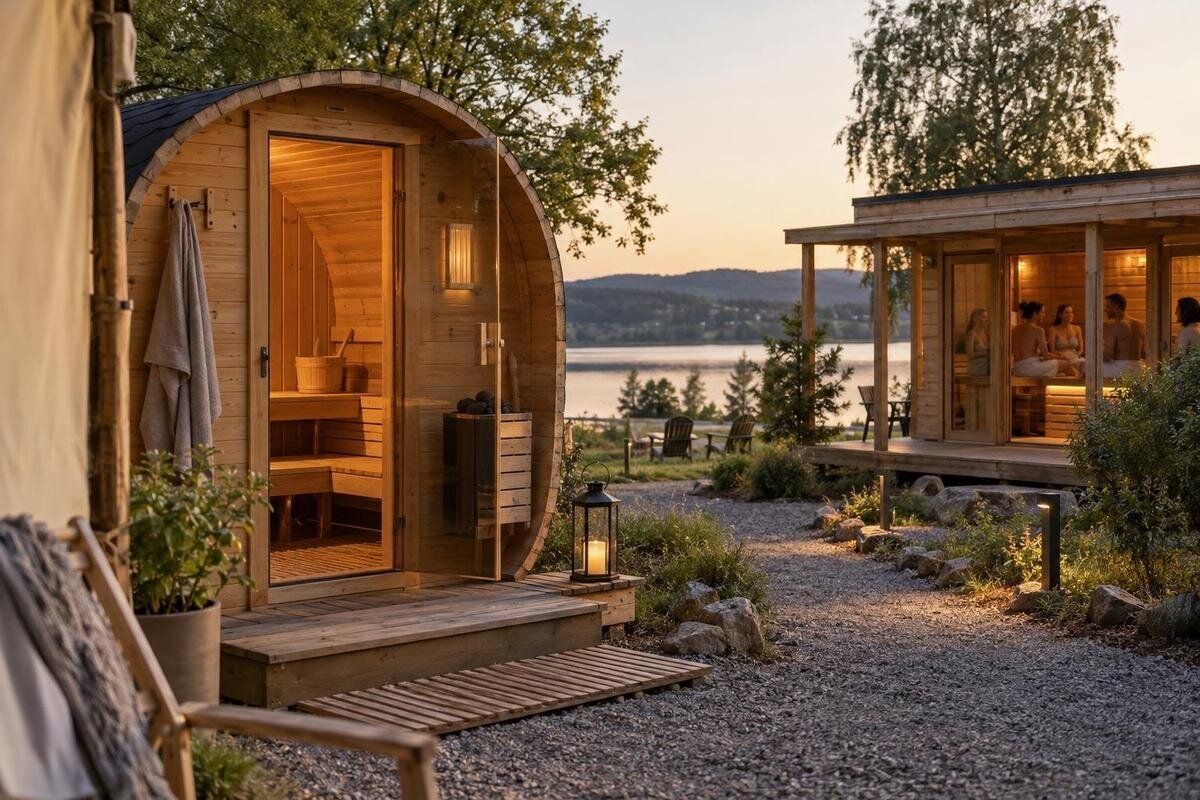
At a glamping site, the choice is not simply one sauna or many. A sauna reserved for each accommodation unit gives that booking exclusive access; one shared facility brings access, cleaning and servicing together but needs a fair timetable and clear guest boundaries. Compare how guests will reach and use the sauna, who will reset it between bookings and what happens during downtime. Then confirm that the exact equipment is suitable for the intended business use. The operating arrangement matters as much as the product selected.
01
What private and shared access mean
Define the choice by who has the right to use the sauna, not simply by where it sits. A private sauna is allocated to one accommodation booking, so that party does not need to coordinate with guests from other units. It may stand beside the unit or elsewhere on the site, provided access remains exclusive. A shared sauna serves guests from more than one booking, either through separate reserved sessions or under a clearly stated shared-use arrangement. These are different guest promises: the label shared alone does not tell visitors whether they may meet another group, how to claim a session, or whether use is included in the stay.
A one-to-one arrangement requires a facility assigned to each unit; it is not enough that a sauna exists somewhere on the property. A shared sauna may still be private to one group during a reserved session, but it is not allocated to that accommodation for the whole stay. Put the distinction in the listing, welcome information and operating plan. Exclusive access should also be distinguished from unrestricted opening hours: guests need to know when their allocated sauna is available and when staff may need access. When comparing equipment, record which proposed facility belongs to which accommodation unit. The catalogue entry for Sauna S-140 gives a stated area of 1.93 m², which is a useful model reference, not a definition of the guest service. The accommodation description should explain the access arrangement separately from the product details.
Guest routes, privacy and clear boundaries
Draw the route from every accommodation unit to the proposed sauna, rather than judging access from a site map alone. Consider distance, steps, changes in level, lighting, signs and whether guests pass through another unit’s outdoor space. A private sauna can still feel exposed if its entrance faces a neighbouring deck or its route crosses a busy common area. A shared facility brings more visitors past the same point, so its position should not create unnecessary disturbance to sleeping or outdoor living areas. Think through both the outward and return journeys, including how a first-time visitor finds the correct unit afterwards. Where routes cross, make the boundary between communal paths and private outdoor areas clear without expecting guests to work it out from the accommodation names alone.
For shared access, decide where guests wait, how they identify the entrance and how access is controlled. Explain how they will know that the previous party has left and the facility is ready, rather than leaving them to knock or try the door. For private access, explain any staff entry needed for inspection or servicing so guests understand what exclusivity means. Keep guest directions tied to the actual site layout, not just a product photograph. If Sauna HC-150 is on the shortlist, its catalogue entry states an area of 2.97 m²; the entrance position and dimensions still need to be established from the exact manufacturer drawing. Use that drawing to assess the approach, then describe the route in terms guests can recognise on arrival.
02
Booking shared sauna sessions
A shared sauna needs a clear procedure for reserving access. Timed reservations make availability more predictable, while a first-come arrangement can leave guests unsure whether they will get a turn at busy periods. If you offer slots, allow for preparation, guest use, inspection and any cleaning between groups, following the manufacturer’s instructions. Distinguish the period reserved for guests from the time staff need before another party enters. A timetable that leaves no room for those tasks creates a promise the operating team may not be able to keep. Decide who releases a slot for use and who can amend the schedule if preparation takes longer than expected. Private saunas need published availability too, but they do not require different accommodation bookings to compete for the same reserved period.
Write the booking procedure before opening: when a guest can reserve, whether a session is exclusive to their party, what happens if they arrive late, and how changes or missed slots are handled. Explain the arrangement at booking and again on site, so guests are not discovering restrictions at the sauna door. Specify whether a reservation is confirmed immediately or needs a staff response, and give guests one clear way to check it. When assessing Sauna HC-225, listed with an area of 4.4 m², review the equipment instructions alongside the proposed timetable. The booking system should reflect the operating routine you can support, rather than allowing reservations first and leaving staff to fit preparation and changeovers around them.
Peak demand and practical capacity
Compare the two arrangements at the times when demand is most likely to overlap, not only across an average week. Several accommodation bookings may want a shared session around the same part of the day; private allocation avoids that particular booking conflict, but creates more separate facilities to operate. List the number and type of bookings you expect, the size of each party and the periods when they may want access. Treat early estimates as assumptions, not as evidence of future occupancy or guaranteed availability.
Capacity must come from information for the exact sauna and configuration. Ask the manufacturer or supplier for the stated maximum occupancy and relevant use instructions, and check that the proposed arrangement matches them. A listed area is not a people count: for instance, the catalogue gives Sauna N-210 a stated area of 4.43 m², which does not establish occupancy, bench layout or suitability for repeated guest use. Do not calculate a safe or comfortable guest limit from area alone. Keep the published equipment information separate from your booking policy.
03
Cleaning between guests and bookings
With a shared sauna, cleaning and inspection are concentrated at one location, but tasks can cluster when sessions follow one another. Decide who checks the facility, when it is prepared for the next group and how much time the operating plan allows before the next booking. Set out what guests are expected to do and what staff must verify, rather than relying on an informal handover. Keep a simple record of completed checks and a way for guests to report a problem before the next session. Separate a guest’s departure from the staff decision that the facility is ready again. This distinction gives the person managing reservations a clear status to work with and avoids treating an empty sauna as automatically available.
With private saunas, the same work is spread across facilities assigned to separate units. That can mean more locations to visit at checkout or between stays, and staff need to know which facilities are ready and which need attention. Distinguish the checks required during an occupied stay from the work completed before a new party arrives, using the cleaning and care instructions for the exact model. For Sauna LC-260, listed with an area of 5.12 m², keep those instructions with the relevant accommodation checklist. If one team handles the accommodation and another handles the sauna, specify who confirms that both are ready. A room being released for arrival should not leave the status of its advertised private sauna unclear.
Servicing, downtime and responsibility
A shared facility concentrates servicing in one place, but an outage can affect every booking that relies on it. Decide how staff will identify a fault, block further access and tell affected guests what is available instead; do not promise that another facility will always be free. With several private saunas, an issue may be limited to one unit, but staff have more equipment and locations to monitor. A clear record of each model, reported issue and completed service helps prevent a fault from disappearing between guest stays.
Before buying, ask who can carry out routine servicing, what maintenance the manufacturer requires and what support is available for the intended business use. Confirm how much access staff or a technician need around the facility and when it can be taken out of service. If considering Sauna N-250, whose catalogue entry gives an area of 5.27 m², ask about servicing for the exact configuration rather than the sauna category generally. For a shared facility, consider how a planned closure will appear in the reservation calendar. For a private facility, decide how its unavailability will be flagged against the associated accommodation booking. In either arrangement, assign responsibility for confirming that work is complete before access is restored, so a booking is not accepted while the facility remains unavailable.
04
Site layout and service access
Plot the two options on the same site plan, including the space needed by staff as well as guests. Private saunas placed by individual units use several locations; one shared sauna concentrates activity around a single installation. Beyond the guest routes, identify how each facility can be reached for inspection and servicing, and whether that access crosses an occupied private area. Show where the proposed installation sits in relation to accommodation entrances, boundaries and other facilities. This helps reveal differences that a simple count of sauna units misses. A central location may be convenient for guests but awkward for service access, while several individual locations need to be assessed separately. Compare the complete layouts before treating either arrangement as the simpler option.
Do not use a catalogue area as a substitute for dimensions, clearances or a site assessment. The listing for Sauna HCF-300 gives a stated area of 6.89 m²; the figure alone does not establish the full footprint or the space needed around the installation. Obtain manufacturer drawings and instructions for the precise configuration. Have utility requirements and any associated site work assessed by qualified professionals against those documents and applicable local requirements. Settling the layout only after selecting equipment can leave access or service needs unresolved.
Confirming suitability for commercial guest use
A product name, listed area or attractive layout does not confirm that a sauna is suitable for repeated use by paying guests. Tell the manufacturer or supplier that the sauna is intended for glamping accommodation, describe the expected pattern of use and ask for written confirmation for the exact model and configuration. Ask what limits or operating conditions apply, including occupancy, duty cycle, supervision and maintenance. Do not assume that a model intended for private use is suitable for a business simply because it can be placed outdoors.
Keep the answer alongside the product documents and confirm that it covers the full proposed setup, including any heater or controls selected with the cabin. Ask for the applicable installation, use and care instructions, and for the terms that apply to the intended use; do not infer warranty coverage or support from a product category. If Sauna LCF-300 is under consideration, its listed area of 6.89 m² is only one catalogue detail. Make sure the supplier’s response names the model and configuration you are actually ordering. If the proposal changes from private allocation to shared sessions, explain the revised use pattern before committing. Have site-specific installation matters checked by appropriate qualified professionals.
05
Costs beyond the sauna unit
Compare quotations for the complete arrangement, not just the equipment. For private saunas, include each facility and its associated site work, access and service requirements. For a shared sauna, include the central installation, guest routes, booking arrangements and the staff time needed to manage sessions. In both cases, ask suppliers and installers for relevant energy-use information for the proposed configuration, then include cleaning, maintenance and planned periods when the facility is unavailable. Separate one-off expenditure from recurring operating costs so that an apparently lower equipment total does not obscure the work needed to provide the service. Record what each quotation includes and what remains to be priced. Use actual quotations and documented assumptions rather than invented prices or consumption figures, and compare both options over the same period.
The operating comparison also differs. Private allocation may mean work at several points on the site, while shared access may concentrate inspections and guest changeovers around one facility. Neither pattern is automatically cheaper: the result depends on the equipment, layout, use and staffing plan. Put the same service promise into both estimates, including how much access guests receive and who handles resets. If the business case depends on a particular number of bookings or on sauna-related income, identify that as an assumption and test it against real operating information when available.
Choosing the arrangement for your glamping site
Test both arrangements against the same operating day. Consider several parties asking for access at a similar time, an accommodation changeover coinciding with sauna cleaning, and one facility being temporarily unavailable. For each situation, identify who makes the booking decision, who prepares the sauna and what guests are told. These are planning exercises, not forecasts of demand or equipment failure. Their value is in exposing an unresolved responsibility or a promise that relies on the same member of staff being in two places. Compare the results with the service you intend to advertise: a private sauna should offer meaningful exclusivity, while a shared facility should have an access arrangement guests can understand and staff can deliver.
A shared sauna is a stronger fit when a central route works for guests and the business can manage access, bookings, cleaning and temporary closures. Private saunas make more sense when exclusive use is important to the offer and the site can support separate facilities and servicing. A hybrid arrangement can also be considered, but only if its access rules and responsibilities are clear. Before committing, check the equipment documents and the operating plan together; neither a product listing nor a guest-facing promise can substitute for the other.
Frequently asked questions
Does a private sauna have to sit beside each glamping unit?
No. Private describes who has exclusive access, not the distance from the unit. The route still needs to feel private and practical, and guests should know whether they may use the sauna freely during their stay or only at reserved times.
How many guests can use a shared sauna at once?
Check the maximum occupancy and use instructions for the exact sauna and configuration with the manufacturer or supplier. Do not infer capacity from a product name or its stated area, and do not set guest numbers from a rough floor-plan estimate.
Should guests book shared sauna sessions?
Booking can help avoid clashes when several accommodation units use one facility. If you use timed sessions, explain how to reserve, what happens if a guest is late, and whether cleaning or inspection time sits between bookings. A first-come arrangement also needs clear rules.
Does one shared sauna automatically cost less to operate?
No. One facility may concentrate cleaning and servicing, while private saunas multiply installations and checks across the site. Compare current supplier quotations, site work, utilities, staff time, maintenance and likely downtime for the service level you intend to offer.
Can a sauna sold for domestic use be used at a glamping site?
Do not assume so. Give the manufacturer or supplier details of the exact model, configuration and intended guest-use pattern, then seek written confirmation of suitability and operating requirements. Have site and installation matters assessed by the appropriate qualified professionals.
Private and shared saunas make different promises to glamping guests. Choose private facilities when exclusive access is central to the stay and separate servicing is manageable. Choose a shared facility when its location and booking arrangements work for the whole site. The stronger option is the one that matches the advertised experience to a practical operating routine, using equipment suitable for that intended use.
