
Greenhouse Aubergines Flowering but Not Fruiting
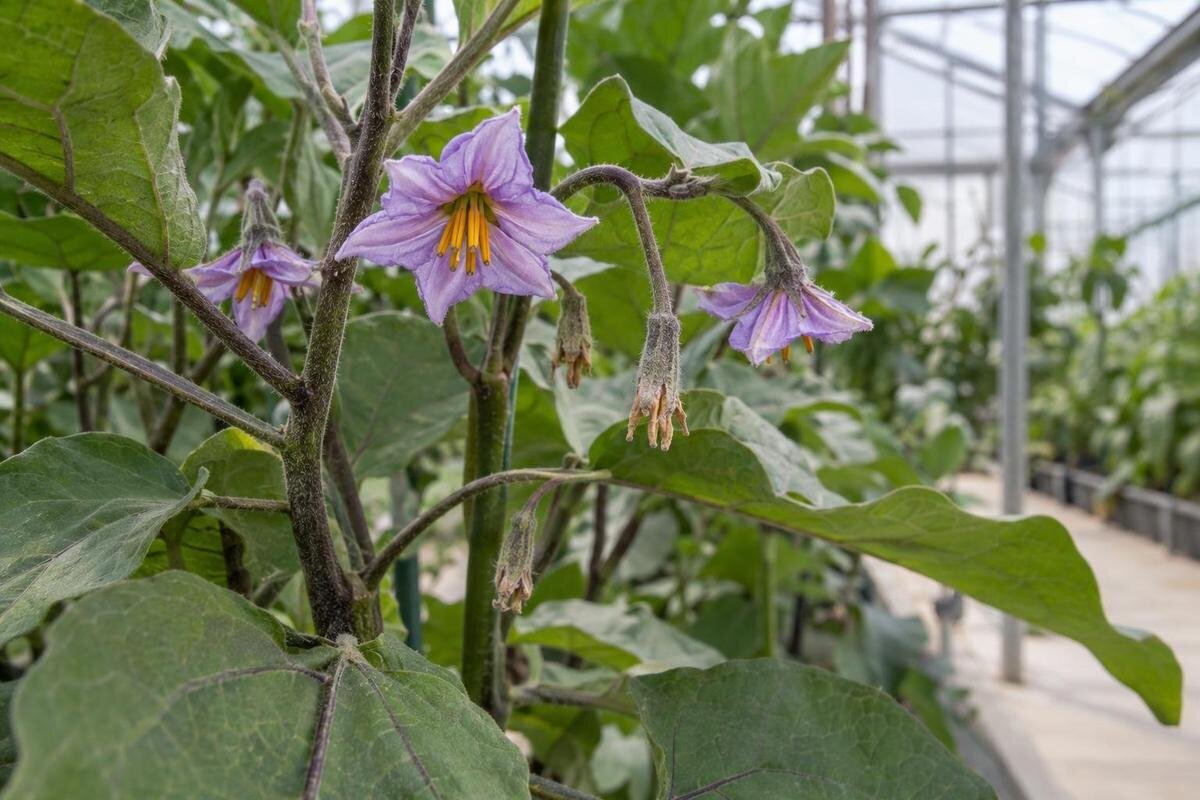
Greenhouse crop troubleshooting
Seeing aubergine flowers open and then fall without forming fruit is frustrating, but it does not automatically mean a pollinator is missing. Aubergine flowers contain both male and female reproductive parts and can self-pollinate; pollen still needs to reach a receptive stigma, and conditions must allow fruit to develop. Check for swelling at the flower base, inspect flower form, then compare day and night temperatures, air movement, moisture and plant growth. A brief record across several blooms is more useful than guessing from one dropped flower.

01
How to tell whether an aubergine flower has set fruit
An open aubergine flower is not a fruit yet. Look closely at the green base where the petals meet the calyx: after successful set, the ovary stays attached and begins to swell into a small fruit as the petals fade. If the flower shrivels or drops without any enlargement, it has not set. That tells you what happened, not why; poor pollen transfer, an unproductive flower type and growing stress can look the same from a distance. One failed blossom is common. Repeated failure across many flowers, several plants or different parts of the greenhouse is a stronger reason to investigate. An early swelling can be subtle, so inspect at close range.
Mark several newly opened flowers loosely, or note their position on the plant, and take a close photograph. Check them again over the following days for swelling rather than judging from petals alone. Record whether the bud opened, whether the base enlarged and whether the flower dropped; include the plant and row. Timing varies with temperature and cultivar, so one day is not a universal deadline. If some flowers set while others do not, compare their position and form. If none set, move on to shared conditions. This simple record helps distinguish normal flower turnover from a problem affecting the greenhouse more widely.
Aubergines are self-fertile, but pollen still needs to move
An aubergine flower has both pollen-producing anthers and a stigma that can receive pollen. It is usually self-fertile, so a second plant and separate male and female flowers are not needed. However, self-fertile does not mean that pollination always happens efficiently: pollen has to loosen, reach the stigma and remain viable. Gentle vibration, flower movement and visits from insects can help transfer it. An open blossom can still fail if the pollen is not released or the flower is under stress. Use aubergine-specific advice rather than applying another crop’s pollination routine without checking how its flowers work.
For a simple test, choose several open, dry flowers and gently tap the flower-bearing stem or its support. Avoid striking the bloom or shaking the whole plant. Compare the marked flowers with similar blooms left untouched, then watch for swelling at their bases. If tapping helps some flowers set, limited pollen movement may be part of the problem; if none set, temperature, flower form or plant health may also be involved. Record which flowers you tapped so that you can distinguish their results from those of untouched flowers on the same plant.
02
Inspect the stigma and flower type
Flower structure gives another aubergine-specific clue. In a well-developed, long-styled flower, the stigma—the tip of the female part—projects above the cone of yellow anthers. In a short-styled flower, the stigma sits within or below that cone. Short-styled blooms are less likely to set fruit, even when pollen is present, and may drop without swelling. Intermediate flower forms also occur, and their ability to set can vary. The mix of flower types can depend on cultivar and growing conditions. This close-up check is a clue, not a diagnosis: inspect several fresh flowers from different parts of the plant rather than drawing a conclusion from one unusual bloom.
Take a side-on photo of a few open flowers so you can compare the stigma position; do not pull flowers apart or rely on a distant picture. Note whether the same form appears repeatedly and whether another plant or variety behaves differently. Record the row and greenhouse zone for each observation. Those positions also matter when planning space for different varieties. The Limited Edition Aluminium Greenhouses listing gives area options from 3.77 to 28.08 m². Compare the selected footprint with a crop plan that leaves each plant accessible for close inspection, rather than judging space needs from the number of plants alone.
Record day and night temperatures at flower height
Aubergines are warm-season plants, but more heat is not always better. Prolonged hot days can reduce pollen quality or flower retention, while cool nights can interfere with pollen function and slow fruit development. The effect depends on the cultivar, flower stage and length of exposure; a single midday reading cannot identify the cause. A greenhouse may reach its hottest point well after your first morning check, and overnight conditions are easy to overlook. If buds fail before opening as well as open flowers failing to set, include temperature stress among the possibilities rather than assuming that pollination is the only issue.
Use a minimum–maximum thermometer or a logger placed near flower height, shaded from direct sun and away from a hot pane. Record daytime peaks and overnight lows for several days, alongside the dates when marked flowers open or drop. If conditions vary across the greenhouse, take readings at more than one crop position. Compare the record with the variety’s growing instructions rather than treating a single midday reading as representative. When reviewing a replacement structure, the T-Model Orangery Greenhouse listing includes area options from 16.52 to 30 m². Check the ventilation details for the chosen configuration and where your flowering plants would stand in relation to its openings.

03
Check air movement and greenhouse humidity
Still air can limit the small movements that help shake pollen from aubergine anthers onto the stigma. Look at the flowers while they are open and dry: do they move gently, or does the foliage remain completely still? Compare plants near openings with those deeper inside the crop, and note whether neighbouring foliage crowds the flowering stems. This helps you identify where movement is limited without repeating the tapping test on every bloom. Pollination does not depend on having insects in the greenhouse, although insect visits can assist it. Consider air movement alongside the results of your marked-flower test, rather than assuming that a motionless flower must fail to set.
Ventilation matters for more than pollen movement. It can help limit heat build-up, while a closed, damp canopy may keep flowers wet and pollen less free-flowing. Conversely, a strong hot draught can stress a plant, so look for gentle air exchange at flower height rather than a blast through the doorway. Note whether flowers remain damp when you inspect them and whether that pattern changes as the greenhouse is opened. Condensation is an observation, not a humidity measurement. When comparing structures such as the Pyramid Greenhouse, examine the specified openings and their positions relative to the beds you intend to plant.
Keep watering and feeding steady
Aubergines need a steady supply of water while flowering and setting fruit. A root ball that repeatedly dries out and then becomes saturated can stress the plant; permanently wet growing media can also impair roots. Check moisture below the surface near the roots rather than watering to a fixed calendar or judging only by dry topsoil. Compare plants in different beds or containers: a locally dry patch may affect one plant while the rest appear healthy. Keep water directed to the growing medium where practical. Noting whether flower loss follows a change in moisture can help separate a watering issue from a problem affecting every plant.
Feeding can alter the balance between leaves and fruit. Excess nitrogen may produce vigorous, leafy growth while flowering and fruiting lag, but dark leaves alone do not prove overfeeding. Do not add fertiliser or a single nutrient on guesswork; check the product label and growing medium, and consider a soil or nutrient test before changing a feeding programme. Layout also deserves attention if reaching plants to water them is difficult. The Aluminium Greenhouses with Storage – Limited Edition listing identifies a storage version. Check its selected plan for equipment space, clear paths and accessible beds, keeping storage separate from the area you intend to cultivate.
04
Review light levels and canopy spacing
Light and spacing affect how well a plant can support flowers. If aubergines are shaded for much of the day, crowded by neighbouring plants or shaded by their own dense canopy, they may grow weakly or produce fewer productive flowers. Look for a pattern: are the poorest plants on the shaded side, tucked behind taller crops or pressed together? Note where shadows fall at different times, because one quick look at noon can miss morning or late-afternoon shade. Avoid stripping many leaves in response; leaves supply energy, and heavy pruning can add stress instead of addressing the underlying light problem.
Spacing should allow light and air to reach flowering stems and give you room to inspect leaf undersides. When reconsidering row density, compare the area options on the Bloomcabin Prestige Greenhouse listing, from 3.77 to 28.08 m², with the exact layout you would use. Allow for paths, door access and existing crops before calculating how much planting space remains. Mark shaded edges on the plan as well as the beds themselves, so those less favourable positions are not overlooked. A larger footprint alone will not resolve shade from taller crops or dense foliage around the aubergines.
Check plant vigour and visible pest damage
Judge flowers alongside the whole plant. A recently transplanted or very young aubergine may need to establish before it sustains fruit; a plant with pale leaves, stalled growth, wilting or damaged shoots has a broader stress issue to address. Inspect buds and open flowers for scarring or tiny insects, and check leaf undersides and growing tips for pests such as thrips or sap-feeding insects. Their presence does not automatically explain every dropped bloom, but visible damage changes the diagnosis. If symptoms are local to one plant, compare its root-zone moisture and condition with a healthy neighbour before changing care for the entire crop.
When several plants differ, record their positions as well as their symptoms. Edge and centre beds can experience different light and heat, so one thermometer reading or one representative flower may hide a local pattern. This is particularly relevant when planning a larger growing area: the Spacious Greenhouse listing covers area options from 47 to 70 m². Divide a proposed crop plan into identifiable rows or zones and leave access for inspecting plants throughout it. That makes it easier to compare a poorly performing group with healthy plants elsewhere, rather than changing care across the whole greenhouse on the basis of one affected corner.

05
Photograph flowers and record patterns
Photographs make comparisons more reliable when they show the same feature each time. Take a side view of the flower to show stigma position, a close view of its base, and a wider view showing its place on the plant. Keep the date and plant or row noted with each image. Include an example of a flower that set as well as one that failed, if available. Photos can reveal a recurring flower form, visible damage or a difference between zones, but they cannot show whether pollen was viable or what happened overnight. Avoid treating one close-up as proof of a single cause.
Pair images with a short record of flower opening, swelling or drop, daily highs and lows, watering changes and whether the greenhouse was ventilated. Keep the notes simple enough to maintain for several days; the aim is to recognise a pattern, not to collect every possible detail. A sketch can help keep photographs tied to the correct plants. For a future layout, the Aluminium Classic Greenhouse listing gives area options from 3.77 to 28.08 m². Use the dimensions of the selected configuration to mark intended beds, paths and observation points, while keeping records of the current crop separate from the proposed plan.
Test one change before reviewing the growing space
Make one small, reversible change at a time. If flowers are still and dry, gently vibrating a few open blooms is a useful trial; if records show repeated heat peaks, review ventilation and shading; if moisture swings, work on watering consistency. Keep an untreated comparison where practical and observe more than one flower. Changing feed, watering, shade and pollination practice all at once may improve the crop, but leaves you unable to tell what mattered. Use the variety’s growing guidance to judge whether its conditions are suitable, and allow new flowers time to show whether the adjustment has helped.
If flowers begin to swell and then young fruits stop growing or fall, the problem has moved beyond initial fruit set and may involve water, heat, roots, pests or crop load. Persistent failure across healthy plants is a reason to share dated photographs and temperature notes with an experienced horticultural adviser rather than relying on one symptom image. When reviewing the position of a wall greenhouse, compare your observations with the proposed orientation, shade and openings. The Wall Greenhouse listing spans 3.69 to 14.34 m²; use the chosen configuration’s plan to assess where the crop would stand, not as evidence that moving it will solve fruit-set problems.
Frequently asked questions
Do aubergines need a second plant to set fruit?
No. Aubergine flowers carry both pollen-producing anthers and a stigma, and they are generally self-fertile. Pollen still needs to reach the stigma, but a neighbouring plant is not required. Check flower condition, pollen movement and growing conditions before assuming that a missing second plant is the problem.
Should I hand-pollinate every flower?
Not usually. In a still greenhouse, gently tapping the support or flower-bearing stem beside a few open, dry blooms can help release pollen. Compare those flowers with similar ones left untouched. Hand vibration will not correct a short-styled flower, temperature-damaged pollen or broader plant stress, so treat it as a test rather than a cure.
Which temperature readings should I watch?
Record both daytime highs and overnight lows near flower height, with the sensor shaded from direct sun and away from the glass. Check for several days and note when flowers open or drop. Use guidance for your cultivar when interpreting the readings; one midday measurement cannot show the conditions buds experienced.
Why do aubergine flowers fall without making fruit?
Poor pollen transfer or viability can prevent fruit set, but short-styled flowers, temperature extremes, irregular moisture, low light, excessive leafy growth and pest damage can produce a similar result. If the ovary never swells, that symptom alone does not distinguish between these causes.
How soon can I tell whether a flower has set?
Look for the green base to stay attached and begin swelling as the petals fade over the days after opening. Timing varies, so mark several flowers and compare them rather than applying a fixed deadline to one bloom. If the base remains unchanged and the flower drops, record it as a failed set.
Poor fruit set becomes easier to investigate when you separate the outcome from its possible causes. Watch the ovary at the base, inspect several flowers for stigma position, and compare those observations with canopy-level temperatures, air movement, water, light and plant condition. The pattern across plants matters more than one dropped bloom. A small, dated record can help you decide whether to adjust pollination practice or growing conditions, then assess the response in newly opened flowers.
