
Greenhouse Automation Without Mains Power: Options
Greenhouse planning
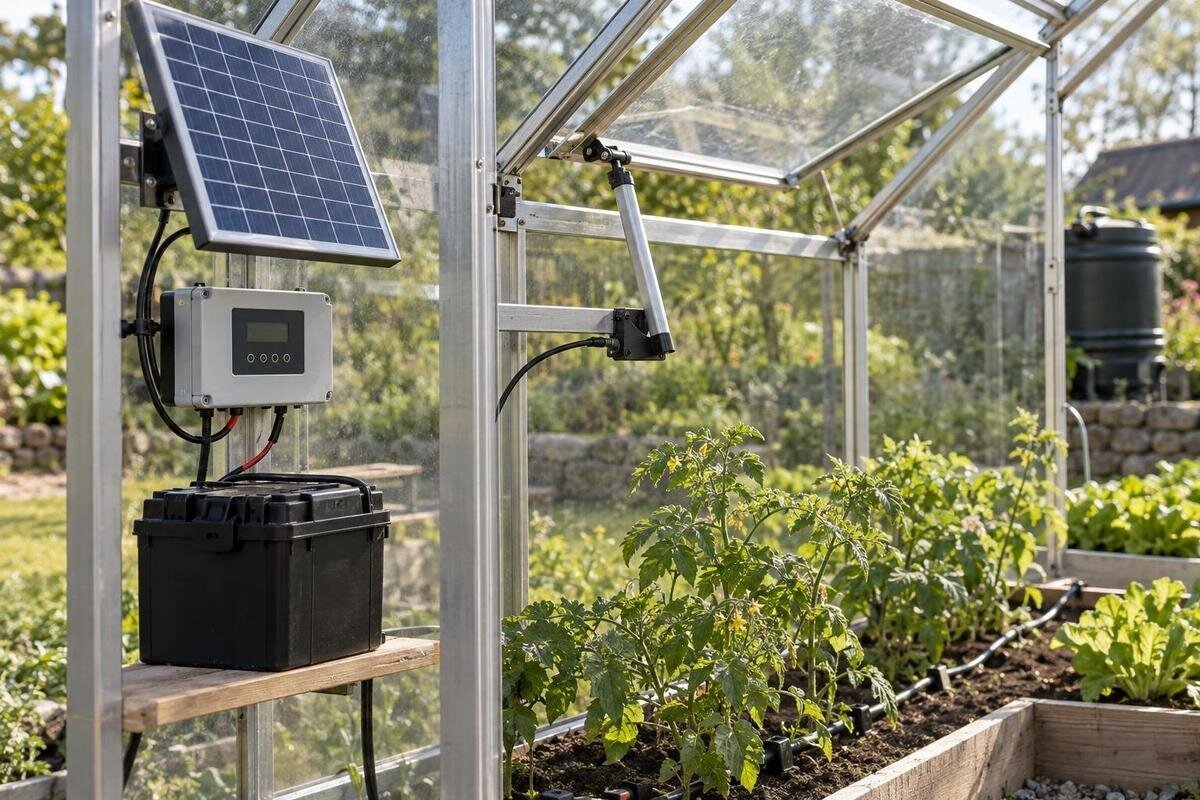
Greenhouse automation does not require mains electricity for every task, but “automatic” does not mean unattended. A mechanical opener can respond to warmth without a plug; a battery controller can time selected actions; a solar-and-battery system can supply some compatible equipment. Water is separate: the source, pressure and storage still have to suit the irrigation method. The useful question is which routine actions can be reduced without hiding a failure. This guide compares the options and explains what to verify before relying on them.

01
What can a no-mains greenhouse actually automate?
It helps to separate three parts of a system: the action, the control and the supply. A vent may move through a heat-responsive mechanical opener or a powered actuator; a controller decides when a powered device should run; water still has to come from somewhere. Removing mains electricity does not necessarily mean removing mains water, and stored water still needs suitable pressure to reach the outlets. A greenhouse may be independent of both utilities, but that is a separate design choice. Name the task first—ventilation, irrigation, monitoring or an alert—rather than buying a device described broadly as an automation system. For each task, distinguish what you want to happen automatically from what you only need to observe. Measuring temperature, opening a vent and notifying you of a problem are separate functions, even when one control system offers more than one of them.
Then consider what happens if the task is missed. A watering interruption may matter more during a warm spell or for plants in small containers than for an established planting with a reserve; a vent that fails to open can leave heat trapped. These are different risks and need different backups. A useful task log records when you watered or opened vents, conditions as you observed them, how long you were away, and whether the task could wait. It turns a vague wish to go off-grid into a clear requirement: which job needs attention, for how long, and what should happen if the device stops?
Passive ventilation without electricity
Natural ventilation is the simplest option when the greenhouse has usable openings and someone can manage them. A door, roof vent or side opening can be opened by hand without power; air movement then depends on wind, temperature differences and the openings available. This exchange can help remove warm, humid air, but its rate is not fixed and cannot be commanded by a controller if no mechanism is attached. A greenhouse exposed to strong sun can still become hot while nobody is there, so a manual-only arrangement is not reliable for unattended temperature management.
Check which openings are present on the exact configuration, how they are operated and whether they can be reached and left in the intended position. A listed size range, such as the 16.52–30 m² range for the T-Model Orangery Greenhouse, does not show the number, size or placement of its vents. Ask about the actual opening layout before treating natural airflow as a complete temperature plan. Also consider what happens when a door or vent is closed: passive ventilation depends on an open route for air, not just on the greenhouse having an opening somewhere.
02
How thermal vent openers behave
A mechanical thermal opener can move a compatible vent without mains power or a battery. Many use a temperature-responsive cylinder that pushes the vent open as it warms and allows it to close as it cools. That is useful for a simple temperature-led response, but it is not the same as a thermostat managing the whole greenhouse. The mechanism reacts to the temperature around it; it does not know whether humidity is high, whether soil is dry, whether rain is approaching or whether plants elsewhere need attention.
Match the opener to the particular vent and follow the maker’s limits for travel, force and operating temperature. Check whether the vent can move freely and whether its opening remains suitable in the conditions at your site; a mechanical opener is not a guarantee against every fault or weather change. The Pyramid Greenhouse listing covers sizes from 5.53 m² to 18.9 m², but the area range alone does not establish which vents a chosen version has or whether a separate opener will fit. Confirm those details with the supplier, and check the mechanism during the growing season for obstruction or wear.
What to check in a battery-powered controller
A battery-powered controller may run a timer, read a sensor or switch a compatible valve or actuator. The important question is whether it can operate the particular device you intend to use. Check its power requirements, outputs and control options, and whether the controlled device needs a separate battery or power source. Distinguish a timed instruction from a sensor-based response: one follows a schedule, while the other depends on a reading. Neither description alone tells you whether the equipment will confirm that the requested action has happened. When comparing controls, note what each one measures, what it can operate and what information you can read locally. Find out how it behaves when the battery is low: some equipment may give an indication, but you should not assume that every system has an alert or a safe fallback position.
Battery life depends on how often the device operates, its standby use and the conditions in which it is kept, so treat a published estimate as a guide rather than a guarantee. Check the operating limits for heat and moisture, and place sensors where their readings are meaningful rather than in direct sun or a draught. The Aluminium Greenhouses with Storage – Limited Edition listing identifies built-in storage; that fact alone does not establish whether the space suits a controller or battery. Check the equipment instructions for its required environment and accessibility.

03
Using solar power for selected equipment
Solar power can supply selected controls when the system is designed for the load, but it is not a constant mains supply. Output varies with available light and shade, while equipment may draw power when no one is in the greenhouse. A battery stores energy for times when the panel is not producing, so the panel, charge equipment, battery and device need to be treated as a matched system. Ask the supplier to assess the expected operating pattern for the specific equipment, including periods with less generation, rather than choosing a panel on the assumption that any size will do.
Think about the panel’s position and its mounting as separate questions from the greenhouse itself. The Bloomcabin Prestige Greenhouse listing specifies a metal foundation; that does not establish that the roof or frame is suitable for supporting a solar panel or other added equipment. Do not infer mounting suitability from a foundation detail or a product image. Confirm the intended arrangement with the greenhouse supplier and, where fixed wiring or structural mounting is involved, get advice from a suitably qualified professional. Use equipment according to its instructions rather than improvising a connection.
Water supply is separate from electrical power
A greenhouse without mains electricity may still have access to mains water, but the two supplies are independent. A battery-controlled valve could use a water source that already has suitable pressure, subject to compatibility; a stored supply needs to be refilled or replenished. Collected rainwater may be useful, but it should not be treated as continuously available unless the storage and refill plan support that assumption. Decide whether the system will use a tap, a tank, manual watering or a combination, and identify what would happen if the usual source ran low.
Water demand depends on what is planted, how it is grown and the conditions in which the greenhouse is used. When considering the Spacious Greenhouse, listed in sizes from 47 to 70 m², plan the water supply around the intended planting rather than floor area alone. Beds, containers, crop choices, watering method and seasonal conditions all affect use. Record actual watering and refilling over representative periods before choosing storage. Keep the source of water separate from its intended use in your plan: knowing where you will fill a tank does not establish how long its contents will last.
04
Match irrigation controls to water pressure
A tank can feed some irrigation systems by gravity, but the components must be designed to work with the pressure and flow available. Do not assume that every drip line, valve or timer will deliver evenly from a stored supply. Check the requirements for the chosen equipment and test the complete arrangement at its outlets, not only at the tank. Follow the water through the system: the control should operate the intended valve or pump, and the outlets should deliver to the intended plants. If the system includes several watering zones, confirm that each one receives water as intended. Record which zones ran and what you observed at the outlets, so a successful timer setting is not mistaken for a successful watering test. A controller’s schedule does not confirm that water has actually reached the plants.
If the chosen irrigation method needs a pump, that pump becomes part of the power plan as well as the water plan. Check its requirements and expected operating pattern with the supplier, and make sure the battery or solar system is intended to support it. The Aluminium Greenhouses listing spans 3.77–28.08 m²; once you know the exact size and planting layout, you can plan the watering zones and route of the lines. Keep a manual method available so a blocked outlet, empty tank or power failure does not leave you with no way to water.
Plan a water reserve from real use
There is no universal volume of stored water that suits every greenhouse. Use a simple water record to turn your observations into a reserve requirement. Note the amount used or added at each refill, the period it covered, the planting being watered and the conditions at the time. Record interruptions separately rather than treating a missed watering as normal consumption. If you expect to be away, compare the observed use with the period you need to cover, then ask whether the proposed reserve and irrigation equipment can meet it. Keep records from different conditions identifiable: a refill during a mild period and one during a warm spell answer different planning questions. If the planting or watering method changes, review the record before relying on the same reserve.
Plan for the period when demand is likely to be higher, not only for an average day, and leave a way to check the level and replenish the supply. The Wall Greenhouse range covers 3.69–14.34 m²; use the planting planned for your chosen version to guide the reserve, rather than applying one allowance across the range. Consider what you will do if a tank runs low sooner than expected and whether replenishing it will be practical during your absence. Stored water reduces the need for a constant source; it does not remove the need to monitor supply.

05
Build in monitoring and manual fallback
Even a simple off-grid system has several possible points of failure: a vent can be obstructed, a battery can run down, a sensor can give an unrepresentative reading, a valve can stick or an irrigation line can clog. A tank can also empty without the controller knowing. Separate what the system reports from what you can confirm. A command to open a vent is not the same as observing an open vent, just as a watering notification does not establish that every outlet delivered water. If the equipment relies on an app or remote alert, connectivity is another part of the chain. Check which signs of failure you can see at the greenhouse itself and what each notification actually means. Monitoring is useful when it helps you recognise a problem and respond, rather than simply showing that a controller is switched on.
Test the complete system while you are present and follow each manufacturer’s instructions when checking or adjusting it. Confirm that you can still open the vents and water by hand, and learn how to override a control if it stops responding. Set inspection frequency according to the crop, season, water reserve and consequences of a missed task; there is no universal schedule. After changing a control, battery or watering layout, observe it again before relying on it while away. A brief record of the result can reveal recurring problems.
Planning a no-mains greenhouse setup
A straightforward plan often begins with the least dependent option that meets the need. Use natural ventilation where it is adequate, then consider a mechanical thermal opener for a compatible vent. Add a battery or solar-backed control only for a task that needs powered timing, sensing or movement. Plan the water source and irrigation method separately, and decide how you will respond if power, pressure or supply is lost. This order keeps the question focused on a real task instead of treating automation as one all-or-nothing purchase.
Before ordering equipment, write down the greenhouse configuration, openings, intended controls, water source, storage, expected time away and manual fallback. Use that list to distinguish the greenhouse purchase from the automation equipment you may need separately. For the Limited Edition Aluminium Greenhouses, identify the exact version you are considering, then ask which openings, controls and accessories are included and which are separate. Record the proposed role of each additional component: what it operates, what supplies it and how you will check it. This makes it easier to compare a simple mechanical arrangement with a powered alternative without assuming that either is a complete package. Resolve compatibility questions before building the ventilation, power and irrigation plan around the chosen configuration.
Frequently asked questions
Can a greenhouse be fully automated without mains electricity?
Selected tasks can be automated, but a fully independent setup should not be assumed. Mechanical vent openers need no electrical supply, while battery or solar-backed controls can run compatible devices. You still need a dependable water source, enough power for the equipment and a way to notice or manage failures.
Does a passive vent opener need a battery?
A mechanical, heat-responsive opener generally works without a battery or mains connection. It responds to the temperature around its mechanism, not to humidity, soil moisture or a weather forecast. Check the instructions for the exact opener and vent to confirm compatibility and operating limits.
Can an irrigation timer work without mains water?
Yes, if another suitable source is available, such as a stored supply, and the irrigation components can work with its pressure and flow. A timer only controls a compatible valve or pump; it cannot supply water by itself. Check delivery at the outlets and keep a manual watering option.
Will a solar panel keep greenhouse controls running all year?
There is no guarantee: available sunlight changes, and the control system may draw power even when it is not operating. Check that the panel, battery and controller are matched to the equipment’s expected use, including periods with little or no generation. Follow the supplier’s guidance on mounting and installation.
How often should I check a no-mains greenhouse?
There is no single interval that suits every crop, season, water reserve or control system. Test the complete setup while you are present, then set checks according to what could fail and how quickly you would need to respond. Increase observation when conditions change or after adjusting equipment.
A no-mains greenhouse can reduce routine work when each part has a clear job and a realistic limit. A compatible thermal vent opener provides a temperature-responsive action without electricity; batteries or solar power with storage can serve selected powered devices; and irrigation still depends on available water and suitable delivery. Keep a manual way to open vents and water plants, and use your own task and water records to judge what the setup can manage. The aim is fewer routine actions, with a workable fallback when conditions or equipment change.
