
Drip Lines or Soaker Hoses for Greenhouse Beds?
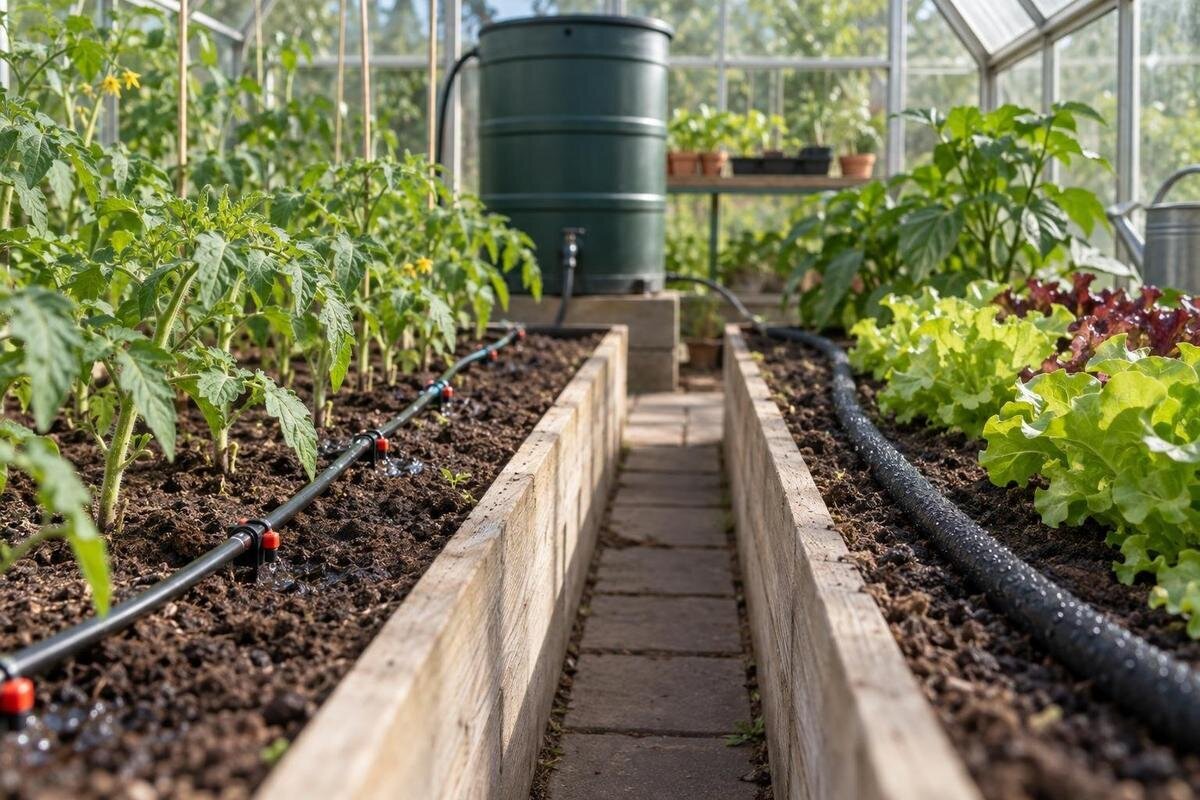
Greenhouse irrigation
Choosing between drip lines and soaker hoses is less about which label sounds more efficient and more about whether the delivery pattern fits the planting plan. In a greenhouse bed, compare where water leaves the line, how output changes from the inlet to the far end, what filtration the product requires and how easily you can inspect it. A small test in the installed bed often reveals more than a general claim about either system.

How drip lines and soaker hoses deliver water
A drip line releases water at repeated outlets, usually called emitters. Their spacing and stated flow are product-specific: some lines have fixed positions, while other systems use separate emitters or a different layout. A soaker hose lets water seep through a porous wall along much of its length, creating a band rather than a sequence of deliberately placed points. Neither label describes one standard construction. Material, emitter spacing, line length and inlet conditions vary, so compare the technical sheet and instructions for the exact model. Check the stated operating pressure, maximum run and any limits on joining or branching the line; a category name alone does not supply those details.
That difference describes the delivery pattern, not a guaranteed result. A drip line can leave dry intervals if outlets do not align with plants or output changes along a run; a soaker hose can leave drier stretches if its length or supply conditions are unsuitable. In either case, water has to move from the outlet through the bed to the roots. Soil texture, compaction and bed preparation affect that spread. A wet dot or strip on the surface is a useful clue, but it does not prove that moisture reaches the full root zone or adjacent plants. Judge the actual bed, not just the system’s name.
Match the wetting pattern to the planting layout
Map planting positions, not only the bed outline. For spaced crops, compare emitter intervals with plant centres and the expected root area as plants grow; if outlets fall between positions, the soil may or may not spread moisture far enough. For closely spaced rows, a hose that seeps along its length may match the intended band better, but it may not cover the bed’s full width. Where plants are staggered, one straight run may miss some roots. Consider whether the line can be positioned to serve the row without crossing the path or getting in the way of routine work.
Draw the beds, paths, rows and supply entry to scale before deciding how many runs to use. If you are still comparing greenhouse footprints, the Limited Edition greenhouse with built-in storage listing gives a range of floor areas; use the specific option you expect to install when sketching beds, rather than treating the range as a ready-made layout. Area alone does not tell you bed width, row spacing or where a feed line can enter. Leave room to reach connectors without stepping on the bed.
Pressure and run length affect uniformity
Uniformity is partly a pressure and layout question. Flow from a drip emitter may vary with pressure at the inlet, the length of the line, elevation differences and the emitter’s design. Some products address pressure variation, but rely on that only if the information for the exact model says so. Soaker hoses also need the conditions for which they were designed; a porous wall does not make pressure or length irrelevant. Look for the operating range, maximum recommended run, permitted feed arrangement and whether a compatible regulator is specified. If those details are unclear, ask before laying a long continuous run.
Measure the route from the supply to the far end, including branches and bends; greenhouse floor area is not the same as line length. When comparing the Prestige greenhouse size options, sketch the supply route for each proposed bed arrangement so you can compare the actual run lengths. During a trial, compare drip output at the beginning, middle and end using equal containers for the same interval. With a soaker hose, compare soil moisture at equivalent points along its length. A consistently drier far end calls for a check of kinks, blockages and product limits, rather than an immediate increase in watering time.
Choose filtration for the line and water source
Filtration must match the irrigation product and the water source. Sediment can obstruct small emitter passages, while particles or deposits may affect a porous hose; the risk and required filter rating vary by design. Stored water can carry debris, and dissolved minerals can leave deposits in some conditions. Do not choose a mesh or micron rating by guesswork: use the manufacturer’s stated requirement for the line and filter, if specified. A finer filter is not automatically better if it is not sized for the system, because restricted flow can create another uniformity problem. Ask the supplier if the instructions do not give a clear specification.
Include access in the layout. A filter hidden behind a planter or at the back of a fixed bed is easy to neglect, so leave room to inspect and clean it as directed. Filtration catches only material it is designed to retain; it does not correct unsuitable pressure or every water-quality issue. If deposits appear, identify the likely source and follow instructions approved for the equipment rather than applying a treatment by habit. Flush a line only where its design and the maker’s instructions allow it, then check that flow is normal afterwards.

Plan the route through beds and paths
Lay out supply and distribution lines before planting. Decide where the main feed approaches each bed, then mark branches, ends, connectors and any shut-off points that are part of the chosen system. Keep lines out of the main walking route where possible, and avoid sharp bends, crushed sections or fittings that will sit under a bed edge. A tidy route is not just cosmetic: you need to see joins for leaks and reach line ends for inspection or cleaning. Check that every connector matches the line specification; similar-looking fittings are not necessarily interchangeable.
On a larger greenhouse plan, trace each bed rather than buying by total floor area. The Spacious Greenhouse area options span 47 to 70 m², but that figure does not show how many beds fit or how long each branch will be. Use the chosen footprint and actual bed positions to measure the supply route, including turns from a main line. Keep the far end and filter accessible, and note which branch serves which row. This makes it easier to locate a dry patch later without disturbing the whole bed.
Test distribution before planting
Test the installed layout before depending on it for established plants. Use the intended water source and the line’s specified fittings, and prepare or flush it only as the instructions allow. For drip line, place identical catch containers under representative outlets near the beginning, middle and end of each run; collect for the same length of time and compare volumes. For a soaker hose, mark similar positions and check the soil at comparable depth and distance from the hose after a consistent trial. Repeat across beds rather than assuming one sample section represents every branch.
Keep a simple test record for each run: its length, the water source used, the sampling positions and the results. If you are planning beds for one of the Aluminium Classic Greenhouse size options, mark those sampling positions on the layout so you can repeat the comparison in the same places. Test the full proposed run, since a short offcut may behave differently. If output is uneven, inspect the filter, connections and kinks before shortening a line or altering the feed. Change one factor at a time, stay within the product’s stated limits and record whether the change improves distribution.
Maintenance and troubleshooting
Drip-line checks focus on both the filter and the individual outlets. Look for a blocked or weak emitter, a leak at a join, and a line that has shifted away from the crop row. Flush an open end only if the system is designed for that and the instructions describe how; do not probe an emitter with a pin or apply a cleaner unless the manufacturer permits it. For a soaker hose, look for kinks, crushed sections, damage or gaps in the damp band. Check connectors and any end closure on either system, because a sound hose cannot compensate for a leaking joint.
Maintenance access belongs on the bed plan, not just on a checklist after planting. When considering the Wall Greenhouse footprint options, which range from 3.69 to 14.34 m², mark where you would stand to reach the filter, connectors and line ends. Avoid placing these behind a planted border that you would have to disturb for every inspection. After moving pots, edging or supports, look specifically for pinched or displaced sections. If you remove the irrigation between crops, follow the maker’s cleaning and storage guidance for that product; do not assume a drip line and a porous hose can be treated in the same way.
Check moisture below the surface
A surface pattern is not the same as a root-zone pattern. Drip line may show separate damp areas around outlets, while a soaker hose may show a longer strip, but soil can spread water differently below the surface. Texture, compaction, organic matter and bed shape all influence the result. Check at more than one point and below the surface, without damaging roots, to see whether moisture reaches the intended planting area. If water pools at the line or runs towards an aisle, note where it happens; a wet surface alone does not prove that the whole bed is adequately watered.
For a proposed layout in one of the Limited Edition Aluminium Greenhouses, mark the bed edges and intended root areas before deciding where to check moisture. Include positions beside the line as well as between outlets or towards the edge of the planted strip. This helps distinguish an evenly supplied line from an arrangement that actually wets the required area. Neither system saves water automatically: leaks, missed rows, excessive run lengths and an unsuitable schedule can waste water with either design. Use the observed soil response to decide what needs adjustment, rather than assuming that a visibly damp line means the whole bed is covered.

Allow for crop changes
If you rotate crops, consider how stable the planting positions are. Fixed emitter spacing can be convenient when rows remain regular, but less adaptable if the pattern changes; moving a line may restore alignment, provided the fittings and product allow it. A soaker hose’s continuous outlet pattern can accommodate different planting points along a row, yet it still wets a defined strip, not every part of the bed. Compare likely crop spacing with line placement, and check whether adding, removing or shifting a run stays within the specified length and pressure limits. Do not plan on making extra outlets or puncturing a hose.
Keep a planting plan alongside the irrigation layout, noting which line serves each row and where its outlets sit in relation to the plants. When comparing the T-Model Orangery Greenhouse area options, which range from 16.52 to 30 m², allow space for paths and for reaching lines once crops mature. Before changing the planting pattern, compare the new positions with the existing wetting pattern: identify which runs can stay and which would need to move. After repositioning, repeat the wetting test at the affected rows. Keep the earlier results so that you can compare the new arrangement with the previous one.
A practical comparison before you choose
Compare products on the same checklist: outlet spacing or porous wetting band; specified pressure and maximum run; required filtration; connector compatibility; cleaning instructions; and access to replacement components. Check these points for the exact model and water source, not just the category name. A general description may not give a flow rate for your conditions, and a greenhouse footprint page cannot confirm what irrigation equipment is supplied. If a key limit is missing, request the product information before planning around it. Then test the proposed route in the bed rather than choosing by marketing language.
If you are also choosing a structure, keep the greenhouse comparison separate from the irrigation specification. The Pyramid Greenhouse size options list 5.53 to 18.9 m² of floor area; that helps establish the space available, but does not establish watering compatibility. For the irrigation choice, favour a drip line when its outlet positions suit the planting plan and the full-run test shows acceptable distribution. Favour a soaker hose when a continuous band suits the row and the soil checks confirm adequate coverage. If neither reaches the intended root areas reliably, revise the arrangement within the product limits or consider another system.
Frequently asked questions
Which system gives more even watering?
Neither is more even in every greenhouse. A drip line releases water at set outlets, while a soaker hose seeps along its porous length, but the result depends on the exact design, pressure, line length and water quality. Test the installed run: compare outlet volumes for drip lines or check soil moisture at corresponding points for a soaker hose.
Does a soaker hose need a filter?
Follow the hose manufacturer’s instructions. The filtration requirement varies by design and water source; particles can affect porous hoses as well as small drip emitters. Check for a specified filter rating and make sure the filter is suitable for the system. If the instructions are unclear, ask the supplier rather than choosing a mesh size by guesswork.
Can I connect either system directly to a tap?
Only if the specific product is designed for the available supply conditions. Check its operating pressure, connection requirements and any stated need for a compatible regulator. Do not assume a line can be connected directly to a tap or extended by joining sections. If the product information does not set out its limits, confirm them before installation.
How many lines should I put in a greenhouse bed?
There is no reliable number without the bed width, planting positions, soil and line specifications. Mark the rows and root areas, then consider how far the chosen system wets beyond each outlet or hose. Test the planned arrangement at several points, including the edges. Add or reposition runs only within the manufacturer’s limits.
Can I cover a line with mulch?
Check whether the exact line is intended for covered or buried use. Covering it can make the wetting pattern and leaks harder to see, and may affect access for cleaning or inspection. If the instructions permit mulch, test the bed after covering it and keep connectors, filters and line ends accessible.
The deciding question is whether water reaches the intended root areas along the whole bed, with a maintenance routine you can carry out. For regular rows with matching outlet positions, a drip line may be the more direct fit. For a continuous row, a soaker hose may suit better if its wetting pattern holds up in the installed layout. A measured test matters more than the system’s name.
