
Growing Celery in a Maltese Greenhouse
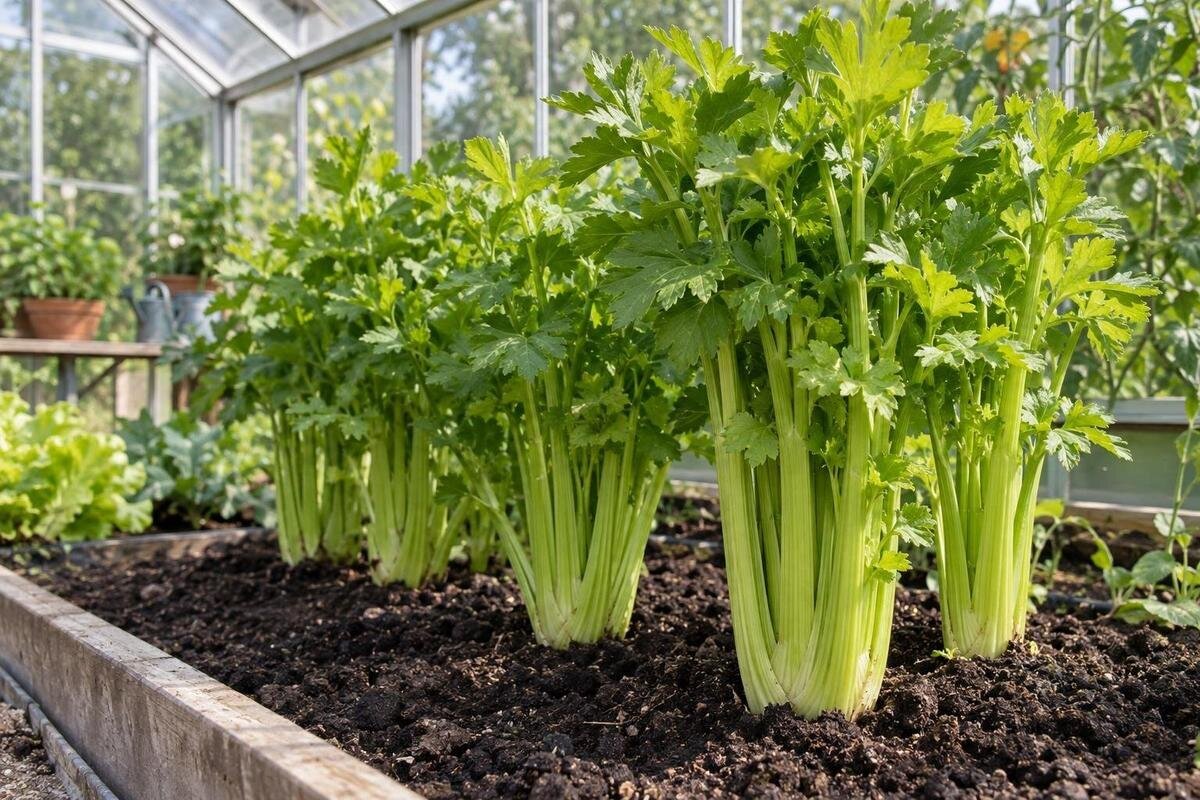
Greenhouse growing guide
Celery can be grown under glass in Malta, but a greenhouse is not automatically an advantage. It is a long-season crop that prefers cool-to-mild weather and a consistently moist, well-drained root zone. An unheated structure can protect seedlings and extend the cooler growing window; it can also trap heat quickly when the sun is strong. The practical question is whether you can give celery a suitable season and a bed that remains evenly watered for months, without letting the greenhouse overheat or crowding other crops.

Greenhouse planning points 1
Is celery suited to a Maltese greenhouse?
Celery is a cool-season, long-season crop. It grows most reliably in mild conditions with a root zone that stays moist; prolonged heat can slow growth and leave stalks coarse or less tender. Malta’s winters are generally mild, but a sunlit greenhouse can still become much hotter than outdoors, particularly during a clear spell. An unheated structure stores daytime warmth and shelters plants from wind and rain; it does not cool itself, nor can it be assumed to keep a uniform temperature overnight. Measure conditions where the leaves grow, not only near the roof, and treat the reading inside your own greenhouse as more useful than a broad climate label.
That makes season choice the main decision. Celery is usually a better protected crop in the cooler part of the Maltese year than in peak summer. Check temperatures during the warmest part of the day and consider whether doors or vents can be opened and suitable shade used without cutting light excessively. Observations over several days help reveal how quickly the house heats up during sunny spells. If there is no practical way to remove accumulated heat, a greenhouse may work against the crop rather than help it. Heating is not automatically needed just because plants are under glass; first aim to grow through a suitable season.
Plan the crop for Malta’s cooler months
Think in months rather than weeks. Identify the cooler stretch at your site, then check the chosen seed packet for its maturity information and sowing advice. In Malta, sowing as the harsh summer heat eases can lead into autumn and winter growth, with harvest extending into spring if conditions remain suitable. Treat this as a seasonal guide, not a fixed date: a particularly sunny site or an unusually hot year can shift the practical window. A greenhouse may lengthen the comfortable period at either end, but it cannot remove the crop’s limits in hot weather.
Because the bed remains occupied for a long time, reserve it before sowing. Work backwards from the intended transplant period: raise seedlings early enough to establish before the main cool-season growth, but do not leave them crowded in trays until roots are tangled or growth is checked. Avoid putting a new batch into a space that will soon be needed for another crop. A small trial row in the first season is a practical way to learn how quickly your greenhouse warms, how often its soil dries and how long your chosen variety takes at your location.
Greenhouse planning points 2
Sow celery seed and raise sturdy transplants
Celery seeds are very small and can take time to germinate, so a dry seed tray can lose a sowing before you notice. Sow thinly on moist seed compost and press the seed onto the surface, or cover it only very lightly; deeply buried seed may struggle to emerge. Keep the tray evenly damp rather than saturated, and use a bright place with gentle warmth. In Malta, avoid a propagation spot that bakes in direct afternoon sun. Once seedlings emerge, give them plenty of light and enough air so that weak, stretched growth does not carry through to planting.
Pot on seedlings when they are large enough to handle, keeping their roots intact and giving them room to grow. Gradually acclimatise them to the conditions in the greenhouse bed, especially if they were raised indoors. Set each plant at the same depth it was growing before, keep the crown clear of soil and water it in. Allow space for both propagation and mature plants when planning the house. The Limited Edition Aluminium Greenhouses range is listed from 3.77 to 28.08 m², but total greenhouse area does not tell you how much room is available for trays, beds and a working path; check the layout of the chosen version.
Keep the root zone evenly moist
Water is a requirement throughout celery’s long growing period, not a rescue task once leaves wilt. Its fibrous roots are relatively shallow, so the surface layers can dry before the deeper soil does. Repeated swings between dry and very wet conditions can interrupt even growth. Check moisture below the surface at more than one point in the bed, especially towards the middle and far end, because greenhouse soil may dry unevenly. Adjust how often you water to the weather, plant size and soil rather than copying a fixed daily schedule from another garden.
Water gently and evenly so moisture reaches the active root zone without leaving standing water. Drip irrigation or careful watering at soil level can help make delivery consistent, though you still need to check the soil rather than assume a system is working. Clean mulch can slow evaporation in warm weather if it is kept away from the crown; it will not correct poor drainage or uneven watering. The Aluminium Greenhouses with Storage – Limited Edition listing gives areas from 5.52 to 28.08 m². Include the storage area, watering route and bed access in your plan instead of treating all the stated greenhouse area as cropped space.

Greenhouse planning points 3
Allow room for roots, leaves and access
Celery needs more than a narrow row of root space: its fibrous roots spread through the upper soil while the foliage broadens above the bed. For initial planning, allow roughly 20–30 cm between plants, then check the seed supplier’s spacing for the variety and intended harvest. Wider spacing can make watering, weeding and removal of damaged leaves easier. Packing plants tightly to fit one more in can restrict airflow and leave stalks difficult to reach. Plan for the mature canopy, not only the small transplant, and leave enough room to work without stepping among the plants.
Draw the bed on paper with paths and the door opening included. A bed that uses every centimetre of floor may be awkward to water, inspect or harvest, while walking among plants can compact the soil. The Spacious Greenhouse range is listed from 47 to 70 m², but that total area does not show how much is available for planting once paths, access and other uses are accounted for. For a small household crop, decide how many plants you want and map their spacing before judging the greenhouse footprint; a modest trial bed may be enough.
Prepare a fertile, free-draining bed
Prepare soil that holds water without becoming stagnant. Friable, fertile soil with organic matter is a better starting point than a compacted bed that dries quickly. Work mature compost through the growing zone before planting, and remove hard clods or stones that could interrupt root growth. Containers are possible only if they provide enough continuous soil volume and do not dry out too quickly. A shallow pot may seem space-efficient, but it can need frequent attention and may not provide the steady root conditions required for a slow-growing crop.
Feed for steady growth, not maximum leaf growth at any cost. Begin with the bed’s fertility and the seed supplier’s crop guidance; if you use a fertiliser, follow its label and avoid repeated heavy applications that do not address heat or moisture stress. The Bloomcabin Prestige Greenhouse listing identifies a metal foundation and variants from 3.77 to 28.08 m², but neither detail describes the finished bed depth or usable floor layout. Treat the foundation and growing soil as separate planning questions, and confirm the actual arrangement before preparing the bed.
Greenhouse planning points 4
Ventilate before greenhouse heat builds
Ventilation is part of daily crop care in a Maltese greenhouse. Open available doors or vents before midday heat accumulates, then check again later if hot air is lingering; one morning opening may not be enough when conditions change. Moving air helps foliage dry after watering and reduces stagnant, humid pockets, but it does not replace even root moisture. During very bright, hot spells, suitable shade can reduce the heat load. Use it in a way that still leaves enough light for leaf growth, and adjust it when cooler or duller conditions return.
Compare the ventilation and shading details for the exact model and size you are considering; a stated footprint alone cannot tell you how a greenhouse responds to heat. The Aluminium Greenhouses range is listed from 3.77 to 28.08 m², so check the specifications for the selected version rather than assuming all have the same openings. Consider how you will ventilate during the hottest part of the day, where you can take a temperature reading at leaf height and whether the openings are easy to reach. If the structure cannot be ventilated when it heats up, do not rely on it to moderate summer conditions.
Check light and heat at the greenhouse site
Give celery a bright position, while considering how the site behaves during hot afternoon sun. The crop needs enough light for sturdy leaf growth; deep shade is not a substitute for a suitable cool-season climate and can slow a long-season crop. A nearby wall, tree or other structure may shade one end for much of the day, while a sunlit wall may add reflected warmth. Check the light pattern across the planned bed at different times. Leave room to open the greenhouse, carry water and work along the bed, rather than choosing a position that makes routine care awkward.
If you are comparing a wall greenhouse, include the actual location in your assessment rather than looking only at its floor-area figure. The Wall Greenhouse listing covers 3.69 to 14.34 m²; that range alone cannot show how a particular wall affects light, reflected heat or airflow. Check the plan for the version you are considering and observe the site through the afternoon, when a sunlit greenhouse may be hottest. If the only workable position is persistently shaded or difficult to ventilate, an outdoor bed for the cooler season may make better use of the space.

Greenhouse planning points 5
Inspect growth throughout the long season
Inspect the crop regularly, not only when watering. Look beneath leaf stalks and along leaf edges for aphids, slug damage, unusual leaf mines or spotting. Remove fallen leaves and keep the space around plants tidy. Good spacing and ventilation help foliage dry, while clean tools and healthy transplants reduce the chance of carrying problems into a crop that will be in place for months. Do not treat every mark as the same disease: pests, watering stress and excess heat can produce different symptoms, so identify the cause before choosing a control.
Watch how each plant is growing as well as the general greenhouse climate. Persistent dryness, poor root contact or an unbalanced supply of nutrients can lead to weak, uneven growth; hot conditions may also leave stalks coarse or pithy. A long row is easier to inspect when every plant can be reached from a path. The T-Model Orangery Greenhouse range is listed from 16.52 to 30 m². When comparing layouts, allow room to examine the leaf stalks and remove damaged leaves without pushing through neighbouring plants. Keep that access clear as the foliage broadens, rather than filling it with extra pots or trays.
Choosing celery varieties and planning the harvest
Choose a variety for the celery you like to eat. Green celery can be grown without blanching, while some self-blanching cultivars are bred to produce paler stalks with less intervention. Check the seed packet, since the variety affects the method and spacing. Blanching traditional varieties by excluding light from the stalks for the final growing period adds work and can make it harder to inspect the plants; keep foliage accessible and ventilated. Depending on the variety, you may be able to harvest outer stalks from a mature plant or cut the whole plant at the base once it reaches the size you want.
Celery uses greenhouse space for several months, first as seedlings and then as plants in their final bed. If the greenhouse is needed for summer crops, the plans may compete: celery’s cooler-season schedule does not automatically free the bed when another crop is ready. The Pyramid Greenhouse listing gives product areas from 5.53 to 18.9 m². Use the floor plan for your chosen size to mark where celery will remain until harvest and where the following crop is intended to go. Compare their expected planting and harvest dates before committing the same bed to both, allowing separately for any space needed to raise seedlings.
Frequently asked questions
Can I grow celery all year in a greenhouse in Malta?
Not reliably without managing summer heat. Celery is better suited to the cooler part of the year, while strong summer sun can make a greenhouse too hot. Check conditions inside your structure and plan the main crop around a suitable growing window.
How often should I water greenhouse celery?
There is no fixed interval that suits every bed. Check the soil below the surface and water when the root zone is beginning to dry. Aim for even moisture, but do not leave the soil waterlogged or standing in water.
How much space should I allow between celery plants?
About 20–30 cm between plants is a useful initial planning range. Check the seed supplier’s guidance for your variety, and leave room to reach the plants for watering, inspection and harvest.
Does celery need to be blanched?
No. Green celery can be grown without blanching, and some varieties are bred to produce paler stalks with less intervention. Check the seed packet before choosing a variety or a blanching method.
Does celery need a heated greenhouse?
Not automatically. In Malta, choosing the cooler growing season and managing excess daytime heat are usually more relevant than adding heat. An unheated greenhouse can still be useful for shelter, but it does not make peak summer conditions suitable.
In Malta, the best case for greenhouse celery is a cool-season crop protected from exposure, with a bed that remains evenly moist and accessible. The main risks are an overheated summer structure, irregular watering and underestimating how long the plants occupy their space. Choose a variety and sowing period for the local weather, monitor temperatures where the foliage grows, and plan around the mature plant rather than the seedling. A modest trial is a practical way to judge whether celery earns a regular place in your greenhouse.
