
Greenhouse Fans: Air Circulation or Heat Extraction?
Greenhouse ventilation
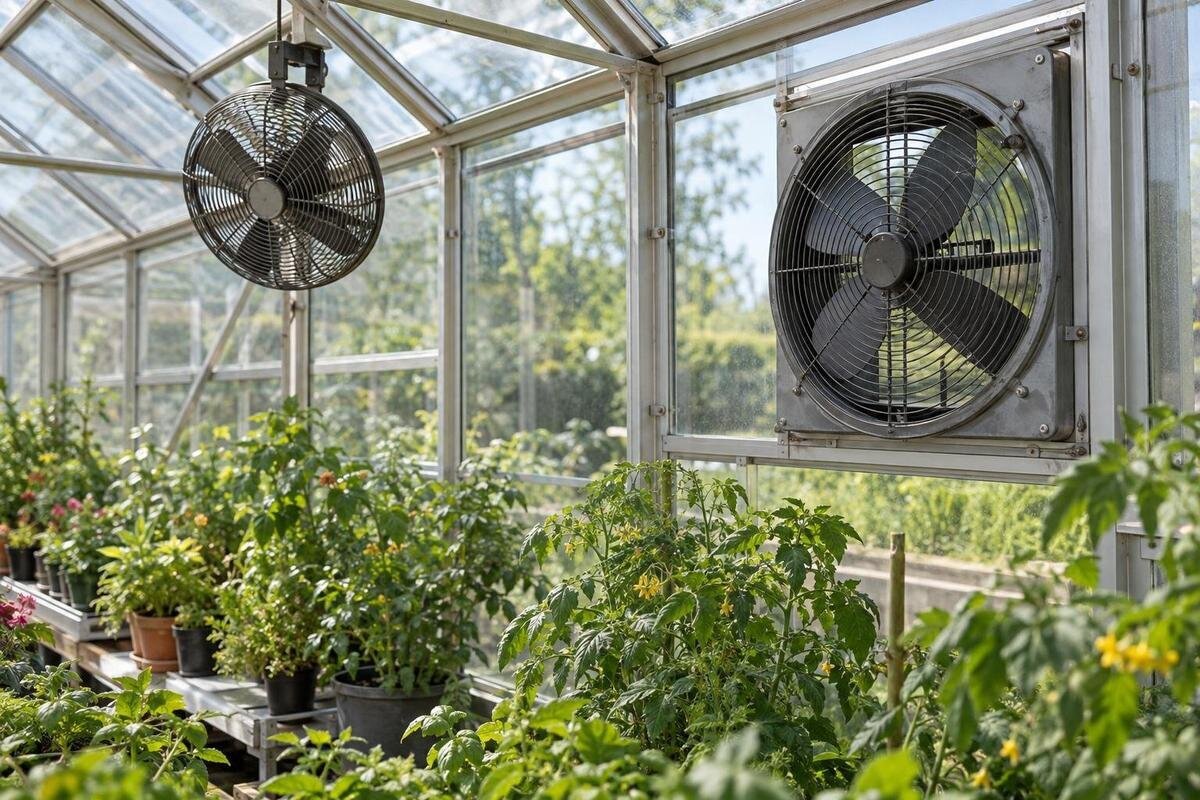
Greenhouse fans are often treated as interchangeable, but circulating air around plants and extracting indoor air are different jobs. A circulation fan moves air within the structure; an extractor sends air outside and needs a route for replacement air. A simple plan showing inlets, crops and outlets can reveal which function is missing before you choose equipment.

01
Circulation and extraction do different jobs
A circulation fan moves air that is already inside the greenhouse. It sets air in motion around the growing area and may reduce differences between a still pocket and a better-mixed area, but it does not, by itself, exchange indoor air for outdoor air. Think of it as redistribution: the same air remains in the structure unless another opening or fan carries it out. Its effect depends on where it points, what blocks the route and how far air can travel. If the main sign is poor movement in one corner, rather than heat throughout the structure, circulation is the function to investigate.
An extraction fan sends indoor air outside. For it to keep doing so, replacement air must enter through an inlet, vent, door or another route. Extraction therefore depends on both an outlet and a way in; installing a fan at an outlet does not define a complete airflow path. It can remove warm greenhouse air, but the temperature effect depends on the incoming air and whether it crosses the growing space. If incoming air is equally warm, extraction may exchange air without achieving the cooling result you want. These two functions can be used together, but a circulation fan should not be counted as an extractor when checking the setup.
Map the route from inlet to outlet
Start with a top-down drawing and mark the openings available during normal use: doors, side vents, roof vents and the intended exhaust outlet. Note which doors and vents are routinely open while the fans operate; a door usually kept shut is not a dependable replacement-air route. Add benches, tall plant rows, shelving, internal partitions and storage so the plan shows what may interrupt movement. If the structure is a wall greenhouse, such as the Wall Greenhouse, draw the wall as a boundary and use the openings shown for the exact configuration rather than assuming every side can admit air. Check the model documentation for the available openings.
Add a side view if the roof height, crop level or vent positions differ substantially. Draw the intended exchange as a continuous sequence: outside → inlet → growing area → far end or upper collection point → extractor → outside. This is a planning line, not a guarantee of the air’s exact path. If the inlet and outlet are close together, incoming air may reach the extractor without sweeping the crop zone. Mark routes blocked by shelves, dense rows, doors or storage, then ask whether air has a clear way through the occupied space. Also note which openings will be open when the fan is running.
02
When the greenhouse needs extraction
Consider extraction when repeatable readings suggest that warm air is not being carried out, rather than simply because one corner feels still. Compare temperatures at crop height, higher in the structure, near the intended inlet and near the outlet at similar times. A difference between locations may point to uneven distribution; broadly high readings do not, on their own, prove that an extractor is the answer. The Limited Edition Aluminium Greenhouse range is listed from 3.77 to 28.08 m², but floor area is not an extraction rating. Use the exact greenhouse configuration and its vent information when planning the route.
An extractor removes indoor air, but the replacement air still comes from outside or another opening. If that air enters through a narrow or poorly placed route, it may not pass through the growing area; if it is already warm, extraction may not produce the temperature change you want. It is also useful to distinguish heat entering from sunlight from heat that is not being carried out: fans do not provide shade. This guide focuses on airflow, so treat shading as a separate part of the decision when sunlight is contributing to the problem. Do not assume that adding circulation will do the extractor’s job.
Place circulation fans around the crop area
Circulation is worth considering when the plan shows that air is not reaching part of the growing space. Look beyond the centre: check the ends of long rows, bench undersides, areas behind tall plants and corners screened by shelving or storage. A fan can produce obvious movement nearby while leaving a sheltered pocket farther away. The aim is not to point a fan at every plant, but to make a route through the areas you need to ventilate. A Pyramid Greenhouse is a useful reminder to map vertical shape as well as floor area: note the actual crop height, roof profile and openings instead of assuming the shape alone will mix the air.
Think of a circulation arrangement as a route that reaches the crop zone and returns, or as overlapping sweeps in a long or divided plan. The exact direction and number of fans depend on the layout and the manufacturer’s instructions, so avoid relying on a universal spacing rule. A fan aimed down an empty aisle may create a fast corridor while leaving movement weak behind rows; a fan facing a wall or another jet may send air back before it reaches the far end. Check several points at plant height and at the ends of the layout. If movement is only obvious beside the fan, adjust its direction or position and check the route again.

03
Use exact dimensions for the airflow plan
Use measurements from the exact greenhouse configuration, not only its advertised floor area. Record length, width, usable height, roof profile, bench levels, aisle width, doors and all vents. The Aluminium Classic Greenhouse range is listed from 3.77 to 28.08 m², illustrating why a model-family range is not enough to plan a fan layout. Floor area does not tell you the greenhouse’s internal volume or the position of its openings, and it cannot show how your shelves and plants will occupy a particular model. Note the selected size before comparing fan specifications.
Draw the plan roughly to scale so you can compare distances and see whether air has to pass between or around fixed features. Include tall crops, internal partitions, storage and any door that may divide the space when closed. A top-down view can hide changes in height or a bench that divides the usable space into layers, so add an elevation when those features affect the route. Mark the intended fan positions and each inlet-to-outlet path. If a partition separates growing areas, do not assume that one fan will circulate or extract air evenly from both sides.
Choose extraction capacity from the full setup
For extraction, compare the fan’s stated airflow with the size and arrangement of the greenhouse; do not use fan diameter or electrical wattage alone as a measure of airflow. Read the conditions attached to the rating and check whether they match the proposed setup. A grille, shutter, guard, duct, bend or mesh can affect the air delivered through the complete route. Check whether the manufacturer specifies an inlet arrangement or other requirements for the fan. If the documentation does not address your planned setup, ask the manufacturer or a qualified installer to confirm suitability rather than applying a generic rule or guessed calculation.
The Spacious Greenhouse options are listed from 47 to 70 m². That is a floor-area range, not a ventilation-flow rating. For the exact size, the manufacturer’s guidance may call for internal dimensions, vent positions and the intended fan arrangement. Confirm where replacement air can enter as well as where it leaves. More extraction capacity cannot make a blocked inlet into a good airflow route, and adding another fan without planning the inlets and outlets may simply create a shorter path. Do not infer the number of fans required from a product’s area range.
04
Check circulation fan specifications and mounting
For circulation, look at the fan’s stated airflow, controls and direction options alongside the layout you have drawn. A broad advertised coverage area is not a substitute for checking whether air can reach behind benches, along rows and into the far end. Consider how the fan will be secured, whether its guard and controls suit the planned location, and whether it can be reached for routine inspection. Follow the fan maker’s instructions for its intended environment and operation; if they do not establish suitability for a greenhouse, ask before buying.
Do not assume a fan can be attached at any point on a greenhouse frame. The Prestige Greenhouse with metal foundation name identifies a greenhouse configuration; it does not, on its own, establish a fan fixing point or the compatibility of a particular fan. Confirm attachment points and clearances in the greenhouse and fan documentation, and use a qualified installer where necessary. Electrical connections and structural alterations should be handled by an appropriately qualified professional, not improvised from a general airflow guide. Check that the selected position will not obstruct a vent, door or regular access to the growing area.
Use temperature and humidity logs to test the layout
Before changing a fan position, take a baseline at several repeatable points: for example, at crop height, in a higher area and near the planned inlet and outlet. Keep the locations consistent and follow the meters’ instructions; avoid placing a temperature sensor in direct sun, against a wet surface or directly in a fan jet if you are trying to compare air temperatures. Record the time, temperature and humidity readings, which openings are open, and whether each fan is running. These notes help separate a lasting pattern from a single reading taken under different conditions.
Change one part of the arrangement at a time, then compare readings and airflow direction at similar locations and times. Temperature and humidity meters describe conditions at their position; they do not show the direction or speed of airflow. If a layout includes storage, as the Aluminium Greenhouses with Storage – Limited Edition listing indicates, check the selected configuration and mark where the storage actually sits. It matters to the airflow plan only if it blocks or redirects the route. Keeping the plan and log together makes it easier to see whether a change improved coverage or only moved the problem elsewhere.

05
Common fan-layout mistakes
One frequent mistake is placing an inlet beside an extractor. Air can take the short route between them and miss the crops, even though the fan is running. Another is running an extractor with its intended inlet closed or obstructed, then treating the result as a fan-capacity problem. A circulation fan aimed down a clear aisle may also leave still pockets behind a dense row or under a bench. These are layout issues to investigate before adding equipment. On the plan, trace the actual route around every obstruction and make sure the crop area lies along it rather than beside it.
A second common error is judging the system from one sensor or one visible sign. A thermometer placed in direct airflow may give a different reading from a sheltered part of the greenhouse, while leaves moving beside a fan do not prove that air reaches the far end. Two circulation fans aimed against one another can create competing jets rather than the intended route. Check several locations, keep the measurement points consistent and compare the observed direction with the plan. If the readings remain uneven, adjust one position or direction at a time rather than changing several parts of the setup together.
Plan the fan choice and check the result
Before buying, describe the problem in plain terms: is air still in particular areas, or does indoor air need a route out? Mark the inlet, growing area and exhaust point, then check the greenhouse dimensions, existing openings and fan specifications against that plan. For example, the T-Model Orangery Greenhouse range is listed from 16.52 to 30 m²; use the exact selected configuration and its instructions rather than assuming every size has the same openings. If the route or required airflow is not clear from the documentation, ask the greenhouse or fan supplier to clarify before choosing equipment.
After installation, confirm that the intended inlet and outlet are available and that the fans operate in the roles you planned. Ask the installer to demonstrate the airflow direction at the inlet and outlet and explain the relevant controls. Then compare measurements at your marked locations under similar conditions, noting any change in fan settings or open vents. If circulation improves coverage but temperatures remain high, the remaining issue may require a separate response; if extraction has little effect, revisit the replacement-air route. Keeping the layout and observations gives you a more useful basis for adjustment than adding fans by guesswork.
Frequently asked questions
Can a circulation fan lower the greenhouse temperature?
It can move warm air out of a still pocket and make conditions more even, but it does not remove indoor air. For heat extraction, you need an exhaust route and a way for replacement air to enter.
Can an extraction fan work with the vents closed?
It still needs replacement air from somewhere. If the intended vents are closed, the route may rely on gaps that are too small or poorly placed. Plan an inlet that is available whenever the extractor operates.
Should an extraction fan always be installed at the highest point?
There is no single position that suits every greenhouse. Warm air may gather higher up, but the outlet position must also work with the inlet, the crop layout and the greenhouse instructions. Check the actual airflow route before deciding.
Can circulation and extraction fans run at the same time?
They can, if their jobs and positions are planned together. The extractor needs an inlet-to-outlet path, while circulation fans should move air through the growing area rather than pushing it straight towards the extractor.
How can I tell whether air reaches the plants?
Check movement at several points around the crop area, not only beside the fan. Log temperatures at consistent locations, check airflow direction and use a suitable meter to compare air movement if available. A temperature or humidity reading alone does not show which way air is moving.
Choose a fan for the air movement you need, not simply because a greenhouse feels warm or still. Circulation moves air within the growing space; extraction replaces indoor air only when there is a workable inlet-to-outlet route. Draw that route, measure at repeatable points and check the exact greenhouse and fan instructions. You will then have a clearer basis for deciding whether to circulate air, extract it, or combine the two.
