
Large or Smaller Glass Panes for a Greenhouse?
Greenhouse glazing guide
Choosing between one broad glass pane and several smaller panes changes more than the view through a greenhouse. It affects the frame’s visual rhythm, the size and number of pieces that need to be moved during fitting, and the practicalities of ordering a replacement later. Yet pane count alone does not tell you how bright, durable or thermally effective a greenhouse will be: those qualities depend on the complete glazing and frame specification. This guide explains what pane layout can change, what it cannot establish, and which drawings and replacement details are worth comparing before you choose.
What pane size changes in a greenhouse
Pane size describes how a glazed bay is divided, not the size of the greenhouse itself. One broad pane may fill a large section of a wall or roof, while several smaller pieces divide the same opening with more visible frame lines. The actual arrangement depends on the frame design, roof and wall geometry, doors, vents and end panels. A sloping roof may use different shapes from a side wall, and a gable can include angled pieces. There is no universal pane size behind the words “large” or “small”, so treat them as relative descriptions of a particular drawing, not fixed categories. Also note whether you are comparing one bay or the whole greenhouse: those counts are not interchangeable.
The distinction matters most when you consider three separate things: how the greenhouse looks from inside and outside, how the pieces are transported and fitted, and what replacing a damaged pane would involve. Pane count does not, by itself, establish the type of glass, its thickness, light transmission, safety properties or insulation. Keep those specification questions separate. If using the Pyramid Greenhouse as a reference, the model name identifies a product family; it does not show how a particular size is divided into panes. Ask for the drawing and glazing information for the exact configuration, then compare those details rather than relying on a label or product photograph.
The visual difference: a clear view or a repeated grid
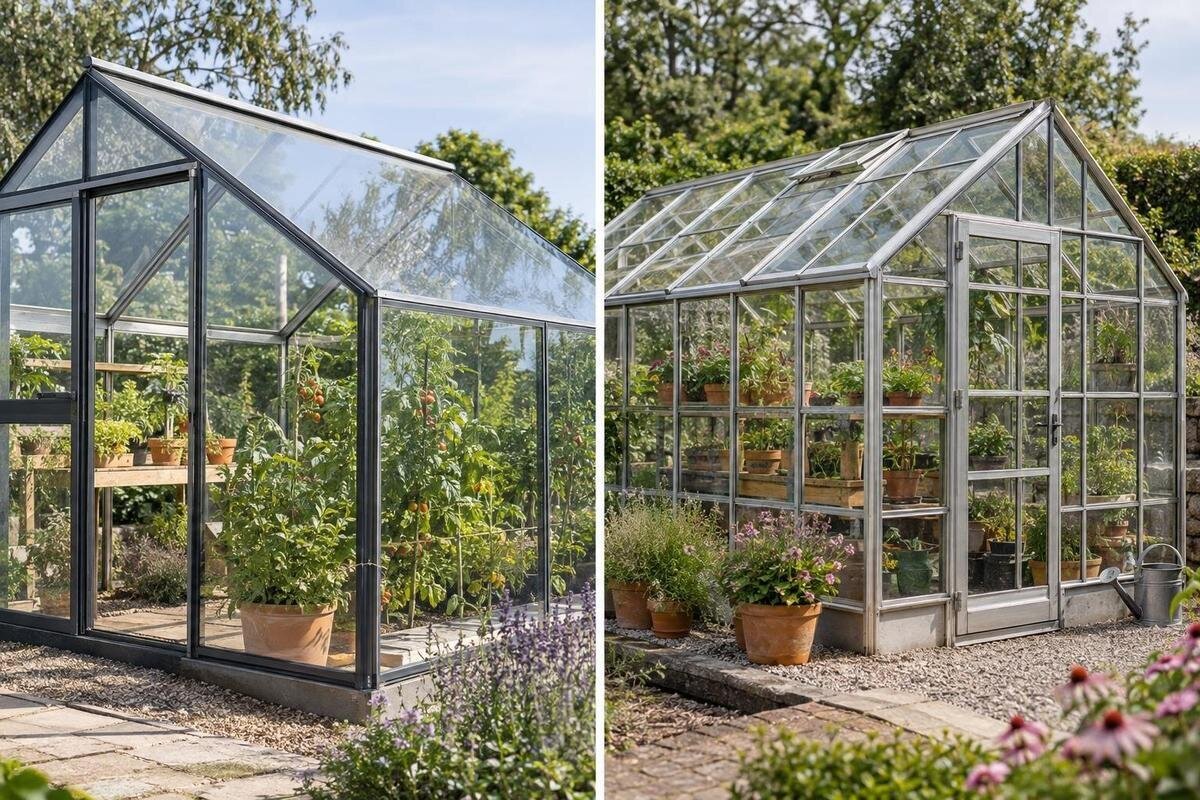
One large pane can make the glazing read as a more continuous surface. Looking out from the greenhouse, fewer vertical or horizontal frame members may interrupt a particular sightline, so the garden or the planting beyond appears less divided. That effect depends on the complete frame: a broad pane still has perimeter supports, and a greenhouse may need intermediate framing elsewhere. Check a front elevation and a side or roof view at a readable scale instead of assuming words such as “panoramic” or “minimal” tell the whole story. The view from a chair or main doorway can differ from the view straight on, and roof bars may be more noticeable when looking upwards.
Several smaller panes create more repeated divisions. The grid can give the greenhouse a more detailed appearance and emphasise individual bays, while the extra lines may feel busy if you want an open view. Neither look is inherently better: frame colour, member width, greenhouse proportions and surroundings all affect how strongly the grid is noticed. Consider the appearance both from the garden and from inside, where wall bars sit behind plants and roof bars cross the sky. When comparing the Aluminium Greenhouses with Storage – Limited Edition, use an elevation of the configuration you are considering to judge the spacing and pattern of its frame lines.
Moving and fitting the panes
The larger a glass sheet is, the more demanding it can be to move, and its weight also depends on the glass specification. A broad pane can therefore need more careful planning for lifting, access through gates or around corners, and bringing it into position. The route from the delivery point to the greenhouse is part of the decision: a piece that fits the opening may still be awkward to carry to the site. Roof sections can involve a different access and fitting process from vertical panes, so note their location as well as their dimensions. Check the supplier’s handling guidance and whether the intended installer can manage the actual pane; do not use pane count as a substitute for weight information.
With smaller panes, each item may be easier to control than a much larger sheet of the same material and thickness, but fitting involves more individual units and may mean more retainers or joints. Piece size is only one part of labour and risk; packing, labelling, access, frame design and the installer’s method matter too. Ask how pieces are identified and whether the fitting team will work from the layout for the exact model and size. For Bloomcabin Prestige Greenhouse, listed in floor areas of 3.77–28.08 m², compare the pane dimensions for your selected size with the available access route.
What happens when glass needs replacing
If one of several small panes is damaged, the affected unit may be smaller to handle and replace than a single broad sheet, provided the frame is designed for independent replacement and that exact unit can be obtained. Smaller pieces do not guarantee a quicker repair: there may be more possible units to identify, and a shaped gable or roof panel may not match a standard rectangle. With a large pane, there may be fewer pieces across the same area, but a replacement can be cumbersome to transport and position. Avoid judging the future job by pane count alone; consider the panel’s shape, location, access route and how the frame retains it.
Before buying, ask how the exact replacement is specified and ordered: model and size, panel position, finished dimensions, glass type and thickness, and any shape or edge detail required by the frame. A photograph or rough tape-measure reading may not provide enough information for a correct match; the manufacturer or glazing supplier should confirm the necessary details. Check whether retainers, seals or other frame components are also identified as replaceable, without assuming they are identical across designs. If you are considering the Spacious Greenhouse, listed at 47–70 m², include its panel sizes and replacement arrangements in the comparison.

The frame drawing matters as much as the pane
Glazing is not laid out in a blank rectangle. The frame’s bays, roof pitch, ridges, corners, doors, vents and opening sections define where glass can sit and how each piece is retained. A manufacturer may use different pane shapes or dimensions at the roof, side walls, ends and around an opening. The pane and frame form a designed assembly; changing a small panel for one large sheet, or the reverse, is not a casual cosmetic alteration. Do not remove bars, enlarge an opening or order a different format unless the manufacturer confirms that it is an approved configuration. A visually similar panel is not necessarily a compatible replacement.
A comparison is most meaningful when both options relate to the same structure, footprint and glazing material, with only the pane layout changing. If one drawing also changes roof geometry, frame width or door placement, the visual and handling difference is not caused by pane size alone. When comparing configurations in the Aluminium Greenhouses range, select the exact size and use matching views to distinguish changes in pane layout from changes in the overall structure. Mark which panes are fixed, shaped or fitted within opening sections, and ask which items can be replaced separately.
Cleaning and day-to-day access
Fewer glass divisions can mean fewer frame edges and intersections to wipe, but it does not automatically mean less work overall. The total glazed area remains, and parts of a broad panel may be difficult to reach from a safe position, especially on a roof or high wall. Several smaller panes create more visible frame lines and more corners to clean, while their smaller areas can make it easier to focus on one section at a time. Real cleaning effort depends on access, greenhouse height and shape, frame details, surrounding planting and the products recommended for the glazing. Avoid comparing panel counts without considering how you would reach each surface.
Think about where you can stand or reach without leaning on glass, climbing over beds or obstructing doors and vents. Pane layout does not make a roof safe to access; follow the manufacturer’s care guidance and seek appropriate professional help where needed. Ask which cleaning products are compatible with the glass and frame, rather than assuming one method suits every coating or glazing type. When considering a Wall Greenhouse, review the position of each glazed face in relation to the surrounding space, using the drawings for your selected size.
Pane size is not a glass specification
Two greenhouses can use panes of different sizes yet share the same declared glazing type, while two panes of the same size can have different specifications. Do not treat a larger pane as stronger, safer, warmer or clearer merely because it is larger; nor assume that more frame divisions make a greenhouse better insulated. Confirm the actual glass or alternative glazing material, thickness, any surface treatment, stated light-transmission or solar-control properties, and the product’s applicable safety information. Pane layout describes subdivision; it does not answer those separate questions. If two configurations use different materials, you are comparing more than pane size.
For plant use, assess the actual glazing and the greenhouse’s orientation and shading separately from pane dimensions. Extra frame members can occupy some of the visible opening, but the amount depends on member widths and panel layout; it cannot be quantified from pane count alone. If light conditions are a priority, use the manufacturer’s stated glazing data and consider the planting plan rather than assuming fewer divisions make a major change. For a model in the Limited Edition Aluminium Greenhouses range, compare that glazing data alongside the pane layout for your selected size.
How to compare the glazing drawings
Ask for a dimensioned elevation and, where relevant, a roof plan for the exact greenhouse size and configuration. The drawing should let you distinguish frame bays from individual glass pieces and show non-rectangular panes, vents and doors. If available, request the manufacturer’s glazing list or pane schedule with part identifiers and dimensions; clarify whether a stated measurement is the glass size, daylight opening or overall frame size. These are not necessarily the same. A catalogue photograph can help with overall appearance, but perspective, reflections and image resolution make it a poor way to count or measure panes. Check that every side you are comparing belongs to the selected configuration.
Review the same views side by side, ideally at the same scale. Count actual glass pieces on each elevation, note which frame lines are structural, and compare the clear view you care about rather than simply counting panes around the whole building. A large greenhouse may have many panels overall but a broad uninterrupted section on one face; a compact one may use small pieces in a particular roof area. With the T-Model Orangery Greenhouse, listed from 16.52 to 30 m², use drawings for the selected footprint and examine the roof and wall layouts separately. Also compare opening sections, which may interrupt an otherwise regular pattern.

Plan for replacement before a pane breaks
Replacement is easier to discuss while model and configuration details are still available. Save the order confirmation, exact size and model code, current drawings, glazing specification and any pane identifiers supplied with the greenhouse. If the paperwork has no part number, ask what information the manufacturer needs later to identify the correct piece. Record whether roof, side, door or gable panels have different shapes and positions. A future owner or installer may not recognise the layout from a general catalogue image, so a labelled drawing and a note of the glazing specification are more useful than relying on memory.
Ask specifically whether replacement panes are available for the configuration you are considering and how the supplier confirms a match; do not infer future availability or delivery times from a product listing. Establish whether individual panes can be ordered rather than assuming a complete glazing set would be needed. If you are considering keeping a spare, ask how it must be stored and protected, and consider where you could keep it without it being knocked or handled casually. Storage space matters for a broad sheet as well as for a collection of smaller pieces. Keep its identifier with the saved glazing details so that its intended position remains clear.
Which pane layout suits your priorities?
Lean towards larger panes when uninterrupted views and a quieter pattern of frame lines matter most, and when access, handling and future replacement of the actual sheets have been checked. Smaller panes may suit buyers who prefer a more pronounced grid or want individual pieces of more manageable dimensions, provided the specific frame is designed for that subdivision and replacement parts can be identified. These are preferences, not guarantees: a large pane is not automatically more expensive or harder to replace, and a small pane is not automatically quick, inexpensive or readily available. Let the exact design and replacement information guide the choice.
If neither priority dominates, compare the overall design and service information together: where each division sits, the route for the largest piece, the number of separate units, and the replacement details for that precise model and size. Then assess the glazing specification against the plants you intend to grow and the manufacturer’s stated properties. A balanced choice is not simply the one with the fewest or most panes; it is the layout whose appearance, handling requirements and repair process you understand before ordering. This matters especially where roof shapes or gables use panes unlike the regular wall sections.
Frequently asked questions
Do larger greenhouse glass panes let in more light?
Not because of their size alone. The glazing specification, frame widths and total glazed area affect how much light reaches inside. Fewer divisions may leave less area occupied by the frame, depending on the design, but the actual difference cannot be judged from pane count. Check the manufacturer’s glazing information.
Are smaller panes easier to replace?
They can be easier to handle individually, but only if the frame allows that pane to be replaced separately and the correct piece can be obtained. Identify its position, dimensions, glass type, thickness and retaining details. A small shaped pane may still need to be ordered specifically, so size alone does not guarantee a simple repair.
Does one large pane make a greenhouse stronger?
Pane size alone does not establish strength or suitability. Those depend on the complete frame and glazing specification, including how each pane is supported. Do not replace the specified layout with a different format unless the manufacturer confirms it for the exact model and configuration.
Will a grid of small panes take longer to clean?
More frame lines and junctions may add edges to wipe, but the work also depends on glazed area, access, height, shape and the recommended cleaning method. A broad sheet can be harder to reach, particularly on a roof. Compare the actual layout and access rather than panel count alone.
What should I check before ordering replacement greenhouse glass?
Record the model and exact size, identify the pane’s position and shape, and confirm its finished dimensions, glazing type and thickness with the manufacturer or glazing supplier. Check which retaining components are needed and whether the pane can be ordered separately. A general greenhouse measurement or photograph is not enough to assume an exact match.
Choose by the task you want the glazing to perform visually and practically: broad panes can keep a view open, while a smaller-pane grid adds regular divisions and breaks the glass into separate pieces. The trade-off becomes clear only in the drawing for the exact greenhouse. Check pane positions and the handling route, then record how replacements are identified and what glass is specified. That gives you a sound basis for comparing layouts without mistaking appearance for performance.
