
Cleaning Worn Greenhouse Glazing Seals: When to Renew
Greenhouse repair
Greenhouse glazing seals can look dirty without being damaged, while a clean surface does not prove that a seal still works as intended. A wipe may remove dust, algae or residue, but it cannot close a split, restore a permanently deformed profile or make a loose strip grip its channel again. Before ordering anything, identify which seal is affected, how it sits in the glazing system and whether the symptom is actually coming from that joint. This guide explains what can be cleaned, which signs call for a matched replacement, when an installer should assess the glazing, and what information helps a parts supplier identify the correct component.

01
What a greenhouse glazing seal does
A greenhouse glazing seal is a flexible strip or gasket fitted at a specified junction between a pane and the frame, or between parts of the glazing system. Depending on the design, it may cushion an edge, limit water or air entry, reduce movement, or work with a separate component that retains the pane. Those functions are not interchangeable. What looks like one black rubber line may be a compression gasket, a retaining wedge or a weather seal, and the manufacturer’s parts diagram is more reliable than appearance. Glass and polycarbonate systems can use different profiles, while one greenhouse may use different seals at the roof, walls, door or vents. The word “seal” can therefore refer to more than one item.
Identify the exact location before searching for a part: note which pane or frame edge is involved, which side of it, and whether another strip, bar or clip sits over it. Check the manual for the model name, diagram and spare-part references; do not assume two visually similar strips are interchangeable. A generic weatherstrip, foam tape or silicone bead is not a substitute unless the manufacturer approves it for that joint. Catalogue names can help you describe the greenhouse in an enquiry: if your records identify it as a Pyramid Greenhouse, include that name alongside its order reference. The model name is a starting point for identifying the structure, while the joint location and parts diagram help identify the seal.
Cleaning surface dirt is not the same as repairing wear
Begin with a gentle clean on an accessible section. Dust, pollen, soil, dried splash marks or algae can sit over an otherwise serviceable seal, and a darkened surface alone does not demonstrate that the material has failed. Follow the greenhouse manual for permitted cleaning products. If it allows, use a soft cloth with water and a little mild detergent, then rinse and dry as directed. Avoid scraping with a blade, wire brush or hard edge: a cut made during cleaning can look like age-related cracking. Do not use solvents, oils, bleach or strong degreasers unless the manufacturer specifically lists them as suitable for the seal; materials vary.
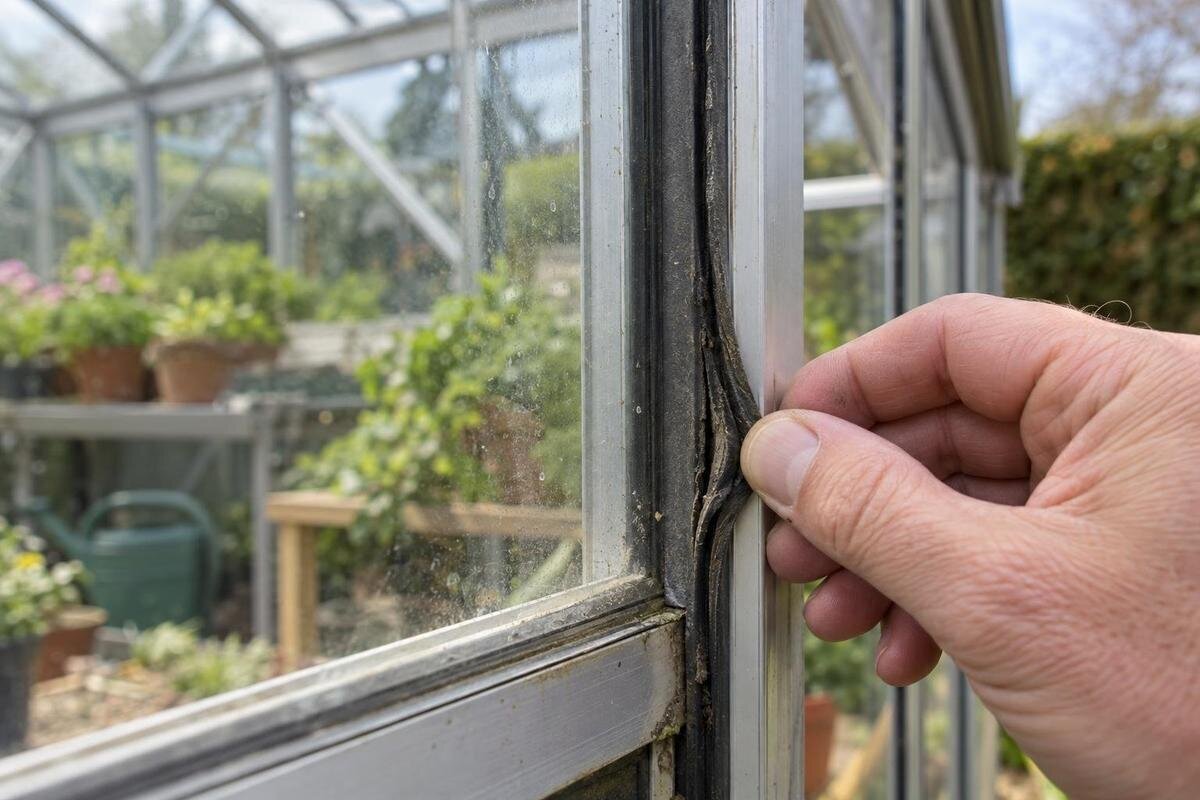
Inspect again when the area is clean and dry. Dirt generally comes away from the surface; a split, missing section or gap remains in the seal itself. Look along the edge for a cut, broken end, lifted section or opening beneath the strip, rather than judging only by colour. Compare it with an equivalent undamaged joint if one is visible, but check that it is the same type and position. Do not flex or press an old seal hard to test its resilience. If the distinction is unclear, photograph the joint close up and from farther back, then ask the maker or parts supplier what to look for on that model. Cleaning can reveal damage, but it cannot restore deteriorated material.
02
Signs that cleaning cannot reverse
Clear signs of physical failure include a split through the profile, a tear, a missing piece, cracks that continue through the material, or a strip that has shrunk back and left an exposed gap. A seal that crumbles or repeatedly lifts from its channel is different from a dirty surface. Note how far the damage extends and whether it affects one pane, several adjoining panes or different parts of the greenhouse. A single defect may be local; similar deterioration along multiple edges may warrant a broader review. The pattern helps describe the extent of the problem, but does not, by itself, establish its cause.
Flattening needs more careful interpretation. Some gaskets are designed to sit compressed when installed, so a low profile is not automatically a reason to replace them. Look for accompanying evidence: loss of contact, an edge pulled away, a continuing gap, movement, or a profile unlike the same type on an undamaged section. Do not pull out or stretch a strip to compare shapes; that can disturb the glazing. Keep the extent of the seal damage separate from any wish to change the greenhouse itself. For example, comparing Limited Edition greenhouses with storage concerns the layout of a complete replacement, whereas deciding whether a flattened gasket needs renewal concerns its condition and fit.
A leak does not always point to the glazing seal
Water on a greenhouse pane, a damp mark or a draught near the edge may justify checking the seal, but each symptom can have more than one source. Condensation, water travelling from another joint, or a gap elsewhere in the frame can produce a similar mark. Note where moisture first appears and whether there is visible damage directly beside it; do not order a gasket from the stain location alone. If the seal remains in contact and shows no visible defect, replacing it may not address the actual problem. Treat one wet patch as a reason to investigate, not as a diagnosis.
Use non-invasive checks first: dry the area, record its position and observe it under ordinary conditions. Do not remove the pane, force water into a joint or cover a drainage route with sealant to see what happens. Persistent water entry, movement of a pane or a gap that changes over time calls for advice from the manufacturer or a suitable installer. Establish the likely repair scope before comparing it with the purchase of a Bloomcabin Prestige Greenhouse. Otherwise, you would be weighing a complete new structure against an undefined repair, without knowing whether the problem is confined to one seal or involves other parts.

03
How to clean and inspect the seal safely
Plan the inspection around safe access, not around reaching every seal in one session. Clean only where the joint is safely reachable; do not lean across roof glazing or use an unstable ladder. Have a soft, clean cloth and the cleaning materials permitted by the greenhouse instructions within reach before starting. Work lightly over the visible surface instead of pushing cloth corners beneath the strip. Rinse and dry as directed, then examine the exposed edge without probing it. Leave inaccessible sections for someone equipped to assess them safely, and distinguish those uninspected areas from the joints you have checked when describing the condition of the seals.
Keep cleaning separate from repair. Tape, adhesive, lubricant, caulk or extra foam can change how adjoining parts meet and may make a later correct replacement harder; use them only if the manufacturer specifies the product and location. If a seal has lifted, do not press, stretch or cut it back into place. Stop at observation, photograph the problem, and mark its position on a simple sketch or the manual’s diagram. Record whether the surface looks different after drying and whether nearby seals look the same. This gives a parts specialist useful information without disturbing the glazing or relying on an improvised test.
Why a replacement seal must match the original
Matching a replacement means matching the specified profile and application, not just buying rubber of a similar thickness. The required part can depend on the greenhouse model, glazing material, the position of the joint and how the strip is retained. Note a cross-section or part number only if it appears in the manual or can be observed without removing anything. Ask whether the proposed part is intended for the exact roof, wall, door or vent location, and whether it is the original item or a manufacturer-confirmed successor. A similar-looking universal gasket may differ at the lip, slot or compression area.
Ask the manufacturer or parts supplier to confirm the identifier before ordering, including any lengths or joining details the system requires. If the original is unavailable, request an approved equivalent rather than choosing by photograph or a loose measurement alone. When consulting the Aluminium Classic Greenhouse listing, distinguish the complete model name from the spare-part reference you need. Neither a familiar product name nor a similar appearance confirms that a current seal fits an older frame. Keep the supplier’s confirmation with your own greenhouse’s manual so that the proposed replacement can be traced to the correct model and joint.
04
What to include in a spare-parts request
Make a parts enquiry easy to answer by sending the model or range name, any serial or order reference available, and a clear photograph of the whole greenhouse as well as close-ups of the affected joint. In each close-up, include enough surrounding frame to show whether the seal is at a roof, wall, door, vent or another edge. State whether the glazing is glass or polycarbonate if known, which panels are affected, and the damaged length if it can be measured safely. Explain what you have observed, such as a split, a section pulled out or a gap. A marked-up manual drawing can be clearer than several unlabelled photographs.
Ask the supplier to identify the exact spare-part reference, confirm that it matches the model and location, and explain any fitting limits or installer requirements. If they need a measurement or sample, ask how to obtain it without releasing the glazing; do not dismantle a joint to make the request more complete. Use the model name recorded on your paperwork, rather than shortening it to a general description. For instance, Limited Edition Aluminium Greenhouses is a catalogue range name, not a seal specification. Keep the confirmed replacement code with the manual and label the photographs by location, making future enquiries easier without having to repeat the inspection.
When an installer should assess the glazing
Ask a qualified greenhouse installer or glazier to assess the work if the seal helps retain a pane, sits under a retaining bar, or is part of a roof or overhead glazing assembly. This is especially important if glass is cracked, a panel moves, the frame looks distorted, a strip is trapped under another component, or access would involve working at height. A seal that seems simple from ground level may belong to a system that needs support before it can be removed. Do not pry it out, lift a pane or improvise a support based on a photograph or a generic guide.
An installer can check whether the problem is limited to the seal, whether the glazing or frame also needs attention, and whether the proposed part is compatible with the assembly. Ask for the replacement part reference and the basis for the match; request the manufacturer’s instructions if fitting differs from the original arrangement. If the inspection leads to a full replacement enquiry, use its findings to explain why repair is no longer the preferred option. A complete model such as the Spacious Greenhouse can then be considered separately, with its suitability for your space assessed rather than assumed from the product name.

05
Weighing a seal repair against greenhouse replacement
A repair is more straightforward to assess when the damage is local, the surrounding glazing and frame appear sound, and the exact part can be confirmed. A wider decision is needed when several seals have failed, glazing is loose, the frame or fittings show other faults, or the required profile cannot be identified. Consider the whole job, not only the length of rubber: part availability, access, safe fitting, related components and an installer’s scope all affect its practicality. Ask for an assessment of the work before concluding that the greenhouse is beyond repair.
Compare that assessment with the condition and usefulness of the greenhouse as a whole. If several components require work, a replacement enquiry may be worth exploring; if one seal has failed on an otherwise serviceable structure, a compatible part may be enough. There is no universal age or number of damaged strips that settles the choice. Separate necessary repair costs from changes you would like to make to the layout. Considering a Wall Greenhouse, for example, introduces a different type of structure into the comparison, so the decision is no longer simply whether to renew the existing glazing seals.
If the original seal is unavailable
If the manufacturer no longer supplies the seal, ask whether a formally superseding part or approved alternative is available for your exact model and glazing arrangement. Request the part number and relevant documentation in writing, and have an installer confirm the fit where the component retains glazing or affects how a pane sits. Do not substitute a generic strip, cut a different profile to size, or fill the joint with silicone simply because the original is hard to source. A part may be discontinued without the entire greenhouse being unusable, but safe options depend on its construction and the manufacturer’s guidance.
If no suitable part can be confirmed, review the greenhouse before committing to an improvised repair: consider the frame, glazing, doors and vents, and whether the work can be completed safely. Keep photographs, part references and installer advice together, including a record of which replacement options could not be matched. If you then enquire about a T-Model Orangery Greenhouse, make clear that you are considering a complete replacement rather than requesting a compatible component. That distinction helps keep two different purchasing questions separate: whether the existing structure can be repaired, and what you would need from a new greenhouse.
Frequently asked questions
Can I clean a greenhouse glazing seal instead of replacing it?
Often, if the problem is surface dirt and the seal remains intact and properly seated. Use only a cleaning method allowed by the greenhouse manufacturer, then inspect the seal when dry. Cleaning will not repair a split, missing section, shrinkage gap or loss of grip.
Does a flattened seal always need replacing?
No. Some seals are designed to sit compressed, so a low profile on its own is not conclusive. Look for other signs, such as a gap, a section pulled out of place or loss of contact, and compare it with the same type of joint if possible.
Can I use generic weatherstripping or silicone?
Only if the greenhouse manufacturer confirms that the material and method are suitable for that specific joint. Similar-looking strips can have different profiles and functions. An unapproved product may change how the glazing components meet or make a later replacement harder.
What information should I send when asking for a replacement seal?
Include the greenhouse model or range, any available order or serial reference, the seal's location, clear close-up and wider photographs, and the glazing type if known. Ask the supplier to confirm the part reference for that model and location before ordering.
Can I replace a seal around roof glazing myself?
That depends on how the glazing is held and how safely the joint can be reached. If the seal helps retain a pane, the work involves roof or overhead glazing, a pane moves, or access is difficult, ask a qualified greenhouse installer or glazier to assess it rather than prying out the strip.
Cleaning is worthwhile when grime obscures an inspection, but it cannot revive material that has split, shrunk or lost its place. Record the exact joint, compare it with the greenhouse manual and request a manufacturer-matched part or confirmed successor. When a seal may retain glazing, a pane moves, or the damage extends beyond one strip, ask an installer to assess the assembly before anything is removed. A sound decision rests on the seal’s function and fit, not its colour alone.
