
When to Replace Greenhouse Polycarbonate Panels
Greenhouse repair guide
Clouding, yellowing or light scratches can make greenhouse polycarbonate look tired, but appearance alone does not establish that a panel has failed. The more useful questions are whether it remains intact and securely seated, whether the greenhouse still performs as intended, and whether the manufacturer approves a repair or replacement part for that exact model. This guide separates cosmetic ageing from functional damage, explains what to observe safely and sets out the details to gather before asking for a matched panel. It also covers when widespread damage calls for an installer’s assessment of the complete structure.

Assessing cloudiness and yellowing
Polycarbonate can become hazier, yellower or less glossy, and light surface marks may appear with use. That change does not by itself prove that a sheet has cracked, lost its seating or needs replacing. There is no single age at which every greenhouse panel should be discarded: the original specification, exposure and care all matter. Follow the product documentation rather than guessing from age or colour. If the sheet remains intact, correctly positioned and free of openings, a changed appearance is a reason to inspect it, not a stand-alone failure test.
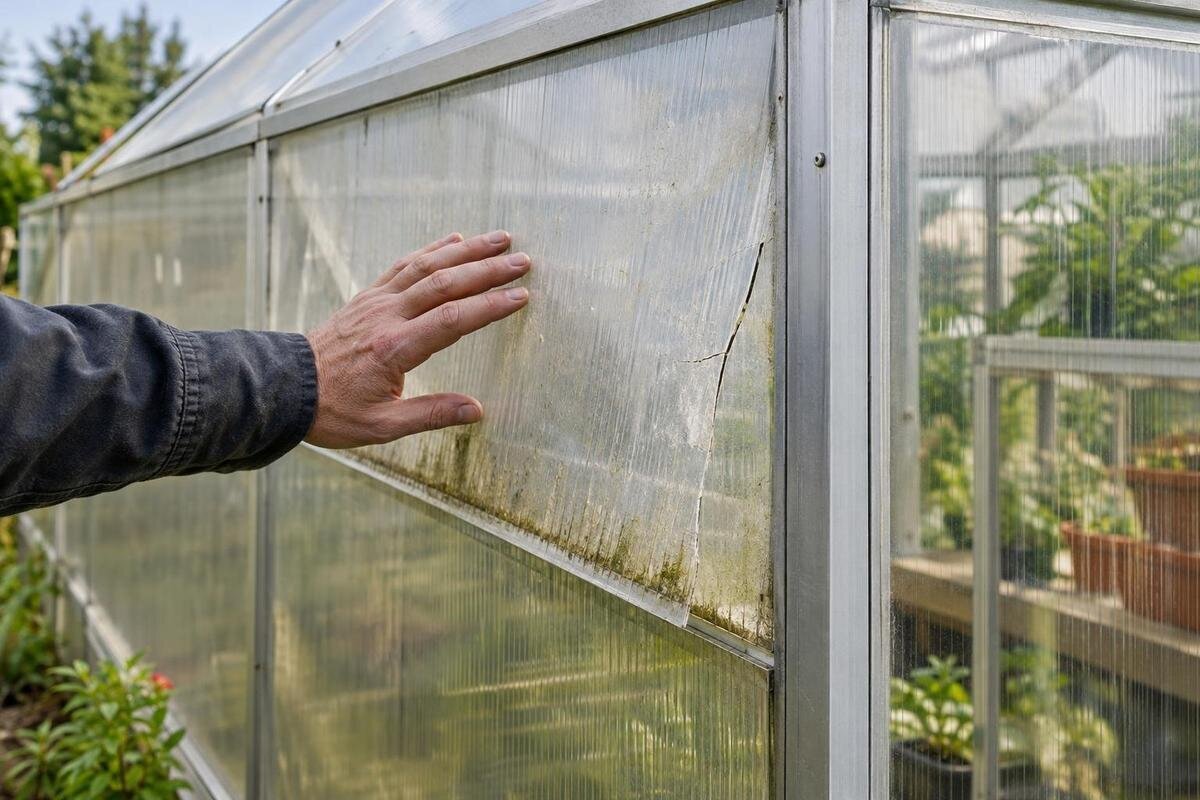
Compare the affected area with adjacent panels and, if available, with a dated photograph taken from a similar angle. Note whether the change covers the whole sheet, follows an edge or appears in isolated patches. Describe what you can see rather than assigning a cause: a photograph can record a change, but cannot certify the panel’s condition. For later comparisons, use a similar viewpoint and lighting so that reflections do not obscure the area you are following. If the panel is dirty, clean it only as the greenhouse instructions permit; abrasive pads, strong cleaners or an unapproved coating can create fresh marks and complicate assessment. Note whether haze remains after approved cleaning and whether it limits the view or light in a way that affects your use of the space. Keep this appearance record separate from observations about cracks, gaps or movement, so that a cosmetic concern does not obscure a functional one. Do not sand or polish the sheet to restore clarity.
Cracks, openings and poor fit need attention
A crack through the sheet, a split edge, a hole, a broken corner or a panel that has moved out of its intended position is more than a cosmetic change. Damage can leave an opening, expose an edge or affect how the sheet stays in place. Treat a loose or broken roof panel as a prompt for professional attention; do not stand below it, pull it back or test it by pressing. If sharp edges or fragments are visible, keep people away until the area has been assessed. The aim is to establish whether the panel remains correctly retained, not to test its strength by hand.
Look for visible gaps at the edges, a corner lifting, movement in the sheet or a new rattling sound. These observations suggest a fit issue but do not show whether the panel, its retaining components or the frame is responsible. Water entering the greenhouse does not automatically mean the sheet has failed; a joint or seal may be involved instead. Record where the issue appears and whether it affects one panel or more, then ask the manufacturer or installer to identify the cause before ordering a replacement. Avoid forcing the sheet back into place.
Inspect from a safe position and keep a record
Inspect only from a stable, accessible position. Look at both faces from ground level or from inside the greenhouse where access is safe, but never climb on the frame, use a panel as a step or lean your weight against the glazing. A roof or high-level sheet that cannot be seen clearly from the ground should be left to a qualified installer. If a panel is loose, broken or above a walkway, do not inspect from directly below it. Keep tools away from damaged edges, and do not remove a panel just to look at its underside.
Take one overall photograph of the greenhouse and close views of each affected area. Note the date, the panel’s location, whether one or several sheets are involved, and any change since an earlier inspection. A simple sketch can help connect each close-up to the correct roof, side or end panel. Give the photographs matching labels so that the supplier can distinguish, for example, two damaged sheets from two views of the same sheet. State which side of the greenhouse you were facing when recording left and right; do not rely on an unexplained description such as ‘the back panel’. Include a label, manual reference or order document if available. If you use an online catalogue to confirm a model name, the T-Model Orangery Greenhouse listing is a product-identity reference only; it cannot show which panel belongs in your particular frame. Clear records are more useful than an unsafe attempt to take measurements at height.
Repair only by a method approved for the panel
A minor surface mark may need no repair, while a crack, hole or damaged edge needs a model-specific answer. Use a repair method only if the greenhouse manufacturer’s instructions explicitly permit it for that panel. Generic tape, sealant, glue, patches, added screws or drilled holes are not universal solutions: materials and retaining arrangements vary, and an improvised fix could interfere with movement, fit or drainage, or conceal further damage. A kit intended for another greenhouse is not proof of compatibility. Do not reshape a sheet or alter the frame, clips or supports to make a repair work.
If the manual does not describe an approved repair, ask whether the maker recommends a matched replacement or an installer’s assessment. The Pyramid Greenhouse page identifies a complete greenhouse model, not an approved patch or spare panel; use such a listing only when comparing whole structures, and obtain the relevant manual separately. Before altering an assembly that may still be covered by a guarantee, check the terms and contact the seller or manufacturer. Do not discard a removed component until the supplier says it is unnecessary for identification.

Identify the greenhouse model and panel position
Before requesting a part, identify the maker and the exact greenhouse model, size or edition. Look for a serial label, purchase date, order confirmation, assembly manual or technical drawing. A model family name alone may not distinguish a size or later version, and panels in the roof, side, end, door or vent should not be assumed to be interchangeable. Use the part number shown in the manual if one is provided. Copy the full designation into your notes rather than shortening it to a general description such as aluminium greenhouse.
Keep every distinguishing word in a model title. For instance, Aluminium Greenhouses with Storage – Limited Edition is a specific catalogue designation, not a generic panel size; the name alone does not confirm which sheet is fitted to your greenhouse. If your paperwork is incomplete, photograph any product label and the whole structure from a safe distance. Use the manual’s drawing to identify the panel position, and ask the supplier for help if the drawing or label is unclear. Similar names or shapes do not establish that two models share spare parts.
Include useful details in a spare-parts enquiry
Give the supplier enough information to identify one part unambiguously: the exact greenhouse model and variant, serial or order number if available, the manual’s part reference, the panel location, the number affected and a short description of the damage. Attach an overall photograph and close views, plus a label or drawing extract if you have one. Add dimensions only if they can be obtained safely and by the method the supplier requests. Do not climb or remove a panel simply to measure it, and state clearly when a detail is unknown rather than estimating.
Ask the parts team to confirm the part number, compatibility with your model and version, panel type, and whether separate retaining pieces are required. Request the relevant fitting instructions and ask whether an installer is needed. When you receive a quotation, check that it identifies the panel position and quantity you requested, rather than simply repeating the greenhouse name. If several components are listed, ask which replace the damaged sheet and which are associated fittings. Keep the reply with your original enquiry so that the description, photographs and proposed parts remain together. A product listing such as Bloomcabin Prestige Greenhouse identifies a complete greenhouse model, not a glazing spare, so use your own order record and manual to identify the panel. If the original label cannot be read, send the photos before ordering. A sheet described only as polycarbonate is not enough to establish a match.
Check the proposed panel against the original specification
Before accepting a proposed replacement, confirm that it is approved for the exact greenhouse and panel position. A general material name is not enough to establish a match. Ask the supplier to verify the dimensions, edge profile, thickness, colour or light-transmission specification, and the construction—such as hollow-channel or solid sheet, where applicable. These are details to check, not values to guess. Ask whether the manufacturer specifies a treated face or a particular orientation, and whether the replacement requires matching clips, seals or other retaining parts.
Use the greenhouse manual or written confirmation from the manufacturer as the reference if a quotation offers a substitute or revised part number. Ask whether the part changes the fitting instructions, what preparation is needed and who should install it. If no approved panel can be identified, consider replacing the complete greenhouse as a separate decision. For example, the Spacious Greenhouse listing gives an area range of 47–70 m² for that model family. That is a whole-greenhouse size reference, not evidence about your existing panel, the intended site or compatibility.
Have the frame assessed if several panels are affected
If more than one sheet is cracked, loose or out of position, or a replacement problem keeps returning, have the surrounding assembly reviewed before buying several panels. A qualified installer can assess whether the damage is confined to the sheets or whether retaining parts, frame alignment, glazing supports or seals also need attention. Repeated or clustered damage is a reason to investigate, not proof of a particular cause. Avoid adding screws, braces, adhesive or other support as an experiment; an unapproved modification could change how the greenhouse is assembled.
If an installer concludes that the existing structure should not be reused, a complete greenhouse comparison may be more useful than another panel enquiry. The Aluminium Greenhouses listing shows model-area options from 3.77 to 28.08 m², which can help with a rough footprint comparison only. Check the exact drawings and specification for any new model rather than treating the area range as its outside dimensions, glazing material or proof that it suits your site. A broad product-category listing cannot replace a model-specific installation assessment.

Compare a panel replacement with replacing the greenhouse
For one damaged sheet in an identifiable greenhouse, an approved panel replacement may be the narrower solution if the remaining structure is in suitable condition. A whole-unit decision becomes more relevant when several panels are affected, approved spares cannot be identified, the frame or retaining system needs professional attention, or you want a different structure for independent reasons. There is no universal panel count or age that makes full replacement necessary. Compare the work involved, the condition of the frame and the supplier’s advice rather than treating every change in colour as a reason to discard the greenhouse.
If a complete greenhouse is under consideration, compare its site requirements, dimensions and access against the available space rather than choosing by name alone. A Wall Greenhouse listing identifies a wall greenhouse with listed areas from 3.69 to 14.34 m²; it does not confirm that a particular wall or location is suitable. Do not assume that a garden greenhouse is rated for a rooftop. Check the selected model’s documentation and have its mounting arrangement assessed by a qualified professional where necessary.
Treat a new greenhouse as a separate buying decision
An upgrade is different from ordering a replacement panel. If you choose a new greenhouse, make a separate checklist for the area it will occupy, the route for bringing components into the garden, the surface or base required by its manual, and any features essential to your use. Separate requirements you want to retain from features you would like to change. This keeps dissatisfaction with an old panel’s appearance from becoming the only basis for a larger purchase. Compare the complete specification, not just the glazing label or photographs. Ask the seller to confirm the supplied panel material and the exact model configuration; the fact that your previous greenhouse used polycarbonate does not establish what a new listing contains. Record the selected version alongside each quotation, particularly when one product page covers several sizes, so that you compare the configurations actually offered rather than the broad model ranges.
The Limited Edition Aluminium Greenhouses listing covers area options from 3.77 to 28.08 m², but that range alone does not confirm the dimensions, material or installation suitability of a selected version. Check the chosen model’s documentation, assembly requirements and parts support before deciding. Keep the scope of each option clear: a quotation for one replacement sheet and a quotation for a complete greenhouse cover different purchases. Identify what each includes and what work would still need arranging before comparing them. If one approved panel is needed and the rest of the greenhouse is serviceable, a full upgrade comparison may be unnecessary. If the frame or several components are affected, treat the choice as a complete-structure decision and seek installer input.
Frequently asked questions
How can I tell if polycarbonate ageing is only cosmetic?
Gradual haze, yellowing or small surface marks may be cosmetic if the panel remains intact and correctly seated, with no openings or loose edges. Inspect it safely and follow the greenhouse manual. Cracks, movement, distortion or a visible gap call for closer assessment; appearance alone cannot establish whether a panel is still suitable.
Do cloudy or yellow greenhouse panels always need replacing?
No. Cloudiness or yellowing alone does not set a replacement deadline. Check for cracks, gaps and poor fit, and consider whether the changed appearance affects how you use the greenhouse. Clean only as the manufacturer instructs; avoid abrasive products or coatings that could create further marks.
Can I repair a cracked polycarbonate panel with tape?
There is no universal tape repair for greenhouse panels. Use a repair only if the manufacturer’s instructions approve it for that exact panel and model. A generic adhesive or sealant may not be suitable or may affect the fit. Keep clear of loose or broken panels and arrange a qualified assessment.
Can I use standard polycarbonate sheet as a replacement?
Not without confirmation that it matches the greenhouse and panel position. Dimensions, thickness, edge profile, sheet construction, orientation and retaining details may differ. Ask the manufacturer or supplier to confirm the approved part and its fit; the material name alone is not enough.
Should I replace one panel or the whole greenhouse?
A single approved replacement may suit an isolated panel problem if the remaining structure is in good condition. Several affected panels, recurring movement or visible frame damage warrant an installer’s review. There is no universal panel count that requires a full replacement; base the decision on spare-part availability and the condition of the complete structure.
Base the decision on the panel’s condition and the manufacturer’s guidance, not appearance alone. Persistent clouding may be cosmetic, while cracks, openings, movement or poor fit call for assessment. For any repair or replacement, identify the exact model and panel position, confirm an approved part and fitting method, and involve a qualified professional when a panel is high or loose or the frame is affected. This helps keep a straightforward panel replacement from overlooking a problem elsewhere in the greenhouse.
