
Choosing Greenhouse Shade Cloth: Percentage and Placement
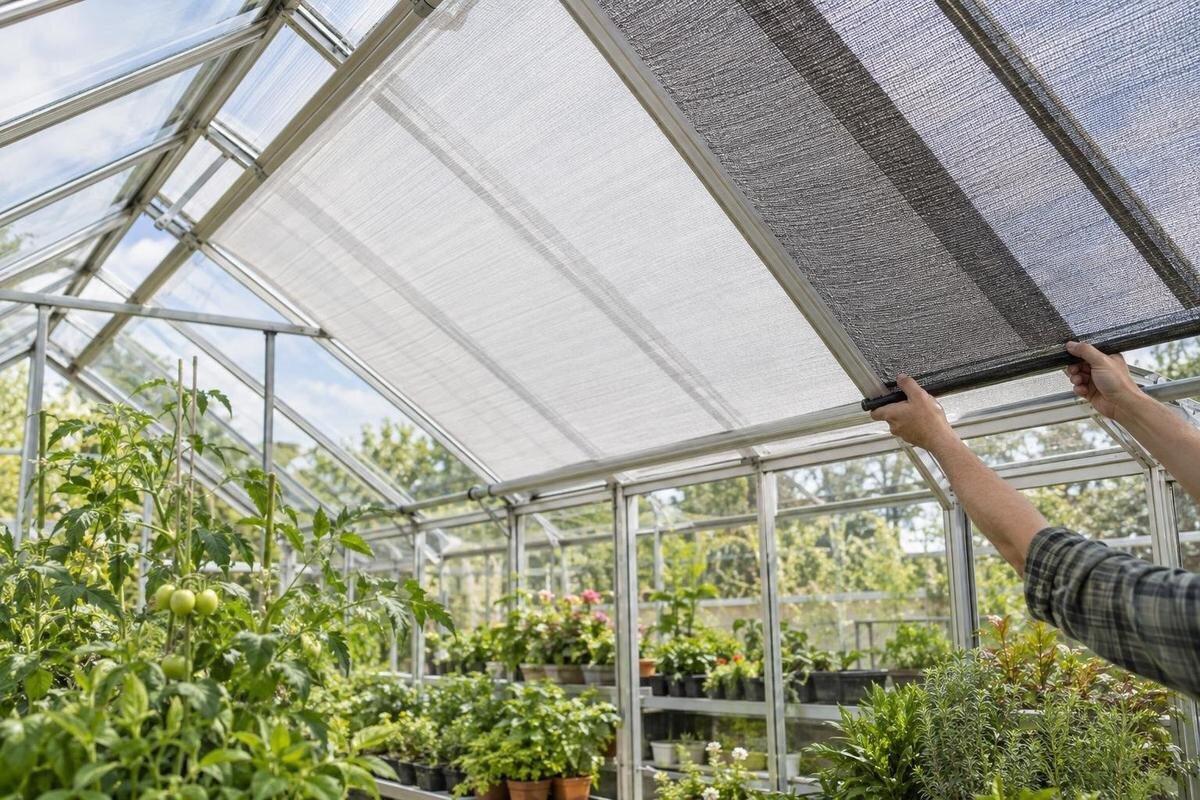
Greenhouse light management
Shade cloth is best chosen by comparing crop requirements with the light reaching the plants, not by picking a familiar percentage. A cloth rating describes the material under stated test conditions; it does not guarantee the same reduction at every bench. Identify the crops and growth stages, measure light at canopy height, and compare the readings with crop-specific guidance. Then choose the shade level and covered area that address the measured excess without needlessly reducing light elsewhere.

Start with crop-specific light requirements
Look up the crop’s light requirement in a dependable crop guide or supplier information, and note exactly what the recommendation describes. A target may be expressed as photosynthetic photon flux density (PPFD) at a particular moment, daily light integral (DLI) across the day, or a qualitative phrase such as full sun. These measures are not interchangeable, and a broad label does not set a precise upper limit for every cultivar. Needs can differ by crop and growth stage: seedlings, established foliage and fruiting plants may not call for the same conditions. Check that the guidance applies to greenhouse growing; if it only describes bright or partly shaded conditions, do not translate that phrase into an exact percentage without more information.
Mark which crops occupy each bench or bed and group plants with similar light needs. Include temporary seedling trays and planned succession crops, since the area receiving shade can change between plantings. A high reading in one zone does not mean every plant needs protection; neighbouring plants may already be within their recommended range. Equally, a plan built around one sensitive group can reduce useful light for the rest. In a mixed greenhouse, decide which groups need less light, at what hours, and whether their growing areas can be managed separately. Empty floor and paths do not need the same treatment as planted canopy.
What a shade percentage means
A shade-cloth percentage usually describes the nominal proportion of incoming light that the material is intended to block under a stated test. A 40% shade rating is a product rating, not a promise that plants in your greenhouse will receive exactly 40% less light. Read the product data for its measurement basis and the kind of light measured. Check whether the figure describes light blocked or light transmitted; those are different quantities. If the test basis is not stated, ask the seller for clarification. Two fabrics with the same number may not be directly comparable when they have been rated under different methods or conditions.
Do not confuse the shade percentage with the share of roof or crop area covered. Cloth rated at 40% could cover one bench or a much larger surface; those are separate choices. The fabric rating also does not account for light already reduced by the greenhouse covering, frame shadows, nearby buildings or trees. Gaps, seams and overlapping sections create their own pattern at plant level. A shade rating does not tell you what temperature change to expect, either, so do not use it as a measured cooling value. Treat the rating as one input, then check the light inside the actual greenhouse.
Measure at crop-canopy height
Use a quantum or PAR meter that reports PPFD when you need a plant-relevant instantaneous reading, usually in μmol/m²/s. Place its sensor horizontally at the crop canopy, not against the roof, at floor level or in the aisle. Keep it clear of your own shadow and use the same sensor orientation at each point. Take readings at representative positions: a bright edge, the middle, a naturally shaded corner and each crop zone. Check that the instrument displays the unit you need, and note its exact position so you can return to it after adding shade. A lux meter or phone app is not an equivalent measure: lux is weighted for human vision and does not convert directly to PPFD.
One reading can conceal differences caused by a nearby wall, frame, roof geometry or external shade. Draw a simple plan and mark each measurement on it; a small grid can show where coverage might help and where it may be unnecessary. The Spacious Greenhouse listing gives an area range of 47–70 m², but an overall area figure cannot describe the light at a particular bench. The same principle applies to any size: measure the occupied growing area instead of assuming a reading by the door or in the centre represents it all. Keep the plan and sensor positions so you can repeat the measurements after changing the shade.
Record light through the day
Light varies over the day, so a single midday reading cannot show the full supply. PPFD is an instantaneous rate; DLI is the accumulated photosynthetic light received during a day, often expressed in mol/m²/day. If crop guidance gives a DLI, use a suitable meter or logger that integrates PPFD, or collect readings at regular intervals and use an appropriate calculation. Multiplying one midday reading by all the daylight hours does not provide a reliable daily total. A bright peak can coexist with lower readings for much of the day, so it may not justify fixed shade over the plants from morning to evening.
Log the date, time, cloud conditions, sensor position, crop height and whether shade was in place. Compare before-and-after readings at matching places and times; a clear day compared with a cloudy one cannot isolate the cloth’s effect. In a lean-to layout such as the Wall Greenhouse, the exact wall, orientation and nearby obstructions are part of the light environment. The model name does not tell you how much light reaches a particular site. For an outdoor reference, use the same meter and take the reading close in time to the indoor one. If conditions change quickly, repeat the comparison on another representative day.

Estimate a reduction from measured light
Use matched readings and a crop-specific reference to estimate a candidate reduction. Subtract the upper limit given in the crop guidance from the unshaded reading, divide the difference by the unshaded reading, then multiply by 100. For illustration only, if a canopy point measured 1,000 μmol/m²/s without shade and the relevant crop reference set an upper limit of 700 for that same interval, the estimated reduction would be 30%. These figures are not crop recommendations; they show the arithmetic. Keep the units, sensor position and time period consistent. If the crop guidance gives a range, compare the readings with that range rather than focusing on a single peak.
The calculation suggests a reduction to investigate; it does not tell you which cloth label will deliver it. The product rating has its own test basis, and a fixed covering reduces light at times beyond the one used in the example. Check readings at other times of day and across crop zones before settling on a rating. If you are choosing a structure as well, the Bloomcabin Prestige Greenhouse listing gives an area range of 3.77–28.08 m². Identify the exact version and its dimensions before planning fabric coverage: a catalogue area range is not a measurement of glazing or planted area. If crop guidance and your readings use incompatible measures, do not invent a precise conversion.
Separate shade strength from coverage
Keep shade strength and coverage as two separate decisions. Strength is the nominal reduction associated with the material; coverage is the surface or crop zone it shades. Covering only part of a roof with a higher-rated cloth does not create the same light pattern as using a lower-rated cloth across the whole greenhouse. Partial coverage can produce transitions between brighter and darker areas, so map those boundaries against the crops below. Where the light problem is local, targeted coverage may preserve more suitable light for neighbouring plants than an all-over screen. Do not assume that covering a given percentage of the roof produces the same percentage reduction in average crop-level light.
Group crops with similar light needs where possible, and check readings on both sides of any boundary. A shade plan for one seedling bench, for example, should not automatically extend to every mature crop. When planning a layout for a model in the Aluminium Greenhouses with Storage – Limited Edition range, mark the benches, beds, storage space and paths separately. Identify which planted areas need shade and which can remain uncovered. Add the crop and growth stage to each zone on the plan so the reason for its coverage remains clear when planting changes. Check the edges of each shaded zone as well as its centre.
Where to position shade cloth
Use the light map to place coverage over the areas and hours that need it. The sun’s apparent position moves during the day and changes with the season; roof shape, greenhouse framing and nearby obstructions also shift shadows. A panel positioned over the centre may miss a bright strip at one end, while a narrow band may cast a changing edge across adjacent crops. Note where direct light falls at the times your readings show an excess, rather than planning from the roof outline alone. The aim is a useful pattern at canopy level, not simply a neat arrangement viewed from above.
Measure the actual surface and crop zone for the selected greenhouse before deciding the size and number of cloth pieces. The Aluminium Greenhouses range is listed across 3.77–28.08 m²; that area range is not a cutting plan or a measurement of individual panels. Use the dimensions for the exact model and note gaps, overlaps and covered boundaries on a sketch. If more than one piece is needed, compare the light beneath each section and at its edges. Overlap can make one area darker, while a gap can leave a bright strip, so check the proposed layout against the map rather than relying on a general roof measurement.
Keep vents, doors and access clear
Plan coverage around doors, vents and regular working routes. Keep cloth and its supports clear of any opening, control or moving part that must remain accessible according to the greenhouse instructions. A shade arrangement that reaches the right crop zone but impedes a door or vent creates a separate management problem. Before buying, note how each opening moves and how much clearance it needs, then compare the proposed layout with those requirements. Keep ordinary plant-care access in mind as well: a covered bench still needs to be reachable. Shade cloth should not be treated as a substitute for ventilation.
Check the instructions for the particular greenhouse rather than assuming a generic fixing approach will suit it. For a model in the Limited Edition Aluminium Greenhouses range, the listing name alone does not establish compatibility with a chosen cloth or attachment. Follow the structure maker’s information on intended attachment locations and clearances. If it leaves a structural question unresolved, ask the supplier or a qualified installer to confirm the appropriate option. Do not infer that a fixing is suitable from a product photograph or a general description. Confirming compatibility first helps keep the shade plan from interfering with the greenhouse itself.

Recheck shade as crops and daylight change
Treat the first arrangement as something to evaluate, not as proof that the chosen percentage is right. Repeat readings at the same points and crop height under comparable conditions, and record whether the cloth was fitted, partly open or absent. Check more than one daylight period: a useful midday reduction may still leave too little light earlier or later. Compare the full pattern with crop guidance, particularly when it gives a daily total. Reassess when a crop is replaced, moves to a different growth stage or occupies another bench. Keep the measurement method consistent so a change in the readings is not simply a change in how you measured.
Keep notes on light alongside crop development, such as new growth, flowering or fruiting where relevant. Visual changes can take time and may have causes other than light, so do not use one leaf or one day’s appearance as the sole test. Label each record with the growing zone and shade arrangement to make later comparisons useful. For a layout in a T-Model Orangery Greenhouse, for example, keep the bench plan with the readings rather than relying on a single greenhouse-wide result. Note when plants move or their canopy height changes; otherwise, readings from different positions may look comparable when they are not.
Check product data and greenhouse compatibility
Before buying, check what the cloth percentage measures, the test conditions and whether the reported light band is relevant to the crop guidance. Confirm the piece dimensions and whether the quoted percentage is a shade rating or a statement about how much area the fabric covers. Ask whether the figure concerns PAR or another stated measure if that detail is not clear. Check that the proposed layout can be adjusted or removed if crop needs change, and that the greenhouse instructions allow the planned attachment. If the rating’s basis is missing, ask for clarification instead of comparing it with a competing figure as though both used the same scale.
Match the order to the actual greenhouse model and version, not just a broad product category or area range. For a structure such as the Pyramid Greenhouse, the product name does not supply exact panel dimensions or verify compatibility with a particular shade system. Confirm the required fabric sizes and attachment arrangements using the relevant instructions or supplier information. Keep these details alongside the selected shade rating and the growing zones to be covered, so the order reflects the whole plan. Any unresolved structural or attachment question needs advice from the supplier or a qualified professional before you commit to that arrangement.
Frequently asked questions
Does a 30% shade cloth reduce light in the greenhouse by exactly 30%?
Not necessarily at crop level. The percentage is a rating for the cloth under stated test conditions, while the greenhouse covering, shadows, gaps, coverage and sun angle all affect the light reaching plants. Compare readings before and after in similar conditions.
How do I choose the right shade percentage?
Use crop- and growth-stage-specific guidance, then measure light at canopy height in the relevant growing areas. Estimate the reduction needed from comparable readings and treat the result as a candidate rating to verify, not a universal prescription.
Can I use a lux meter or phone app to measure plant light?
They may help you compare readings consistently, but lux is weighted for human vision and does not translate directly to PPFD. For plant-relevant measurements, use a suitable quantum or PAR meter that reports PPFD.
Should I cover the whole greenhouse?
Only if the crops and growing areas have similar light needs. Map readings by zone first. Targeted coverage may preserve more light for neighbouring plants that do not need the same reduction.
When should I reassess the shade?
Recheck after changing crops, moving plants, or changing the covered area, and when daylight patterns shift. Compare readings at the same locations and times under similar conditions.
Good greenhouse shade is not a number chosen in isolation. Crop-specific guidance tells you what to aim for; repeated readings show where and when the greenhouse exceeds that need; the cloth rating helps identify a candidate reduction. Keep coverage distinct from shade strength, preserve useful light in other zones, and check the result when crops or daylight patterns change. This evidence-based approach helps avoid both over-shading and choosing cloth on its label alone.
