
Insect Screens on Greenhouse Vents: Balancing Pests and Airflow
Greenhouse ventilation
An insect screen on a greenhouse vent can limit entry by a chosen pest, but every mesh also adds resistance to airflow. The right choice depends on the insect’s size and behaviour, the screen’s clear openings, the ventilation available through the actual greenhouse, and a fit that does not obstruct the vent. This guide explains how to weigh those factors without treating mesh count as a guarantee of either exclusion or adequate ventilation.

Before you buy 1
How an insect screen affects a greenhouse vent
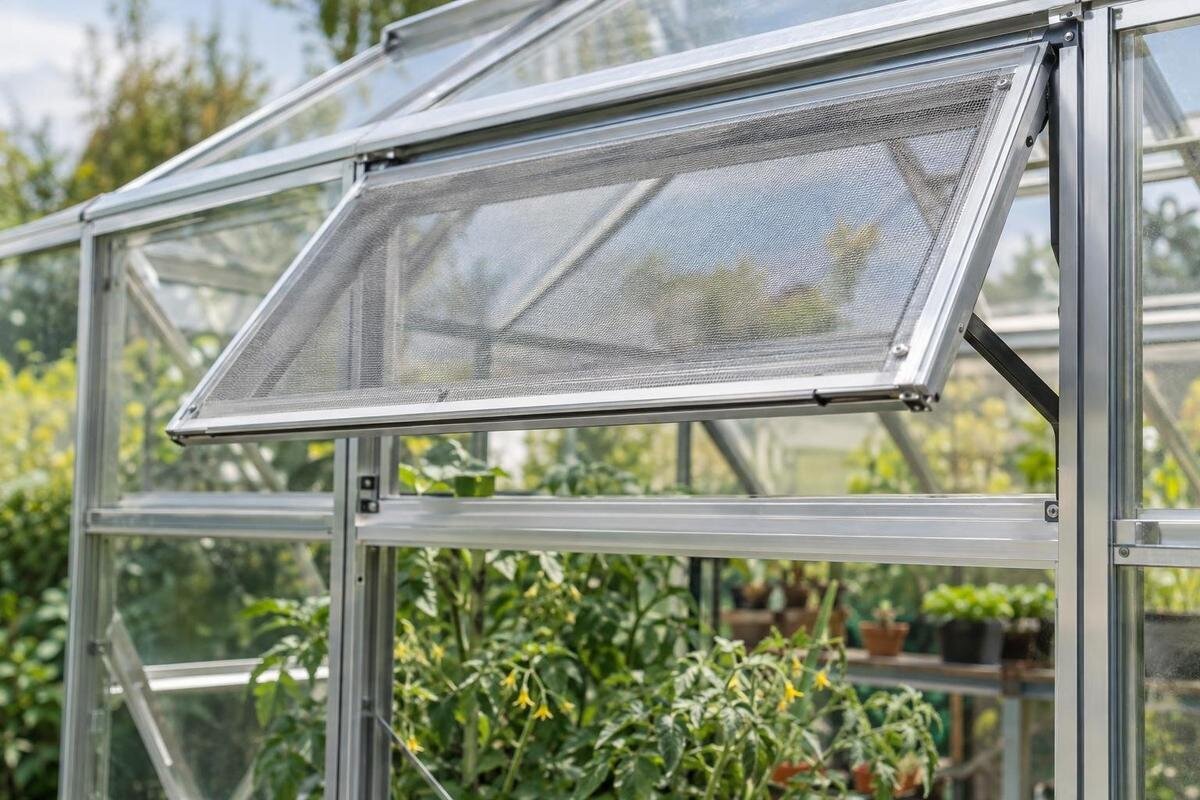
An insect screen over a greenhouse vent changes two things at once: which insects can pass and how easily air moves through the opening. That makes it a trade-off rather than a simple add-on. A smaller aperture can exclude smaller insects, but the mesh strands also occupy space that would otherwise be open to air. If the screen covers much of the ventilation route, the vent can be open yet deliver less air than it did without the mesh. The size of that change depends on screen construction, the area covered, the rest of the vent layout and conditions outside; there is no universal reduction to apply to every greenhouse. Where air uses several openings in sequence, restriction at one point can affect the whole route. The same fabric may also behave differently if doubled at a seam, stretched across a smaller vent or partly covered by a frame, so assess the installed screen, not just a loose sample.
Start by identifying the exact greenhouse and vent, not by ordering mesh labelled for greenhouse use. A product page for the T-Model Orangery Greenhouse helps name the model under consideration, but its name alone cannot confirm which screen fits or how much airflow remains. Find the matching manual or ask the supplier about the specific vent type, clear opening, fixing points and any opener clearance. Similar-looking windows can have different frames and opening paths, so general greenhouse dimensions are not enough. This information also helps distinguish a screen meant for a fixed panel from one intended to work with a moving vent.
Identify the insect before choosing mesh
Before selecting mesh, name the insect you are trying to exclude. Check affected leaves, new growth, the underside of foliage and the vent area; distinguish live insects from damage that could have another cause. Sticky cards can show that flying insects are present, but a catch alone may not identify the species or reveal non-flying stages. Clear photographs or an identified sample can help an experienced grower or horticultural adviser confirm the target. This matters because pest insects are not all the same size: openings that deter a larger flying insect may still admit a smaller species or life stage. A tiny insect can be hard to judge by eye, so do not estimate aperture suitability by holding mesh beside a leaf.
Ask a supplier for the clear aperture between threads and evidence that the mesh excludes the pest and stages you have identified. Mesh count alone is ambiguous: it describes spacing in a stated convention, not necessarily the usable gap. The relevant question is whether the insect can pass through, not its total length or wingspan; body shape and life stage matter, so pest-specific guidance is more dependable than a rough visual comparison. Ask whether the recommendation covers the named pest and whether it assumes a clean, correctly fitted screen. Do not pick the finest mesh available just in case; it may restrict airflow without addressing the actual pest route. When asking about a Pyramid Greenhouse, give its exact version and vent details so the advice relates to a real opening.
Before you buy 2
Read mesh specifications beyond the mesh count
When reading a mesh specification, separate three measures: clear aperture, or the gap an insect could pass through; mesh count, the number of openings over a stated length; and open area, the share of fabric left for air. They are related but not interchangeable. Two meshes with the same count can have different clear gaps when thread thickness differs, and a fine-looking fabric can leave less free area than its count suggests. Ask whether stated dimensions refer to the opening or the thread pitch, and request airflow or pressure information for the complete screen if available. Open-area percentage is not a guaranteed flow rate: weave and the pressure across the vent also matter. If figures are quoted, ask what they describe and whether they include the frame, seams and fitted position. This is more useful than choosing by a label such as fine or extra fine.
The fitted screen may differ from the specification for the mesh alone. Folds, seams and parts of the frame can cover some of the opening, while stretching can distort the gaps between threads. Ask whether the quoted open area describes just the fabric or the complete framed panel. Dust, pollen, cobwebs and plant debris can reduce that area further, so cleaning access matters when comparing arrangements. The floor area listed for Aluminium Greenhouses with Storage – Limited Edition is a separate measurement: it does not tell you how much clear opening is available for ventilation.
Assess the complete ventilation route
Look at the complete air path, not only the screened panel. List the vents that are actually used, their positions and opening range, and any other openings that normally carry air. If air enters through one screened vent and leaves through another, both screens contribute resistance; covering one opening does not mean the rest of the greenhouse has spare capacity. Doors and vents may also be opened at different times, so a brochure’s vent count cannot be treated as a measured air-exchange rate. A screen can leave a sash fully open while still reducing flow through it, and its frame can reduce the free opening further. Note which openings act as inlets and outlets in everyday use; a theoretical layout you do not use will not reflect actual performance.
If your growing set-up depends on substantial ventilation, ask the greenhouse or screen supplier for information about the full installed arrangement, not just a bare mesh sample. For a Bloomcabin Prestige Greenhouse, use the exact model and vent configuration when making that enquiry; figures from another greenhouse do not establish its screened capacity. Ask whether the stated vent area accounts for the frame and operating limits, and which openings need to be used together. Avoid resolving a ventilation problem by leaving an unscreened gap, since that restores an entry route at the same time.

Before you buy 3
Check screen compatibility with the vent
Fit is not just a question of matching a rectangle to the window. Check whether the vent pivots, slides or lifts, whether it uses an opener, which parts move and how the opening changes as the vent travels. A screen frame or loose mesh must not obstruct the full opening, catch a hinge or opener, rub against glazing, or leave a perimeter gap when the vent is shut or open. Ask how the screen is meant to sit in relation to the moving sash and fixed frame, and whether it can be removed for maintenance. A screen that clears the mechanism only when the vent is closed is not compatible with normal operation. Measure the clear opening, not just the outside edge of its frame, and show the supplier how the vent opens.
Before ordering, send the supplier the greenhouse model, exact size or variant, vent type, opening measurements and clear photographs with the vent closed and fully open. Ask how the proposed screen is retained and whether it changes the travel of any automatic opener. When choosing a screen for a Spacious Greenhouse, specify the particular size and vent arrangement rather than relying on the range name. Check whether the supplier’s dimensions refer to the screen panel, the clear opening or the full frame. These measurements are not interchangeable. Do not alter a frame or mechanism to make generic mesh fit; follow the relevant instructions or request model-specific advice.
Keep the mesh clean and intact
A screen only works as intended while its openings and edges remain clear and intact. During routine checks, look for tears, pulled threads, loose edges, sagging, damaged joins and gaps around the frame. Check for dust, pollen, cobwebs, dried leaves and other deposits as well. A small tear or gap may allow the target insect through even though most of the vent is covered; in the opposite direction, a dirty or distorted surface can further reduce air movement. Inspect the whole perimeter, not just the middle of the mesh, because a neat-looking panel can still be bypassed at an edge.
Follow the screen maker’s cleaning and repair instructions: vigorous brushing, stretching or an unsuitable cleaning product can damage some materials. For a model in the Aluminium Greenhouses range, distinguish instructions for cleaning the greenhouse from those for its fitted screen. Check more often when debris is accumulating or after the screen has been handled, and make sure the vent still opens and closes as intended after maintenance. Use a repair method approved for the mesh and frame; a patch that blocks a broad area can create another airflow restriction. A photograph of the fitted edge can help you spot movement or damage over time.
Before you buy 4
Screens prevent entry but do not remove existing pests
Vent screens are preventive barriers, not a way to remove an infestation already inside. Insects may have arrived on plants, growing media, tools or through an opening before the mesh was fitted, and they can continue feeding or reproducing indoors. Check new plants and the undersides of leaves before placing them with established crops; use monitoring that suits the suspected pest, and seek horticultural advice if you cannot identify it. Screens work alongside plant inspection and other pest-management measures, not as the whole control plan. Do not assume a screened vent will clear affected plants or prevent a pest already inside from moving.
Map other routes too: a door while open, damaged mesh, edges that do not meet the frame and any unscreened vent or service opening can bypass a good screen. You may need a consistent way to manage frequently used entrances, while still preserving access and ventilation. A screen fitted to a vent controls only that opening; it does not seal a greenhouse. Whether you are considering a Wall Greenhouse or another style, verify the likely entry points before attributing every new insect to mesh failure. Keep track of when and where insects are found: a pattern near a door or new plants points to a different route than repeated activity at a screened vent. Monitoring cards can help show activity, but they are not a complete survey of pests on plants.
Compare conditions before and after fitting
Treat fitting as a change to test, not a result to guess. Before installation, record temperature and humidity inside, along with the time, outside conditions, vent position, door use and unusual watering or other changes. Repeat observations after fitting at comparable times and with similar vent settings. Photos of the screen, its edges and the vent at full opening make it easier to notice a shifted mesh or obstructed mechanism later. Use the same monitoring set-up each time; a single before-and-after number taken in different weather is not a fair comparison. Note whether the mesh is new and clean or has accumulated debris.
Look for a pattern over several comparable observations rather than reacting to one hot or humid reading. If ventilation appears weaker, first check that the vent reaches its usual opening, the mesh is clean and no frame or edge is blocking it. Note other changes, including crop growth or objects that may alter the air path, before concluding that the mesh is responsible. For a model in the Limited Edition Aluminium Greenhouses range, record the particular version and vent layout alongside your observations. If the change persists, these notes will help the manufacturer or screen supplier understand the arrangement and discuss what to revise.

Before you buy 5
When a fine screen may not be the right choice
Fine mesh is not automatically the right answer. If you have not identified a target pest, a very tight weave may reduce airflow without a clear exclusion benefit; a horticultural adviser can help with identification before you buy. If the greenhouse already struggles to exchange air through its available vents, covering each opening with restrictive mesh may worsen that limitation. Once the pest is known, ask whether a less restrictive screen is documented to exclude it, or whether another ventilation arrangement is compatible with the greenhouse. Do not add an opening, change a vent or leave a screen loose as an improvised remedy.
Sometimes the useful response is a combination of measures: inspect incoming plants, reduce entry through doors and gaps, and choose a screen supported for the insect you have identified. If a supplier proposes more screened area or another vent configuration, ask how it works with your exact model and how the full arrangement affects airflow. A coarser mesh is not a compromise unless it still excludes the target; an unscreened opening may undo exclusion. If ventilation is already a concern, have the model’s approved options reviewed before fitting a restrictive screen. Where evidence is uncertain, make one documented change at a time so pest entry and ventilation effects can be distinguished.
What to confirm before buying insect mesh
Before you buy, collect three answers: which insect and life stage you are excluding; what clear aperture and airflow information the screen supplier provides; and which screen is confirmed for the exact vent and greenhouse variant. Add the practical details: openings that need screening, edge closure, access for cleaning, and clearance for hinges or an opener. Keep manuals and supplier replies with your greenhouse records. If one answer is missing, pause rather than using mesh count or a generic fits-most description as a substitute. Written confirmation can prevent confusion between a screen designed for a vent type and one verified for your actual model.
After fitting, treat the mesh as part of a monitored ventilation plan. Check that it remains clean and secure, confirm the vent still moves freely, and compare conditions with your baseline. If insects continue to appear, inspect edges and other entry routes as well as the mesh aperture; if airflow seems reduced, review dirt and vent operation before replacing the screen. Include cleaning access in your choice: an inaccessible screen is harder to keep clear and aligned. The most appropriate mesh is not necessarily the finest; it is the one with evidence for your target pest, a compatible fit and an acceptable effect on the greenhouse’s actual air path.
Frequently asked questions
Does insect mesh reduce airflow through a greenhouse vent?
Yes. Mesh occupies part of the opening and adds resistance, so airflow is usually lower than through the same unobstructed vent. The amount depends on the aperture, thread thickness, screen area, cleanliness and the rest of the ventilation route. Ask for information about the fitted assembly where available; mesh count alone cannot quantify the effect.
How fine should greenhouse vent mesh be?
Choose it for the pest and life stage you have identified, not for a general claim that it is pest-proof. Compare the measured clear aperture with supplier evidence for that insect, then consider open area and airflow. There is no single mesh size that suits every pest, crop and vent arrangement.
Do all greenhouse vents need the same screen?
Not automatically. Consider every opening that could admit the target pest, including other vents and doors, but also check each opening’s role in the air path. Using the same very fine mesh everywhere may cause unnecessary restriction, so confirm the complete arrangement rather than deciding by vent count alone.
Will a screen get rid of insects already inside?
No. A screen limits access through the opening it covers; it does not remove insects on plants or in growing media, or those that enter through doors, gaps or new plants. Monitor and manage an existing infestation separately, and seek horticultural advice if you cannot identify the pest.
Can I fit generic insect mesh to any greenhouse vent?
No. Mesh with a suitable aperture may still leave gaps, obstruct an opener or restrict airflow more than the vent arrangement can accommodate. Check the exact greenhouse model and vent, take measurements, and confirm compatibility with the supplier or the relevant instructions.
The aim is not to seal every opening with the finest mesh available. Match a measured screen to a defined pest, preserve as much usable ventilation as the chosen exclusion level allows, and confirm that the mesh fits the vent. With supplier details, a clean installation and comparable records, you can judge whether the compromise is working and identify what to revisit if pests or ventilation remain a problem.
