
Growing Okra in a Greenhouse in Malta
Greenhouse growing guide
Okra is a warm-season crop, so Malta’s long, sunny growing period makes it a realistic choice; a greenhouse is not automatically an improvement. Its main benefit is helping the soil and night air warm earlier and extending the crop into cooler parts of the year. Its main risk is trapping excessive heat during bright weather. Success depends on timing, reliable ventilation, enough room for a tall plant and frequent picking. For most home growers, an unheated greenhouse is best treated as a seasonal extender, not a way to grow okra through winter. Heating is worth considering only when the extra harvest justifies the energy and effort.

What to check before choosing a greenhouse 1
Is Malta warm enough for okra?
Okra is a frost-sensitive, warm-season vegetable. It grows reliably only when soil and air are warm: cold soil delays germination, while repeated cool nights slow seedlings and later growth. A soil temperature around 20–21°C is a useful lower guide for sowing, although variety and conditions make a difference. Regular nights below about 15°C can set plants back, even if daytime sunshine feels strong. A greenhouse may raise the daytime temperature, but that alone does not prove that the bed or the night air is warm enough for an early start. Waiting for a settled warm spell can save time compared with sowing into cold soil.
Malta’s extended warm season gives okra a useful window, often with sowing in late spring or early summer and picking through the hottest months; exact dates depend on exposure and the year. At a sunny, sheltered site, open ground may already provide enough warmth for the main crop, so a greenhouse is optional rather than essential. Under cover, a warmer start can bring flowering forward, but opening doors and vents becomes essential when the weather is bright. The useful question is whether the structure adds warm weeks at the beginning or end of your season without making the summer environment too hot. Local temperature readings are more useful than relying on a calendar alone.
Sowing and the length of the growing season
Direct sowing is straightforward once the soil is warm enough, and avoids moving a plant with a developing taproot. Sow several seeds at the depth and spacing stated on the packet, then thin seedlings to the strongest plant at each position. For an earlier start, sow into individual deep modules in a warm, bright place and transplant with the root ball intact; avoid keeping seedlings in small cells for too long. In warm conditions, seeds often emerge within roughly one to two weeks, while cool compost can stretch germination or make it uneven. Keep the growing medium moist but not waterlogged until the seedlings emerge.
Check the variety description for days to maturity, because the first-picking estimate varies between cultivars and can shift with temperature. Many varieties begin cropping in roughly 50–65 days from sowing under favourable conditions, but a slow start can add time. Count backwards from the point when nights are likely to cool rather than assuming a greenhouse will make up for any delay. The harvest window can last longer if the plant continues flowering, so a few staggered sowings may spread the supply when space allows. In a small greenhouse, one healthy plant may be enough for a trial; too many can crowd the aisle and make regular picking harder.
What to check before choosing a greenhouse 2
How much warmth does an unheated greenhouse add?
An unheated greenhouse gathers solar warmth during the day and can shelter plants from wind, but it does not hold a stable temperature by itself. Heat falls after sunset, and the overnight minimum depends on the cover, air leaks, exposure and warmth stored in the soil and surrounding materials. A clear day can therefore produce a warm afternoon followed by a cool night. Okra may survive such variation, but growth can pause, shortening the useful season. A greenhouse helps when it reduces a modest seasonal chill; it is not a dependable substitute for heating during cold spells. The word greenhouse alone does not tell you what temperature a particular site will maintain.
Before planting a full row, record the minimum air temperature at plant height and the soil temperature at sowing depth over several days and nights. A min/max thermometer helps reveal the gap between a warm afternoon and a cool night. You could try a small number of plants under cover and compare them with one outdoors in a similarly sunny position to see whether the greenhouse advances growth at your site. For a floor-area comparison, the Aluminium Classic Greenhouse is listed in sizes from 3.77 m² to 28.08 m². That range describes available area, not overnight warmth, glazing performance or ventilation, so check those separately.
When does heating make sense?
Heating is most defensible when you have a clear aim: starting seedlings earlier, protecting a planned late crop from cool nights or keeping a mixed greenhouse crop within its required range. For okra alone, heating a whole structure through winter is often a poor match. The plant is annual, production slows with inadequate light as well as low temperature, and the harvest may not repay the energy used. In Malta’s warm season, heating normally adds nothing; at the season’s edges, compare the likely extra picking period with the running cost and effort. Even warmer nights cannot make a short, dull period behave like summer.
A lower-energy plan is to wait for warm soil and start only a few seedlings in a warm place, rather than heating the whole greenhouse just to germinate them. If you use supplementary heat, follow the equipment maker’s directions and monitor actual temperatures; a thermostat setting alone does not prove that conditions suit the crop. A compact option to compare is the Aluminium Lean-to Greenhouse, listed from 3.69 m² to 14.34 m². When considering heating, account for the site, exposure and construction as well as the size. Base the decision on measured conditions and your intended harvest window, not on the assumption that any covered space needs heat.

What to check before choosing a greenhouse 3
Ventilation for Malta’s hot, sunny weather
Malta’s sunshine makes ventilation central to growing okra under glass. A closed greenhouse can heat much faster than the outdoor air, so open doors and available vents early on bright days rather than waiting for leaves to wilt. Keep access to openings clear and check temperature at plant level, since a thermometer near a shaded doorway may miss the hottest part. Okra appreciates warmth, but the hottest possible air is not a target: excessive heat can stress plants, dry containers rapidly and interfere with steady flowering. Air exchange also helps reduce stagnant, humid conditions around foliage. If the interior remains excessively hot after opening, consider temporary shading, while remembering that heavy shade reduces light.
Ventilation is worth considering before you buy, not treating as an optional extra. Check the product specifications for the number and location of opening vents and doors, how they are operated, and whether you can reach them easily. The Limited Edition Aluminium Greenhouse is listed in sizes from 3.77 m² to 28.08 m². When comparing sizes, consider where the plants will stand in relation to the openings and whether foliage could obstruct access as it grows. Assess the ventilation arrangements against your site’s summer exposure. If openings are limited or awkward to use, consider whether you will be able to ventilate consistently during hot spells.
Plant spacing and room for access
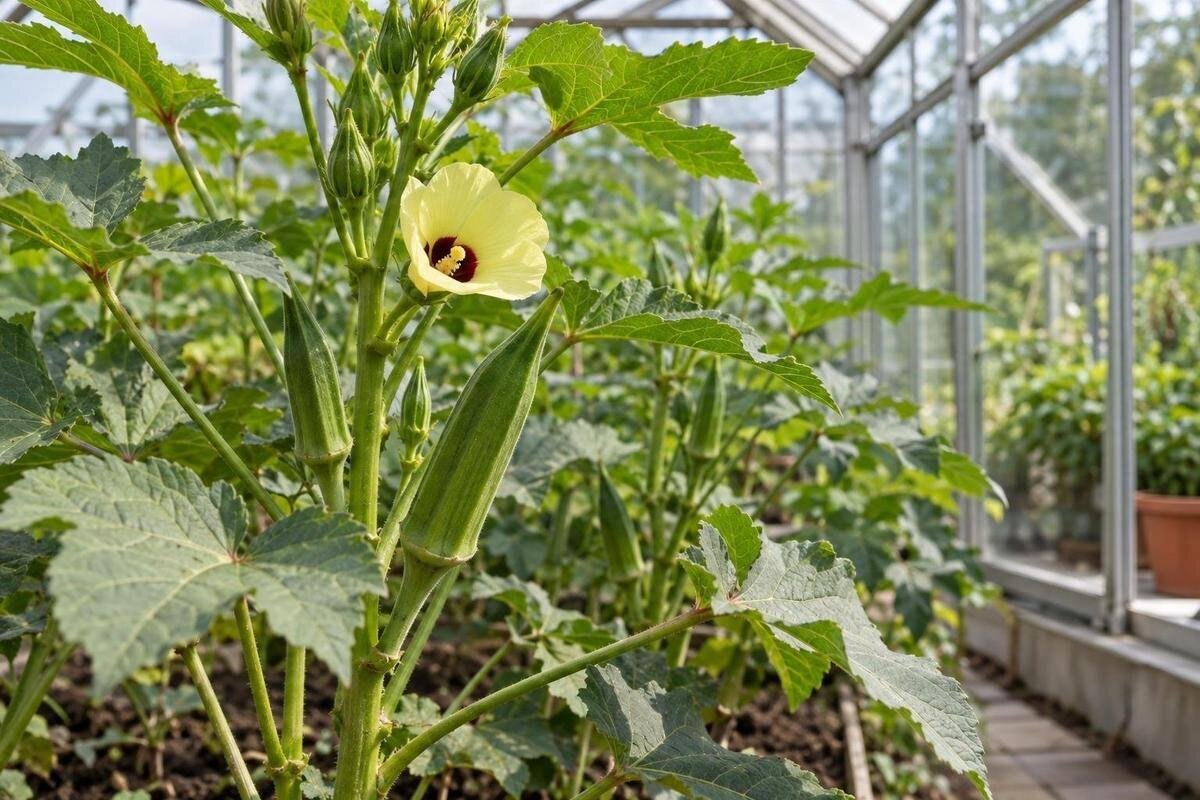
Okra can form a tall main stem and side branches, and its height varies with the cultivar and growing conditions. Many varieties reach around 1–2 m, so read the seed description and leave enough headroom to inspect, water and pick without bending stems into the roof. As a practical starting point, allow about 30–45 cm between plants and around 75–90 cm between rows; follow the variety’s advice and allow more room for vigorous plants. In a greenhouse, the aisle matters as much as the bed. If foliage fills the route, routine harvesting becomes awkward and air movement around the crop suffers. A few well-spaced plants are usually a better first trial than a crowded row.
Draw the bed, pots and walking route on a plan before choosing a footprint. Include the door access area, room to reach each side of a plant and space for tools or a watering can; the full floor area is not all growing area. Deep containers can work if they drain freely and provide enough root room, but large plants still need space above and around them. The T-Model Orangery Greenhouse is listed from 16.52 m² to 30 m². Compare the actual dimensions with your proposed layout rather than estimating plant numbers from the total area. Check that you can reach the furthest plants without stepping into beds or squeezing between containers.
What to check before choosing a greenhouse 4
Soil, watering and feeding
Choose a sunny growing position with fertile, freely draining soil. Okra roots dislike persistent waterlogging, and a compacted bed makes it harder for roots to develop. Address poor drainage and improve the growing medium before planting. Greenhouse beds do not receive rainfall, and pots can dry especially quickly in warm, ventilated weather. Check moisture below the surface and water the root zone when needed, keeping the supply steady while flowers and pods are developing. Avoid leaving containers standing in water. If growing in a pot, use a deep, stable container and a suitable free-draining growing medium rather than a shallow decorative pot.
Okra does not need lavish feeding. Mix in mature compost where the soil needs organic matter, then use a balanced fertiliser according to its label if growth or the growing medium calls for it. Excess nitrogen can produce a mass of leaves at the expense of flowers and pods, so avoid repeated feeding simply because the plants look vigorous. Watering and feeding are linked: nutrients in a container are used and washed through differently from those in a bed, so follow the compost and fertiliser instructions. The Pyramid Greenhouse range is listed from 5.53 m² to 18.9 m²; when comparing any footprint, allow for bed or container access and the route for watering, not just the planted surface.
Flowering and harvesting okra
Okra flowers usually set pods without hand pollination: the crop is generally self-pollinating, so a home grower does not normally need to transfer pollen by hand. If flowers appear but pods do not develop, consider the wider conditions before blaming a lack of insects. Cool nights can slow growth; severe heat, uneven watering or overcrowding may also affect flowering and fruit set. Inspect plants regularly and note whether flowers are dropping, whether new buds continue to form and whether young pods begin to swell. These observations can help distinguish a pollination problem from temperature or moisture stress, avoiding unnecessary extra work.
Pick pods while they are young and tender, before they become long, fibrous and full of mature seeds. For many varieties, that is around 5–8 cm, though the seed packet is a better guide for the cultivar you have chosen. During a productive spell, check daily or every other day; pods can pass their best eating stage quickly in warm weather. Use snips if the stems are firm, and wear gloves if the plant’s fine hairs irritate your skin. If you want space for tools as well as plants, the Limited Edition Aluminium Greenhouse with Storage is listed from 5.52 m² to 28.08 m². Check the division between storage and growing space when planning access for picking.

What to check before choosing a greenhouse 5
Pests and disease in a protected crop
Warm greenhouse conditions can also favour common pests such as aphids, whiteflies and spider mites. Check the undersides of leaves, young growing tips and the base of flower buds at least weekly, and more often when temperatures rise or pests have appeared. Look for clusters, fine webbing, sticky deposits or speckled leaves rather than assuming one symptom tells you the cause. Inspect new plants before bringing them under cover and keep weeds and plant debris under control. Dense, stagnant foliage can also stay damp. If you cannot identify a problem, get it identified before choosing a treatment, and consider water stress as well as pests when leaves change colour.
Leave enough room to inspect foliage closely and reach affected parts of a plant. Remove fallen leaves and old pods, avoid keeping the soil saturated, and clean tools after dealing with an affected plant. Before applying any treatment, check that it is suitable for edible okra and for use in a protected growing space, and follow its instructions. The Bloomcabin Prestige Greenhouse is listed from 3.77 m² to 28.08 m². When planning beds within your chosen size, allow access for checking leaf undersides and removing debris, not just for watering along the edge of the bed.
Choosing a greenhouse around the crop
Choose the greenhouse around the crop and its wider use. First decide how many plants you want, whether they will grow in a bed or containers, and whether other crops will share the space. Consider whether you can ventilate, water and harvest during the hottest part of the season. Check the model’s floor area, internal height, opening arrangements and door access, as well as whether its location suits the available light and access to water. Do not infer these details from a product name or photograph. If you already have a greenhouse, try a few plants before adding a heater or redesigning the space.
A very large growing space is not necessary for a few okra plants. If you are planning several crops or a dedicated work area as well, the Bloomcabin Orangerie is listed from 47 m² to 70 m². Consider that range in relation to the whole growing plan rather than the okra crop alone. Decide which areas would hold other crops, where you would work and how you would move between them. A larger structure should serve those wider needs; a small trial of okra does not by itself justify the extra space.
Frequently asked questions
Can okra grow in an unheated greenhouse through winter in Malta?
Not reliably as a productive crop. An unheated greenhouse can buffer some cool weather, but it does not maintain steady warmth overnight, and short, dull days also limit growth. Heating may extend the season, but heating a whole greenhouse for one annual crop is often difficult to justify.
Can I grow okra outdoors in Malta?
Yes, if the soil is warm enough and the plants have a sunny, sheltered position. For the main warm season, a greenhouse may not be necessary. Growing under cover is most useful if it brings planting forward or helps the crop continue later.
How much space does an okra plant need?
As a starting point, allow about 30–45 cm between plants and 75–90 cm between rows, then check the variety’s advice. Leave room for the plant’s height, side branches, an aisle and access for harvesting.
Do okra flowers need hand pollination in a greenhouse?
Usually not. Okra is generally self-pollinating, so home growers do not normally need to move pollen by hand. If flowers drop without pods forming, check temperature, watering and plant health before assuming pollination is the problem.
How often should I pick okra pods?
Check plants daily or every other day when they are producing. Pick pods while they are young and tender—often around 5–8 cm, depending on the variety—before they become tough and fibrous.
Okra is a realistic warm-season greenhouse crop in Malta, but using cover to extend the warm growing season is more practical than trying to maintain a winter crop. Sow according to soil temperature, check overnight readings before planting in an unheated greenhouse, and be ready to ventilate early on sunny days. A modest number of well-spaced plants and frequent picking will show whether cover adds a useful harvest at your site. If summer already provides enough warmth outdoors, that is a sound result too; a greenhouse can remain available for crops that benefit more from protection.
