
Seedling Bench Heat or Whole-Greenhouse Heat?
Greenhouse heating
Whether to heat a seedling bench or the whole greenhouse depends on what the crop needs warmed. Seeds may need suitable growing-medium conditions to germinate, while emerged seedlings also depend on the air around their leaves. Local root-zone heat can avoid treating the entire greenhouse as one warm zone, but it cannot make unsuitable air harmless. Compare the crop's requirements at each stage with the area you plan to heat and the greenhouse's heat loss.

What a heated bench warms
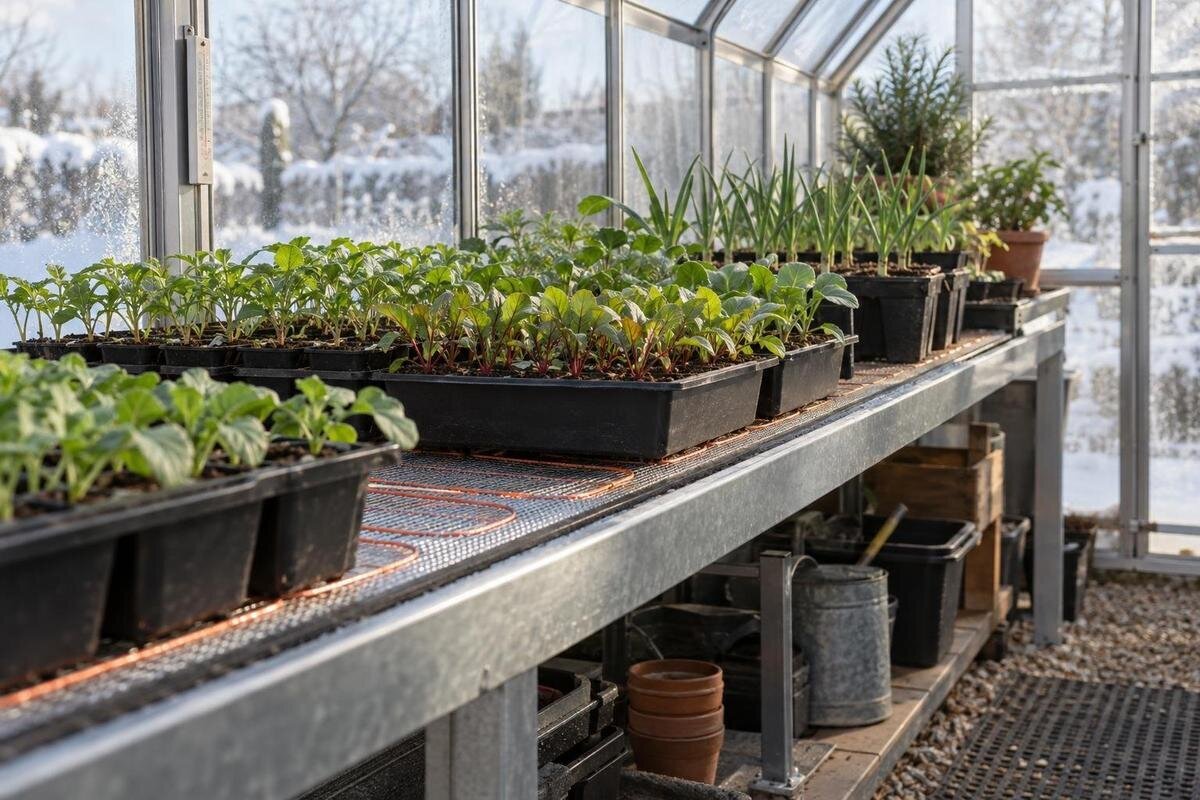
A heated seedling bench targets a defined surface, usually the area carrying trays or pots, so the growing medium can be warmer than the surrounding air. Depending on the equipment, warmth reaches containers through a mat, bench surface or another designed arrangement; follow the manufacturer's instructions rather than assuming every system transfers heat in the same way. Some warmth passes between the medium and surrounding air, but that does not make the greenhouse evenly warm. A whole-greenhouse heater has a different job: it raises the temperature of a larger air volume and influences the space around leaves, benches and paths. Its distribution still depends on the heater and layout.
These are different targets, not simply two settings for the same job. A warm root zone cannot keep leaves warm if the surrounding air is too cold for the crop. Equally, heating all the greenhouse air to a propagation target may be unnecessary when only a few trays need warmth and seedlings tolerate the ambient conditions. Air and medium temperatures influence one another, but they do not match automatically; their difference changes with the equipment, layout and weather. Compare both measurements with crop guidance, rather than relying on the number displayed by one control. The question is which growing zone needs to meet the crop's requirements.
When local root-zone heat suits propagation
For seed sowing, local heat can suit a task concentrated in one area when crop guidance calls for a warm growing medium during germination. It can be practical for small batches, repeat sowings or trays kept together, especially if the rest of the greenhouse serves another purpose. This arrangement makes most sense when the bench can be treated as its own zone and the seedlings can still have suitable air conditions without warming the full space. It is not a universal germination setting: species differ, and some seeds do not benefit from extra warmth. Use the seed supplier's instructions as your reference, and position trays as the heating equipment maker specifies. If varieties have different needs, avoid assuming one bench setting will suit them all.
Estimate the heated area before choosing bench equipment or a greenhouse footprint. Count the trays likely to be in use at once, the space needed to reach and remove them, and room for watering and handling young plants; do not treat the whole floor as propagation space. The Limited Edition Aluminium Greenhouses listing covers sizes from 3.77 m² to 28.08 m², but a published area range does not show the usable bench surface in a particular configuration. Check the selected model's measurements and plan the working area independently, allowing room for tasks that are not heated.
When the surrounding air also needs heat
After emergence, roots are only part of the growing environment. Seedlings need air conditions suitable for the crop around their leaves, and a warmed pot cannot compensate if foliage is exposed to unsuitable cold or pronounced fluctuations. Bench heat may remain useful as plants grow, but you still need to assess the medium and the surrounding air separately. If you are raising crops that need sustained warmth around the whole plant, or using several benches and shelves, heating the greenhouse air may be more appropriate. Check reliable crop-specific guidance; do not assume that a suitable root-zone temperature alone means the seedlings have suitable growing conditions.
Whole-space heating becomes more relevant when the greenhouse is being used for growing seedlings on rather than only for germination. It may suit several propagation areas that need similar air conditions, although temperatures can still vary within a structure. The Pyramid Greenhouse listing includes sizes from 5.53 m² to 18.9 m². When comparing these options, consider where trays will go after germination as well as where you will sow them. If young plants will occupy several parts of the greenhouse, include those areas when deciding whether a heated bench will cover the task.
Reassess heat after germination
Sowing, germination and growing-on are related but not identical stages. A temperature selected to encourage germination may not be the best continuing condition once shoots appear. Check the crop's guidance for what should change, if anything, rather than leaving a bench at one setting by habit. This matters when several seed types share a mat or heated bench: one control may give them all the same medium temperature even if their requirements differ. Group batches with similar needs where practical, or use separately controlled equipment if the system is designed to allow it.
Light becomes a more visible part of the balance after emergence. For many seedlings, warmth can accelerate growth, so a warm root zone paired with insufficient light may encourage stretched growth rather than sturdy development. That does not mean heat should be switched off suddenly: assess the species, stage, and actual air and medium readings, then adjust in line with growing guidance. If a batch is moved from a heated area to a cooler part of the greenhouse, a gradual change may be more suitable than an abrupt one, depending on the crop. Treat the move as a change in growing conditions, not just a change of bench.

Plan the heated area around benches
Draw the working zone before comparing heater types. Mark the surfaces that will actually carry trays, plus aisles, access to doors and vents, space to lift trays out, and any area needed for potting or watering. Bench heating relates to the surface and containers served by the system; a greenhouse floor measurement does not tell you how many trays fit on that surface. If benches are on more than one level, verify that the equipment is designed for that arrangement and that you can still tend every tray. Also consider how routine access and door use may affect the air around your plants. Count the zone you intend to use, not every square metre under cover.
The same plan helps compare a local zone with a whole heated room. One bench in a greenhouse is a different heating task from several working benches spread across it, even before heat loss is considered. The T-Model Orangery Greenhouse range is listed from 16.52 m² to 30 m²; those figures describe available area options, not a guaranteed bench layout. For the selected size, confirm the exact dimensions and how doors, circulation and work surfaces affect the area you can actually heat and use.
Compare energy use with realistic assumptions
Local heating can use less energy when it warms a small bench area for limited periods instead of maintaining a warmer air temperature throughout the greenhouse, but it is not automatically cheaper. The result depends on the area being heated, the temperature difference, operating hours, system input and control behaviour. Heat also escapes through the greenhouse covering and through air exchange; the amount depends on the structure, its condition, ventilation and outdoor weather. A bench may lose some warmth to the surrounding space, while whole-air heating can serve plants across a larger area. Compare the actual growing task rather than relying on a heater label or a general claim about savings.
For a transparent running-cost estimate, use the heater's documented electrical input, realistic hours of operation and the electricity tariff that applies to you. With thermostatic cycling, actual consumption will not necessarily match a simple full-power estimate, so state your assumptions and treat the result as an estimate. The Bloomcabin Prestige Greenhouse listing includes sizes from 3.77 m² to 28.08 m², but area alone cannot establish heat loss or the heater capacity needed. Check documented information for the chosen greenhouse and heater, and compare like-for-like periods of use. Germinating a batch for a limited period is also a different task from maintaining warm growing conditions over a longer season.
Measure the medium and the air separately
Measure growing-medium temperature at representative trays and air temperature around seedling height. A heater display or mat-surface reading may describe its sensor or heating element, not the conditions inside a root ball or at the leaves. Record readings during the periods that matter to the crop, including cooler parts of the day, and compare them with crop guidance. If the bench spans a large or uneven area, check more than one tray; a single reading cannot show that every container has the same conditions. Use probes suited to the measurements you need and follow the equipment instructions.
The readings can change which heating method makes sense. If the medium reaches the required range but the surrounding air does not, consider whether the seedlings can grow in that air or whether some space heating is needed. If the air is suitable but the bench is too cool, local heat may address the actual problem. The Wall Greenhouse listing covers sizes from 3.69 m² to 14.34 m². When planning a propagation area within your selected size, identify where representative trays and air readings can be checked during normal use. Compare readings across that area rather than treating one convenient measuring point as representative of every plant.
Account for watering, storage and access
Heat affects watering decisions as well as temperature. A warmer growing medium can lose moisture at a different rate from a cooler one, so check the compost or substrate rather than watering to an unchanged timetable. Do not add water simply because a heated mat is running: tray depth, plant size, airflow and the greenhouse environment all influence drying. Keep drainage and access in mind so trays can be checked and watered without disturbing the heating arrangement. The aim is to meet the crop's normal moisture needs while monitoring the warmer zone, not to use extra water as a way of compensating for cool air.
Tools, spare trays and watering equipment also occupy usable room. If you are considering storage within a greenhouse, include it in the layout instead of counting the full floor area as available bench space. The Limited Edition greenhouses with storage listing gives sizes from 5.52 m² to 28.08 m². The product name identifies a storage option, but the area range does not tell you how much bench surface remains in your chosen arrangement. Confirm the actual dimensions, keep a workable route to the seedlings, and allow enough space to inspect and move them.

Choose the greenhouse around its intended use
Whether you already have a greenhouse or are choosing one, consider the propagation work first: the number of trays, bench area, plants to grow on, and whether the air around them must also be warm. Review the information for the particular model, including its usable dimensions and any stated ventilation or insulation details. Do not infer thermal performance from appearance, material name, size or a product photograph. More room can make work easier, but it can also mean more air and surfaces to heat if you intend to warm the whole space. The heater's documented capacity and intended use must match the conditions you are trying to maintain.
Scale matters when whole-greenhouse heating is under consideration. The Spacious Greenhouse range is listed from 47 m² to 70 m², so distinguish the area needed for propagation from the total space available. If you intend to heat the whole structure, use the chosen greenhouse specification, actual ventilation needs, intended air conditions and local weather assumptions when getting an estimate. Establish which heating equipment, controls and any insulation are included in the proposal, rather than assuming they form part of the greenhouse listing. For fixed or mains-powered equipment, follow the maker's instructions and have the proposed setup assessed by a qualified professional where appropriate.
Choosing bench heat, space heat or both
Begin with the crop, not the heater. Bench or root-zone heat can be the main approach when the task is a small, defined group of trays, crop guidance calls for warmer medium, and the surrounding air remains suitable. Consider whole-space heat when seedlings need warmer air around their leaves across the greenhouse, when many benches need a shared environment, or when the space will be used for ongoing warm growth. A mixed setup may suit a bench that needs a warmer root zone while the rest of the greenhouse has a different target, provided both zones can be controlled and checked.
Before buying, set out what each option would need to serve: a defined tray area, the air throughout the greenhouse, or both. Note the growing-medium and air requirements, expected hours of use and documented heater inputs for each arrangement. The Aluminium Greenhouses listing covers sizes from 3.77 m² to 28.08 m², giving you a range of footprints to compare with your planned layout. Use the space you will actually grow in as the basis for that comparison. This keeps the choice tied to the propagation task, rather than assuming that every part of the greenhouse must be equally warm.
Frequently asked questions
Will a heated bench warm the rest of the greenhouse?
Not reliably. A heated bench is intended to warm a defined growing area, while greenhouse air and plants outside that area may remain cooler. Heat can pass from the bench into the surrounding space, but it does not ensure even air temperatures. Measure the air around the seedlings as well as the growing medium.
Is bench heating always cheaper than heating the greenhouse?
No. It can use less energy when only a small area needs warmth, but the result depends on the heater, operating hours, temperature targets, greenhouse heat loss and your electricity tariff. Compare documented heater input and realistic use; do not assume a saving from the heating method alone.
Do all seeds need a heated bench?
No. Germination requirements vary between species, and some seeds do not need extra warmth. Use the seed supplier's guidance for the growing medium and germination stage. A heated bench is useful only when it matches the needs of the seeds you are raising.
What if the roots are warm but the seedlings are in cool air?
Root-zone warmth does not replace suitable air conditions around leaves. If the air is outside the crop's growing requirements, consider whether space heating or a separate heated zone is needed. Check both air and medium conditions against reliable guidance for the crop and its current stage.
What should I compare before choosing a heating method?
List the crops and stages, the required medium and air conditions, the bench area, and how long the heat will be used. Then compare those needs with documented heater specifications, the greenhouse's verified details and your local tariff. Measurements are more useful than assumptions based on floor area alone.
The useful comparison is not bench heat versus whole-greenhouse heat in the abstract. It is which plant zone needs warmth, for how long, and across how much space. A heated bench can suit propagation when the medium is the priority and the surrounding air remains adequate; whole-space heating matters when the canopy also needs warmth. Measure both conditions and choose around the crops you are raising.
