
Greenhouse Relocation: Is Moving It Worthwhile?
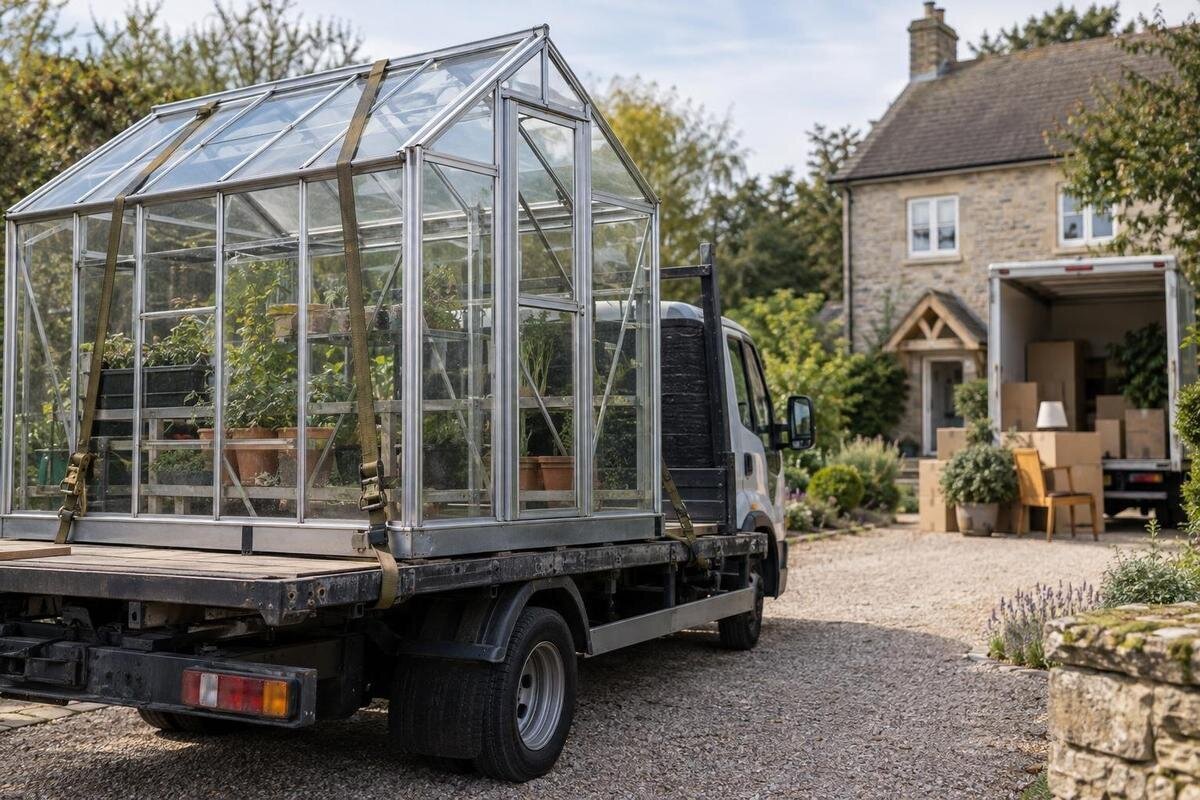
Greenhouse planning
Moving home turns a greenhouse into a practical decision: take it apart and rebuild it, leave or sell it, or replace it at the new property. The right choice depends less on what it originally cost than on its current condition, whether it is realistically reusable, what the new garden can accommodate and the complete cost of each option. This guide helps you compare those factors before arranging transport; it does not explain how to dismantle the structure.

Assess the greenhouse as it stands
Before asking anyone to move it, assess the greenhouse you actually own. Note its age if known, but give more weight to its visible condition and maintenance history. Look for damaged or missing glazing, loose or distorted frame members, deteriorating seals, corrosion where relevant, and doors or vents that no longer operate smoothly. The material and construction affect what these signs mean, so a mark or small gap does not by itself prove that the whole structure is unsound. Photographs from several angles, invoices, manuals and a record of earlier repairs give a supplier or installer useful information to review.
Separate cosmetic wear from problems that could make reuse unreliable. A greenhouse that has been maintained and has identifiable parts may justify a relocation assessment; repeated leaks, missing components or undocumented alterations may mean repair costs need to be added first. This is not a remote diagnosis: if the frame is bent, glazing is damaged or the structure’s condition is in doubt, ask a suitably qualified greenhouse installer or supplier to inspect it. Record which shelves, staging or accessories belong to the current setup and whether you want to keep them. They affect the value you are moving and may change how useful the greenhouse will be at the new home.
Confirm that dismantling and reassembly are realistic
Find the make, model and assembly information before assuming the greenhouse can be taken apart and put back together. Ask a supplier, installer or removal specialist whether the design is serviceable, which parts can be identified and whether reassembly is within their scope. Check what evidence they need for a firm view: the manual, photographs, purchase records, measurements or an inspection. A structure assembled with undocumented changes may be harder to assess, while a missing manual does not automatically make relocation impossible. It does add uncertainty to the estimate. Keep the question focused on feasibility and scope; a general transport quote is not confirmation that reassembly will work.
Get the provider’s answer in writing, including whether the estimate covers dismantling, transport, reassembly, replacement parts and any separate repair work. Ask whether one firm accepts responsibility for all stages or whether you will need to coordinate several providers; gaps between their scopes can leave the greenhouse incomplete or in storage. If replacement is a credible alternative, the aluminium greenhouse range includes listed areas from 3.77 m² to 28.08 m². Choose a size that meets your needs as a starting point for the comparison. Keep the assessment of your existing greenhouse separate: a replacement listing cannot establish whether its frame or components can be reused.
Price every part of the decision
Compare complete costs, not just the removal charge. Request an estimate that separates assessment, specialist labour, transport, temporary storage if needed, reassembly, repair or replacement parts, and work at the new site. Include any cost of leaving the greenhouse behind, such as removal or disposal if applicable, as well as the cost of preparing an alternative. A replacement estimate should make clear whether delivery, assembly and site work are included or quoted separately; do not assume a product’s headline price covers them. The scope varies by provider, so request written figures that can be compared rather than adding a guessed percentage to the relocation estimate.
Include indirect costs too. If the greenhouse will be unavailable during a growing period, consider whether you are willing to pause production, move plants temporarily or give up a season of use. If plants or contents cannot travel with it, account for their replacement as a separate cost. For a replacement price comparison, Limited Edition aluminium greenhouses are listed in areas from 3.77 m² to 28.08 m². Request the full cost of a particular size rather than comparing a broad range with a detailed relocation estimate. Keep unpriced repairs visible as unknowns, and distinguish money you would need to spend from inconvenience you would be prepared to accept.
Check the new garden against the greenhouse’s footprint
Measure the greenhouse as it stands, including its external length and width, height and door position if available. Catalogue floor area alone will not establish whether the existing structure fits. At the new property, check the usable space around it as well as the nominal patch: access for installation, paths, boundaries, nearby trees and structures, room to open doors, and obstructions above or beside it. Consider the actual pattern of sun and shade, drainage and access to water rather than assuming the plot will behave like the old one. A sketch with measurements can reveal a mismatch before you pay for transport.
Identify whether the existing greenhouse is freestanding or designed to sit against a wall; the new property may not offer an equivalent position. If you are considering a different configuration, the lean-to wall greenhouse is listed in areas from 3.69 m² to 14.34 m². Use the exact dimensions of the selected size on your site sketch, rather than relying on floor area alone. Discuss the proposed wall and location with the supplier, and ask an appropriate professional to assess any site condition outside your experience. This comparison may reveal that a different layout fits the new garden better than the structure you already own.

Compare replacement options on equal terms
A replacement can be smaller, larger or differently configured, so decide what you genuinely need before comparing prices. Write down what the greenhouse must do at the new home: how much growing area you will use, whether you want to raise seedlings or grow through a season, how many people will work inside, and what access or storage matters. Do not pay to reproduce every feature simply because the old structure has it. Equally, a cheaper and smaller option may not serve if you plan to grow at the same scale. Compare against a greenhouse that meets your requirements, rather than choosing one simply because its quoted price is easy to find.
Select a specific replacement and compare its dimensions, included components and installation scope with the relocation estimate. The T-model orangery greenhouse is listed in areas from 16.52 m² to 30 m², giving you another range to consider against your space requirements. Once you have chosen a size to investigate, confirm its specification and whether delivery, assembly and site work are included in the quoted price. Your comparison should show which costs are fixed, which depend on inspection and what has been excluded. Otherwise, an estimate that includes repairs and reassembly can look unfairly expensive beside a product price that covers far less.
Allow for damage and missing parts
Transport and reassembly create uncertainty beyond the greenhouse’s original condition. Glazing, panels, seals, fixings and frame members may be damaged or misplaced, or prove unsuitable once the structure is dismantled. The risk depends on the design, material, age and any previous alterations, so there is no reliable percentage to add to every move. Ask the person assessing it to identify likely replacement parts and explain which unknowns could change the final estimate. If parts are no longer available, check whether an alternative can be sourced and used in the specific frame. Do not assume that a generic replacement will fit. This detail can matter more than the transport cost.
Ask what happens if a problem emerges after work begins: who will discuss extra costs with you, how damage will be documented, and whether temporary storage is available if reassembly is delayed. Agree who will authorise additional spending rather than leaving that question until the greenhouse is in pieces. If these uncertainties make replacement worth considering, the Oasis pyramid greenhouse is listed in areas from 5.53 m² to 18.9 m². Obtain a quote for a suitable size to compare with the revised relocation estimate. The useful comparison is between the likely cost of a complete, usable greenhouse under each option, not the purchase price versus transport alone.
Reconsider storage, layout and day-to-day use
A new home may change why you own a greenhouse. You may have less time, different planting plans, fewer or more people to share the work, or other storage nearby. List what you actually use in the current structure: growing beds, staging, tool storage, access around plants or room for pots. Distinguish essentials from arrangements that grew out of the old garden. If the greenhouse will have a different position, consider whether the same internal layout will still be useful rather than assuming that accessories will fit. The aim is not to plan every crop; it is to avoid paying to transport a setup that no longer matches your routine.
If built-in storage is part of your requirements, the Limited Edition greenhouses with storage are listed in areas from 5.52 m² to 28.08 m². Check how the selected layout divides the available space between growing and storage, and compare it with the staging, pots and tools you intend to keep. Include any separate storage you would otherwise need in your plans. If you rarely used the existing greenhouse, a smaller replacement or no greenhouse may be more sensible than paying to recreate every square metre. The decision should reflect the routine you expect at the new home, not simply preserve the arrangement you had before.
Check the base and site separately
Assess the base separately from the greenhouse frame. Do not assume that the old base can move with the structure, or that a base already at the new property will be compatible. Its dimensions, condition and level need to be considered alongside the new site’s ground, access and drainage. Repair, adaptation or replacement may be necessary, but floor area alone cannot establish what work is needed. Ask the greenhouse supplier or a qualified installer to confirm the requirements for the particular structure. If the site has a slope, uncertain ground or an unusual constraint, seek advice from an appropriately qualified professional rather than relying on a universal rule.
The Prestige greenhouse with a metal foundation illustrates why the product configuration and site work need separate consideration. Its listing specifies a metal foundation, but you still need to establish how the selected configuration relates to the proposed site. Ask what is included with the greenhouse and what preparation the installer expects before assembly. For relocation, include the cost of recreating or adapting the existing structure’s support arrangement. For replacement, include the site preparation required by the alternative. Keep these items visible in both estimates so that an included foundation component is not mistaken for a complete allowance for work at the new property.

Coordinate the greenhouse plans with the house move
Timing can change the value of either option. The house completion date, removal schedule, access to both gardens and availability of an installer may not line up, while a dismantled greenhouse may need temporary storage. Ask providers for realistic dates and how long each stage could take; do not assume a transport booking includes dismantling or rebuilding. If you plan to grow during a particular period, note which plants or uses would be affected by a pause and whether you are willing to restart later. This matters if the move coincides with a busy point in your gardening calendar, but there is no universal month that makes relocation sensible for every household.
Use the same timeline when you request a replacement estimate. Confirm the expected supply and installation schedule directly with the seller; a catalogue listing does not establish availability or a delivery date. Consider whether your longer-term space requirements change that timetable. If you want substantially more growing space, the spacious orangery greenhouse is listed in areas from 47 m² to 70 m². Assess a suitable size against the new site before including it in your plans. Then compare when each option could actually be ready for use. Neither a low relocation estimate nor an appealing replacement price tells you how long you may be without a working greenhouse.
Decide whether relocation is worthwhile
Write down four answers: Is the greenhouse in good enough condition? Has a knowledgeable provider confirmed that dismantling and reassembly are feasible? Does it fit the new site, including the base and access? Is the complete relocation cost reasonable compared with a replacement that meets the same needs? If you cannot answer one of these questions, treat it as open rather than guessing. Get the assessment or estimate that resolves it and revise the comparison. A written record also stops the original purchase price, or attachment to a familiar structure, from dominating a decision that is really about future use and likely total cost.
Moving is more likely to make sense when the greenhouse is in good condition, its parts can be identified and reused, the new garden suits it and the full scope is clearly priced. Replacement or leaving it behind becomes more attractive when repairs and reassembly are uncertain, the site requires extensive changes, the greenhouse no longer suits your plans, or the relocation estimate approaches the cost of a suitable alternative. There is no fixed price threshold: account for existing parts, time without growing and the work each choice involves. Make the decision from the written comparison, then plan the option that fits both the new garden and your household.
Frequently asked questions
Is it worth moving an old greenhouse?
Age alone does not decide it. Compare the greenhouse’s present condition, the likelihood of successful reassembly, its fit at the new property and the full relocation cost with the cost of a replacement that meets your needs. An inspection and written estimates can resolve the biggest uncertainties.
Can any greenhouse be dismantled and reassembled?
No. Whether it can be reused depends on its design, condition, parts and assembly history. Ask the supplier or a suitably qualified installer to assess the specific greenhouse. A general transport quote does not confirm that reassembly is feasible.
What costs should I include when comparing the options?
For relocation, include assessment, labour, transport, any storage, reassembly, parts and work at the new site. For replacement, include the selected model, delivery, assembly, site work and any removal or disposal costs for the old structure. Keep unpriced items visible rather than treating them as free.
Will a greenhouse fit if the new garden has a similar area?
Not necessarily. Floor area does not tell you the exact footprint, height, door position or space needed for access. Check the greenhouse’s actual measurements against the usable site, nearby obstacles and the base. Ask a supplier or installer about compatibility if any detail is uncertain.
When should I arrange the move?
There is no universally suitable date. Coordinate the house move, access to both properties, provider availability, temporary storage and the growing period you care about. Ask for realistic dates for each part of the work, and decide whether a gap in greenhouse use is acceptable.
Treat the greenhouse as a separate decision within your house move. Its value at the old address does not automatically transfer to the new one: condition, site fit and a realistic reassembly plan matter. If those checks support relocation and the complete estimate suits your budget, taking it with you may be worthwhile. If they do not, a replacement or a clean break can be a more sensible way to begin in the new garden.
