
Choosing an Outdoor Sauna for Long, Cold Winters
Outdoor sauna planning
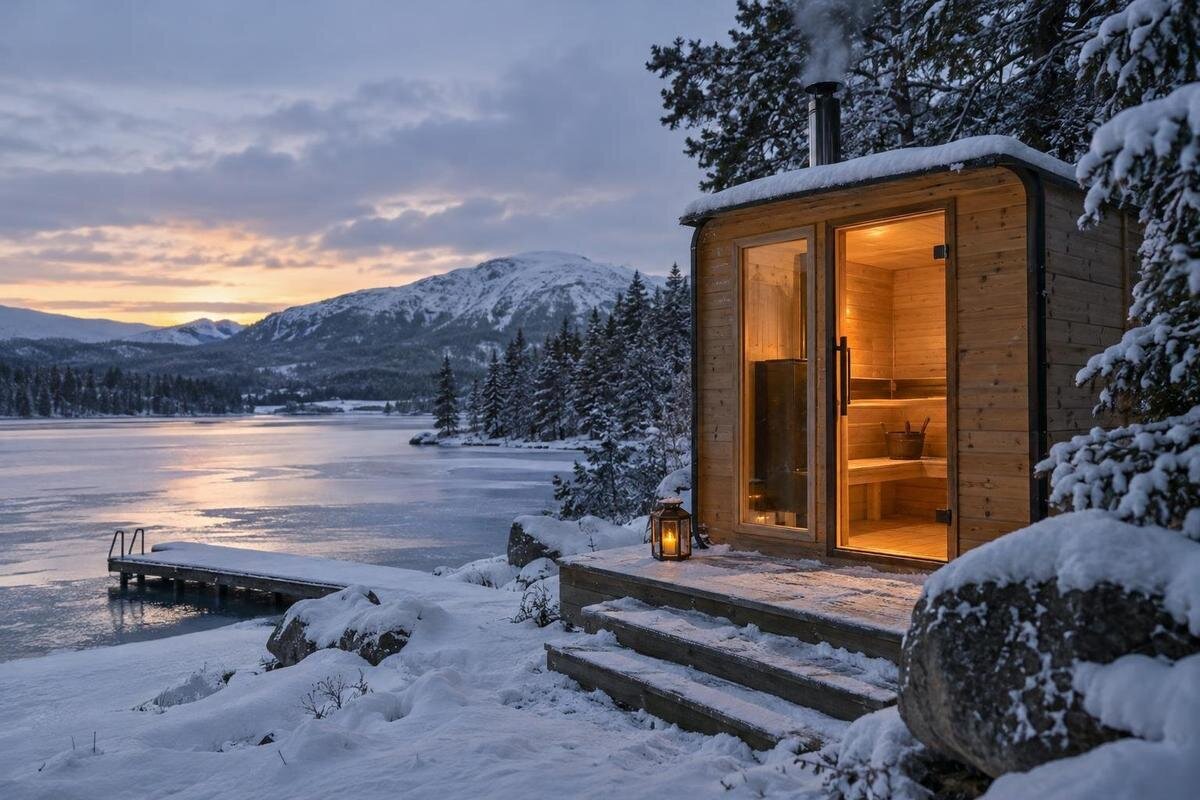
A sauna intended for prolonged cold needs more than a cabin style that looks robust. The exact model, heater, weather protection, support and route to the door all need to suit the site’s conditions. A product name or catalogue area does not establish a minimum operating temperature, insulation level, wind resistance or snow capacity. Begin with the cold the site actually experiences, then compare current manufacturer drawings and instructions for the precise cabin and heater configuration. Structural and electrical questions belong with suitably qualified local professionals. The aim is to select on documented limits and practical winter access, rather than assuming that every outdoor sauna is designed for every cold climate.
01
Site conditions during a long winter
Treat a long winter as a set of conditions at the plot, not as a broad climate label. Note the lowest outdoor temperatures the site normally faces, how long cold spells last, and whether strong wind, drifting snow, driving rain or repeated thaws add exposure. Regional weather records can help establish a realistic range, but an open position and a sheltered corner may behave differently even on the same property. Include periods when the sauna is unused as well as the times you hope to operate it, because storage and operating limits may differ. Also note where snow collects and where meltwater flows after a thaw.
Use those observations to prepare a brief for the manufacturer and installer: site exposure, coldest expected conditions, concerns about snow or wind, likely periods without heating, and intended frequency of use. If there are two possible positions, compare both rather than assuming a fence or nearby building provides sufficient protection. A local climate average is not a substitute for conditions at the exact installation point. You do not need to forecast every weather event; the aim is to cover credible extremes that the sauna and its access route will face, not just a mild winter day.
Cold-weather limits for the cabin and heater
Ask for the manufacturer’s stated outdoor ambient range for the exact cabin: when it may be left unheated, when it may be started and when it may be operated. These are different questions, and a room-temperature range alone may not answer them. Confirm whether the stated limits apply with your proposed heater and any selected options, and whether the manufacturer sets conditions after an extended cold spell. If warm-up times or performance figures are offered, ask which outside temperature, cabin build-up and heater they assume. Without those conditions, the figures cannot be compared reliably with a long-winter site.
Keep a record of the exact cabin variant and heater model, including whether each is included or specified separately; catalogue wording can leave options unclear. Ask the supplier to confirm that the cabin and heater are a compatible combination and to identify any restrictions in the installation and care instructions. If coverage or service depends on a particular assembly, ventilation arrangement or maintenance routine, request those terms in writing. Do not fill a missing cold-weather limit by choosing a more powerful heater or extrapolating from another model in the range. An unanswered limit should remain a question to resolve before purchase.
02
Review the complete cabin construction
The visible outer finish is only one part of winter performance. Ask for a section drawing or written specification that identifies the wall, roof and floor build-up, insulation if any, and the joints between components. Find out whether any thermal figures apply to the complete cabin, including glazing and floor, or to a wall panel only. Check how the door and windows meet the shell, and what seals are used at their frames and at the threshold. A product name, shape or timber description cannot establish insulation, airtightness or a minimum outdoor temperature. The manufacturer should identify the exact supplied assembly and any optional components.
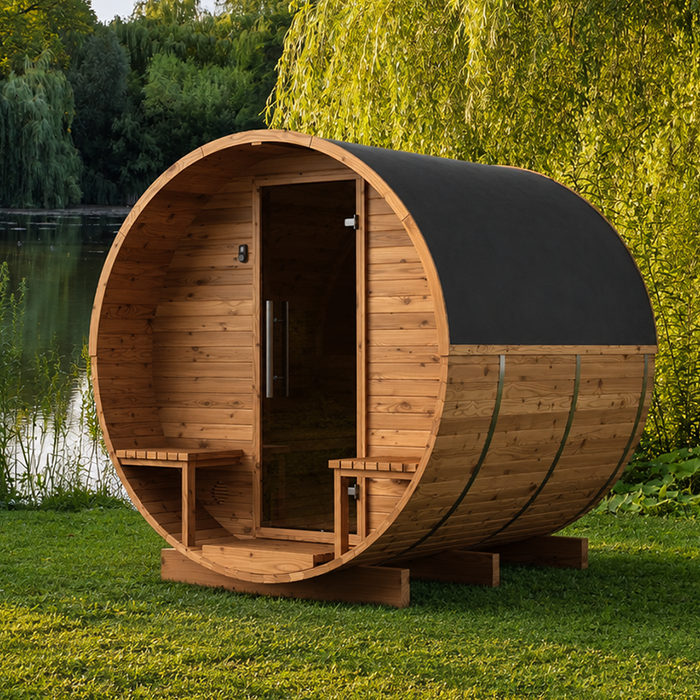
For the Thermowood Barrel Sauna HC-225, the listing gives an area of 4.4 m² but does not state wall construction or winter operating limits. Match the model to the current installation drawing and manual for the version offered. Look for details at corners, roof-to-wall joints, floor edges and around the entrance, rather than relying on a headline material or thickness. These details help you understand how the individual parts form the complete enclosure. If the maker specifies a particular sealing or insulation arrangement, follow that documented assembly. Adding layers or closing an intended opening without approval can alter ventilation and moisture behaviour, so ask before making changes.
Check roof protection against snow, wind and water
Insulation does not answer whether the exterior can manage snow, wind and precipitation. Ask what roof covering, flashing and weather seals are included, and which surfaces or joints need a separate protective component. Confirm whether the maker has a snow or wind design limit for the complete assembly, including any roof option, and whether that limit needs site-specific review. Do not assume that the word outdoor, a nearby garden shelter or a decorative canopy means the cabin is rated for accumulated snow or wind-driven rain. A suitably qualified local building professional can assess the exposure and proposed protection. Ask how roof runoff and snow shedding are intended to work around the entrance and access route.
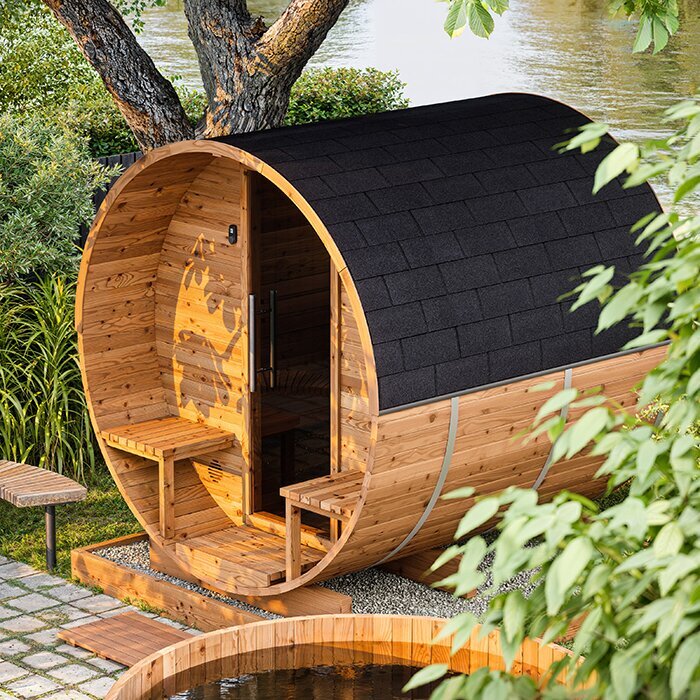
When reviewing the Thermowood Barrel Sauna N-210, listed at 4.43 m², request the specification for the roof as supplied and distinguish it from any optional covering or separate shelter. The published area is not a snow-load rating. Check that the roof details you are comparing belong to the configuration in your quote, rather than another version shown in a photograph. If snow can slide from a nearby roof or collect in a drift, tell the installer when choosing the position. Do not add brackets, guards, a heavier covering or other alterations on the assumption that they improve protection; each change needs the manufacturer’s approval and, where structural performance is involved, professional review. Ask for the approved approach to clearing snow rather than improvising.
03
Foundations, supports and drainage
A level-looking patch is not automatically a suitable base. The support needs to match the manufacturer’s installation drawing and the actual ground conditions, including drainage and any seasonal movement caused by freezing and thawing. Ask which support points and clearances the design requires, what information the installer needs about the cabin’s weight, and whether a groundworks or structural professional should assess the site. There is no universal foundation choice for every plot: soil, existing paving, slope and exposure can change the answer. Avoid choosing a base from a generic diagram when the exact sauna support plan is available, and do not use catalogue area as a substitute for load information.
Use the dimensioned support plan when preparing a base for the Thermowood Barrel Sauna N-250, whose listing states an area of 5.27 m². That area does not define the support footprint or the load at each support. Confirm what needs to be prepared before delivery and make sure the installer is working from the plan for the exact version ordered. Plan where roof runoff and thawing snow will go, and where cleared snow can be stored without blocking the entrance or directing water towards the base. Discuss drainage changes with the installer rather than digging or altering supports by guesswork. Water that repeatedly collects beside the structure can complicate maintenance and access, even if the cabin is designed for outdoor use.
Compare usable space, not just catalogue area
Choose a size based on the people and activities the cabin needs to accommodate, then check a dimensioned internal layout. Compare bench lengths, clear floor space, entry area and the room needed for the heater using the manufacturer’s plan rather than a headline area alone. Ask how many users the maker intends the layout to suit and which dimensions are internal; do not infer capacity from the outside shape or area figure. A crowded bench or obstructed entrance can be inconvenient, while excess volume may affect the heater specification. If winter clothing or supplies need to be close at hand, plan where they can go without narrowing the way in or out.
For a layout comparison, the Thermowood Barrel Sauna LC-260 has a listed area of 5.12 m². Check what that figure measures against a drawing showing internal and external dimensions; the listing alone does not establish usable floor area, seating capacity or door clearance. Allow for the door’s actual opening, room to sit and move, and any separate changing or storage area you want. Do not count an optional room, porch or accessory as included unless the quote says so. Check that the installed footprint and service clearances also fit the base and access route. Consider how people will enter and leave together: an unplanned pause outdoors while others make room inside can make a layout less practical in winter.
04
Match the heater and services to the cabin
Assess the cabin and heater as one system. Ask the supplier to match the heater to the manufacturer’s stated internal volume and construction, and to confirm the match for the outdoor conditions you have documented. An estimate based only on floor area or a generic heater output may miss wall and ceiling construction, glazing, ventilation and exposure. Do not assume a bigger heater compensates for an undocumented cabin limit or poor weather protection; it may not be an approved pairing. Require the exact heater model and the instructions that apply to it, with any conditions on configuration recorded before purchase.
The Thermowood Barrel Sauna HCF-300 is listed at 6.89 m². To assess its heating requirements, you still need the internal volume and the specification for the proposed cabin and heater combination. Ask whether the heater is included, which fuel or power source it uses, and how ventilation is specified for that exact combination. If you want a warm-up or energy-use estimate, request one based on your expected outside conditions and stated use pattern, including the assumptions behind it. This lets you distinguish an estimate for your intended use from a general performance figure. Have electrical or solid-fuel design and installation reviewed by suitably qualified professionals; do not alter wiring, flues or heater arrangements yourself.
Plan the winter route and delivery access
Winter access deserves the same attention as the cabin. Map the route from the usual arrival point and consider where snow will be cleared, how ice or meltwater may affect footing, whether the entrance will remain unobstructed and whether the door can open without hitting a snowbank. Lighting, a stable path and space to carry towels or supplies are practical details, not cosmetic extras. Keep cleared snow away from the door, base and service access, and think through how you will reach the sauna after snowfall rather than only on installation day. The route should suit everyone expected to use it.
Before planning delivery of the Thermowood Barrel Sauna LCF-300, listed at 6.89 m², ask for its overall dimensions and details of the delivery sections. The catalogue area does not reveal door width or the turning space needed to get the cabin on site. Compare the supplier’s delivery access requirements with gates, paths, steps, overhead obstructions and ground conditions. Keep delivery access separate from the everyday route to the sauna: both need to work, but they involve different dimensions and activities. Confirm what space is needed for assembly and later servicing. If lifting equipment or a specialist installer is required, arrange a site review before committing to a position; do not assume that a clear garden entrance is sufficient.
05
Set out maintenance for winter exposure
Ask for winter maintenance instructions before choosing between models. Care guidance should cover which exterior surfaces, roof components, seals, hinges and fixings need attention, which products are compatible, and how often the manufacturer recommends checks. Do not apply a generic timber treatment or sealant on the assumption that it will protect every finish. Find out what the maker expects after severe weather and what visible damage should be assessed before use. A cabin kept outdoors through cold and wet spells may need a different routine from one kept under cover, so rely on instructions for the materials and components actually supplied.
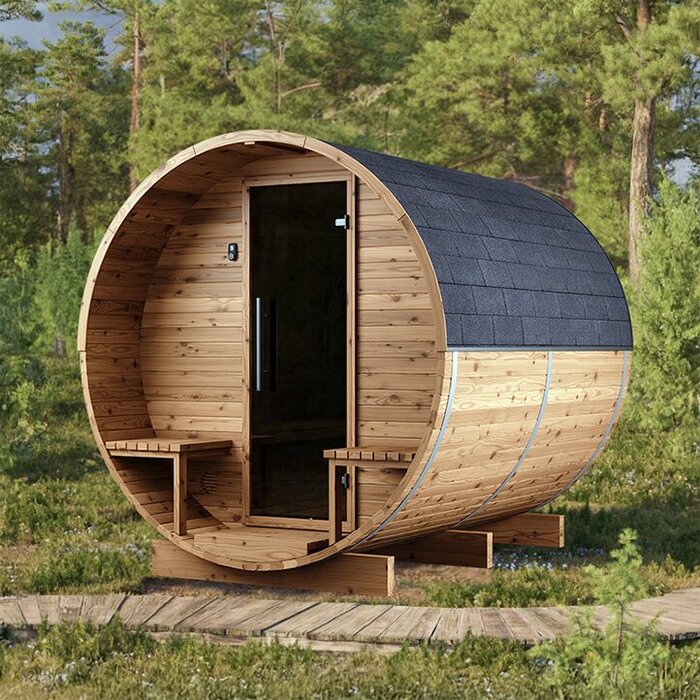
Even when considering a smaller listed area, such as the 1.93 m² shown for the Thermowood Barrel Sauna S-140, allow space to inspect, maintain and repair the structure. Use the installation drawing to check access around the cabin, including the parts that may be difficult to reach once it is in position. Keep the care instructions with the handover documents so the relevant guidance is available throughout winter. Ask what to do during long periods of non-use, whether any cover is approved, and how designed ventilation should remain unobstructed. If the heater has its own seasonal care instructions, keep them alongside the cabin guidance and distinguish the tasks that apply to each.
Comparing specifications and costs
Build a comparison around evidence rather than a broad claim such as all-season. Record the exact cabin and heater models, written minimum ambient conditions, construction layers, roof details, support plan, dimensions, ventilation, access needs and maintenance requirements. Mark each answer with the document or supplier confirmation behind it, and leave unknowns visibly blank. Then request an itemised quote so the cabin, heater, protective options, site preparation, assembly and services are not confused with one another. Verify every inclusion and local installation responsibility in writing; a product image or short listing cannot show the complete scope. This also avoids comparing a configured package with a cabin alone.
Include the Thermowood Barrel Sauna HC-150, listed at 2.97 m², in a comparison only on the basis of its stated configuration. The product page identifies the model and area, not its winter performance or running cost. Keep any energy or warm-up estimates alongside their assumptions so a figure based on different outdoor conditions or another heater does not distort the comparison. Where information is missing, record the gap rather than borrowing a figure from another sauna. Ask who can provide service or replacement parts at your location and what arrangements are actually offered. Consider those arrangements alongside the itemised purchase and installation costs, then judge whether the proposed package meets your winter requirements.
Frequently asked questions
Does a barrel sauna automatically cope better with severe cold?
No. Its shape does not establish insulation, a minimum outdoor temperature or resistance to snow and wind. Check the construction and operating limits for the exact cabin and heater, along with the roof and installation details.
What cold-weather limit should I ask the manufacturer for?
Ask for the permitted outdoor ambient conditions when the sauna is unheated, starting and in use. Confirm that the limits apply to the exact cabin and heater combination, and request them in writing if the documents are unclear.
Can catalogue area tell me whether a heater is suitable?
No. An area figure does not give the cabin’s internal volume, construction or heater compatibility. Ask the supplier to confirm the specified heater for the exact cabin and your expected outdoor conditions.
Does an outdoor sauna necessarily have a snow rating?
Do not assume so. Ask for the documented limits of the complete roof and cabin assembly, then have a suitably qualified local professional consider the site exposure. A general outdoor description is not a snow-load specification.
What makes a sauna practical to use through winter?
The route needs to remain accessible, the entrance must not be blocked by cleared snow, and there should be a clear plan for maintenance and weather protection. Check these alongside the cabin and heater specifications before choosing a position.
Choosing an outdoor sauna for long, cold winters means considering the cabin, compatible heater, weather protection, support and access together. Confirm the exact model’s documented limits, then review the drawings and site with the appropriate professionals. If an essential detail such as a minimum ambient condition or roof design limit is missing, leave it unresolved rather than treating winter use as established. The best basis for your choice is a configuration that suits the site and remains practical to reach and maintain through winter, not appearance or a headline area figure alone.
