
Insulated or Uninsulated Outdoor Sauna: Practical Considerations
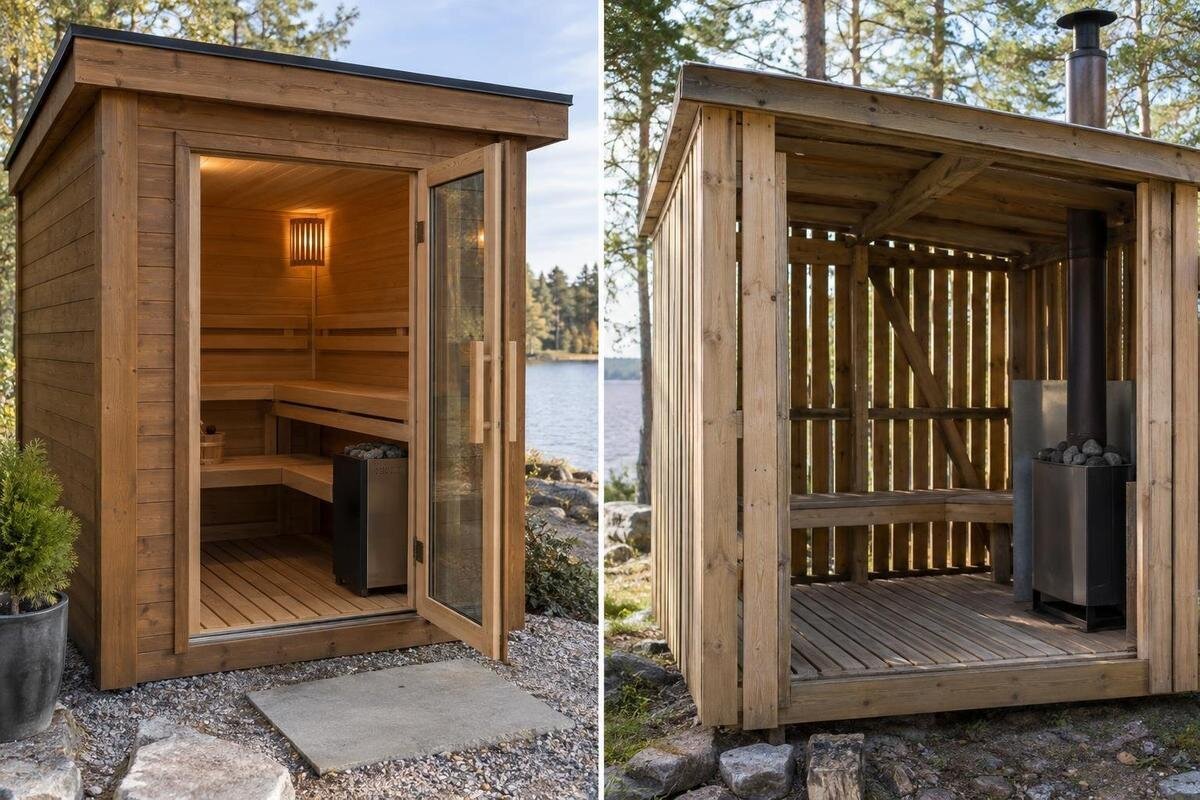
Outdoor sauna buying guide
An outdoor sauna’s insulation affects how heat moves through parts of its structure, but it does not tell you the whole story about use or energy demand. The result depends on which surfaces are insulated, how joints and openings are detailed, the heater and ventilation, and how often the cabin will be used. Product descriptions may use “insulated” without spelling out those details. Compare the complete construction, intended routine and installation site before choosing between the two.
01
What “insulated” means in an outdoor sauna
Insulation is part of the cabin envelope: the walls, roof and floor that separate the warm interior from outdoor conditions. A layer or material intended to slow heat flow can be included in one part, several parts or a complete build-up. Ask which applies, because the roof and floor may not match the walls. Solid timber also resists heat flow to some extent, so “uninsulated” does not mean the cabin has no physical barrier or that heat escapes instantly. It means you should not assume a separately specified insulated assembly unless the product documents say so. The word “insulated” by itself does not describe how the layers are joined.
Insulation does not provide heat, correct a poorly fitted opening or replace a ventilation plan. Its contribution therefore needs to be understood alongside the rest of the construction, rather than read as a promise of warm-up time, temperature or energy use. For example, the listing for Sauna HC-225 gives an area of 4.4 m². That describes one aspect of the product, while the wall and roof specifications answer a different question. When comparing listings, keep dimensions and construction details in separate columns so that neither substitutes for the other. Record whether “insulated” refers to the whole enclosure or selected panels, and whether those panels belong to the standard version or an optional package. This gives the term a specific meaning for the configuration you are considering.
The whole cabin envelope matters
Think of the sauna as a complete enclosure, not just a wall panel. Heat can pass through the roof, floor, wall joints, doors and windows, while intentional ventilation moves air for a separate reason. If only the walls have insulation, the roof or floor may still be an important part of heat exchange; gaps or poorly detailed openings can also affect the overall result. This does not mean every model needs the same arrangement. It means a description that names one insulated component is not enough to compare two complete cabins or judge how either will work in your garden.
A manufacturer’s cross-section can show the wall, roof and floor build-up, while a plan locates the door, windows and vents. Read these together: the cross-section explains the layers, and the plan shows where openings interrupt the enclosure. The Sauna N-210 listing states 4.43 m², which is useful when recording size but does not describe those junctions. For each cabin, note where the insulation continues, where the assembly changes and which details remain unspecified. This makes a comparison more informative than a single yes-or-no entry for insulation. If one drawing covers several versions, establish which details apply to the offered configuration before comparing it with another cabin. An optional insulated roof, for example, should not be recorded as part of the standard specification.
02
What an uninsulated sauna means in practice
An uninsulated outdoor sauna generally has no separately specified insulation layer in some or all of its shell. It may still have timber walls and a roof that create a physical barrier; the term is not a measure of workmanship, weather protection or suitability. In otherwise comparable assemblies, adding effective insulation slows heat transfer through the parts where it is installed. However, two cabins labelled insulated and uninsulated may also differ in shape, wall construction, roof, openings, heater and ventilation. Without matching details, the label alone cannot settle which will perform better as a complete building.
For a buyer, it is important to distinguish a cabin explicitly described as uninsulated from one whose listing simply omits insulation details. An omission leaves the construction uncertain; it does not establish what is inside the walls or roof. The Sauna S-140 is listed at 1.93 m², but its area and model name do not resolve that question. Ask the supplier to clarify the description, then consider the operating, ventilation and maintenance instructions alongside your planned schedule and site. This avoids rejecting a cabin merely because its listing is brief, or treating an unspecified construction as equivalent to a documented one. Where the information remains incomplete, leave that part of the comparison open rather than assigning the cabin to either type.
Match the construction to your use pattern
Think about how often you will use the sauna, the usual length and spacing of sessions, and whether it will stand unused for long intervals. A cabin that begins cold needs heating from its starting condition. Insulation can slow heat leaving the parts it covers once the interior is warmer, but it cannot remove the initial heating demand. If several people will use the sauna in sequence, you may also care about how consistently it holds its conditions between sessions. Ask the supplier about the cabin and heater’s intended operating pattern instead of assuming that insulation alone determines warm-up or recovery time.
Make the use plan concrete: occasional evenings, frequent weekly sessions and use across different seasons are not the same brief. Consider how many people need to sit comfortably and whether the layout works for them; do not treat area as a promise of capacity. The Sauna HC-150 is listed with an area of 2.97 m², but that figure cannot establish bench space or user capacity. Request internal dimensions and a seating plan, then ask whether the specified shell and heater suit the schedule you have in mind. If you are considering keeping the cabin warm between sessions, check the model’s operating instructions.
03
Why insulation alone cannot predict energy use
Insulation is relevant to heat loss, but its label is not an estimate of an energy bill. Heat can leave through uninsulated parts and openings, while deliberate ventilation changes the air in the room. Energy use also depends on the heater, cabin size and construction, starting temperature, outdoor conditions, operating settings, and how often the door is opened. These factors interact. An insulated part will generally pass less heat than an otherwise comparable uninsulated part, but this does not give a whole-cabin saving figure when the cabins, heaters and conditions differ.
If a supplier gives an energy-use or warm-up claim, ask which cabin and heater were used, along with the starting conditions, outdoor weather, session length and ventilation assumptions. Keep those conditions beside the result when comparing offers: a figure without its context cannot establish a saving for your own routine. The Sauna HCF-300 listing shows 6.89 m², but this is an area measurement, not an energy rating or a statement of heater demand. Similarly sized cabins still need to be compared as complete systems. Where the available figures use different conditions, do not convert them into a percentage advantage for insulation. Instead, compare the documented cabin-and-heater combinations and consider how closely the stated operating conditions resemble your intended use and chosen energy source.
Ventilation and moisture management need their own specification
Insulation and ventilation do different jobs. A sauna needs its designed air movement; adding an insulating layer does not make ventilation unnecessary, and reducing heat loss is not a reason to block vents. Take the location and size of air inlets and outlets from the manufacturer’s instructions for the particular heater and cabin. A description that mentions insulation but says little about ventilation leaves an important question unanswered. Check how the intended airflow relates to the heater and seating area, and do not improvise changes to vents or the cabin envelope using advice intended for a different building.
Moisture management also belongs to the assembly. Hot, moist indoor air needs to be considered in the design of layers and joints; a poorly detailed build-up can allow moisture to collect in concealed parts. Ask how the specified materials, vapour-control details and drying arrangements work together, and distinguish those construction details from routine care after use. When reviewing Sauna LCF-300, keep its listed area of 6.89 m² separate from the ventilation assessment. The relevant drawing and manual should explain the vent positions and internal layers for that exact model. An equal floor area does not make two ventilation arrangements interchangeable, so retain each cabin’s own instructions rather than applying the details from another model of a similar size.
04
Timber treatment and insulation are separate
Timber treatment and thermal insulation answer different questions. Insulation concerns heat flow through the wall, roof or floor. Timber selection, modification, surface finish and maintenance concern the timber and its exposure; those details do not tell you whether there is an insulating layer behind the interior lining. An exterior finish intended to protect timber is not a substitute for insulation, and insulation is not proof that exterior timber needs no care. Keep the comparisons separate when reading product information: ask what the timber and finish are, how they should be maintained, and what the complete wall and roof assemblies contain.
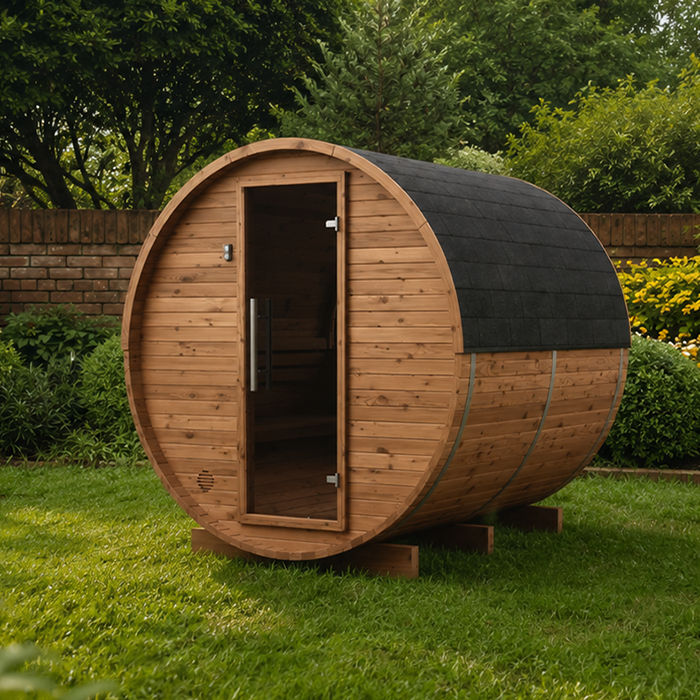
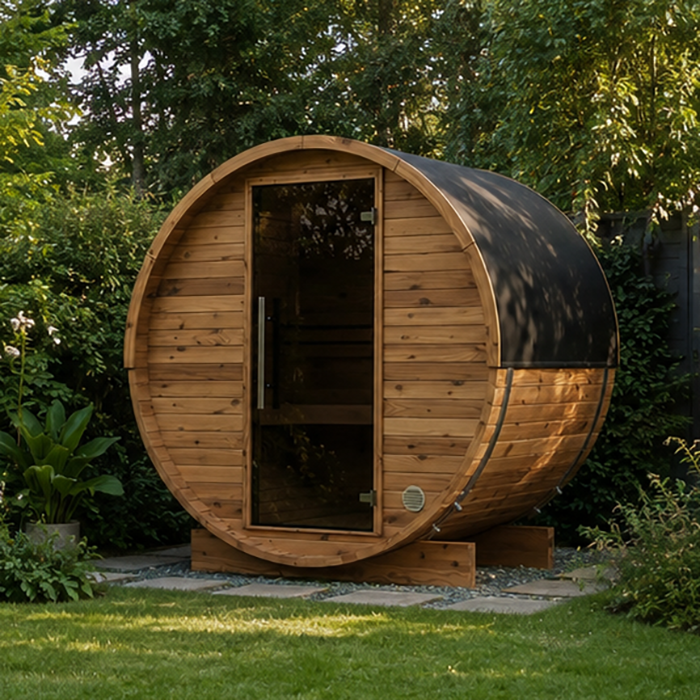
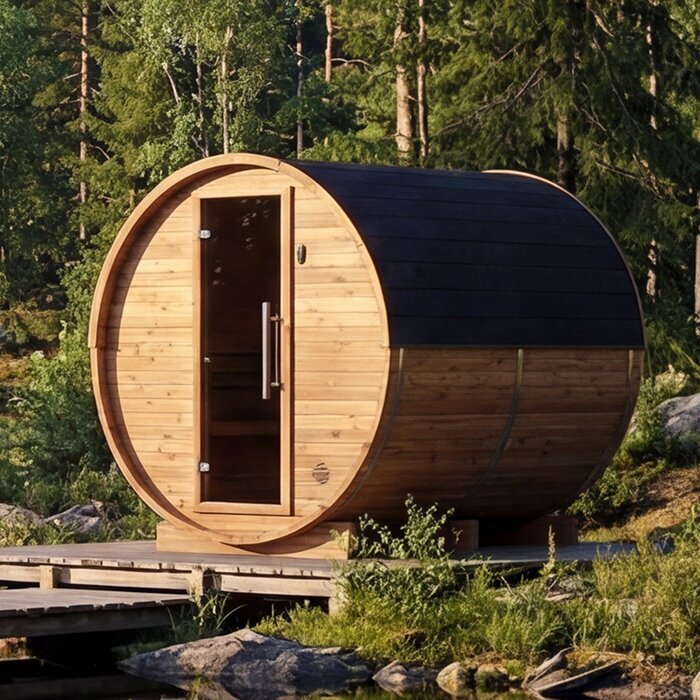
The Sauna LC-260 is listed as a Thermowood Barrel Sauna with an area of 5.12 m². The timber description identifies one aspect of the product, but it does not document wall insulation, exterior finish or maintenance requirements. Keep three separate entries in your comparison: the timber specification, the finish and care requirements, and the wall and roof build-ups. This helps you identify exactly what a supplier’s answer establishes. A response about timber care may answer your maintenance question while leaving the insulation question open; a response about insulated panels may leave the exterior finish unspecified. Neither answer is a substitute for the other. You can then compare thermal construction without allowing a familiar timber term to imply details that have not been stated.
How site exposure affects the choice
An outdoor sauna is exposed to its site, so consider wind, rain, direct sun, shade, splash from nearby surfaces, drainage and access to the door and service areas. Wind and outdoor temperature affect the conditions around the shell; ground moisture and water run-off matter for the base and nearby timber. Insulation can reduce heat moving through covered surfaces, but it does not make a cabin weatherproof, provide a suitable base or make every position acceptable. A sheltered and an exposed location can place different demands on the same product, so check the manufacturer’s siting guidance instead of assuming an insulated model is automatically the better choice.
Before ordering, relate the base, clearance, anchoring and weather-exposure requirements to the proposed position. Have site-specific structural or electrical questions checked by a qualified professional. If the location is exposed to salty air or wind-driven rain, ask whether the specified exterior materials and fixings are appropriate and what care is required. For Sauna N-250, the listed area of 5.27 m² is only one part of the placement information; it is not a site or foundation rating. Use the model’s dimensions and installation requirements to consider the base, access to the door and room for servicing. This keeps the site assessment focused on the actual installation rather than treating insulation as evidence that the cabin suits any outdoor position.
05
Compare cabin size, layout and heater together
Compare internal volume and layout as well as external footprint. A floor-area figure cannot tell you ceiling height, the volume the heater must warm, the amount of glazing, bench arrangement or how much usable sitting space remains. Shape can also change the relationship between volume and surface area. These details matter when comparing insulated designs because cabin size and construction differ, and when matching a heater to a room. Ask for internal and external dimensions, cross-sections and a seating plan. Do not size a heater from catalogue area alone or assume that cabins with similar areas will behave alike.
Treat the heater as part of the complete specification. Confirm whether one is included or chosen separately, which cabin configuration it is intended for, and what the manufacturer requires for operation, ventilation and installation. The right match is model-specific: an insulation label cannot tell you whether the heater is suitable, and no general rule replaces the published instructions. Have electrical supply and installation matters assessed by a suitably qualified installer where relevant. For another heater type, follow its manufacturer’s requirements and arrange installation with a competent professional. Compare the documented cabin-and-heater combination rather than making the insulation choice in isolation.
What to verify in the product documents
Before committing, ask for the current drawing and manual for the exact model and configuration, not just a product photograph or general description. Ask the supplier to state which parts are insulated, what the build-up is in the walls, roof and floor, and how doors, windows, joints and ventilation are handled. Check which heater, controls, lining, floor components and other items are included, which are optional, and whether the installation requirements refer to your selected version. A clear answer lets you compare like with like and identify missing information before delivery or site work is arranged.
Compare the answers with the way you plan to use the sauna. If you expect frequent use or want to retain heat between sessions, ask for evidence about that exact cabin and operating pattern. If you will use it occasionally, weigh the same information alongside starting conditions, the heater and your routine rather than assuming one construction type always wins. If terms remain vague, ask what the seller means by “insulated” and request a written response. The manufacturer’s documents should explain the intended build and operation; a qualified professional can advise on site and installation questions. Choose based on the complete specification and the conditions it must serve.
Frequently asked questions
Does a timber sauna count as uninsulated?
Not necessarily. Timber itself slows heat flow to some extent, but that does not confirm whether the cabin has a separate insulation layer. Check the exact model’s drawings or written construction details for the walls, roof and floor.
Will an insulated sauna always cost less to run?
No. Insulation can reduce heat passing through the parts where it is installed, but energy use also depends on the whole cabin, heater, starting conditions, ventilation and how you use it. Compare claims only when their test conditions are clear and comparable.
Can an uninsulated sauna be used outdoors?
A sauna can be designed for outdoor use without a separately specified insulation layer, but the label alone does not establish whether a particular model suits your site. Check the manufacturer’s instructions for siting, operation, weather exposure and maintenance.
Does the word Thermowood mean that a sauna is insulated?
No. A timber-related product name does not document the wall, roof or floor build-up. Ask separately about the cabin’s insulation, timber and finish, and follow the care instructions for the exact model.
What documents should I ask for before choosing?
Request current drawings and a manual for the exact model and configuration. Ask which parts are insulated, how the openings and ventilation are handled, what heater is included or required, and what site and installation details you need to confirm.
The practical comparison is between complete, documented cabins and the way you expect to use them. Insulation can affect heat loss through the parts where it is installed, but it cannot replace details about the roof, floor, openings, ventilation, heater or site. Check those parts together, keep timber care as a separate question, and choose the construction that fits your routine and location.
