
Outdoor Sauna Roofing: Protection and Upkeep Checks
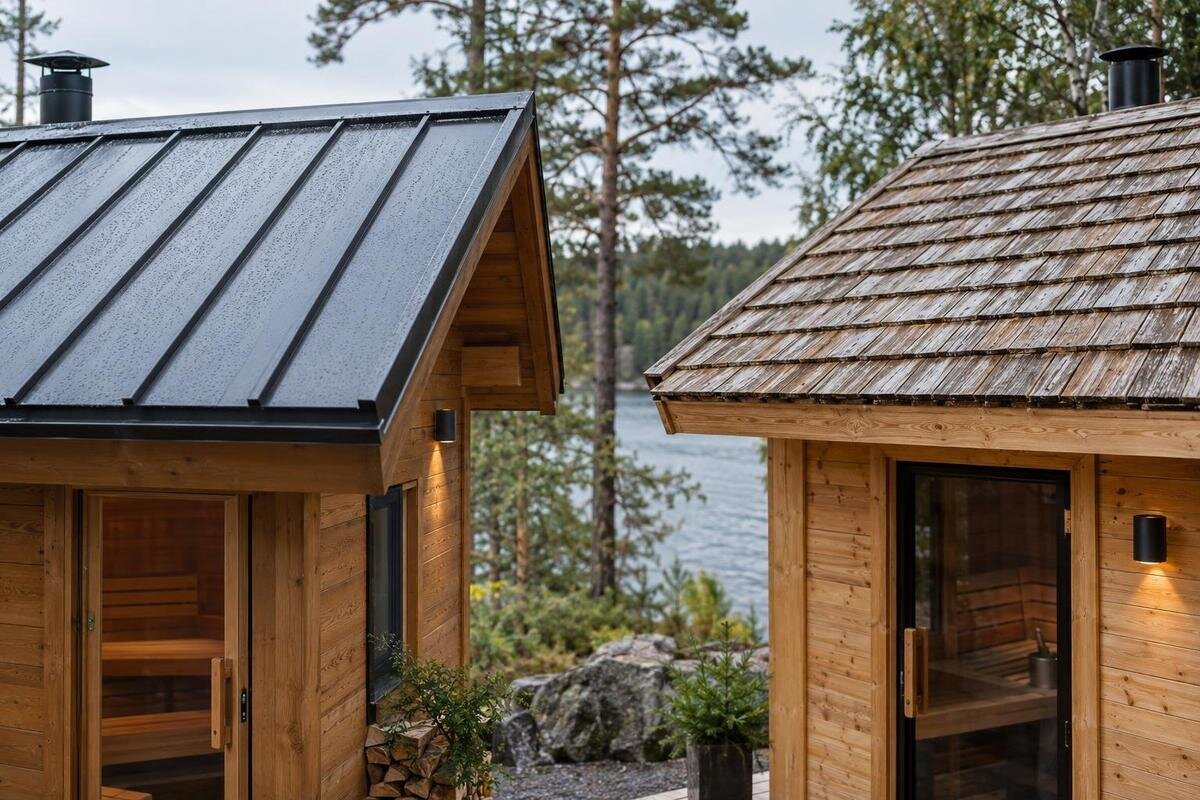
OUTDOOR SAUNA ROOFING
An outdoor sauna roof is more than the surface visible from above. The covering works with its supporting layers, joints, edges and route for rainwater, while the site determines the exposure and access available for maintenance. A product name or photograph cannot confirm how that system is built or what conditions it is intended to handle. Compare documents for the exact model and configuration with the place where it will stand. That gives you a sound basis for questions about upkeep, repairs and runoff before you buy, and for a practical inspection routine afterwards.
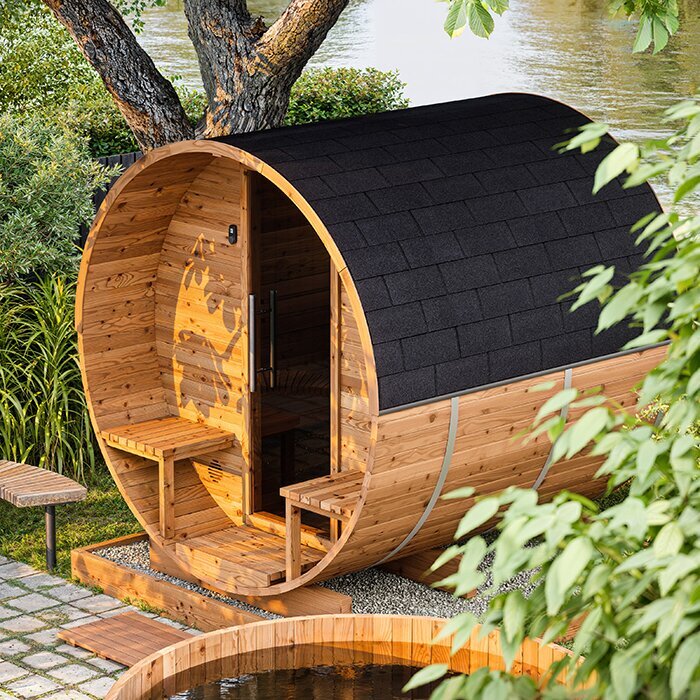
Confirm what the roof package includes
Start by defining what the seller means by a roof. It may refer to the visible covering alone, although water protection can also depend on an underlay, overlaps, joints, edge pieces and the way each part is fixed. Request the specification for the exact model and configuration, with a drawing that names the layers and shows how they meet. Ask what is included as standard and what is an optional finish or accessory. A photograph may help identify the design, but it cannot establish the materials, fixings or weather limits. For Thermowood Barrel Sauna LCF-300, use the model name to identify the option, then confirm its roof build-up in the supplied documents. Keep the relevant drawing version with the purchase record.
Check that the quoted version matches the one you intend to order: an added opening, optional accessory, changed covering or site-installed extra can affect the junctions. Ask whether the roof is assembled at the factory, completed during installation or supplied as a separate element, and who is responsible for sealing joins and finishing edges. Request the drawing revision that applies to your configuration; a general brochure may show another version. If the supplier relies on standard drawings, ask how options or changes are marked so the installer can identify the delivered version at handover. If an answer is given verbally, request confirmation in writing and keep it with the installation and maintenance documents.
Compare roof coverings by their documented requirements
Do not compare roof coverings solely by a material name or a general word such as “weatherproof”. If proposals name a membrane, sheet covering, shingles or another finish, ask for the exact product and complete assembly rather than ranking the labels. Water protection also depends on the support, overlaps, fasteners, edges and any underlayer. Request the manufacturer’s description of intended exposure and care. For different proposals, compare like with like: the full build-up, stated limits, approved repair method and maintenance schedule. When assessing Thermowood Barrel Sauna S-140, use information for its exact supplied version rather than inferring details from the model name or photograph.
Ask what upkeep changes with each option: whether the surface or joints need routine checks, whether particular cleaners or coatings are allowed, how a damaged section is replaced and whether fixings can be inspected. If two finishes are offered, request the same answers for both and record any intervals stated by the maker. Ask whether compatible replacement parts are available and how they are identified. A phrase such as “low maintenance” should have a clear meaning; it does not prove that cleaning or inspection can be skipped. Neither apparent thickness nor a smooth finish in a photograph reliably indicates service life. If care instructions are vague, request clarification before deciding.
Check the roof profile, joints and assembly details
Roof shape affects where joints and transitions occur, but it does not by itself establish how well the roof sheds water. A curved, segmented, pitched or near-flat profile can require different assembly details; ask how the specified covering follows each change in plane and directs water at every seam. Request a drawing that identifies overlaps, end joins, fixing points and changes in profile. Check whether parts must be fitted in a particular order and which gaps are intentional. If Thermowood Barrel Sauna HC-150 is on your shortlist, request the drawing for the delivered version rather than relying on a general image.
Compare the drawing with the proposed site and delivered kit, not just a showroom photograph. Confirm the intended orientation and the direction in which the roof is designed to discharge water; ask whether any optional section changes the joints. Do not trim an edge, add a layer or bridge a gap on site without approval, as this may alter how parts meet or where water flows. If the drawing shows only an outline, request detail views of transitions that may need inspection later. Ask the installer to explain critical junctions before assembly and keep the instructions accessible afterwards. A labelled drawing also provides a reference when checking for movement or damage.
Pay attention to edges and roof openings
Edges matter because water protection must continue where the covering ends, meets another surface or turns around an opening. Ask for a detail showing whether an edge trim, flashing, overlap or another component is specified, and how it relates to the underlayer. Confirm the name of any required accessory; “finish the edge neatly” is not a useful maintenance detail. Check that the drawing covers all sides and ends, not only the main roof area, and ask whether the front and back details differ. For Thermowood Barrel Sauna HC-225, verify the edge treatment in the supplied guidance instead of inferring it from a product photograph.
List every roof opening or junction that applies to the chosen arrangement, including a flue or vent if the design has one. Ask who supplies the flashing or collar, who fits it and which manufacturer instructions govern the interface. Any flue or specialist roof opening should be handled to the relevant directions by a suitably qualified installer; do not treat it as a routine sealing job. A later-added cable, aerial or other opening should not simply be sealed with a convenient product. First confirm that the proposed method and materials are compatible, then keep a record of the detail for future inspection or repair.
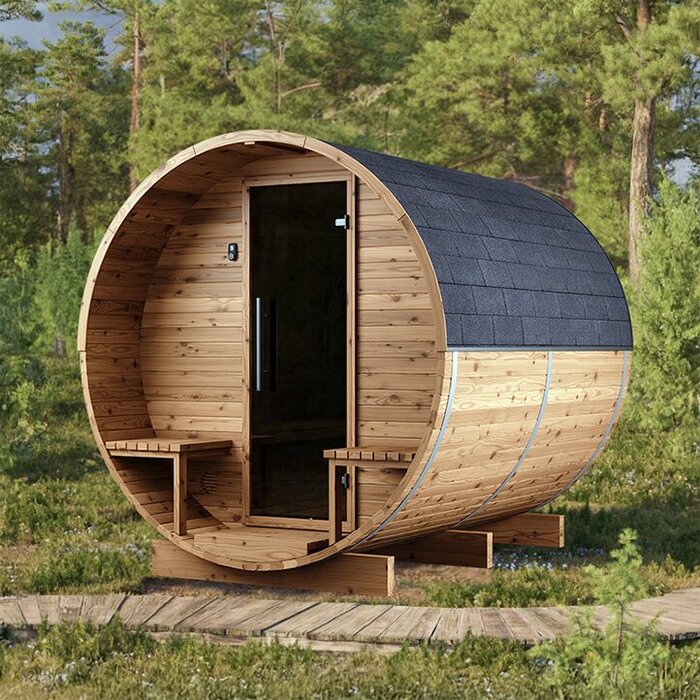
Plan where rainwater will go
Rain protection depends not just on the covering but also on where water leaves the roof. Ask whether the design relies on free discharge, a gutter or another specified arrangement; do not assume an accessory is supplied. On the site plan, mark the likely discharge line and look for paving, doors, paths, walls, planting and drainage points below it. Water falling beside the cabin can splash back onto lower surfaces or collect where access is needed, so plan a route that can be observed and kept clear. If Thermowood Barrel Sauna N-210 is on your shortlist, check the proposed position against the model drawings and runoff guidance.
Consider what happens after heavy rain rather than relying on a dry-day inspection. Check the direction of ground fall, whether runoff can reach a suitable outlet and whether leaves or other debris might obstruct the route. A gutter, diverter or drain added later can change where water goes and how it attaches to the sauna, so ask the supplier or installer to confirm compatibility before fitting one. Keep the discharge path accessible for inspection after landscaping or storage arrangements change. Avoid improvised channels that create an obstruction or send water to an unsuitable area. The aim is a visible, maintainable route, not a guessed slope or unapproved alteration.
Match site exposure to the roof guidance
Exposure varies by site. A sheltered garden and an open, coastal position do not present the same conditions, even if the products look alike. Tell the supplier where the sauna will stand and ask what the covering, exposed fixings and finish require in strong sun, wind-driven rain and, where relevant, salt-laden air. Request the maker’s stated guidance and any maintenance or material compatibility notes for that setting. Do not infer suitability from the word “outdoor”, a photograph or the fact that a model is sold in a particular market. For Thermowood Barrel Sauna N-250, as for any option, seek advice tied to the exact version and site.
Wind exposure is another reason not to judge by roof shape, weight or a neighbouring installation. Ask what the assembly instructions say about securing the structure and whether a qualified professional needs to assess the proposed location; do not copy fastening details from another model. If the site is particularly exposed, ask the supplier what additional assessment is required and who can provide it. Where the available information does not cover the site, obtain project-specific advice before purchase or installation. Never infer a wind limit from appearance; ask for the documented basis and for professional review if the site falls outside the guidance.
Set a safe inspection routine
Use the maintenance schedule supplied for the exact covering; there is no single inspection interval that applies to every roof material and exposure. Before handover, ask what should be checked, how often, from which safe access point and which signs call for repair. A visual check can look for movement at edges, lifted or damaged surface sections, blocked runoff, loose-looking trim or fresh debris at joins. Inspect from the ground where possible; arrange safe closer access rather than walking on an unfamiliar roof. Request guidance for Thermowood Barrel Sauna LC-260 that matches the delivered configuration, and keep it with the model documents.
Inspect after installation and again after unusually heavy rain or strong winds, as well as at the intervals set by the manufacturer. These event-based checks supplement, rather than replace, the written schedule. If access is awkward, agree in advance who will inspect the roof and how; a plan that depends on unsafe ladder use is not practical. Keep a dated note of the inspection, any condition observed, cleaning carried out and advice received. If debris repeatedly gathers in one area, record that pattern and ask whether the site or runoff route needs attention. Photographs from the same safe viewpoint can help you compare changes, but they do not replace a professional assessment where a defect is suspected.
Clean carefully and repair the correct layer
Cleaning should follow the covering maker’s instructions, not a generic roof-cleaning routine. Ask which tools and cleaning products are acceptable and which should be avoided; do not assume that a pressure washer, abrasive brush, solvent or coating is safe for every surface. Remove leaves and other loose debris only by a method that can be carried out safely and without damaging the edges. If the manual permits owner cleaning, follow its method and stop if a surface begins to lift or change. For Thermowood Barrel Sauna HCF-300, request instructions for the exact model rather than applying advice intended for a different covering.
Repairs need to address the failed detail, not just hide a mark. A patch or bead of sealant may be unsuitable if it is incompatible with the covering, blocks a drainage route, traps moisture or prevents later inspection. Ask the supplier or installer to identify the affected layer, specify compatible replacement materials and explain whether a qualified roofer or installer is needed. Do not assume that a spare part from another model will fit. After work, request a record of what was changed and any follow-up checks, then include that information in the maintenance file. This helps distinguish an earlier repair from later deterioration.
Investigate indoor moisture before repairing
Moisture inside does not identify its source by itself. Rain may enter through the covering or at a seam, edge, opening or adjacent wall, while condensation is another possible explanation; a stain’s position alone cannot distinguish them. Note when the mark appears, whether it follows rainfall or a change in conditions, and whether it grows. Look for repeated staining, drips, damp areas or changes in material around the roof and junctions, without removing parts or disturbing the covering. A record of timing and photographs can help an installer assess the pattern. Avoid covering the mark with paint or sealant before the cause is understood.
Ask a qualified installer or roofer to investigate suspected water ingress and identify the repair scope. The inspection should consider the roof detail and nearby interfaces rather than stopping at the spot where water becomes visible; the entry point may not be directly above it. If the roof appears sound, ask whether condensation, ventilation or another source should be assessed by the appropriate professional instead of repeatedly sealing the exterior. Keep the assessment and repair notes with the model documents. If water may have reached electrical equipment, leave it untouched and seek qualified help, following the equipment maker’s safety guidance.
Roof details to confirm before ordering and at handover
Before ordering, put the key questions into one written request: the covering and layers included; the drawing for the exact model and configuration; details at edges, seams and any openings; intended weather exposure; the runoff route; installation responsibility; and the source of maintenance instructions. Ask whether optional accessories or changes alter any of those details. If you are comparing several versions, request the same information for each so that unlike roof packages are not compared as though they were identical. This is a better basis for comparison than a label such as “weather-resistant” or a photograph of a finished sauna.
At handover, keep the correct assembly instructions, model and configuration identification, approved cleaning guidance and notes about installation or roof repairs together. Record where to ask about replacement covering or compatible repair materials, but do not assume a particular warranty or claim process; read the current terms for the supplied product. Confirm who is responsible for checking a detail that the drawings do not show and whether the site needs a qualified professional’s review. Keeping these records accessible makes later maintenance easier to compare with the supplied design, rather than relying on memory or advice for a different roof.
Frequently asked questions
Does “outdoor sauna” mean the roof is fully weatherproof?
Do not infer the roof’s performance from that label alone. Ask for the complete roof assembly, the manufacturer’s guidance for the exact configuration and any exposure limits. Confirm how the edges, joints and water discharge are dealt with; a product name or photograph cannot answer those questions.
How often should I inspect an outdoor sauna roof?
Follow the interval in the maintenance guidance for the specified covering; there is no single schedule that fits every material and site. Check after installation and after unusually heavy rain or strong winds, and arrange safe access for a closer inspection if something looks loose or damaged.
Can I add a gutter or change the roof covering later?
First confirm compatibility with the supplier or installer. An added gutter can affect attachments and runoff, while a different covering can alter the assembly and its upkeep. Ask for confirmation for the exact configuration before making changes.
What should I do if I find a damp patch inside?
Note where and when it appears, particularly whether it follows rainfall, and do not simply cover it. Rain entry and condensation can look similar, so ask an installer or roofer to investigate the roof and nearby junctions. If electrical equipment may be affected, seek qualified help rather than handling it.
Does a coastal location need a different maintenance plan?
It depends on the materials, finish and actual exposure. Ask the manufacturer whether salt-laden air, strong sun or wind exposure changes the guidance for the covering and exposed fixings, and which cleaning and inspection methods are suitable. Do not assume one maintenance rule applies to every roof.
Good roof planning is specific: identify the covering, layers and junctions, understand where rainwater will go, and plan upkeep using the supplier’s guidance for the site’s exposure. Keep the configuration drawing and care instructions with the sauna, then use them for safe inspections and any repair. If a detail or exposure is not documented, obtain advice for that exact installation instead of copying a different roof. That is the practical difference between a visible finish and a maintainable weather-protection system.
