
Growing Peaches or Nectarines Under Glass
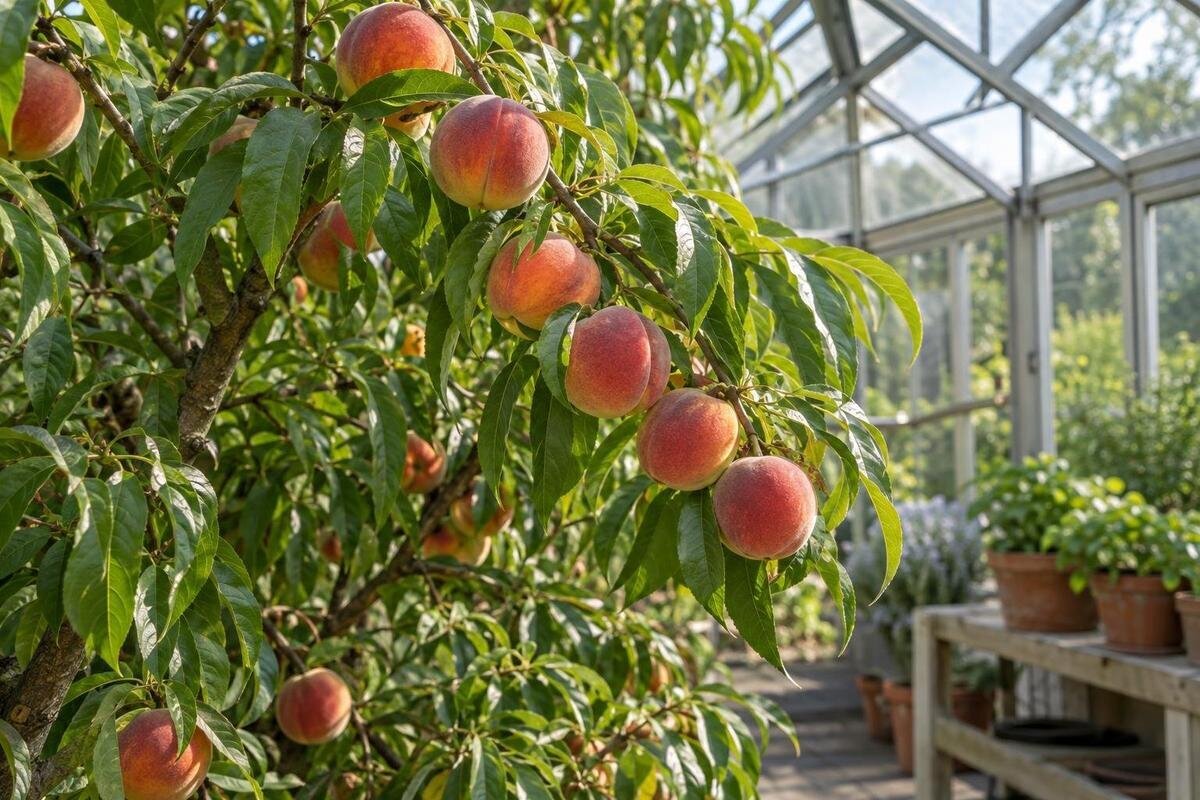
Fruit trees under glass
Peaches and nectarines can be trained under glass, but a greenhouse does not remove the tree's need for winter chill or guarantee pollination. In Malta, mild winters and bright, hot summers make cultivar choice and ventilation as important as the greenhouse footprint. Before planting, check the tree's chill requirement, mature size, training plan and access for blossom and harvest.

01
What glass changes in Malta's climate
Glass provides shelter, not a climate guarantee. It can keep wind and rain off blossom and fruit and makes irrigation easier to manage, but it also changes air movement, rainfall and temperature around a tree. On a sunny, still day, an enclosed structure can become much hotter than the garden. For deciduous stone fruit, that difference matters in two seasons: winter chilling helps buds resume growth evenly, while summer light and heat affect growth and fruit development. A greenhouse that suits tender vegetables may be too warm for a peach tree during its dormant period, or too hot when sunlight is strong. A glass roof can also keep rain from the root zone, so protection changes watering needs as well as conditions around the canopy.
Decide whether the tree needs year-round cover or only shelter at particular times. A container-grown tree can be easier to move, but its roots still need enough volume and its winter position must meet the cultivar's chill requirement; an in-ground tree is a long-term commitment. Compare usable growing space with headroom, doorway clearance and airflow, not floor area alone. For example, the Pyramid Greenhouse is listed in area options from 5.53 to 18.9 m²; that range does not describe the precise roof clearance around a mature crown. Use the drawing for the chosen size, and map where the tree will stand before buying. Leave room to bring a pot through the doorway if moving it outdoors is part of the plan.
Winter chill is the first cultivar test
Peaches and nectarines are deciduous and normally need a period of winter chilling for buds to resume growth evenly. The amount differs by cultivar, and nursery figures may use different ways of counting chill. A value in 'chill hours' cannot always be compared directly with one given in chill portions; ask which method is used and what the named variety requires. Chill accumulation is a gradual seasonal total, not simply the lowest temperature reached. When its requirement is not met, dormancy may break irregularly: flowering and leafing can be delayed or uneven, and fruit set may suffer. A warm greenhouse does not create winter chill; it can reduce the tree's exposure to cold air outdoors.
Malta's mild Mediterranean winters make this a central consideration when choosing a cultivar, not a detail to leave until after planting. Use observations or reliable weather records for the garden's location over several winters, not a single cold spell or a general national average; a sheltered courtyard may differ from a nearby open site. Ask a reputable nursery which low-chill cultivars have performed under comparable local conditions and whether its recommendation applies to a tree kept under glass. If a movable pot is part of the plan, compare conditions in its winter position with the cultivar's requirement; moving it outdoors changes exposure but does not prove enough chill will accumulate. Heating a greenhouse will not help it meet a chilling requirement.
02
Choose the cultivar and rootstock together
A nectarine is a smooth-skinned form of peach, not a way around the tree's climatic requirements. The nursery label matters more than the fruit category: confirm the exact cultivar, its documented chill requirement and the method used to express it, likely flowering period, harvest window, and expected size on the chosen rootstock. Peach cultivars differ in chill and flowering needs; a general label such as 'warm-climate' is not enough unless the nursery explains what it means. If harvest timing matters, ask how the fruit ripens in comparable conditions, since flowering date alone does not tell you when it will be ready.
Choose rootstock and cultivar together. Buying a named, grafted tree makes fruit traits more predictable than raising a seedling, which may not reproduce the parent variety. Rootstock affects vigour, mature dimensions and response to soil, but it does not change the scion's chilling requirement. Ask for the rootstock name and expected size under the intended growing method, rather than relying on a promise of a 'dwarf' tree. A vigorous combination can outgrow a restricted space; a rootstock unsuitable for a container or local soil can create different problems. Verify its compatibility with the site, drainage and any pot plan before buying.
Pollination inside an enclosed growing space
Most peach and nectarine cultivars are self-fertile, so a second tree is often unnecessary, but check the specific variety rather than assuming. Self-fertility does not mean a sealed greenhouse will pollinate itself: pollen still has to move within or between flowers. Insects and air movement can help, and access through doors or vents while flowers are open can matter. If a variety needs a compatible pollinating variety, both must flower at the same time; get compatibility information before committing to two trees and twice the canopy space. Fruit set also depends on winter chill and blossom conditions, so poor cropping is not automatically a sign that another tree is needed.
Choose access and opening positions with pollination in mind, not just the area on a catalogue page. The Bloomcabin Prestige Greenhouse with metal foundation is listed in area options from 3.77 to 28.08 m². Check the exact configuration and drawings to assess insect access through openings and whether you can comfortably reach the blossom. If natural pollinator access is limited, hand pollination may be an option for a self-fertile cultivar, but it cannot compensate for unmet chill requirements or poor flowering. Ask the nursery for cultivar-specific guidance on the technique and make sure you can reach the flowers without damaging branches.

03
Train the tree before it fills the greenhouse
Decide how the tree will be trained while it is young. A fan-trained tree spreads its branches along a flat plane and can make the fruiting canopy accessible in a narrow layout; an open-centre form needs more width around its framework. Either approach still requires regular pruning and a compatible cultivar and rootstock. Peaches and nectarines crop mainly on shoots grown in the previous season, so pruning is not merely a way to hold the outline: it renews fruiting wood. Set the branch framework while the young tree is manageable rather than trying to force mature woody limbs into place. Use a fruit-tree-specific pruning guide or local nursery advice for timing and cuts; do not treat it like a vine or hedge.
A wall or boundary may be relevant to a fan-trained design, but do not assume a greenhouse frame is a suitable support. Determine whether independent wires or supports are needed, and attach anything to a structure only if its manufacturer confirms the intended use; a mature tree is not the same as a lightweight vine. A Wall Greenhouse is one layout to compare if a boundary is central to the plan, but check actual wall height, usable width, light, access and attachment options before planting. Do not let the word 'lean-to' stand in for those measurements.
Plan around the mature canopy
A young nursery tree can look small enough to fit almost anywhere; judge by its expected mature crown, not its first-year silhouette. The eventual height and spread depend on cultivar, rootstock and whether it is fan-trained or free-standing, so request dimensions for that exact combination. Map the whole canopy, not just the trunk: fruiting branches need light and air, and you need room to prune, inspect and pick without pushing against glazing. Leave usable access through the doorway and around the tree, and consider how far branches may extend over paths or beds. If a ladder or long-handled tool would be needed, the roof profile and working clearance matter too. Repeated hard pruning just to contain an oversized tree may disrupt its shape and fruiting wood.
Separate the tree's footprint from the greenhouse's published floor area. Paths, work space, pots, storage and other crops all reduce room available to the canopy. The Spacious Greenhouse is listed from 47 to 70 m²; that area range can help compare footprints, but does not by itself confirm roof height, internal layout or a workable training plan. Draw the structure on a plan, add the expected branch spread and access zones, then confirm each dimension from the chosen model's drawings. A generous floor area cannot compensate for a low roof over the tree or a blocked route to the fruit.
04
Manage heat and light in summer
Summer heat is a major management issue under glass in Malta. A peach needs good light to grow and ripen fruit, but trapped heat and poor air movement can stress the tree and make watering less forgiving. Site it where it receives strong light while planning how warm air leaves the structure. Use ventilation appropriate to the actual greenhouse and local conditions; keeping a door shut on bright days simply because the tree is 'protected' can make conditions worse. If additional shading is considered, avoid making the canopy persistently dark: reduced light can weaken growth and interfere with fruit development. Air movement through the canopy also helps avoid a persistently stagnant, damp environment.
Compare the exact opening positions and day-to-day access in the greenhouse specification, rather than inferring ventilation from the frame material or model name. For example, the Aluminium Classic Greenhouse is listed in area choices from 3.77 to 28.08 m²; that range describes floor area, not how effectively a selected model releases heat. Ask the supplier for the drawings and ventilation details for the exact size. Make a watering plan for hot periods too: a roof limits natural rainfall reaching beds and pots, and a tree carrying fruit can be less forgiving of repeated drying and sudden saturation. Check moisture at root level rather than relying on the greenhouse feeling humid.
Give the roots enough room and water
Choose between planting in greenhouse soil and growing in a substantial container before the tree goes in. In-ground roots need soil that drains adequately and enough space to develop beyond the trunk; a greenhouse roof can mean the bed receives little or no rain. A container offers more control over root conditions but restricts root volume and dries faster in warm weather. It does not make a large fruit tree low-maintenance. Confirm the container size and rootstock suitability with the nursery, and make sure excess water can drain away. If planting in the ground, check the existing soil rather than assuming sheltered soil is suitable.
Water consistently through active growth and fruit development, adjusting to the actual soil, pot and weather instead of following a fixed calendar. Letting a rootball dry repeatedly and then soaking it creates an uneven water supply; waterlogged roots create a different problem, so drainage matters as much as access to water. Apply fertiliser according to its instructions and local growing advice, because excessive feeding can encourage leafy growth at the expense of a balanced tree. Keep fallen fruit and plant debris from building up, and make room to reach the root zone without compacting the bed. If tool storage is part of your plan, compare the Limited Edition greenhouse with built-in storage and check how the chosen layout divides space between storage, growing and access.

05
Fruit set, thinning and harvest need access
Even with blossom and pollination, a crop is not guaranteed. Once fruitlets form, the tree may carry too many for them all to develop well. Thinning some fruit while it is small can reduce competition and leave a manageable crop, but the amount depends on vigour and branch strength. Follow advice for the cultivar rather than applying one fixed count. Do not confuse a heavy initial fruit set with long-term success: crowded fruit is harder to inspect, and a dense canopy can make routine checks difficult. Keep access to the tree for monitoring and remove fallen or spoiled fruit promptly.
Use the cultivar's harvest window and maturity signs, not a date from an outdoor calendar: protected conditions may shift development, and different varieties ripen at different times. Colour alone may be unreliable, so ask the nursery how to judge ripeness for the specific cultivar and handle the fruit carefully once ripe. Harvesting means reaching the fruit without knocking branches into glazing or crushing lower growth. When comparing the Limited Edition Aluminium Greenhouses range, listed from 3.77 to 28.08 m², check where you would stand to pick from each part of the canopy. The chosen layout should leave working space beside the branches as well as a route through the greenhouse.
Decide whether a greenhouse is worth the space
Run the plan in order: choose a named low-chill cultivar and suitable rootstock, confirm a winter position that can meet its requirement, verify pollination, select a training method, and allow for mature crown and root space, ventilation and irrigation. Resolve unknowns before planting, because changing the layout after a tree is established can be difficult. A heated greenhouse is not an automatic answer: added warmth does not provide winter chill and can alter the tree's seasonal cycle. Glass may make sense where shelter, training and access solve a clear problem; if an open sunny site can meet the variety's needs, growing under glass may add heat and work without improving fruiting.
When comparing structures, compare dimensions and plans, not names alone. The T-Model Orangery Greenhouse is listed in area options from 16.52 to 30 m²; that information can help compare floor areas, but it does not establish height, ventilation or usable canopy clearance in a chosen size. Mark the trunk, mature branches, growing bed or pot, path and entry on the model drawing, then check glazing, openings and any proposed support with the supplier. If the layout gives the tree room, suitable winter conditions and access without compromising summer ventilation, growing under glass may be practical; if not, reconsider the location or crop.
Frequently asked questions
Can peaches grow in an unheated greenhouse in Malta?
Yes, if you choose a cultivar whose low chilling requirement is reliably met at your site. Unheated glass can still be warmer than outdoors in winter and may reduce chill, while summer heat needs managing. Ask a nursery for advice on a named cultivar and local conditions; not every peach is suitable.
Do I need two peach or nectarine trees for fruit?
Usually not: many peach and nectarine cultivars are self-fertile. Check the named variety, since exceptions exist. In a closed greenhouse, limited access for insects and still air can affect pollen movement. Confirm whether a compatible second variety is actually needed before allocating space to another tree.
Will a greenhouse provide the winter chill a peach needs?
No. A greenhouse does not create winter cold, and even an unheated structure can moderate the tree's exposure. A roofed growing space may accumulate less chill than the open garden. Compare the cultivar's stated requirement with local winter conditions where the tree will actually stand.
Is a nectarine easier to grow than a peach?
Not simply because of the fruit type. A nectarine is a smooth-skinned form of peach, and both share basic needs for winter chill, pollination, pruning and canopy space. The specific cultivar and rootstock, rather than the fruit's skin, determine whether the tree suits your conditions.
Can I keep a peach tree in a pot under glass?
It is possible if the cultivar and rootstock suit container growing and the pot provides enough root volume. Pots can dry more quickly under warm glass, so reliable watering and drainage matter. Mobility may help with seasonal positioning, but it does not guarantee adequate winter chill or control summer heat.
Growing peaches or nectarines under glass in Malta is a long-term climate and space decision, not a question of finding a vacant corner. First match a named cultivar to the site's winter chill and confirm pollination; then plan the mature canopy, support, root zone and summer ventilation. If those needs cannot be met in the chosen structure, more floor area alone will not solve the mismatch. Checking these conditions before planting is the basis for a realistic plan.
