
Planning Bed Depth and Soil Volume in a Greenhouse
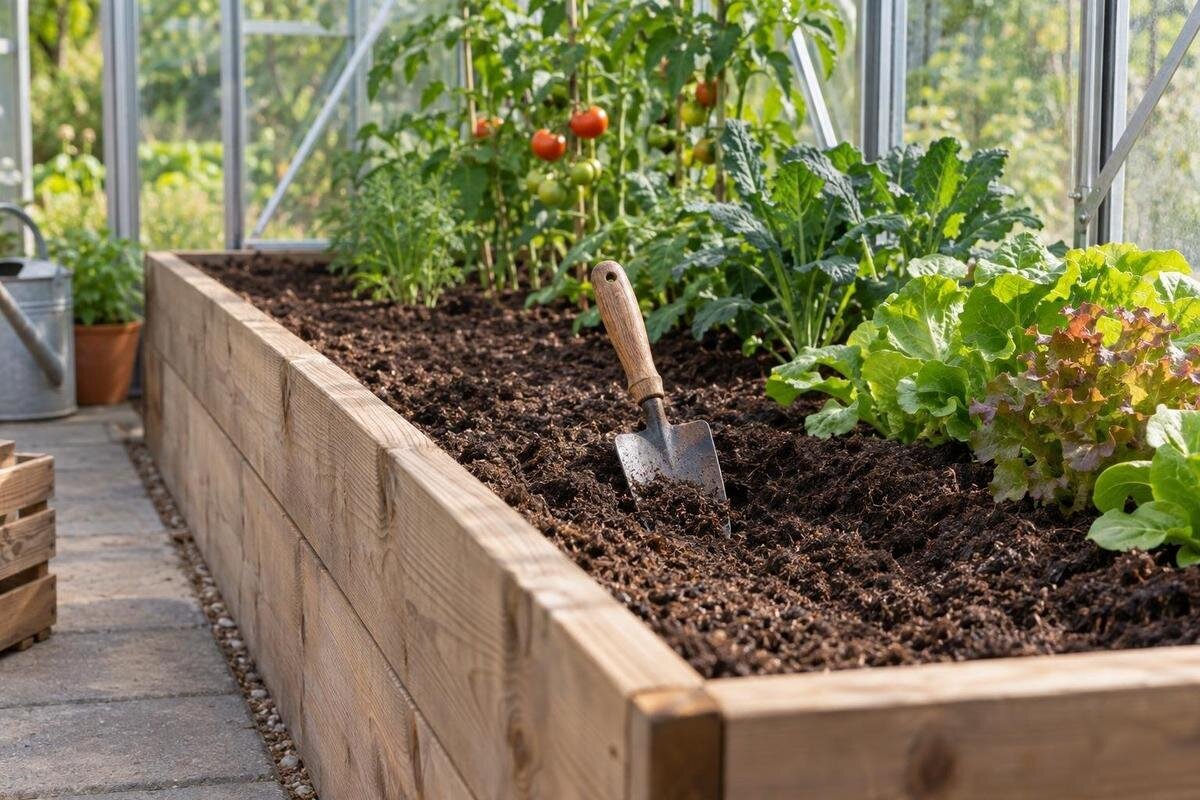
Greenhouse bed planning
Planning greenhouse beds is easier when three questions are kept separate: how much rootable depth each crop needs, whether water can drain through the bed, and how many litres the dimensions require. A raised bed’s side height is not always its usable growing depth, while an open-bottom bed may let roots reach soil beneath it. This guide gives practical crop-based ranges, explains what to inspect below a bed and works through volume calculations in metres, cubic metres and litres. Treat the ranges as planning estimates and confirm them against the chosen crop variety and the bed’s actual construction.

Depth means usable root space
Bed depth is the vertical thickness of rootable growing medium, measured from the finished surface down to the bed base or to a layer roots cannot readily penetrate. In a raised bed, that is not automatically the height of the side walls. A frame with 40 cm sides filled to 35 cm has 35 cm of medium; if it sits over loose, workable soil, roots may be able to explore farther. If the base is paving, a solid liner, rubble or a compacted layer, the space beneath cannot be counted as part of the root zone. This distinction matters when estimating both crop space and how much material to buy.
For an in-ground bed, record the depth of usable soil and any obstruction below it, rather than treating a surface top-up as the whole root zone. For a contained bed, plan for the full depth the plants must use. Bed depth also determines fill volume: adding 5 cm across a 3 m² bed means 0.15 m³, or 150 litres. The Limited Edition Aluminium Greenhouses are listed with floor areas from 3.77 to 28.08 m²; that total is not bed space, because paths, frames and working areas must be left out.
Match depth to the crop’s roots
Rooting needs vary with the crop, variety and soil beneath the bed. As a practical starting range for a confined bed, many salad leaves, radishes and compact herbs can be planned with about 20–30 cm of prepared rootable medium. Some can grow in less, but extra depth provides more room for roots and can give the bed a larger moisture reserve when drainage is sound. These figures are planning ranges, not minimums for every variety. Use the intended crop and variety, rather than the plant’s mature height above ground, to choose a starting depth.
Root vegetables need loose soil at least as deep as the usable length of the chosen variety, with some room below the root. Shorter carrots may suit a shallower bed than long carrots, while parsnips generally need a deeper, unobstructed layer. For tomatoes, cucumbers and peppers in a bed with no access to soil below, roughly 30–45 cm of continuous rootable medium is a sensible planning range, not a guarantee or maximum. In open ground, roots can extend deeper if conditions allow. Check guidance for the chosen crop and give deeper-rooting plants a suitable zone instead of deepening every bed unnecessarily.
Open-bottom beds and contained beds
An in-ground bed uses the existing soil profile, so imported material may only need to improve or raise the surface. Before setting a target depth, inspect the ground in more than one place for a compacted layer, rubble, building debris or soil that stays saturated. This can reveal whether roots have a path below the top layer. If the underlying ground is unknown, contaminated or consistently waterlogged, do not assume that putting deeper soil on top will resolve the problem. Find out what is causing the issue before committing to a fill volume.
An open-bottom raised bed over workable ground combines the filled depth with the soil below it; a bed over paving or with a sealed base contains the whole root zone. For a contained bed, consider drainage and root space together. A trough or planter is also a contained growing space, so its full internal dimensions matter and it may dry more quickly than ground-connected soil. The T-Model Orangery Greenhouse is listed with floor areas from 16.52 to 30 m². Treat that figure as a comparison point, then check the chosen model’s actual plan and base conditions against your bed system.
Drainage can limit usable depth
Roots need both moisture and air, so the aim is not simply to make a bed drain as quickly as possible. A compacted base can leave the lower layer wet for too long, while a very free-draining medium may need closer attention to watering. Check the bed after a normal watering: look for surface pooling and feel the medium below the top few centimetres rather than judging it by the surface alone. If one end stays wetter than the other, note the pattern. A slope or local drainage issue may be affecting the bed, and a uniform depth calculation will not show it.
Extra depth is not a cure for poor drainage. An open-bottom bed still depends on the soil beneath it, and a contained bed needs a suitable route for excess water. Adding a coarse layer at the bottom is not a substitute for a functioning drainage design; a sharp change between fine and coarse layers can sometimes leave water sitting above the boundary. If water regularly stands in the proposed bed, or its drainage could affect a nearby building, resolve the site question with someone qualified before filling it. Include the conditions at the base when deciding on bed depth and growing medium.

Measure the bed before calculating volume
Measure the inside length and width of a rectangular bed, then multiply by the depth you intend to fill. Convert every dimension to metres first: 30 cm is 0.30 m, and 25 cm is 0.25 m. The formula is length × width × fill depth = cubic metres (m³); multiply the result by 1,000 to get litres. Use the level of the finished growing medium, not the wall’s full height. A wall with space left below its rim holds less than its full internal height suggests, and an open-bottom bed’s fill volume is not the same as its total rootable zone.
For a bed measuring 0.90 m by 2.40 m, filled 0.35 m deep, the calculation is 0.90 × 2.40 × 0.35 = 0.756 m³, or 756 litres. If the inside wall is 0.40 m high and you leave 0.05 m free at the top, 0.35 m is the fill depth to use. Measure between the inside faces, because wall thickness does not hold growing medium. For an irregular bed, divide the floor into rectangles and add their volumes. If the base slopes, measure the depth at several points and use sections or an average depth. The Pyramid Greenhouse options are listed from 5.53 to 18.9 m²; use the bed’s own measurements, not the greenhouse floor area, to calculate litres.
Worked soil-volume examples
Consider a bed 1.20 m wide and 3.00 m long, filled to 0.25 m: 1.20 × 3.00 × 0.25 = 0.90 m³, or 900 litres. This is the volume occupying the bed at that measured fill depth, not a guarantee that a particular number of bags will produce exactly that finished level. If the bed already contains usable soil and you only add 0.10 m across the same 3.60 m² area, calculate the top-up instead: 3.60 × 0.10 = 0.36 m³, or 360 litres. Do not order the full-bed volume when you only need to raise the existing soil level.
For two beds, each 0.75 m wide, 3.00 m long and filled 0.30 m deep, one needs 0.75 × 3.00 × 0.30 = 0.675 m³, or 675 litres. The pair therefore requires 1.35 m³, or 1,350 litres, at the stated depth. Add beds individually when their widths or depths differ instead of multiplying one bed’s volume by the number of beds. The Aluminium Greenhouses with Storage – Limited Edition range is listed from 5.52 to 28.08 m². On your plan, mark storage, paths and bed rectangles separately before adding the bed volumes.
Give deeper-rooted crops their own zone
Set a depth for each crop zone before totalling the material needed. A section holding salad leaves may need less rootable medium than one reserved for long carrots or large fruiting crops. In a mixed bed, use the requirements of the deepest-rooting crop sharing that section, or make separate zones if the bed construction allows it. Identify these zones on the plan rather than assigning the deepest measurement to every bed. This keeps the volume estimate realistic while still giving each crop enough root space.
Draw the bed outline and label each section with its planned fill depth, then calculate those sections separately. For example, a 2 m² salad zone at 0.25 m needs 0.50 m³, while a separate 1 m² root-crop zone at 0.35 m needs 0.35 m³. Together, the plan totals 0.85 m³, or 850 litres. The Bloomcabin Prestige Greenhouse is one model range to compare, but its selected plan must leave room for the crop zones and access routes you have drawn. Check the actual dimensions for the specific model rather than assuming that its headline floor area gives the same amount of planting space.
Converting the calculated volume into an order
Treat the calculation as the volume that needs to occupy the bed, then check how a supplier states the product volume. A loose bulk load, compressed bale and bag labelled in litres may be measured or supplied in different conditions. Use the stated unit and any instructions about loose or settled volume; do not convert a cubic-metre total into a bag count without checking each bag’s declared litres. If you are combining different materials, calculate the total amount first and apply proportions specified for the mix. Avoid estimating proportions by eye when you need a particular finished volume.
Growing medium can settle after watering and handling, and a bed should not be filled to the rim if that leaves no room for watering or cultivation. Do not use a fixed extra percentage as a universal allowance: check the supplier’s volume basis and leave practical space below the rim, then assess the finished level. When comparing the Spacious Greenhouse options, keep an itemised volume estimate for your proposed beds. Record each bed’s calculated litres before combining the figures into an order total, so you can revise the quantity if an individual bed’s dimensions change.

Leave paths and working space out of bed volume
Mark the door opening, paths, benches, stored tools and access to each bed on a simple plan before ordering fill. A bed that is too wide to reach from its edges may tempt you to step on the growing soil and compact it. Choose a width you can manage from the path, and keep routes clear enough to reach the back of the greenhouse without crossing a bed. The clearance you need depends on how you work and what you carry, so measure your own access rather than relying on a generic layout.
Check the interior dimensions for the specific greenhouse model, then separate bed footprints from paths and fixed items. A listed floor area can include space that cannot be filled as a bed, and a bed near a frame or doorway may be harder to reach than its area suggests. The Aluminium Greenhouses are listed in a range of sizes; compare the selected model’s dimensions with your bed-and-path drawing, not just its headline area. Once the layout fits, recalculate the growing-medium volume from the bed rectangles alone.
Final bed measurements and crop records
Take final measurements after the greenhouse and bed frames are in place, since changes in width or fill depth alter the volume. Measure to the intended surface of the growing medium rather than automatically using the top of the frame. Before filling, confirm that the bed base is free of loose debris and that water moves through it as expected. If the bed sits on an impermeable surface, follow the design for that contained system rather than assuming roots can reach the ground below. Update the volume calculation if the installed dimensions differ from the original plan.
Keep a record of each bed’s internal length, width and fill depth, its calculated volume, and the crops planned for it. Revisit the depth if those crops change, especially for long-rooted vegetables or plants that must grow entirely within a contained bed. If you are comparing the Wall Greenhouse options, label your drawing with the exact model and dimensions so the bed calculations remain tied to the layout you intend to use. Keep the original fill quantity separate from later top-up calculations: they describe different amounts of material, even when they refer to the same bed.
Frequently asked questions
How deep should a greenhouse bed be for tomatoes?
For tomatoes growing in a contained bed, about 30–45 cm of continuous, rootable medium is a useful planning range, rather than a strict limit. Roots may reach into workable soil below an open-bottom bed. Check the variety’s growing guidance and account for the base, drainage and the depth of soil available to the roots.
Can lettuce and herbs grow in a shallow greenhouse bed?
Many salad leaves and compact herbs can grow in a prepared bed with around 20–30 cm of rootable medium, and some need less. A little extra depth can provide more room for roots and moisture. If the bed has a sealed base, its full usable depth must be enough for the plants.
Should I put gravel at the bottom of a raised bed?
Not as a general fix for poor drainage. Gravel cannot correct an obstructed outlet or waterlogged ground, and a change between fine and coarse layers can sometimes leave water sitting above the boundary. Check the bed’s base and drainage design before filling it.
How do I calculate the volume of soil for a greenhouse bed?
Multiply the bed’s internal length by its internal width and the intended fill depth, with all dimensions in metres. Multiply the result in cubic metres by 1,000 to get litres. For example, 1.20 m × 3.00 m × 0.25 m equals 0.90 m³, or 900 litres.
Does an open-bottom raised bed need to be as deep as a bed on paving?
Not necessarily. If the ground beneath an open bed is loose, usable soil, roots may grow below the filled section. A bed on paving or with a sealed base contains the whole root zone, so its internal depth and drainage arrangements need to support the plants.
A useful bed depth gives the chosen crops a continuous root zone without ignoring what lies beneath it. Check the ground and water movement first, set separate depths where crop needs differ, and calculate each section from its internal dimensions. The examples show how quickly litres accumulate, so use the drawn bed layout for your final figure rather than the greenhouse’s total floor area or the height of its walls.
