
Planning Greenhouse Shelves and Baskets Without Overloading the Frame
Greenhouse planning
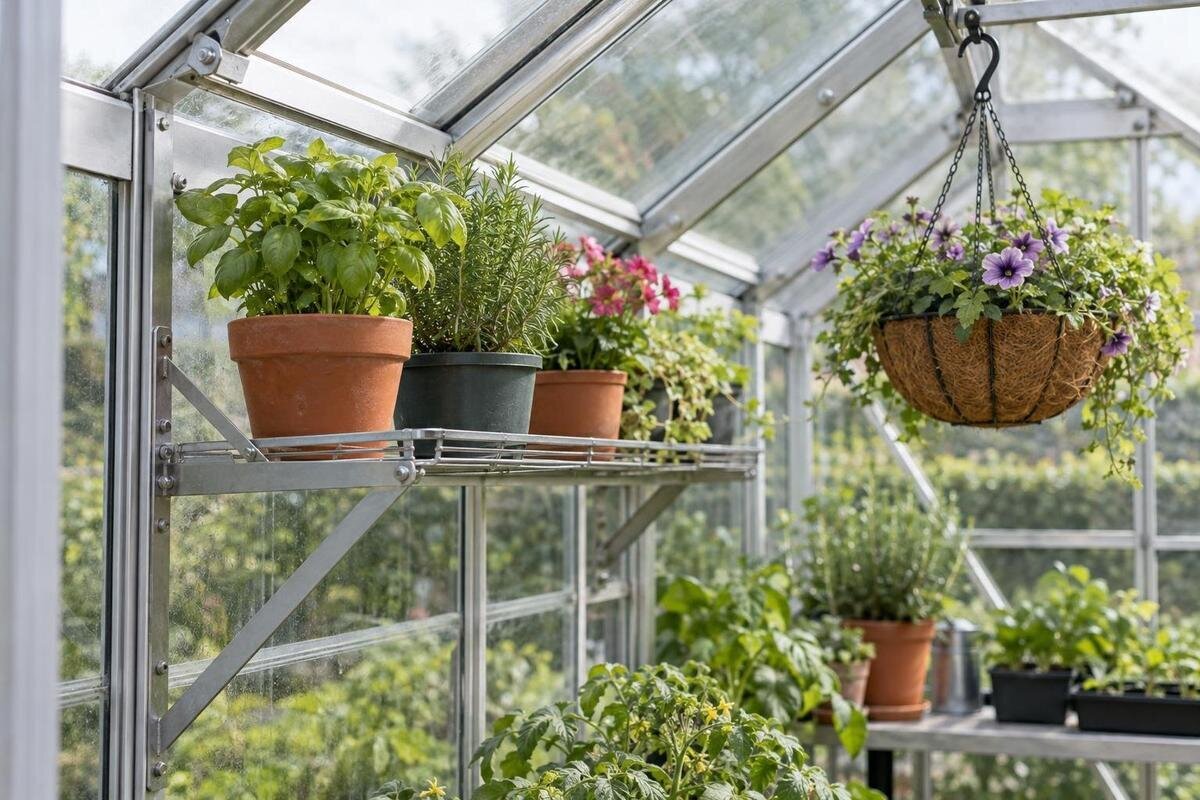
Greenhouse shelves and hanging baskets can free up floor space, but every fitting transfers weight to part of the structure. What matters is not whether an aluminium rail or roof member looks solid, but whether the manufacturer approves that exact fixing point and documents a load for the accessory. This guide explains how to plan the layout, find the right instructions and handle gaps in the documentation before fitting anything.

Before fitting an accessory 1
Plan shelf positions around daily use
Decide what the storage must hold before choosing where it goes. A shelf for seed trays, hand tools or small pots has a different use pattern from one carrying larger containers throughout the season. Note the tallest plants and their expected spread, how much access you need for watering, and whether items will be lifted down often. Mark the door swing, main route, vents, work surface and beds on a simple plan. Include the space needed for routine movement and maintenance. Decide whether each surface is for daily-use items or seasonal storage, and keep those uses distinct. A position that fits on paper can still make ordinary greenhouse work awkward.
Measure the clear internal run at the proposed shelf position rather than relying on the footprint alone: corner posts, braces, door tracks and openings can reduce usable space. The Wall Greenhouse range is listed with areas from 3.69 m² to 14.34 m², but floor area does not identify uninterrupted shelf length or approved fixing points. In an existing greenhouse, note frame members, glazing, openings and fitted accessories on your sketch. If choosing a new model, use its size to assess the layout, then check the relevant instructions for accessory compatibility. Measure at the intended height too, since the available space can vary across the interior.
Identify the exact model before looking for fittings
Start with the greenhouse's own paperwork, not a generic guide to aluminium frames. Record the manufacturer, product family, model or variant, overall size, approximate purchase or installation date, and any serial or order reference shown on documents or labels. Similar names can cover different configurations, and a replacement part may depend on an exact profile or kit. Photograph a label if present and keep the original assembly instructions, invoice and part codes together. Do not remove glazing or dismantle a section just to find an identifier; ask the seller or manufacturer how to identify the model safely. If the greenhouse has been moved, note that too.
A product-family title is only a starting clue. The Limited Edition Aluminium Greenhouses listing identifies a family, but its title does not tell you whether a particular greenhouse has an accessory rail, which fittings suit it or how much weight a point may carry. Compare the name and variant on your paperwork with the manual cover and diagrams, and check that the document matches the size or revision. If the frame has been altered or contains replacement components, tell the manufacturer; a manual for a similar-looking model may not cover the changed arrangement. Product identity and accessory approval are separate checks.
Before fitting an accessory 2
Use only fixing points named by the manufacturer
An approved fixing point is one the manufacturer identifies for the specific greenhouse and accessory, with the fitting method and any limits stated in the instructions. It may be a dedicated rail, a named bracket position or another purpose-designed component, but the manual must say so; do not infer approval from a slot, channel, bolt head or apparently substantial profile. A hook that physically fits is not proof of compatibility. Check that the accessory code and greenhouse model match, including any variant or required matching parts. Follow the location and orientation shown in the diagram rather than adapting it. The allowed point may be limited to a particular accessory.
Do not improvise a fixing by drilling, using a self-tapping screw, clamping to a member or substituting a generic bracket unless the manufacturer explicitly authorises that exact arrangement. When considering the T-Model Orangery Greenhouse, for example, ask which accessories and fixing points its matching instructions cover. If the manual shows a point for one accessory, that does not automatically approve a different shelf or basket in the same place. Ask before changing the fitting, location or combination of parts. Approval needs to cover the proposed assembly, not merely one component.
Read the accessory load limit in context
An accessory-load figure is useful only when it says what it covers: a complete shelf, an individual bracket, one fixing point, a length of rail or another defined assembly. The instructions may also specify how the weight is distributed or which arrangement applies. Do not transfer a limit from one accessory to another, or treat a general frame figure as permission to attach a shelf. If you are considering the Pyramid Greenhouse, look for load information in the relevant accessory instructions rather than inferring capacity from the greenhouse's shape. Read the notes and diagrams alongside any stated limit.
Check whether the documented maximum is for evenly spread contents, a local load or the whole accessory, and whether it includes the shelf, brackets and fixings. These definitions matter because a single figure can be misread as a general allowance. Use the manufacturer's stated conditions as written; where the manual is silent or ambiguous, request clarification rather than making your own engineering interpretation. If a load figure belongs to a different greenhouse size or revision, do not assume it applies to yours. A component rating may not describe the complete installed arrangement, so ask about the exact model, accessory and attachment point.

Before fitting an accessory 3
Include the shelf, pots and wet contents in the plan
List everything that will be supported, not only the plants. Depending on the manufacturer's definition, the shelf or basket, brackets, containers, growing medium, plants and water may all affect the total carried load. A pot that feels light when empty can be much heavier once filled and watered, and its contents can change through the season. Record the intended items and maximum normal fill rather than today's temporary arrangement. A few large pots may represent a different load from many small trays. If you cannot establish the expected load from product information or a sensible inventory, do not guess that it sits below the limit; ask how the documented rating should be applied.
Plan for the heaviest normal use, then consider how several items work together on the same accessory or support. Two shelves each shown with an individual limit do not automatically allow their limits to be added on one rail or frame member; the manual must say how combined loading is treated. The Aluminium Greenhouses with Storage – Limited Edition listing identifies built-in storage, but that does not document the capacity of an extra retrofit shelf or hanging basket. Keep built-in features and later add-ons distinct in your records, and recheck the arrangement if its use changes.
Keep shelves clear of doors, vents and growing space
Where a shelf sits matters even when the proposed fitting is approved. Leave the route to the door and work area usable, and make sure stored items do not obstruct door movement, vent openings or their operating parts. Avoid positions where a basket or shelf edge could interfere with opening a vent, or where watering and tending plants become difficult. Think through how you will carry a tray in and out, not just whether a shelf fits along a side. Consider whether a shelf will shade plants below or make it awkward to remove trays without brushing foliage. A layout that is easy to use each day is less likely to become cluttered.
Make a simple interior drawing with the intended shelf depth and height, mature plant positions and points that must remain accessible. If you are comparing a replacement model such as the Prestige Greenhouse, ask for an internal plan or relevant manual so you can mark the proposed storage layout. Show where you would stand to water plants, lift trays and reach items at the back of a shelf. Check these positions against the exact model and approved accessory layout before deciding. A shelf may fit within the available space yet leave too little room to handle its contents comfortably, particularly when trays or containers are moved often.
Before fitting an accessory 4
Treat hanging baskets as a separate structural question
Do not assume the roof can carry hanging loads. A ridge, roof bar, glazing bar or other member may look like a convenient place for a hook, but its appearance does not establish that it is designed for a basket. Suspend a basket only from a fixing point expressly approved for that greenhouse and accessory, with a documented load covering the intended arrangement. If the manual mentions a roof accessory but not its load, or gives no permitted point, pause and ask the manufacturer or a qualified installer. Do not test the point by hanging a basket, and do not rely on another owner's experience as evidence for your model.
A basket's contents change as plants grow and are watered, and a suspended object may move when handled or disturbed. Those are reasons to follow the documented setup, not to choose a stronger-looking member or guess at a safe amount. Even a large greenhouse floor area, such as the 47 to 70 m² listed for the Spacious Greenhouse, says nothing about roof loading. Where the approved design permits a choice of position, keep baskets away from walkways, doors and moving vents. Choose a location that remains accessible for watering without pulling on the fitting.
Protect glazing and keep moving parts accessible
Keep the proposed shelf or basket clear of glazing panels and do not use glass as a support, stop or brace. A loaded container leaning against a pane can put pressure where it is not intended; contact with glass can also make routine access harder. Do not attach anything through glazing or alter glazing-retention components unless the manufacturer gives explicit instructions and, where needed, a qualified professional confirms the work. Do not remove panes to make an installation easier. Glass work and structural changes are not substitutes for an approved accessory fixing point.
Allow access for cleaning and routine inspection as well as everyday use. A shelf can leave a door or vent free to open yet make its handle, mechanism or nearby glazing difficult to reach. For the Classic aluminium greenhouse range, consult the relevant assembly guide when checking clearances and permitted accessories. Consider whether stored trays and pots would need to be removed to reach these areas, and whether the shelf itself would still obstruct access once emptied. Where a fitting would sit close to glass or moving hardware, have the layout reviewed before work begins. Do not force a panel or mechanism to accommodate a shelf.

Before fitting an accessory 5
Ask for written guidance when documentation is incomplete
If you cannot find a manual or it does not name a load, contact the manufacturer, supplier or installer before fitting the accessory. Give them the product name, model or variant, size, serial or order details if available, approximate age, accessory part number and a clear description of the proposed position. Include photographs taken without disturbing the structure and relevant pages of any instructions. State what the shelf or basket will carry, including containers and wet contents, and whether other accessories share the same rail. This detail helps prevent advice being based on a similar but different greenhouse.
Ask specific questions: Is this point approved for this exact shelf or basket? What fixing and parts are required? Does the stated load cover the complete assembly and its contents, and does it apply when other accessories are fitted nearby? Ask whether the manual gives a combined-load limit and whether your variant is covered. Keep the response with the manual and accessory details. If the answer is uncertain or no documented approval is available, do not fit a suspended load there; choose a documented alternative or discuss a model upgrade. A general assurance is less useful than a model-specific answer.
Choose independent storage if the frame has no approved point
If the manufacturer does not approve a suitable fixing point, the practical alternative is storage that does not transfer its weight to the greenhouse frame. A freestanding rack or bench must be designed by its maker for the intended load and the conditions where it will be used. Position it on a suitable, stable base, keep it from pressing on glazing or the frame, and leave doors, vents and access routes clear. The floor or foundation also needs to be suitable for the complete arrangement; if in doubt, ask the greenhouse installer rather than relying on the rack label alone. Do not brace a freestanding unit against panes to stop it moving.
If an independent unit would use too much growing space, reduce the amount stored, keep heavier items in a supported floor-level position where practical, or consider whether another model better suits the intended layout. Ask for its internal plan and accessory instructions before buying; a broader footprint can solve a space problem without proving anything about roof or frame capacity. If a model offers built-in storage, treat that as a distinct product feature and still check which parts it covers. The aim is useful storage without a fitting the manufacturer has not approved.
Frequently asked questions
Can I hang a basket from a roof bar if it feels solid?
Only if the instructions for your exact greenhouse and basket explicitly approve that roof fixing point and give a relevant accessory load. A ridge, roof bar or glazing bar is not approved just because it feels firm or looks substantial. If the instructions are silent, leave it unused and ask the manufacturer or installer. Do not test it by hanging a basket.
How do I find the allowable load for a shelf?
Check what the accessory instructions say the figure covers: contents alone or the full accessory, each bracket or the whole shelf, and any requirement about how weight is distributed. Make a complete inventory that includes containers, growing medium and water. If the manual does not define the rating or your planned combination, ask for model-specific clarification rather than assuming a capacity.
Do universal clips or clamps make a shelf compatible?
Not by default. A clip that fits a rail or a clamp that grips a profile does not establish that the greenhouse manufacturer approves it, or that the accessory load is documented for that combination. Use only specified fixings and compatible parts. If a universal fitting is proposed, request confirmation for the exact model, rail, accessory and planned load before installing.
What information should I give the supplier or installer?
Share the greenhouse model and variant, size, serial or order reference if available, approximate age, accessory part number and photographs of the intended location. Describe what the shelf or basket will carry, including wet contents, and mention other accessories on the same support. Ask whether the fixing point is approved, which parts are required and how the stated load applies.
What if the manual does not approve a suitable shelf point?
Do not fit the shelf or basket to an unapproved point. Consider an independent shelf or bench designed for the intended load, without leaning it on the frame or glazing. Keep doors and vents accessible and check that its base is suitable. If you are considering built-in storage or another greenhouse model, request its layout and accessory documents before deciding.
Well-planned greenhouse storage begins with the actual work area and ends with a documented connection between the exact model, accessory, fixing point and load. Measure for access, identify the right manual and read what its rating covers before putting weight on a shelf or basket. If the roof point or combined load is not expressly covered, do not rely on appearance or trial and error. Choose an independent storage option or seek a model-specific review instead.
